The Tochar Mona Conneda Peace1255 CE
In 1255, Feidlim Ua Conchobair of Connacht and his son Áed strengthened their position through diplomacy, protected movement and negotiated peace. Áed travelled to Tír Eógain, reconciled his father with northern powers, and escorted Connacht exiles, dependants and goods safely home through hostile territory. Feidlim’s envoys and Archbishop Florence Mac Flainn secured favourable responses from Henry III, while Feidlim reached a major settlement with Mac William Burke at Tochar Mona Conneda. Elsewhere, Brian Ua Néill failed to obtain hostages in Breifne. Ecclesiastical appointments, clerical deaths, killings and raids reflected local instability. The year demonstrated peace’s strategic, fragile role amid rivalries.
Dateline
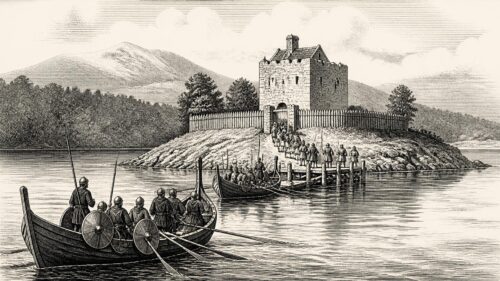
In 1255, one of the clearest signs of political change in Ireland came not from a great pitched battle but from movement, negotiation and a settlement at a place remembered as Tochar Mona Conneda. The surviving Irish annals place several related developments in this calendar year: Áed, son of Feidlim Ua Conchobair of Connacht, travelled north to arrange peace; envoys and an archbishop crossed to the king of England; and Feidlim reached an agreement with Mac William Burke. Together, these notices show a country in which power was contested in many ways, but where travel under escort, hostage-taking, petitions and carefully made peace could matter as much as raids.
A Connacht Prince in Tír Eógain
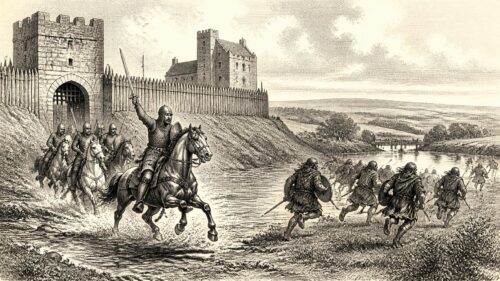
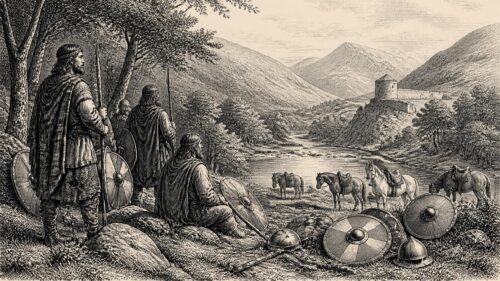
The year’s most vivid episode concerns Áed mac Feidlimid Ua Conchobair, the ambitious son of Feidlim, king of Connacht. According to the Annals of Connacht and the closely related Annals of Loch Cé, Áed went into Tír Eógain and made peace between his father and “the North of Ireland”. This was not a vague gesture of goodwill. He then brought back Connacht men who had been living in the North while hostile to Feidlim, together with their cóic or trains of movable goods and dependants. The annal’s emphasis on their chattels is important: political reconciliation enabled households, livestock, baggage and retainers to be moved safely across dangerous ground.
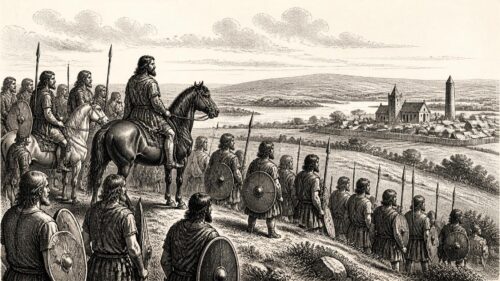
The return journey was itself a public demonstration of strength. Áed’s party passed through territory dominated by his father’s enemies, identified as descendants of Ruaidrí Ua Conchobair and the Galls, or English settlers and lords. The annalist states that these opponents could do no more than watch the host and its train go by. That is rhetorical language, but it preserves a significant point: Áed had secured enough northern backing, or commanded enough armed protection, to escort people out of exile without interception. In a landscape where a rival’s cattle, followers and dependent families could be seized as readily as a castle, such a passage was a practical achievement.
The agreement also belonged to a longer northern struggle. Brian Ua Néill, king of Cenél nEógain, had been resisting the expansion of Anglo-Irish power and had recently demonstrated that royal and baronial armies could be checked in Ulster. The annals record a major Anglo-Irish expedition against him in 1253 which failed to gain hostages or submission. That was not an event of 1255, but it helps explain why a Connacht prince could look north for allies and refuge. The peace made by Áed in 1255 did not create an all-Ireland coalition, nor should it be treated as a formal declaration of national unity. It did, however, joined Feidlim’s Connacht more securely to a northern political world in which Brian Ua Néill was a central force.
Across the Sea to the King
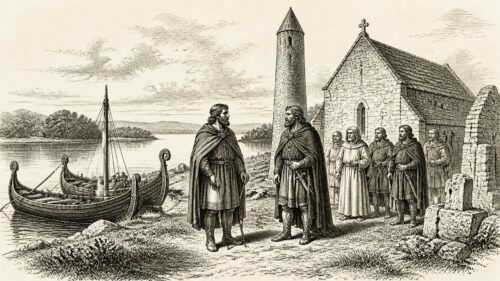
Connacht’s rulers did not rely only on Gaelic alliances. The same year, Feidlim sent ambassadors to the king of England, Henry III. Florence Mac Flainn, archbishop of Tuam, also crossed the Irish Sea to speak with the king, while Maurice FitzGerald, the powerful lord of Offaly and former justiciar of Ireland, made the same journey. These parallel voyages show how disputes in Ireland were pursued at more than one level. A Gaelic king, a metropolitan archbishop and a major Anglo-Irish lord each had business at the English royal court, where grants, complaints, patronage and claims to protection could be advanced.
The annals are unusually encouraging about the results for Connacht. Florence returned to Ireland having obtained all that he had asked of the king; Feidlim’s envoys returned “in like manner”. They do not specify the petitions, and it would be unsafe to invent their contents. Yet the language suggests that Feidlim had won a useful response from royal authority rather than merely sending a ceremonial embassy. The archbishop’s involvement further indicates that ecclesiastical rank and political advocacy could work together. Tuam was not a remote spiritual outpost: its archbishop could act across the sea and return as an important broker in Connacht affairs.
The diplomatic activity of 1255 must also be viewed against the character of the English lordship in Ireland. Henry III was lord of Ireland, but his authority was exercised through officials in Dublin and through magnates whose territorial interests did not always coincide with royal policy. Maurice FitzGerald had long campaigned in Connacht and Ulster; Walter de Burgh, known in Irish sources as Mac William Burke, held immense influence in Connacht as well as the earldom of Ulster. Appeals to the king therefore offered Irish rulers a means of dealing with, and sometimes counterbalancing, local colonial power. Royal favour was not a guarantee of peace, but it was a resource worth seeking.
The Meeting at Tochar Mona Conneda
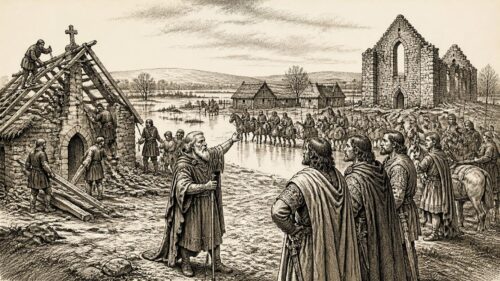
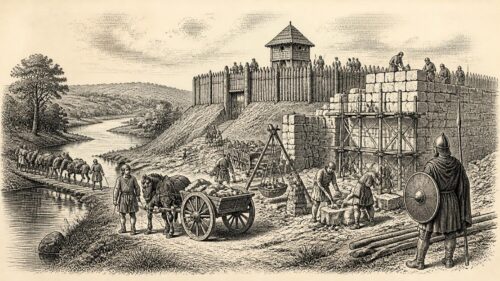
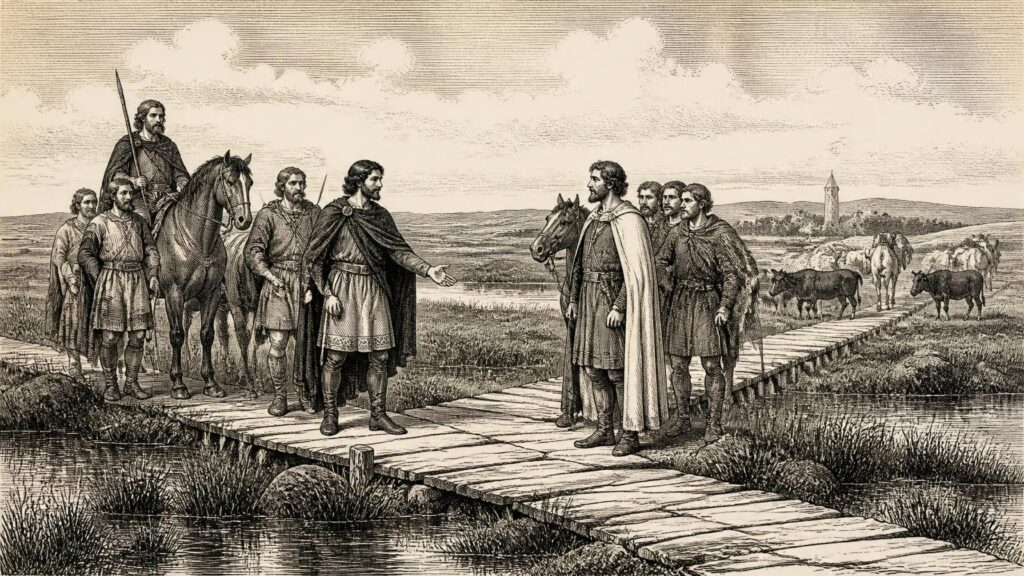
The most consequential settlement explicitly dated in the annals took place at Tochar Mona Conneda, probably a causeway or roadway through boggy country. There Feidlim Ua Conchobair and Mac William Burke held a “great meeting”, made peace, and, in the annalist’s striking words, everything for which Feidlim had been contending was conceded. The formula is clearly favourable to Feidlim and does not provide a treaty text. Nevertheless, it records a negotiated result rather than a military defeat imposed upon him.
This meeting gives the year its distinctive shape. The safe recovery of Connacht exiles from the North, the embassy to Henry III, the archbishop’s successful petitions and the agreement with Mac William Burke can reasonably be read together as parts of a determined effort by Feidlim’s household to improve its position. The evidence does not permit us to say that one directly caused another, or that all were arranged as a single programme. But they point in the same direction: Connacht’s ruling family used kinship, armed escort, church leadership, overseas diplomacy and personal negotiation to preserve room for manoeuvre.
Peace in this setting did not mean that borders became quiet or authority became simple. It was an agreement between particular rulers with particular claims. Nor did it erase competing Ua Conchobair branches, whose hostility is visible in the account of Áed’s northern journey. Rather, peace was an active political instrument: it could recognise possession, end an immediate confrontation, permit safe passage and allow a ruler to concentrate on other rivals. Its value lay precisely in its fragility.
Breifne and the Limits of Force
Elsewhere, the year brought a less successful display of power. Brian Ua Néill and “the men of the North of Ireland” made three attacks on Cathal Ua Raghallaigh and his brother Cú Chonnacht in Breifne. They returned without obtaining either power over them or hostages. The repeated emphasis on hostages is revealing. Hostages were not merely prisoners: their delivery marked a political relationship and offered security for obedience. To come home without them meant that the expedition had not achieved its central purpose.
This episode cautions against imagining a straightforward northern advance under Brian Ua Néill. Breifne was a contested middle zone between Connacht, Ulster and the lordship’s frontier, occupied by rival kindreds with their own interests. The Ua Raghallaigh could resist despite pressure from a much larger northern force. For ordinary communities, such campaigning meant the threat of raiding parties, food requisition, seized animals, disrupted travel and the obligation to support local lords. Annalists chiefly name kings and noblemen, but their brief reports of hosts, baggage and plunder expose the wider human and material burden of politics.
Church Offices and Local Loss
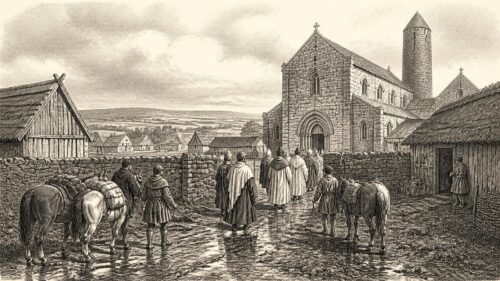
Church affairs were woven through the year’s secular politics. Mac Cerbaill assumed the archbishopric of Cashel, a major Munster see, while Florence Mac Flainn’s journey displayed the reach of the archbishopric of Tuam. The death of Tomás Mac Diarmata, archdeacon of Elphin, and that of John Ua Laidigh, archdeacon of Annadown, mark changes among senior clergy in Connacht. Such offices involved more than worship: archdeacons supervised clergy and ecclesiastical discipline, while bishops and archbishops were landholders, patrons and negotiators whose standing could be decisive in regional affairs.
The annals also record violence at a smaller, local scale. Diarmait Ua Cuinn, his son Amlaíb and nobles of Muintir Gillagáin were killed by Gilla na Naem Ua Fergail at Feradan Móige Treaga, described as an act of treachery, after which their possessions were plundered. A raid by the Galls against Ua Flainn is noted without further detail. These terse entries are reminders that the year’s high diplomacy existed beside private feuds and opportunistic violence. Wealth remained portable and vulnerable: livestock, goods and household resources could be carried away after a killing or raid.
One chronological warning is necessary. Several Irish annals place the death of Pope Innocent IV under 1255, but Innocent died on 7 December 1254. The entry belongs to the annalists’ year-heading, not to the calendar year under review. It should therefore be used as evidence for what Irish chroniclers chose to record, not as proof that the pope died in 1255. This small discrepancy illustrates why medieval annals must be read critically even when they supply precise-looking dates.
A Year of Managed Rivalry
No surviving source describes the weather, harvest or prices of 1255 in the detail available for some neighbouring years, so it would be wrong to supply an imagined picture of abundance or scarcity. What the evidence does show is a society in motion: men and dependants travelling with their goods, clerics crossing the sea, envoys carrying petitions, hosts seeking hostages, and rival lords meeting on a roadway to settle claims. For Feidlim Ua Conchobair and his son Áed, 1255 was a year in which Connacht recovered people from exile, secured recognition through negotiation and reached an accommodation with one of the greatest Anglo-Irish powers in the west. The peace at Tochar Mona Conneda did not end Ireland’s conflicts. It showed, rather, how effectively power could be defended without a battlefield victory.
Primary Sources
- Annals of Connacht: Annal 1256
- Annála Connacht: Annal 1255 (Irish text)
- Annals of Loch Cé: Annal LC1255
- Annals of Ulster: Year U1255
- Annals of the Four Masters: Annal M1255
- Annals of Connacht: Annal 1253
- O'Connor (Ó Conchobair), Fedlimid
- O'Neill (Ó Néill), Brian
- FitzGerald, Maurice fitz Gerald
- O'Reilly (Ó Ragallaig), Cathal
- Calendar of Ormond Deeds, Volume I, 1172–1350
- Register of Tristernagh
- Registrum de Kilmainham
- A History of the Irish Dominicans, Volume I
- The Annals of Connacht: A.D. 1224–1544, National Library of Ireland catalogue
- Annals of Connacht: Annála Connacht A.D. 1224–1544, Irish History Online
- Innocent IV, Vatican biography
- King Henry III and Ireland: The Shaping of a Peripheral Lordship
- The O'Conors of Connacht and the O'Briens of Thomond
- Letter from Cathal ‘Crovdearg’ O'Conor, King of Connacht, to Henry III, circa 1224