Crawley’s Basel Return1438 CE
In 1438 Ireland remained divided among Gaelic lordships, Anglo-Irish communities and ecclesiastical jurisdictions, with power shaped by kinship, warfare and office. Archbishop Thomas Crawley died in England returning from the Council of Basel, linking Dublin to Church conflict, while Lionel, Lord Welles, became royal lieutenant. O’Conor Faly fought Meath’s English yet made peace with his brother. Captures, killings and depositions affected Maguires, O’Dowdas, O’Donnells and O’Briens. Deaths of bishops, clerics and heirs from disease disrupted institutions. Prominent jurists, historians and poets also died, demonstrating learned patronage’s continuing public importance. Annals record these crises unevenly rather than a unified national narrative.
Dateline
In 1438 Ireland’s political map remained a patchwork of lordships, lordly towns, ecclesiastical jurisdictions and kin-based territories. The year does not offer one island-wide turning point. Instead, its contemporary records reveal how authority was made and unmade at several levels: through appointments made by the English crown, disputes among Gaelic ruling families, custody in castles, alliances between kinsmen, and the work of bishops, religious houses and learned professionals. The annals are especially valuable here because their apparently disconnected notices expose the links between public power, family succession and cultural life.
A Year Recorded Unevenly
The surviving evidence must be handled carefully. The Annals of Ulster, Annals of Connacht and Annals of the Four Masters all place important deaths, killings and political changes in 1438, but they do not provide a complete chronicle of everyday life. They are much more likely to name a lord, cleric, poet or jurist than a tenant farmer, craft worker or household servant. Nor should an annalistic notice be treated as proof that an event occurred on a particular day unless the annalist gives one. The birth, in February, of Cathal junior Mac Maghnusa is unusually precisely dated; most of the year’s entries are not.
That unevenness is itself revealing. The people whose deaths and acts were recorded were those around whom obligations of lordship, church office, clientship, learning and kinship were organised. In 1438, violence was not separate from politics, and scholarship was not separate from power. Lords relied on retainers and alliances; churches held property and influence; learned families preserved law, history and poetry for their patrons.
Dublin, England and the Church Council
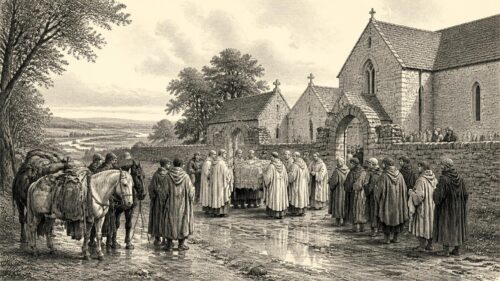
A notable connection between Ireland and wider European affairs came with the death of Thomas Crawley, Archbishop of Dublin. The brief Dublin annals state that he died in England while returning from the Council of Basel, acting with the authority of Pope Eugenius IV. This was an unusually charged description. In 1438 the long-running conflict over the council’s authority had reached a new stage: a papally supported assembly met at Ferrara while a rival body continued at Basel. Crawley’s recorded association with Eugenius’s position shows that the archbishopric of Dublin was not merely local. Its holder moved within the legal, diplomatic and ecclesiastical arguments of Latin Christendom.
Crawley’s death also mattered in Ireland because the archbishop of Dublin stood at the centre of the English lordship’s church and government. Ecclesiastical office brought influence over appointments, jurisdiction and political networks. The following year Richard Talbot became archbishop, but that later succession should not obscure the uncertainty created in 1438 by Crawley’s death.
Royal government was also being recast. Lionel, Lord Welles, was appointed the king’s lieutenant in Ireland in 1438. The appointment signalled the English crown’s continuing claim to direct the lordship from Westminster, though an appointment did not automatically create effective control beyond the areas where Dublin government, Anglo-Irish magnates and local allies could enforce it. The crown’s authority in Ireland depended upon money, military service, office-holding and accommodation with powerful local interests; it was not a uniform administrative presence across the island.
Offaly and the Meath Frontier
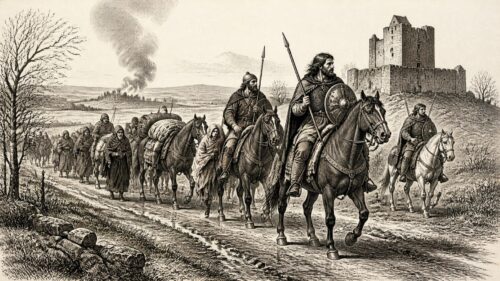
The sharpest recorded conflict involving the English lordship occurred in the midlands. The Annals of the Four Masters state that O’Conor Faly continued his war against the English of Meath. This struggle lay along a frontier where Gaelic lordship and the settler community of Meath met through raiding, retaliation, tribute-taking and negotiation. The annal’s phrase “the English of Meath” describes a political community within the lordship; it should not be read as a simple modern ethnic label.
Yet 1438 was not only a year of conflict for the O’Conors of Offaly. Peace was made between O’Conor Faly and his brother Cathaoir. Their reconciliation is important precisely because family divisions could be as dangerous as external enemies. In the previous year Cathaoir had aligned himself with the English and brought them into Offaly. The settlement of 1438 therefore had immediate strategic importance: it reduced a fracture within the ruling family while warfare with Meath continued. It also illustrates the flexible, pragmatic character of late-medieval politics. A lord could be embroiled in conflict with a neighbouring power while seeking peace within his own kin-group.
Captivity, Killing and Succession
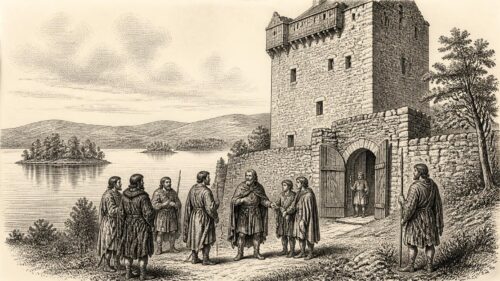
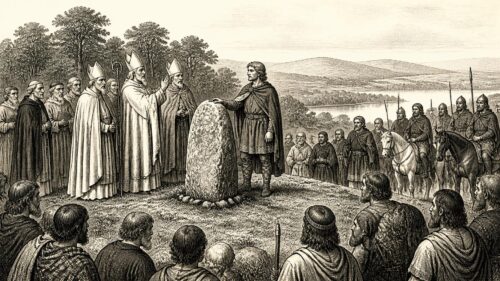
Elsewhere, the year’s entries show that lordship rested on precarious family arrangements. In Fermanagh, Philip Maguire was seized by his own kinsmen in the Maguire castle after Thomas junior, described as king of Fir Manach, and Ruaidhrí and Domnall formed an agreement against him. The capture was not an incidental crime: detention inside a lordly stronghold was a direct intervention in the balance of power within the Maguire kindred. Castles could serve as residences, defensive sites and instruments for controlling rivals.
In north Connacht, Conor O’Dowda, lord of Clann Donough O’Dowda, was killed treacherously by named kinsmen and Henry Barrett; three of Conor’s sons were killed with him on the same night. The account is unusually stark in its emphasis on betrayal and on the destruction of several potential heirs together. The Annals of Connacht independently records Conor’s killing, lending particular weight to the event. Such attacks were attempts to reshape a lordship through the elimination of a rival line, with consequences that could extend well beyond one household.
In Tyrconnell, Donough na Coille O’Donnell was killed by Conor Don O’Donnell after plundering Tír Enda. In Thomond, Teige O’Brien was deposed by his brother Mahon, who was then styled “the O’Brien”. This was not a parliamentary transfer of office. The title marked recognition as head of the ruling lineage, and the annal records the outcome without pretending that the change was peaceful or uncontested. A further Connacht notice records the death of Maurice, son of William, son of the Earl of Kildare, a reminder that the great dynasties of the English lordship were also shaped by family mortality and inheritance.
Church Offices and Disease
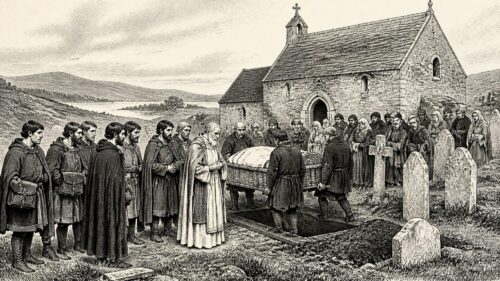
Church institutions feature prominently in the year’s losses. Lochlainn Ó Gallchobhair, bishop of Raphoe, died after holding the see from 1420. The death mattered in north-western Ireland, where bishops were religious leaders but also participants in local networks of lordship and patronage. The prior of Kilmainham likewise died. The Four Masters identifies him as a grandson of the Earl of Kildare, underlining the connection between the Knights Hospitaller’s leading Irish house and one of the most powerful Anglo-Irish families.
Two clerics, the abbot of Cill na Manach and Nicholas Ó Maonaigh, vicar of Caisleán mic Conchobhair, were said to have died of plague. John, son of Edmund Burke, died of galar breac, rendered in the English annalistic translation as smallpox. These entries establish grave illness in particular places and households, but they do not justify claims of a single nationwide epidemic in 1438. Their significance lies in their specificity: disease could remove office-holders and heirs as suddenly as warfare, affecting the continuity of communities whose governance often depended on a small number of prominent people.
The Passing of Learned Men
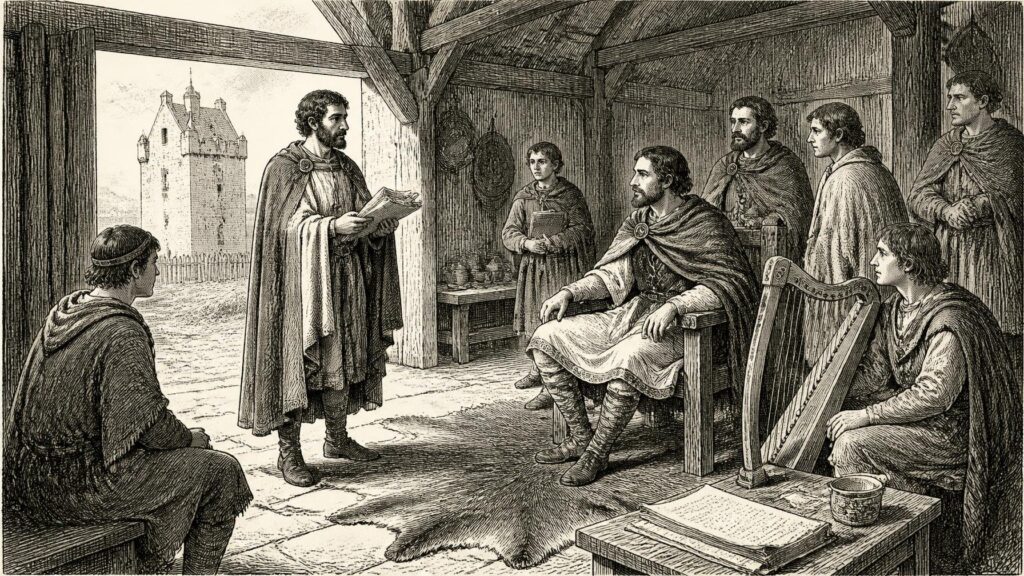
Perhaps the most striking cultural pattern in 1438 is the number of deaths among the learned orders. Conchobar Mac Aodhagáin, ollam of Clanricarde in jurisprudence, died; the Annals of Ulster calls him eminent in law. Donnchadh Ó Cuirnín, praised as a historian, also died. So did Aodh Ó Dálaigh of Breifne, ollam in poetry to the O’Reillys, and Ó Clumáin, chief poet to the O’Haras. These were not simply writers in a private sense. An ollam held a recognised senior rank in a learned discipline, while a chief poet or legal scholar worked within a patronage system that supported dynastic memory, formal praise, legal expertise and historical knowledge.
The deaths therefore register a loss of skilled custodians of inherited learning across Connacht and Breifne. Their work was sustained through households, schools, manuscripts, recitation and service to rulers. The notices should not be romanticised into evidence of a uniformly flourishing cultural world: they are obituaries, after all. But they do show that learned offices retained public importance in fifteenth-century Ireland, and that poets, historians and jurists were named alongside bishops and kings in the historical record.
Several Irelands, One Year
1438 was a year of local crises rather than national unity. The death of an archbishop linked Dublin to the struggles of the universal Church; Welles’s appointment recalled the crown’s ambitions; fighting in Offaly showed the limits of lordship government; and family conflict drove events from Fermanagh to Thomond and Connacht. At the same time, plague, smallpox and the deaths of learned men exposed the vulnerability of institutions that depended on particular individuals. Ireland’s history in this year is best understood not as a single story, but as an interlocking set of regional worlds, connected by church, kinship, warfare and learning.
Primary Sources
- Annals of the Four Masters, Annal 1438 (English translation)
- Annals of the Four Masters, Annal 1438 (Irish text)
- The Annals of Ulster, Year U1438 (English translation)
- Annals of Ulster, Year U1438 (Irish text)
- Annála Connacht, Year 1438
- Annales Breves Hiberniae, Annal 1438
- The Genealogies, Tribes, and Customs of Hy-Fiachrach, Commonly Called O’Dowda’s Country
- Exploring the Irish Annals
- Thomas FitzGerald, Prior of Kilmainham, 1438–47
- Maynooth: A Select Bibliography of Printed Sources
- War and Politics in Late Medieval Ireland, Trinity College Dublin thesis
- The English Aristocracy and Ireland, Durham University thesis
- 1438: King Henry VI, A Chronological Sourcebook
- The General Council of Basel-Ferrara-Florence, 1431–45: Canons and Decrees
- Council of Basel, 1431–45: Documents
- England, the Pope, and the Council of Basel, 1435–1449
- Monasticism, Colonization, and Ethnic Tension in Late Medieval Ireland
- From Kingdom to Colony: Framing the English Conquest of Ireland
- Tanaise Rig: An Alternative Interpretation
- Bishop Lochlainn Ó Gallchobhair, Diocese of Raphoe
- Catholic-Hierarchy: Diocese of Raphoe
- The Oxford Dictionary of Family Names of Ireland