Annadown Tower1238 CE
In 1238, Anglo-Irish leaders Maurice FitzGerald and Hugh de Lacy campaigned in the north, deposing Domnall Mac Lochlainn, installing an Ó Néill claimant and taking hostages from Cenél nEógain and Cenél Conaill. In Connacht, barons extended castle building after the 1235 partition, while dynastic killings, captures and raids demonstrated insecurity. A Bréifne force plundered Cluain Coirpthe, causing deaths among pursuers. Annadown’s bell-tower was built beside Lough Corrib, though its exact form remains uncertain. Archbishop Felix Ó Ruadáin died after resigning and becoming a monk in Dublin. Overall, the annals depict contested power expressed through hostages, fortifications, violence and ecclesiastical construction.
Dateline
In 1238, Ireland’s political map was being redrawn not by one decisive national contest but by a sequence of campaigns, raids, killings and building projects. The year’s annals move from Connacht to Tír Eógain, from the lake shore at Annadown to the road between captivity and death in Luighne. Their entries are brief, but together they reveal a country in which power rested on control of people, fortifications and movement: hostages taken in the north, castles planted in Connacht, cattle and goods seized in raids, and an ecclesiastical bell-tower raised beside Lough Corrib.
It is important to keep the evidence in proportion. The surviving annals firmly place several events in 1238, yet they seldom give dates within the year, exact sites, army sizes or the experiences of ordinary people. They record chiefly what their compilers considered politically, religiously or socially consequential. The result is a sharply focused view of elite action, though the consequences of that action reached far beyond kings, earls and churchmen.
A Northern Settlement by Force
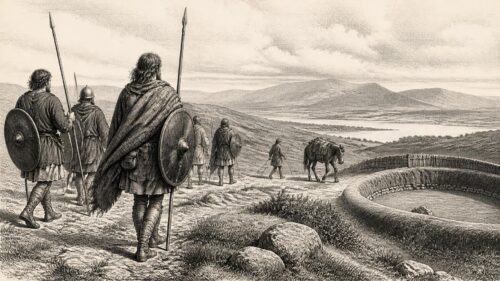
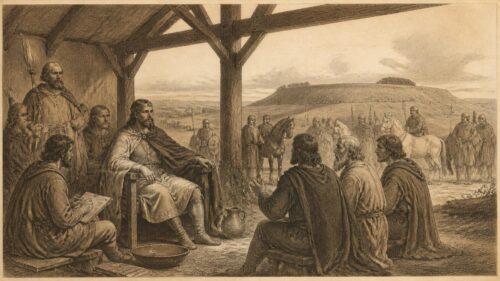
The most consequential recorded event of 1238 was a major intervention in the north. The Annals of Connacht and the Annals of the Four Masters agree that Mac Muiris, the justiciar of Ireland, and Hugh de Lacy led a large host into Cenél nEógain and Cenél Conaill. Mac Muiris was Maurice FitzGerald, the king of England’s justiciar in Ireland since 1232; Hugh de Lacy was earl of Ulster. The annals say that they deposed Domnall Mac Lochlainn, expelled him from his territory, installed “the son of Ó Néill” in the kingship, and took hostages from both northern peoples.
This was not a simple conquest of a vacant region. Cenél nEógain, broadly corresponding to much of modern Tyrone and surrounding districts, was contested between the Mac Lochlainn and Ó Néill dynasties. Cenél Conaill, in much of present-day Donegal, was an indispensable neighbouring power. The campaign represented an effort by the Anglo-Irish administration and the lord of Ulster to turn an existing dynastic rivalry to their own advantage. Their objective was not merely battlefield success but a working political settlement: remove one ruler, elevate another and secure obedience through hostages.
Hostages were central to medieval diplomacy. They were usually persons of rank or value to a ruling kindred, held as a guarantee that undertakings would be honoured. Their seizure in 1238 therefore signalled more than a raid for booty. It was an assertion that the justiciar and de Lacy could dictate terms across the northern provinces. Yet the settlement was fragile from the outset. Modern biographical scholarship, drawing on the annalistic record, places an earlier clash in the same year behind the expedition: followers of de Lacy killed a lord connected with Mac Lochlainn, and Mac Lochlainn’s response drove de Lacy from the province. The later counter-campaign, probably in the harvest season, temporarily restored de Lacy’s position.
The word “temporarily” matters. Mac Lochlainn was back in the struggle in 1239, while the contest continued into 1241. The events of 1238 should therefore be understood as a forceful but provisional rearrangement, not as the permanent submission of Tír Eógain. The identity of the unnamed “son of Ó Néill” is also not entirely secure in the annal entry, though Brian Ó Néill is generally considered the most likely beneficiary. Such uncertainty is a useful warning against making the evidence say more than it does.
Castles and Violence in Connacht
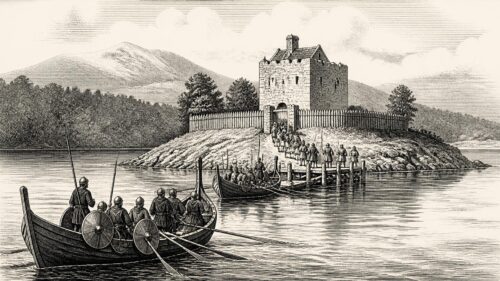
In Connacht, 1238 shows the parallel advance of lordship through masonry, alliance and local coercion. The annals state that “the aforesaid barons” built castles in Muintir Murchada, Conmaicne Cúile and Carra. These were districts across western and northern Connacht, including areas of modern County Galway and County Mayo. The annal does not name the individual castles, their precise positions or the particular barons responsible. It would be unsafe to attach the entry confidently to a surviving ruin without further proof. What it securely records is a new stage of castle construction in three strategic territories.
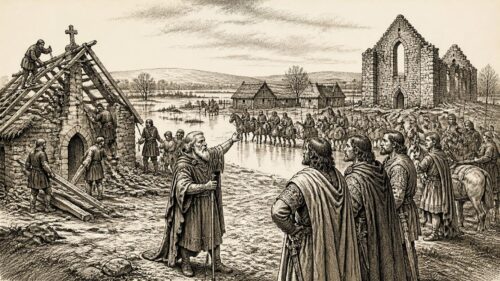
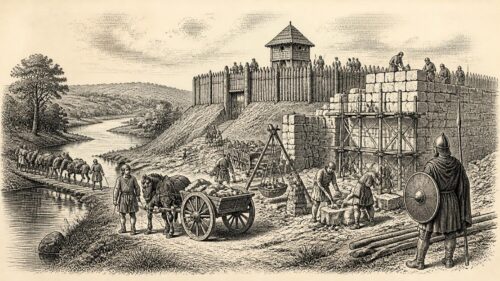
The building programme belonged to a wider transformation already under way. In 1235, Anglo-Irish forces had imposed a major partition on Connacht after campaigning against Fedlimid Ó Conchobair. In 1237 the annals noted that the barons had gone into Connacht and begun erecting castles; the entry for 1238 records further construction. Castles were military posts, centres of seigneurial administration and statements of possession. They could shelter garrisons, supervise routes and provide a base from which rents, food renders and labour might be demanded. But the sources do not allow us to reconstruct the workforce, materials or daily routines at the castles begun in this particular year.
Alongside this expansion came violence within Gaelic ruling families and between neighbouring lordships. Donnchad Uaithnech, grandson of Ruaidrí Ó Conchobair, was killed by Tadc, grandson of Cathal Crobderg Ó Conchobair. The names locate the killing within the extended Connacht royal dynasty. It was not an isolated loss: the province’s kingship had long been divided by rival branches, while outside magnates sought to make and unmake rulers.
Another killing exposes the dangerous overlap of capture, kinship and political rivalry. Donnchad son of Duarcan Ó hEgra, described as king of Luighne, was captured by Tadc son of Áed son of Cathal Crobderg. While being taken to custody, he was killed by his own kinsmen, the sons of Áed Ó hEgra, in Tír Oileáin or a closely related district named in the sources. The annals provide no motive. They do, however, show that being seized by a rival did not remove a prisoner from the calculations of his own family.
A raid from Bréifne brought the effects of warfare even more directly into view. Donnchad son of Muirchertach Mac Diarmata joined Ó Raghallaig and entered Connacht, plundering the community of Cluain Coirpthe. Men of Muintir Eolais and many people of the local tuatha, or communities, were killed pursuing the raiders. Medieval Irish annals frequently describe war in the language of cattle, plunder and burnings because movable wealth was both a practical resource and a measure of authority. This entry does not enumerate the plunder or identify every victim, but it makes clear that a raid involved more than a clash between leaders: a community was stripped of goods and local people died in the attempt to recover them.
Other deaths were also recorded. Máelruanaid Ó Dubda was killed by Connacht rivals, while Ruaidrí son of Áed Ó Flaithbertaig was captured by the Galla, the annalists’ term here for the Anglo-Irish. In Fermanagh, Flaithbertach Mac Cathmhaoil, a leading figure among Cenél Fearadhaigh, Clann Conghaile and Uí Cheannfhoda, was treacherously killed by his kinsman Donnchad Mac Cathmhaoil. The annals’ praise of Flaithbertach’s prowess and generosity reflects a political culture in which martial reputation and hospitality were marks of legitimate lordship.
A Tower at Annadown
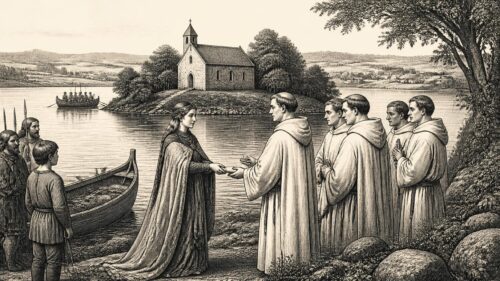
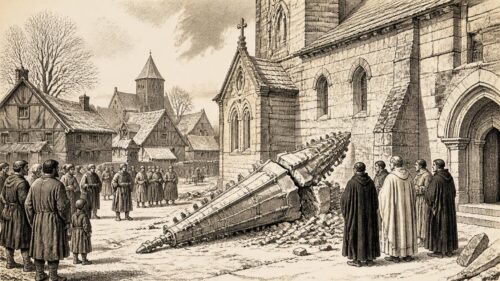
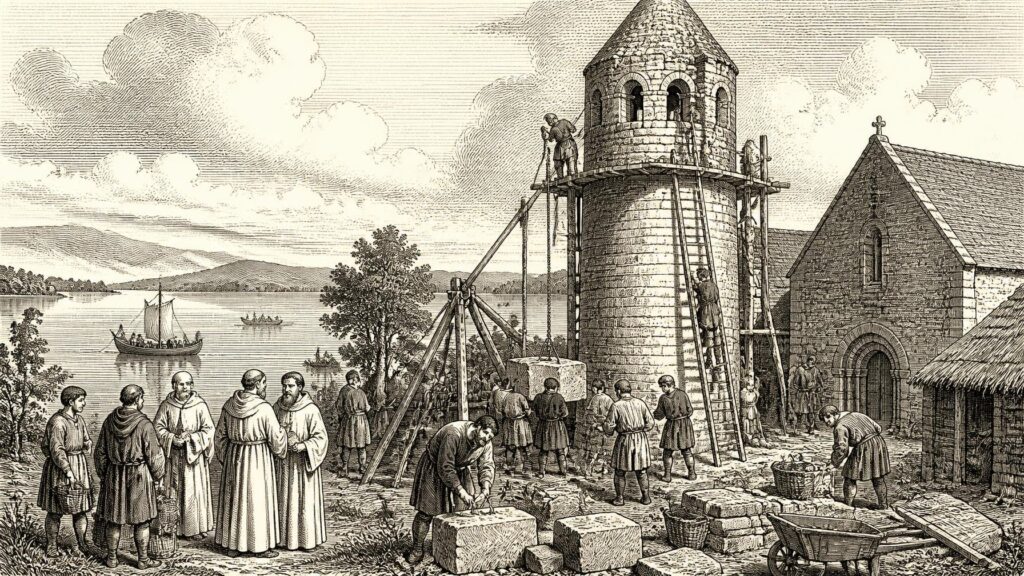
Against this backdrop, the building of the cloictheach, or bell-tower, at Annadown was a striking ecclesiastical event. Annadown stood on the eastern shore of Lough Corrib, within an important church complex and a landscape linked by water to Galway and the wider west. The Annals of Connacht record simply that its bell-tower was built in 1238; the Annals of the Four Masters make the same statement. This is one of the few firmly dated construction notices for such a structure in medieval Ireland.
Later writers have often called Annadown’s building the last Irish round tower. That identification is plausible but not certain. The Irish word cloictheach literally means “bell-house” and can denote a bell-tower; it does not, by itself, prove the exact architectural form. No complete tower survives at Annadown. Archaeological and architectural discussion has therefore debated whether the 1238 notice referred to a round tower at the ecclesiastical site, a tower elsewhere in its jurisdiction, or a structure that was rebuilt or later lost. The responsible conclusion is that a bell-tower was erected in 1238, while its precise appearance remains unresolved.
Its construction nevertheless speaks to institutional confidence. Stone building required resources, skilled labour and organisation. A bell-tower gave audible form to the rhythms of worship and made a church site visible from a distance. At Annadown, the project formed part of a religious landscape that retained significance even as Connacht was being militarised by castle building and shaken by dynastic conflict.
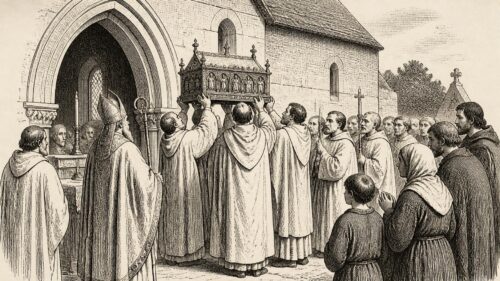
Church affairs also brought an ending in 1238. Felix Ó Ruadáin, archbishop of Tuam, died after resigning his office and taking the monastic habit at St Mary’s Abbey in Dublin. Both the retirement and the place of death are carefully preserved in the annals. They show a senior western churchman connected at the end of his life with the great ecclesiastical centre of Dublin, while the new tower at Annadown marked continuing investment in the churches of the west.
A Year of Uneasy Possession
For Ireland in 1238, castles, hostages and bell-towers were all forms of possession. A castle sought to make a lord’s claim durable in contested country. Hostages attempted to bind rulers to an imposed political order. A bell-tower expressed the material and ceremonial presence of a religious community. None guaranteed permanence. Mac Lochlainn’s displacement in Tír Eógain was soon challenged; Connacht’s newly fortified order remained contested; and the physical form of Annadown’s tower itself has passed from certainty into debate.
What survives most clearly is the year’s uneven geography of power. Anglo-Irish officials could march north with a large army and take hostages, but could not settle Tír Eógain for good. Barons could build castles in Connacht, yet raids and killings continued around them. Gaelic dynasties remained powerful, divided and resilient. Meanwhile, beside Lough Corrib, a church community raised a bell-tower whose very mention in the annals ensured that 1238 would be remembered for more than war.
Source References
Hover over a number to see the source. Select it to open the source.

- [1] Annála Connacht: Annal 1238
- [2] The Annals of Ulster: Year U1238
- [3] Annals of the Four Masters: Annal M1238
- [4] Annals of Inisfallen: Annal AI1238
- [5] Annála Connacht
- [6] FitzGerald, Maurice fitz Gerald
- [7] Lacy, Hugh de
- [8] MacLoughlin (Mac Lochlainn), Domnall
- [9] O'Neill (Ó Néill), Brian
- [10] O'Connor (Ó Conchobair), Fedlimid
- [11] Ua Conchobair, Cathal Mór Crobderg
- [12] Ua Conchobair, Ruaidrí
- [13] O'Reilly (Ó Ragallaig), Cathal
- [14] Monastic and Medieval Annaghdown
- [15] Round Towers and Tall Tales
- [16] Galway East: Ecclesiastical Heritage
- [17] The Archaeology of the Early Medieval Irish Church
- [18] Round Towers
- [19] Clonmacnoise Visitor Guide
- [20] The Annals of the Four Masters: Irish History, Kingship and Society in the Early Seventeenth Century
- [21] Exploring the Irish Annals
Primary Sources
- Annála Connacht: Annal 1238
- The Annals of Ulster: Year U1238
- Annals of the Four Masters: Annal M1238
- Annals of Inisfallen: Annal AI1238
- Annála Connacht
- FitzGerald, Maurice fitz Gerald
- Lacy, Hugh de
- MacLoughlin (Mac Lochlainn), Domnall
- O'Neill (Ó Néill), Brian
- O'Connor (Ó Conchobair), Fedlimid
- Ua Conchobair, Cathal Mór Crobderg
- Ua Conchobair, Ruaidrí
- O'Reilly (Ó Ragallaig), Cathal
- Monastic and Medieval Annaghdown
- Round Towers and Tall Tales
- Galway East: Ecclesiastical Heritage
- The Archaeology of the Early Medieval Irish Church
- Round Towers
- Clonmacnoise Visitor Guide
- The Annals of the Four Masters: Irish History, Kingship and Society in the Early Seventeenth Century
- Exploring the Irish Annals