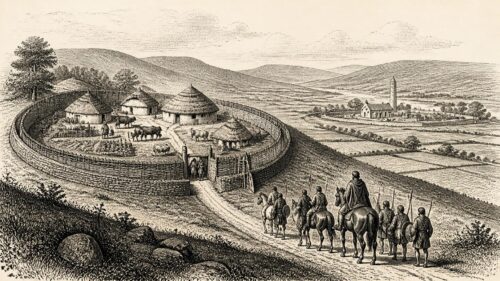
Cell Dara After Fire709 CE
In 709, although annalistic year-numbering varies, Congal Cennmagair of Cenél Conaill died suddenly, reportedly in a fit, ending his kingship of Tara. Fergal son of Máel Dúin of Cenél nÉogain succeeded, reflecting competitive Uí Néill dynastic politics rather than automatic inheritance or unified national rule. The annals also record the burning of Cell Dara, later Kildare, a wealthy and influential Leinster ecclesiastical centre, but provide neither cause nor extent of damage. Deaths of the abbots of Iona and Lorrha underline interconnected Irish Sea religious networks. Together these notices reveal entwined royal, ecclesiastical, economic and patronage systems amid persistent historical uncertainty.
Dateline
In 709 CE, Ireland’s annals place a sudden change of northern overlordship beside a fire at Cell Dara, the major ecclesiastical settlement now known as Kildare. Congal Cennmagair, king of Tara, died unexpectedly; Fergal son of Máel Dúin then began to rule. The same annalistic sequence records that Cell Dara was burned and notes the deaths of prominent abbots at Iona and Lorrha. These brief notices do not yield a continuous story, but together they show a country in which royal succession, the security of great churches and authority across the Irish Sea were closely connected.
Dating a Difficult Year
Early Irish annals are invaluable but their year-headings do not always align neatly with a modern calendar. The Annals of Ulster places Congal’s death, the burning of Cell Dara and Fergal’s accession under its entry U710, whose chronological heading corresponds to AD 709. The closely related Annals of Tigernach and Chronicon Scotorum preserve the same cluster under 710. By contrast, the much later Annals of the Four Masters puts the burning of Kildare and Congal’s death one annal earlier, while placing Fergal’s first year in 709. This is not a reason to discard the evidence. It is a reason to be precise: the events belong securely to the transition represented by 709, but the surviving compilations preserve different internal systems of numbering.
No day, month or season is supplied for either the fire or the succession. Nor do the contemporary-style entries state that one caused the other. It would therefore be wrong to portray the burning as an attack ordered by Congal, a portent of his death, or a deliberate act of Fergal’s supporters. Later narrative and hagiographical traditions encouraged more elaborate stories around kings and great saints’ churches. For this year, the responsible historical picture is sparer: Cell Dara burned; Congal died suddenly, reportedly in a fit; and Fergal began his reign.
The End of Congal’s Rule
Congal Cennmagair belonged to Cenél Conaill, the powerful northern branch of the Uí Néill whose heartland lay in the north-west. He had succeeded to the kingship of Tara after Loingsech son of Óengus was killed in 704. “King of Tara” was a claim to pre-eminence, not rule over a territorially unified Irish state. Ireland remained divided among numerous kingdoms, lordships and kin-groups, with the leading branches of the Uí Néill, the rulers of Leinster, Munster, Connacht, Ulster and many smaller peoples negotiating and fighting for advantage.
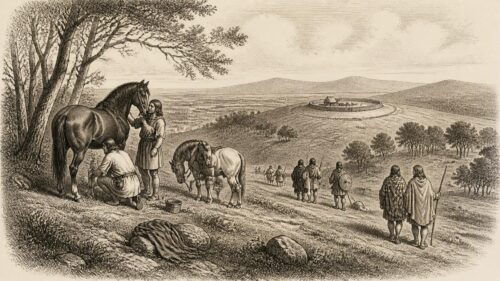
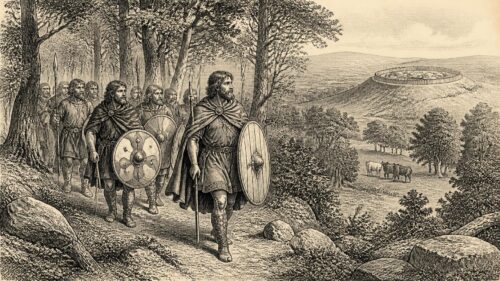
Congal’s recorded reign had included pressure upon Leinster. A hosting against the Laigin was noted shortly before this period, and it was remembered as a damaging assertion of northern power. Such campaigns were not simply battles between tidy national blocs. They involved moving armed retinues, demanding submission, provisions, hostages or cattle, and testing local alliances. Their consequences fell on households beyond the named kings: crops could be trampled, livestock driven away, food stores requisitioned, and travel made unsafe. Yet the annals do not say that 709 itself brought a new Leinster expedition. The year’s political importance lies instead in the abrupt vacancy at the top of an already competitive order.
The notice of Congal’s death is unusually concise and unusually human: he died suddenly, “of a fit” in the wording of the Annals of Ulster. Medieval annalists often recorded deaths without medical explanation, and this phrase should not be inflated into a modern diagnosis. Its significance is political. Sudden death denied a ruler the chance to manage a transition publicly, settle rival claims or establish a son securely in office. Congal had sons, but the kingship passed not to his immediate line but to Fergal of Cenél nÉogain, the rival northern Uí Néill dynasty based further east and north.
Fergal’s New Kingship
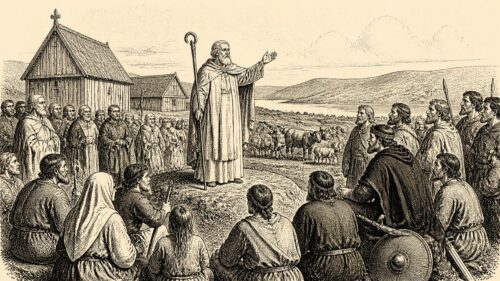
Fergal son of Máel Dúin was already a consequential ruler before he became king of Tara. As leader of Cenél nÉogain, he commanded resources and connections in the north, and his accession shifted the balance within the Uí Néill rather than creating a wholly new political order. The annals’ simple phrase that Fergal “begins to reign” should not be mistaken for evidence of a coronation at Tara attended by all Ireland. It records recognition of his superior kingship in the annalistic political vocabulary. How broadly, how quickly and on what terms that recognition was accepted is not stated.
His position was nonetheless formidable. Cenél nÉogain’s interests reached across the northern Midlands and into relations with the Airgíalla and the kingdoms of Ulster. His predecessors had competed with Cenél Conaill, and the transfer from Congal to Fergal made that rivalry central to Irish politics. Later events would show Fergal pursuing demands in Leinster and eventually meeting his death in the catastrophic battle of Áth Senaig in 722. Those later developments must not be read backwards as if they had already happened in 709. What can be said is that the new king inherited a political world accustomed to military mobilisation and contested overlordship.
The succession also demonstrates the limits of hereditary expectation. Irish kingship was deeply dynastic, but it was not simple primogeniture. Eligible men came from a wider royal kindred, and success depended on lineage, adult leadership, allies, military capacity and the willingness of other rulers to acknowledge a claim. The replacement of a Cenél Conaill king by a Cenél nÉogain king was therefore both a family matter within the Uí Néill and a redistribution of opportunity among allied and subordinate peoples.
A Burned Ecclesiastical Centre
The burning of Cell Dara was the other great Irish notice associated with 709. Kildare was not a remote chapel but one of the island’s foremost churches, associated with Brigit and embedded in the political landscape of Leinster. A generation or more earlier, Cogitosus’s Life of Brigit had portrayed the community as a place of exceptional eminence, with a large church, shrines and separate arrangements for men and women. Its claims of authority over almost all Irish churches were rhetorical and aspirational, but they testify to Kildare’s ambition, wealth and wide network of dependants and patrons.
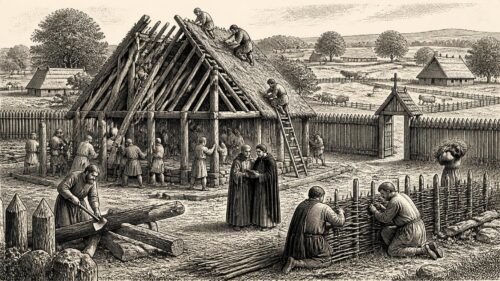
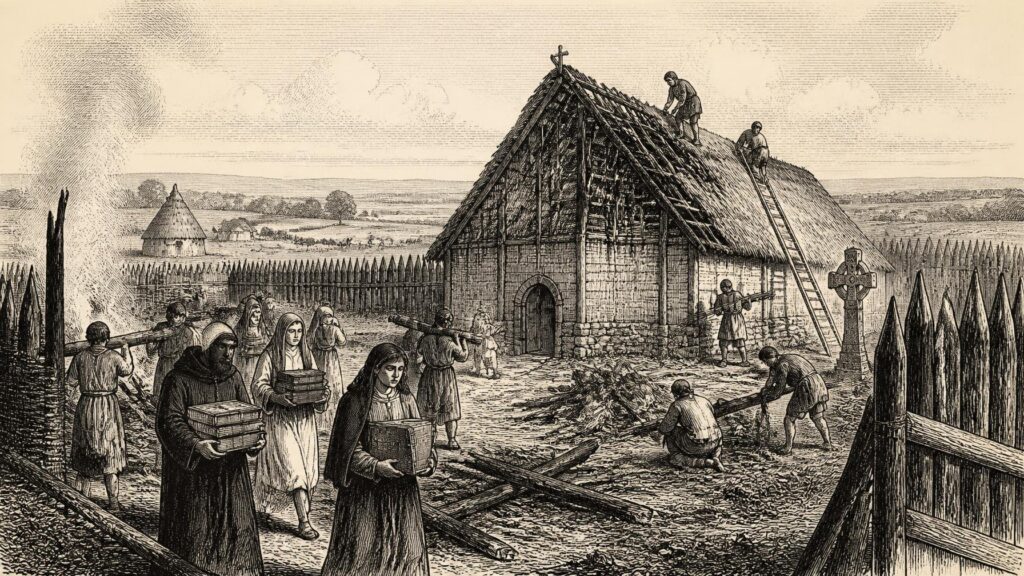
Fire at such a place was serious even when the annal gives no casualty figure. Early medieval churches, dwellings, roofs, fences, workshops and storehouses commonly depended heavily on timber, wattle, thatch and other combustible materials. The word “burning” does not tell us whether a church, domestic buildings, stored food, books, reliquaries or the whole enclosure were lost. It also does not identify the cause: accident, hostile action, lightning and deliberate destruction are all possibilities in the abstract, but none is proved here. The entry’s restraint is itself a warning against supplying dramatic details that the evidence does not contain.
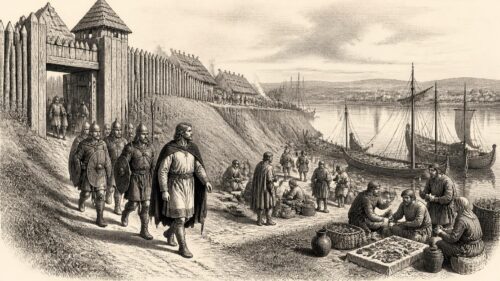
Even so, the choice to record the event confirms Cell Dara’s standing. A great church was a centre of worship, burial, learning, hospitality, estate management and political patronage. Its personnel could include clergy, religious women, craftsmen, labourers, tenants, fostered children, visitors and people seeking aid or judgement. A fire could interrupt liturgy and education, displace residents, damage food reserves and require labour and gifts for repair. It could also test relationships between the church and Leinster’s secular rulers, because rebuilding a prestigious complex needed timber, skilled work, provisions and protection.
Churches Across the Sea
Two deaths recorded in the same chronological sequence place Irish affairs in a wider ecclesiastical world. Conmael son of Fáilbe, abbot of Í, or Iona, died, and Colmán son of Sechnusach, abbot of Lothra on the Shannon, also died. Iona lay in Dál Riata, in what is now western Scotland, but it was founded from Ireland and remained integral to Gaelic religious and political networks. Its abbot’s death mattered on both sides of the sea. Lorrha, meanwhile, occupied an important inland position close to routes linking Munster, Mide and Connacht.
These obituaries should not be treated as proof of a coordinated church policy in 709. They do, however, show how the annalists mapped authority. Kings, bishops and abbots belonged in the same yearly record because lordship and religion were entwined. Churches held land and livestock, received patronage, preserved genealogies and legal memory, educated clerics, and supplied moral language through which rulers represented themselves. In a society without cities in the later medieval sense, great ecclesiastical settlements were among the most durable places where people, goods, information and influence gathered.
Work, Recovery and Uncertainty
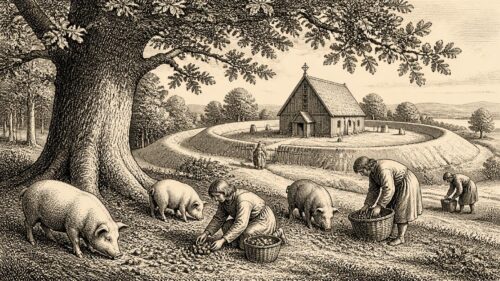
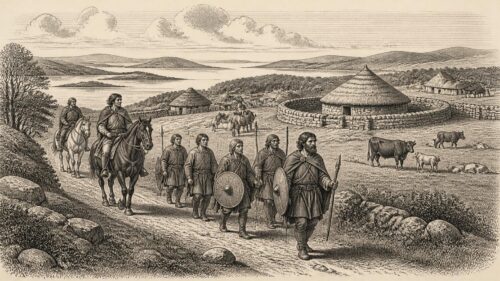
For most people, the year was experienced not through the change at Tara but through farming, kin obligations and the immediate demands of local lordship. Ireland’s population was overwhelmingly rural. Cattle were central to wealth, food and status, but households also kept sheep, pigs and horses, cultivated cereals, processed dairy produce, repaired enclosures and maintained paths and water crossings. The labour of women and men, free and unfree, sustained both secular households and religious establishments. A major fire at Kildare would have drawn on precisely this rural surplus: animals, grain, wood, cloth, transport and skilled hands.
The surviving record cannot tell us whether harvests were good or poor in 709, whether the Kildare fire reached nearby farms, or how ordinary people viewed Fergal’s accession. Silence matters. It prevents a falsely panoramic account. Yet the annals preserve enough to make the year intelligible: a leading king died without warning; a new northern ruler claimed the foremost kingship; Kildare suffered a damaging fire; and two important ecclesiastical offices fell vacant. These were not isolated items. They were pressures on the connected systems of power, labour, worship and patronage that shaped early medieval Ireland.
Primary Sources
- The Annals of Ulster
- Year U710, The Annals of Ulster
- The Annals of Tigernach
- Chronicon Scotorum
- Annals of the Four Masters
- Annals of Inisfallen
- Chronological Synchronisation of the Irish Annals
- Congal Cennmagair
- Fragmentary Annals of Ireland
- Cogitosus
- Kildare: Extracts from Cogitosus’s Vita Brigitae
- County Kildare Urban Archaeology Survey
- Conversion and Consolidation in Leinster’s Royal Heartland
- Early Medieval Archaeology Project
- Agriculture, Settlement and Society in Early Medieval Ireland
- The Archaeology of Livestock and Cereal Production in Early Medieval Ireland, AD 400–1100
- The Economy of Early Medieval Ireland
- Early Medieval Dwellings and Settlements in Ireland, AD 400–1100
- Legal Position and Living Conditions of Peasants and Commoners in Early Medieval Ireland, c.680–c.1170
- Exploring the Irish Annals