Lóchéne Menn’s Killing696 CE
In 696, Irish annals recorded the deaths of several prominent rulers and the killings of Lóchéne Menn, learned abbot of Kildare, and Domnall son of Conall Crandomna. Finguine, king of Munster, died, while Fergal of Aidhne’s death coincided with a shift in Connacht kingship towards Muiredach Muillethan. Congalach of Brega, involved in the previous year’s overthrow of Fínnechta of Tara, also died. The sources provide few circumstances or connections between these events. They nevertheless reveal unstable authority among competing dynasties and ecclesiastical communities, while the wider lives of farming populations remain largely unrecorded.
Dateline
In 696 CE, Irish annalists recorded a striking concentration of deaths and killings among rulers, ecclesiastics and men of high rank. The fullest contemporary-looking notices name the killing of Lóchéne Menn, the learned abbot of Cell Dara (Kildare); the deaths of Finguine, king of Munster, Fergal of Aidhne, and Congalach of Brega; and the killing of Domnall son of Conall Crandomna. The notices are brief, often frustratingly so, but they reveal a year in which power changed hands across several regions and in which a leading monastery suffered the violent loss of its head.
Dating a Sparse Year
The evidence needs careful handling. The Annals of Tigernach and Chronicon Scotorum place this cluster under 696. The Annals of Ulster preserve essentially the same entries under their annal U696, but their internal heading corresponds to AD 695 because of a known displacement in this stretch of their chronological framework. Modern historical dating normally assigns the events considered here to 696 CE. Later compilations, especially the Annals of the Four Masters, redistribute some notices further still. For this reason, 696 can be treated as the best reconstructed calendar year for the principal events, but no month, day or season can responsibly be supplied for any of them.
The annals also do not offer a narrative linking these deaths. They do not say that they resulted from a single campaign, epidemic, feud or conspiracy. Their juxtaposition may partly reflect the interests of the recorders: kings, abbots and learned men were the people whose passing was most likely to be entered. Yet the notices, read alongside the political upheaval of the immediately preceding year, show how precarious authority could be in an Ireland divided among many dynasties, kingdoms and ecclesiastical communities.
A Violent Loss at Kildare
The most exceptional notice is also the most revealing. Lóchéne Menn, described as sapiens or “the learned”, was abbot of Cell Dara, the Irish name of Kildare, and was killed. The annals do not identify his killer, give a location, or explain a motive. It would therefore be wrong to call the killing a raid, a dynastic assassination or an attack by a rival church. What can be said is that the death was violent and that it affected one of Ireland’s most prestigious religious houses.
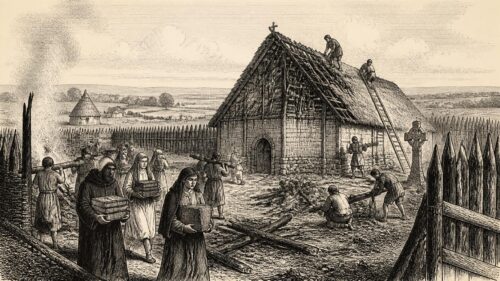
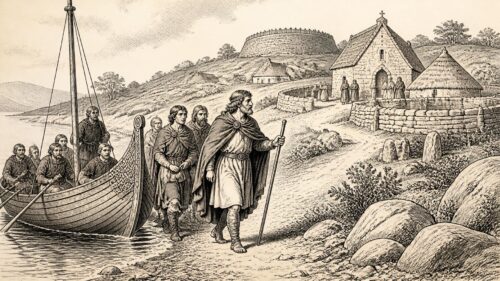
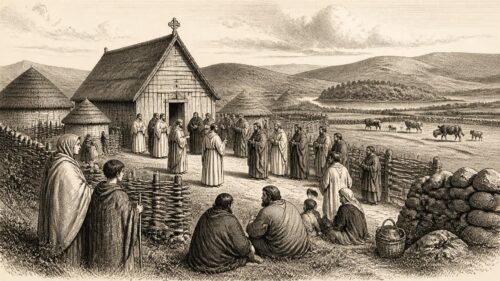
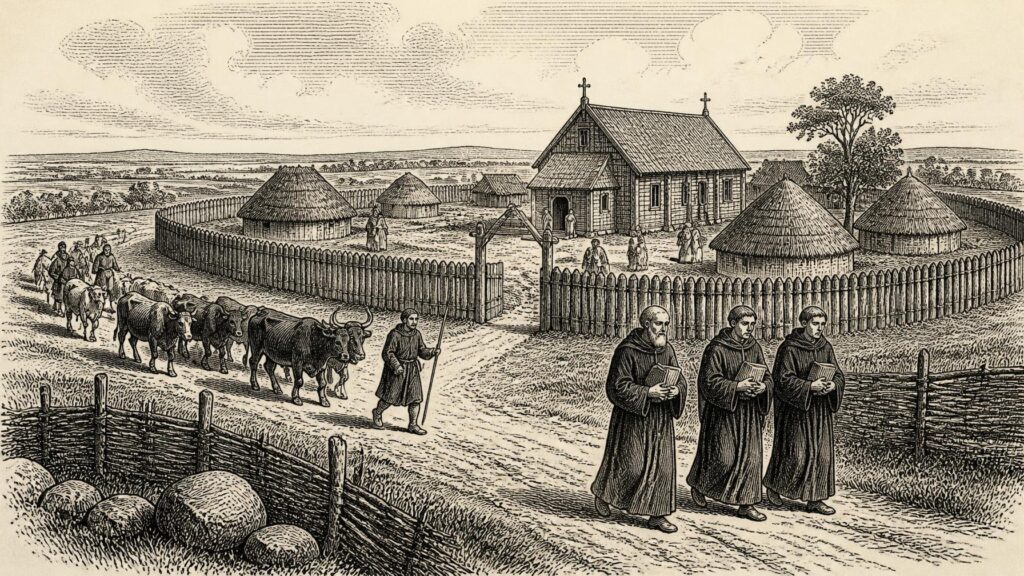
Cell Dara was associated with Brigit and stood in the plain of Leinster, within a landscape of royal estates, ecclesiastical land and dispersed farming settlements. By this date a major monastery was not merely a secluded place of worship. It was a community of clergy and dependants, a destination for patrons and pilgrims, a landholder, a centre of literacy, and a place where food, livestock, craft goods and hospitality had to be managed. An abbot’s position could consequently carry religious authority, control over resources and considerable political importance. The description of Lóchéne as learned suggests a reputation extending beyond routine administration, although the annals do not tell us what texts he taught, copied or composed.
His killing is a reminder that ecclesiastical status did not place an individual beyond conflict. Early Irish churches possessed recognised sanctity and could be protected by custom, patronage and law, but their communities existed within the same competitive society as royal kindreds. The entry should not be made to foreshadow the Law of the Innocents, which Adomnán promulgated in the following year, 697 CE. That celebrated legislation belongs to another year. Nevertheless, Lóchéne’s death makes clear why security, protection and the moral standing of churchmen were pressing matters in the Ireland of the late seventh century.
Munster Without Finguine
Finguine son of Cú cen Máthair, king of Munster, died in 696. He belonged to the Éoganacht Glendamnach, one of the competing branches through which the Munster overkingship circulated. “King of Munster” should not be understood as the ruler of a unified territorial state in a modern sense. His authority rested on relationships with subordinate peoples and kings, control of tribute and hostages, personal lordship, and the capacity to gather followers. It was powerful, but it required constant maintenance.
The annal does not state whether Finguine died naturally or violently, nor does it record an inauguration or battle to settle the succession. Later king lists and annalistic notices connect his brother Ailill with the Munster kingship, but they do not permit a securely dated scene of accession in 696. The prudent conclusion is that Finguine’s death opened a succession question within the Éoganacht political order, rather than that it produced a clearly documented transfer on a known day.
Finguine’s family remained important. His son Cathal would later become one of the best-attested Munster rulers of the eighth century. That later prominence should not be projected backwards as proof that Finguine himself dominated Ireland in 696. Still, the death of a Munster overking mattered beyond his immediate dynasty: it affected the balance of obligations among local rulers, churches and landed communities across the southern half of the island.
Connacht and Brega in Transition
In the west, Fergal of Aidhne, son of Artgal, died, alongside Fiannamail son of Máenach. Chronicon Scotorum explicitly calls Fergal king of Connacht, while the Annals of Tigernach identify him with Aidhne. Aidhne lay in the south of modern County Galway, and Fergal belonged to the Uí Fiachrach Aidhne, a powerful Connacht lineage. His death marked the end of that branch’s period at the head of the province. The Annals of Tigernach place Muiredach Muillethan’s emergence as king of Connacht in the same year, suggesting a shift towards the Uí Briúin of Mag Aí.
That apparent transition deserves emphasis, but not embellishment. No battle, assembly or negotiated settlement is recorded for 696. Nor should later success be mistaken for inevitability. Muiredach’s descendants, the Síl Muiredaig, became a major force in Connacht, but the annal for this year simply allows us to see one moment in the changing distribution of regional kingship. In a polity where royal authority was shared and disputed between kindreds, the death of an overking could alter the prospects of whole dynastic networks.
Further east, Congalach son of Conaing died. His genealogy placed him in the Síl nÁedo Sláine, a dominant Uí Néill kindred of Brega, the rich central region around the Boyne and its neighbouring plains. Congalach was no obscure casualty: in 695 he had been named, with Áed son of Dlúthach, as one of the men responsible for killing Fínnechta, king of Tara. Congalach’s own death in 696 therefore removed a participant in the previous year’s upheaval. The sources do not give its cause. It is unsafe to call it retaliation, execution or death in battle.
The wider consequences were political rather than constitutional. Loingsech son of Óengus of Cenél Conaill had begun his reign at Tara in the immediate transition after Fínnechta’s death, though the annals differ over how that transition should be dated. By 696, the elimination of Congalach from Brega weakened one figure associated with the overthrow of the former king. It did not end rivalry within the Uí Néill, nor did it turn Loingsech into an uncontested ruler of all Ireland. The title “king of Tara” expressed pre-eminence and aspiration; effective power still depended on alliances across the northern and southern Uí Néill, Leinster, Munster and Connacht.
An Unlocated Killing
The annals also record the killing of Domnall son of Conall Crandomna. This is among the year’s most opaque notices. Conall Crandomna was a name borne by a prominent seventh-century figure connected with Dál Riata, the Irish Sea kingdom spanning parts of north-east Ireland and western Scotland, but the annal gives too little information to establish the identity, position or location of Domnall with confidence. It is tempting to turn the entry into evidence for a specific Dál Riata succession struggle. The responsible course is to resist that temptation.
Even so, the wording matters. The annals distinguish Domnall’s killing from ordinary deaths, just as they distinguish the killing of Lóchéne Menn. Violence among elite men was sufficiently significant to be remembered, while its circumstances could be lost or omitted. This is one limitation of annalistic evidence: it is exceptionally good at preserving names and the bare fact of a death, but often silent about the people who planned, carried out or suffered from the events behind the entry.
Life Beyond the Annals
The surviving record names no famine, cattle plague, flood, harvest failure, foreign raid or major battle in Ireland for 696. That silence must not be converted into a claim that the year was peaceful or prosperous. Most people did not appear in the annals at all. Their lives were organised around households, kin, cattle, crops, obligations to lords and churches, and the seasonal demands of food production.
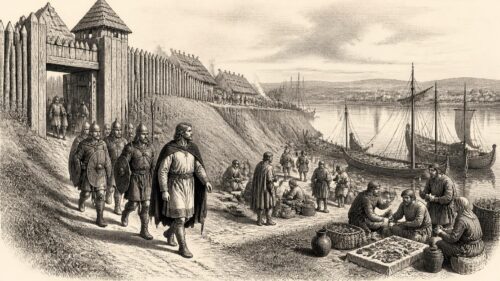
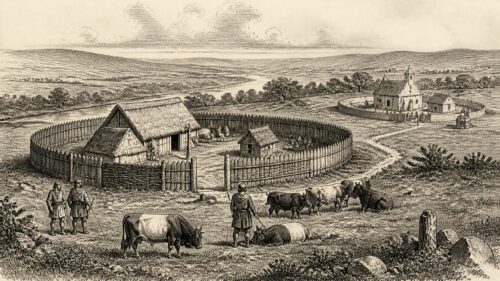
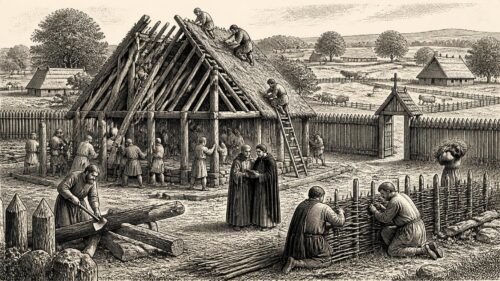
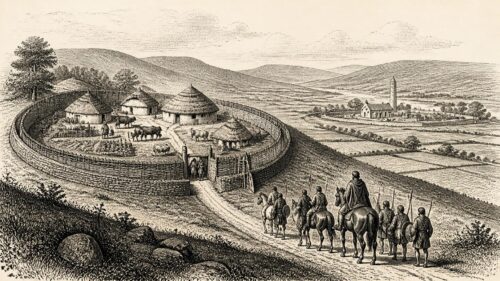
Archaeology provides the broader setting, rather than a diary of this particular year. Across Ireland, many families lived in and around enclosed farmsteads now known as ringforts or raths, with stone cashels commoner in some western districts. Such sites were connected with mixed farming: cattle remained a principal measure of wealth, while cereals were grown, processed with querns and dried in kilns. Settlements varied greatly in status, and a royal centre or major monastery stood far above an ordinary farmstead, but both depended upon the labour and produce of surrounding communities.
Churches such as Cell Dara formed another focus of settlement and exchange. They needed timber, grain, livestock, leather, metalwork and manuscripts; they also offered worship, burial, education, hospitality and access to influential networks. The murder of Kildare’s abbot therefore mattered to more than a clerical circle. It potentially disturbed a community whose religious and economic life extended into the surrounding countryside, even though the surviving sources do not describe the immediate local response.
A Year of Open Ends
696 CE is not a year that yields a single dramatic story. It is a year of closely recorded endings: a Munster king dead, a Connacht king dead, a Brega dynast dead, an eminent abbot murdered, and another high-status man killed in circumstances now beyond recovery. These losses occurred as Loingsech’s kingship of Tara took shape after the killing of Fínnechta in 695. They show an Ireland governed not from one settled capital, but through shifting relationships between regional dynasties, church communities and local societies.
The following year would bring Adomnán’s law and better-known public action. In 696 itself, the evidence is quieter and more sombre. Its value lies precisely in that restraint: the annals preserve the names of people whose deaths changed the human landscape of Ireland, while leaving us to acknowledge how much of their world—its motives, griefs, negotiations and daily continuities—remains unrecorded.
Primary Sources
- The Annals of Tigernach, Annals T688–T708
- The Annals of Ulster
- CELT Project: The Annals of Ulster
- Chronicon Scotorum, Annals CS692–CS696
- Chronicon Scotorum
- Annals of the Four Masters
- CELT Project: Annals of the Four Masters
- CELT Project: Annals of Inisfallen
- Fragmentary Annals of Ireland
- The Laud Synchronisms
- TEI Header for The Laud Synchronisms
- Loingsech | Dictionary of Irish Biography
- Cathal Cú Cen Máthair | Dictionary of Irish Biography
- Aislinge Meic Con Glinne: Background Information
- The Political History of Munster, 450–800 A.D.
- Farming and Archaeology: The Irish Historic Landscape
- Traditional Buildings on Irish Farms: The Rural Settlement Pattern
- Rathbeagh Ringfort, Co Kilkenny
- Brú na Bóinne World Heritage Site Research Framework
- TEI Header for Book of Leinster, Formerly Lebar na Núachongbála