Cross and Kingship1,123 CE
The surviving Irish chronicles make 1123 unusually vivid, but not uniformly clear. They record royal expeditions, disputed successions, attacks on major churches and the arrival of a relic associated with Christ’s Cross. Yet the annals were compiled in different centres and sometimes disagree over names, numbers and political interpretation. Their entries therefore provide firmly dated points around which a cautious account can be built, rather than a complete diary of the year.
Tairdelbach’s Ascendancy
The dominant political figure was Tairdelbach Ua Conchobair, king of Connacht and the strongest claimant to the high-kingship. The death of Domnall Ua Lochlainn in 1121 had removed his most formidable northern rival, but Ireland was not a centralised kingdom. Tairdelbach’s authority depended on repeated demonstrations of force, negotiated submissions, hostages and alliances with regional rulers. When annalists called him king of Ireland, they expressed a claim to supremacy, not undisputed administrative control over the island.
His principal recorded enterprise in 1123 was a major expedition into the south. The Annals of Tigernach and Chronicon Scotorum describe an advance through Ciarraige to Cork, where leading men of Desmond entered Tairdelbach’s house—a conventional sign of submission or negotiation. Among those named were Donnchad Mac Carthaig and rulers associated with Ciarraige and other southern territories. The Four Masters place the army as far as Bealach Eochaille and state that Tairdelbach obtained the hostages of Desmond. The Annals of Inisfallen more briefly record a hosting to Cíche Anann in the Luachair district.
These accounts differ in geographical emphasis, but together they show a substantial campaign directed at compelling southern obedience. The expedition also illustrates Tairdelbach’s reach beyond Connacht. Chronicon Scotorum says that forces moved by both land and water, a reminder that rivers, lakes and coastal routes were essential to large-scale warfare. Hostages secured agreements and discouraged rebellion, although their value lasted only while the king remained powerful enough to threaten punishment.
A Change in Desmond
The southern campaign coincided with uncertainty inside the Mac Carthaig dynasty. The Annals of Inisfallen report that Tadc Mac Carthaig suffered a grave illness and that his brother Cormac assumed the kingship of Desmond in his presence. Tadc did not die until 1124. Other chronicles preserve a different formulation, naming a Donnchad son of Tadc as the ruler who died before Cormac’s accession. The precise sequence is therefore uncertain, but Cormac’s emergence as king during 1123 is well supported.
This was more than a family succession. The Mac Carthaig dynasty was replacing the Uí Briain as the principal power in southern Munster, particularly in Desmond. Cormac’s position depended upon influential local dynasts, while Tairdelbach sought to turn southern divisions to Connacht’s advantage. Submission during the campaign did not make Cormac a passive dependent. Within a year he would oppose Tairdelbach’s interventions, beginning a prolonged contest over who could organise Munster and command its kings.
Fire and Revolt in Mide
Another sharply recorded crisis occurred at Daimhliag Chianáin, modern Duleek. The Gailenga attacked a residence occupied by Murchad Ua Máelshechlainn, king of Mide and claimant to the kingship of Tara. The chronicles say that the building was burned, together with either seventy or eighty surrounding houses, and that many of Murchad’s followers were killed. Murchad escaped, an outcome attributed by the annalists to the protection or honour of St Cianán.
The incident was not a foreign invasion but a violent challenge within the political landscape of Mide and Brega. The Gailenga were a significant regional people whose support could not be assumed by an overking. A royal residence might consist of a defended hall surrounded by dwellings, workshops, stores and accommodation for retainers. Burning scores of houses attacked not only a ruler’s person but also the material base of his household.
Domnall, described as a royal heir of Mide or Tara, was also killed by the Gailenga in 1123. Whether his death formed part of the same rising cannot be proved, but the entries reveal the vulnerability of Murchad’s dynasty. His survival at Duleek preserved him as an important player, and he would soon attempt to throw off Tairdelbach’s overlordship.
Violence at Emly
The sanctity of churches offered influence but not immunity. At Emly, one of Munster’s foremost ecclesiastical centres, armed men attacked Máel Mórda, successor of St Ailbe, and the son of Cerball Ua Ciarmhaic, king of Áine. Seven people were killed inside the seized house, although the principal targets escaped. The Bernán Ailbe, a revered object associated with the saint, was burned.
The chronicles present the assault as an extraordinary violation of God, Ailbe and the Church. Gilla Cáech Ua Ciarmhaic, identified as the leader and as a deacon in name, was killed and beheaded within a month. Annalists interpreted this as punishment for sacrilege. Whatever the immediate political motives, the episode shows how ecclesiastical settlements served simultaneously as sacred places, centres of landed wealth and meeting grounds for regional elites. Conflict within them could be both a political crime and an offence against a saint’s protection.
In Osraige, Donnchad Mac Gilla Pátraic Ruaid was killed by his own people or kindred. The terse notice gives no cause, but it points to another internal deposition carried out through violence. Kingship rested on dynastic legitimacy, military ability and continuing acceptance among powerful relatives and clients. A ruler who lost that support could fall without an external conqueror.
The Relic and the Cross
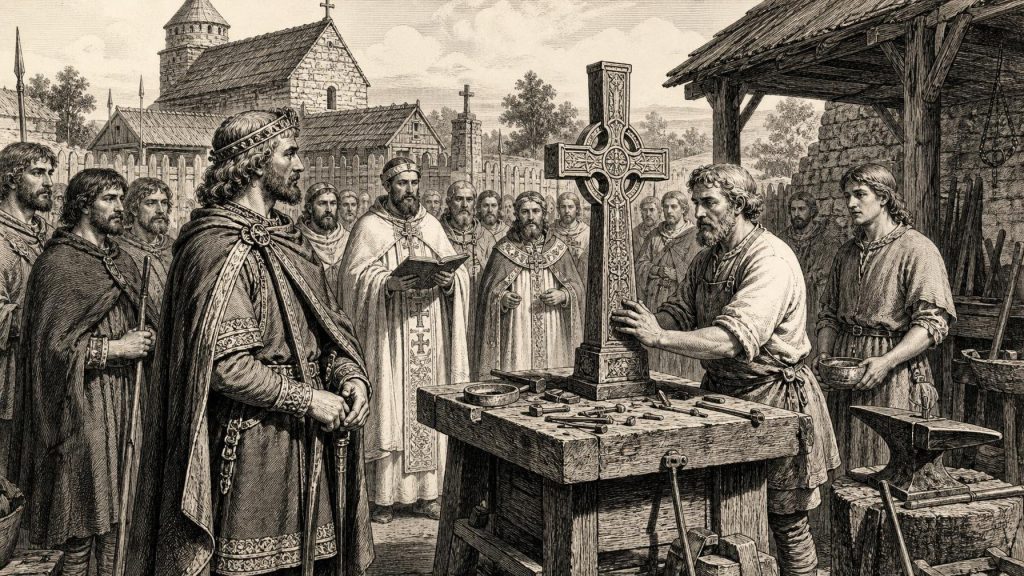
The year’s most enduring cultural development was the reception of a relic believed to be a fragment of the True Cross. The Annals of Tigernach say that the relic travelled through Ireland, receiving a great circuit or tribute from Tairdelbach. The king requested that part of it remain in Ireland, and the granted fragment was enshrined at Roscommon.
This event is firmly connected with 1123. The celebrated Cross of Cong was commissioned under Tairdelbach to house the relic, although modern authorities vary between assigning the surviving object specifically to 1123 and dating its manufacture across approximately 1123–1127. Its inscription names Tairdelbach as patron and Máel Ísu mac Bratáin Uí Echach as the craftsman. It was probably intended for the important church at Tuam before later being preserved at Cong.
The reliquary joined political ambition, religious devotion and exceptional craftsmanship. Its intricate metalwork drew upon long Irish traditions while incorporating artistic influences shared around the Irish Sea and northern Europe. Patronage of such an object enhanced Tairdelbach’s standing as a Christian ruler. Possession of a relic associated with Christ also strengthened the religious prestige of Connacht and its developing ecclesiastical centres.
The cross should not be treated merely as royal propaganda. Its inscriptions ask for prayers for the patron, craftsman and other participants, placing skilled labour within a spiritual community. Máel Ísu was not an anonymous artisan: his name was deliberately preserved. The object consequently offers rare evidence for the status, confidence and learning of a master metalworker in twelfth-century Ireland.
Churchmen and Pilgrims
Several deaths recorded in 1123 reveal the organisation and mobility of the Church. Aengus Ua Gormáin, successor of Comgall at Bangor, died while on pilgrimage at Lismore. His journey linked two major religious centres at opposite ends of the island. Flann Ua Duibhinsi, airchinnech of Louth, and Máel Muire Ua Condubháin, airchinnech of Doire Luráin, also died. An airchinnech managed a church’s property and community, illustrating the practical administration underlying religious life.
These events occurred during the wider reform of the Irish Church following the Synod of Ráith Bressail in 1111. Reformers promoted diocesan government, clerical discipline and closer connections with European practice, while older monastic offices remained influential. No new national synod is securely recorded for 1123, but pilgrimage, episcopal authority, relic devotion and royal church patronage all belonged to this changing religious environment.
Work, Wealth and Movement
The annals concentrate on rulers and clergy, yet their language exposes the foundations of ordinary life. Armies sought cattle, food, hostages and accommodation because wealth remained closely tied to farming and household production. Most people lived in dispersed farmsteads and enclosed settlements, tending cattle, sheep and pigs, cultivating oats and barley, repairing boundaries, processing milk, grinding grain and spinning or weaving fibres. A campaign could consume stored provisions, scatter herds and destroy the work of an entire season.
Ireland nevertheless possessed important towns at Dublin, Waterford, Wexford, Cork and Limerick. These Hiberno-Norse centres supported merchants, sailors and specialist craftspeople and connected Irish rulers with trade across Britain and continental Europe. Coinage circulated, particularly through Dublin, although cattle, food rents, precious metal and negotiated tribute remained central measures of value beyond the towns.
Maritime movement also carried risks. Tadc Ua Máille, lord of Umaill in western Connacht, was drowned with his ship at Aran. The notice gives no purpose for the voyage, so it cannot securely be labelled trade or warfare. It does, however, show that western lords and their households routinely used coastal waters linking Clew Bay, Galway Bay and the islands.
A Contested Order
Other notable deaths included Congalach Ua Flaithbertaig, royal heir of Ailech; Cú Caisil Ua Cerbaill, lord of Fernmag; and Donn Sléibe Mac Cathaláin, praised as the prosperity of Ulaid. Such notices reflect continual turnover among regional elites. In 1123 Tairdelbach Ua Conchobair stood above his rivals, but Duleek, Emly, Osraige and Desmond demonstrated the limits of any king’s control. The year’s finest surviving achievement, the Cross of Cong, expressed an aspiration towards sacred and political order amid a society still governed through personal allegiance, local power and repeated negotiation.
Primary Sources
- The Annals of Tigernach
- Annals of Inisfallen
- Annals of the Four Masters: Annal M1123
- The Annals of Ulster
- The Annals of Ulster: Year U1123
- Annals of Loch Cé: Annal LC1123
- Chronicon Scotorum: Annal CS1123
- The Cross of Cong
- The Cross of Cong: The Art, Archaeology and History of a Medieval Irish Treasure
- Ua Conchobair, Tairdelbach (O'Conor, Turlough)
- Mac Carthaig, Cormac
- Ua Máelshechlainn, Murchad
- Malachy (Máel-M'áedóc) Ua Morgair
- Pre-Norman Dublin: Capital of Ireland
- The Transformation of the Irish Church in the Twelfth Century
- Crisis and Recovery: Church and Society in Twelfth-Century Ireland
- The Economy of Early Medieval Ireland
- The Archaeology of Livestock and Cereal Production in Early Medieval Ireland, AD 400–1100
- Early Medieval Dwellings and Settlements in Ireland, AD 400–1100, Volume 1
- Early Medieval Ireland: Archaeological Excavations, 1930–2009
- The Viking Age in Ireland
- Early Medieval
- 950–1450: Vikings, Normans and Medieval Mints
- The Dublin Region in the Middle Ages: Settlement, Land-use and Economy
- Corpus Inscriptionum Insularum Celticarum, Volume II