
Bogbean Beneath the Tills31902 BCE
About 31,902 BCE cannot be treated as a precise Irish historical year: evidence belongs broadly to Marine Isotope Stage 3, within the later Middle Midlandian. Ireland experienced severe, variable glacial conditions before the ice sheet’s maximum. Derryvree deposits in Fermanagh indicate local ice-free wet tundra, with sparse treeless vegetation, while Castlepook Cave in Cork preserves remains of reindeer, mammoth, giant deer, hyaena and other cold-adapted animals. Lower sea levels altered geography but did not ensure permanent land access. A possibly butchered reindeer bone suggests episodic Upper Palaeolithic visitation, yet remains unconfirmed. No secure evidence supports settlement, institutions, warfare or occupation.
Dateline
“31,902 BCE” gives an impression of precision that the evidence cannot sustain. No event in Ireland can be assigned to that modern calendar year, and there is no written record, named person, settlement or securely dated human occupation from it. In archaeological terms, the point lies about 33,850 calendar years before 1950, within Marine Isotope Stage 3 (MIS 3), a fluctuating phase of the last glacial cycle. The responsible way to approach it is therefore through broad calibrated ranges, cave deposits, animal remains, pollen, plant macrofossils and the changing behaviour of the British-Irish Ice Sheet. These sources illuminate an Ice Age landscape rather than a year in the later historical sense.
Dating an Uncertain Moment
Radiocarbon laboratories report ages in years before present, where “present” conventionally means 1950, not the present day. Those measurements must then be calibrated against independently dated records of past atmospheric carbon, using curves such as IntCal20. At great antiquity, a radiocarbon measurement can correspond to a wide calendar range rather than a single year. “31,902 BCE” is thus best read as a notional place within the later Middle Midlandian, the Irish term commonly used for this part of the Last Glacial Period, rather than as an anniversary that archaeology can observe.
The chronology has become more complicated, and more interesting, as old bone collections have been retested. At Castlepook Cave, near Doneraile in north County Cork, early twentieth-century excavations recovered a large mixed collection of animal remains. Improved pretreatment and accelerator mass spectrometry have shown that several earlier radiocarbon determinations were too young, in some cases by thousands of radiocarbon years. A 2020 reassessment placed elements of the Castlepook fauna firmly in MIS 3 and suggested that species including giant deer and spotted hyaena may have disappeared locally before the Last Glacial Maximum. That revision is a warning against treating old cave dates, or a numbered BCE year, as immovable fact.
An Ireland of Ice Margins
Ireland was not yet at the maximum extent of the last British-Irish Ice Sheet. Current reconstructions place that maximum much later, broadly around 25,000–23,000 years ago. Around 31,902 BCE, however, climate was already cold, unstable and capable of changing sharply over periods far longer than any human lifetime. Ice expanded and contracted across the region over successive phases; mountain and lowland ice, periglacial ground and cold-season snowfields reshaped the possibilities for plants, animals and any people who might have entered the island.
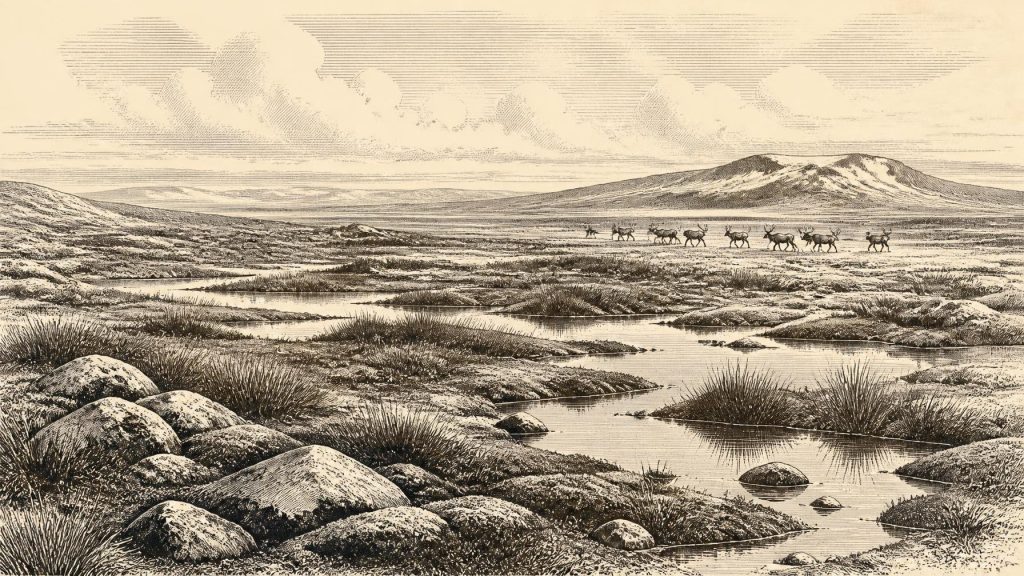
It would be misleading to picture the whole island as a single unbroken white sheet at every moment. Evidence from sites such as Derryvree near Maguiresbridge, County Fermanagh, preserves an organic freshwater deposit between glacial tills. Its radiocarbon age, formerly reported as about 30,500 radiocarbon years BP, and its fossil content demonstrate that ice-free or partly ice-free ground existed in at least some Irish regions during parts of the Middle Midlandian. The deposit’s plant remains, pollen and insects point to an open, treeless tundra or muskeg environment: grasses, sedges, herbs, mosses, dwarf shrubs and arctic-alpine plants, with shallow water and saturated ground in sheltered places.
That local record should not be mechanically projected across all of Ireland or onto one exact date. Sediments accumulate in particular hollows; pollen may travel; plant fossils indicate a nearby habitat rather than an entire province. Yet Derryvree gives a rare, tangible picture of the kinds of ecological refuges and exposed landscapes that could punctuate a generally severe climate. There was no forest comparable with modern Irish woodland. Wind, frost, seasonal thaw, bare mineral ground and sparse vegetation would have been central features of many landscapes. Rivers carried sediment from unstable slopes, while caves and fissures trapped bones, droppings and debris that later became the principal archive.
The Cave Fauna
Castlepook is especially important because its faunal assemblage contains animals associated with cold-stage north-west Europe. Reindeer, woolly mammoth, giant deer, brown bear, wolf, fox, Arctic fox, mountain hare, collared lemming, Norwegian lemming and spotted hyaena have all been identified among material attributed to its Pleistocene deposits. Not every specimen belongs to the same moment, and the original excavations did not meet modern standards of recording. Even so, the recurring combination establishes that southern Ireland could support, or at least receive, a diverse cold-adapted fauna during MIS 3.
These animals were not merely a picturesque “mammoth-steppe” list. Reindeer were mobile grazers and browsers suited to open country; lemmings indicate harsh conditions and low vegetation; carnivores show that food chains extended beyond herbivores alone. Hyaena remains and gnawed bones matter particularly because caves may have been dens, scavenging places or natural traps, not necessarily places where humans lived. Mammoth bone likewise proves that mammoths occurred in Ireland, but does not show how numerous they were, whether they formed permanent herds, or whether a particular cave bone was brought in by people, carnivores, water or collapse.
Sea level was substantially lower than today because large quantities of water were locked in continental ice. Ireland’s coastlines therefore lay farther out in places, and the Irish Sea and Celtic Sea basins formed a different geographical setting. Lower sea level did not automatically create an easy, continuous land route from the European mainland: glaciers, channels, cold waters and changing terrain all mattered. The fossil record nevertheless demonstrates that animals had reached Ireland. Their presence is evidence for real connectivity at particular times, not a map of one permanent route.
The Castlepook Human Question
The most provocative evidence close to this era is a reindeer femur fragment from Castlepook reported in 2021 as dating to roughly 33,000 years ago and bearing marks interpreted as stone-tool butchery. If that interpretation is eventually confirmed through full specialist publication and comparison with natural damage, it would indicate that people processed a reindeer in Ireland during the Upper Palaeolithic, far earlier than the formerly accepted record of human presence. It would be a major discovery.
For now, its implications must remain narrow. The bone comes from a complex cave collection created by antiquarian excavation, not from a modernly excavated camp floor containing a tool assemblage, hearth, dwelling and human remains. A date on the bone establishes when the animal died within a statistical range; it does not prove where it was killed, who made every mark, how long people stayed, or whether they returned. Carnivore tooth marks, trampling, sediment movement, excavation damage and later handling can all complicate bone-surface interpretation. The National Museum of Ireland still describes Palaeolithic human presence on the island as lacking clear evidence in the conventional archaeological record.
Consequently, it is not responsible to describe a settled Irish population in 31,902 BCE. There is no basis for named clans, an enduring village, a language, clothing style, burial rite or family economy. The strongest cautious interpretation is that Ireland may have been visited episodically by very small Upper Palaeolithic groups moving through the wider north-west European world, perhaps following animal movements or exploiting a short-lived opportunity in an ice-free landscape. That is an inference from a possible butchered bone and regional comparisons, not a demonstrated history of permanent colonisation.
No Polities, No Proven Wars
Political affairs, diplomacy and organised conflict cannot be recovered for Ireland at this depth of time. There were no states, kingdoms, borders, treaties or institutions visible in the evidence, and it would be anachronistic to supply them. Nor is there direct Irish evidence for warfare, ritual practice, formal learning, art, long-distance trade or structured exchange at this date. Stone technologies, symbolic traditions and social networks are well documented elsewhere in Upper Palaeolithic Europe, but they cannot simply be transferred across the sea to Ireland without local finds.
The same restraint applies to everyday life. A potentially butchered reindeer bone could imply skilled cutting and knowledge of carcass processing, but it does not reveal meals, shelters, gender roles, kinship, leadership or seasonal routines. Caves may have offered temporary protection, yet the available cave evidence does not demonstrate that Castlepook was a human home. The island’s archaeological silence here is partly historical: later glaciation eroded and buried landscapes, while acidic soils, mobile sediments and early collecting practices have reduced what survived and what can now be interpreted.
Regional Change Before the Maximum
The important development around this notional year was environmental, not political. Ireland was moving through a severe and variable glacial world in which habitable ground, animal ranges and routes of movement could alter dramatically. Derryvree preserves evidence for open wet tundra in the north; Castlepook and other southern caves preserve a striking animal archive; offshore research shows that the major ice-sheet maximum still lay in the future. Together, they replace an older image of a uniformly lifeless island with a more uneven picture of cold refuges, fauna and profound uncertainty.
That uncertainty is itself the historical conclusion. Around 31,902 BCE, Ireland was certainly part of the ecological geography of Ice Age north-west Europe. Reindeer, mammoth and predators entered or lived within its landscapes during the broader period, while tundra vegetation persisted in favourable places. Whether people briefly reached the island at a closely comparable time remains an important but unresolved question. Future excavations of undisturbed cave sediments, direct dating and microscopic study of bones may make the answer clearer; they cannot justify inventing a calendar-year story before the evidence exists.
Primary Sources
- A Reconsideration of the Radiocarbon Dating of the Marine Isotope Stage 3 Fauna from Southern Ireland
- The Irish Quaternary Fauna Project
- Phylogeographic, Ancient DNA, Fossil and Morphometric Analyses Reveal Ancient and Modern Introductions of a Large Mammal: The Complex Case of Red Deer (Cervus elaphus) in Ireland
- The Exploration of Castlepook Cave, County Cork, Being the Third Report from the Committee Appointed to Explore Irish Caves
- Irish Cave Exploration
- First Evidence of a Late Upper Palaeolithic Human Presence in Ireland
- New Insights on the Fauna of Ireland's Younger Dryas and Early Holocene from Alice & Gwendoline Cave
- Maximum Extent and Dynamic Behaviour of the Last British-Irish Ice Sheet West of Ireland
- Stratigraphic and Palaeo-Geomorphological Evidence for the Glacial-Deglacial History of the Last British-Irish Ice Sheet in the North-Western Irish Sea
- Pattern and Timing of Retreat of the Last British-Irish Ice Sheet
- The IntCal20 Northern Hemisphere Radiocarbon Age Calibration Curve (0–55 cal kBP)
- IntCal Publications
- OxCal
- Prehistoric Details: Mell Flint Flake
- Stone Age
- The Antiquity of Man in Ireland
- Palaeoecology
- Menyanthes trifoliata
- Dryas octopetala
- Understanding Irish Landscape Evolution: Pollen Assemblages from Neogene and Pleistocene Palaeosurfaces in Western Ireland
- The Exploration of Castlepook Cave, Co. Cork
- Mammoth Cave