Fermanagh’s Freshwater Silts31874 BCE
About 31,874 BCE, Ireland lay within the climatically unstable Late Pleistocene, not a date recoverable as a discrete historical year. At Derryvree, County Fermanagh, freshwater silts between till layers indicate an ice-free interval marked by treeless, periglacial terrain, cold-adapted insects, mosses and sedges. The last British–Irish Ice Sheet was building towards its later maximum, while conditions varied regionally and abruptly. Cave remains show a wider Pleistocene fauna, although assemblages cannot define contemporaneous communities. Secure evidence for human settlement is absent; possible early contact remains unproven. This period is understood through fragmentary environmental archives, not political, social or cultural history alone.
Dateline
The numbered year 31,874 BCE cannot be treated as a date in the ordinary historical sense. No written record, settlement sequence or securely dated event permits a view of one particular year in Ireland this far back. It belongs to the Late Pleistocene, within Marine Isotope Stage 3 and the Irish regional sequence often termed the Midlandian. The responsible approach is therefore to set the nominal year against wider, calibrated ranges of evidence. In round terms, 31,874 BCE falls about 33,800 calendar years before AD 1950, the conventional reference point for archaeological “BP” dating. It sits within a long cold-age interval when Ireland’s environments were changing sharply, but before the fullest expansion of the last British–Irish Ice Sheet.
Dating an Undated Year
Radiocarbon dates are not calendar dates. A laboratory measurement records the remaining radioactive carbon in a sample and is conventionally expressed in radiocarbon years BP; it must then be calibrated against independently dated records of changing atmospheric carbon. At the depths of time involved here, calibration can produce broad and sometimes discontinuous probability ranges. A date such as 31,874 BCE is consequently useful only as a modern reference marker: it cannot identify a season, a generation, or even a discrete archaeological horizon. The relevant evidence comes instead from deposits whose ranges overlap that point in time.
The most important Irish comparison is Derryvree, near Maguiresbridge in County Fermanagh. Road works exposed organic freshwater silts and fine sands preserved between two thick till sheets in a drumlin. The organic deposit returned a conventional radiocarbon age of about 30,500 BP, with a sizeable uncertainty; published calibration places it broadly at c. 36,900–31,700 calendar years BP. The nominal year considered here falls within that wide span. This does not mean that the silts were laid down in 31,874 BCE, or that every plant and insect recovered from them was living then. It means they are the closest securely relevant environmental archive for Ireland around this part of the last glacial cycle.
A Basin Between Ice Advances
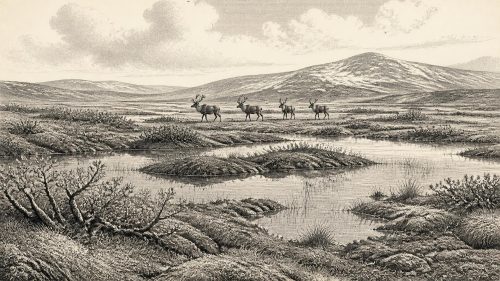
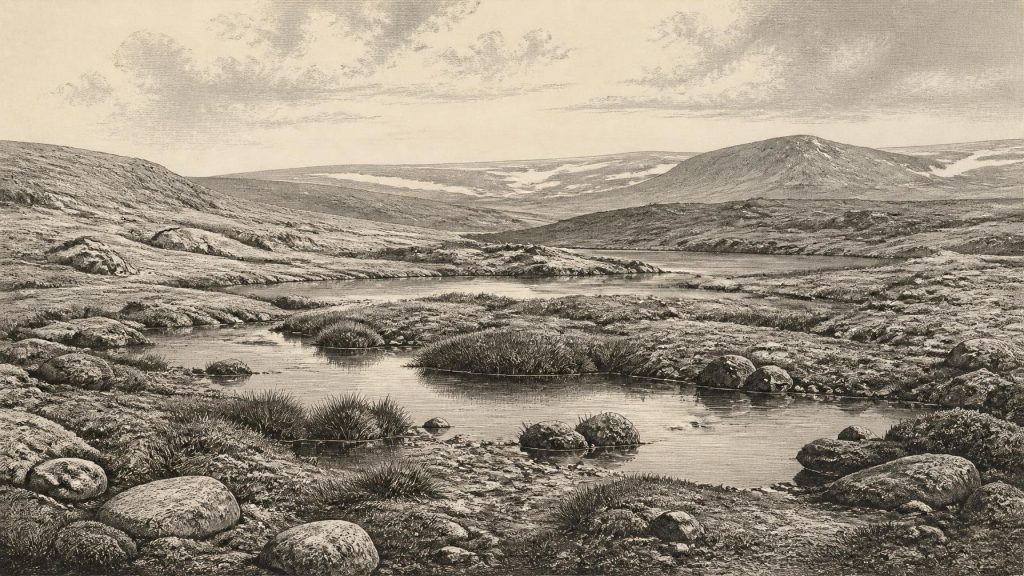
Derryvree’s significance lies in its position between glacial deposits. Beneath the freshwater beds was an earlier till, laid down by ice; above them lay a later till, evidence of a subsequent advance. During the intervening interval, the locality was not overridden by glacier ice. Water collected in a shallow freshwater setting and trapped fine sediment, mosses, sedges and insect remains. The published biological evidence indicates open, treeless ground and a periglacial regime: land subject to severe cold, seasonal thaw and freeze, rather than an ice cap occupying every valley and lowland.
This was no benign countryside awaiting later settlement. The vegetation reconstructed from such deposits points to low, sparse cover rather than woodland: moss-rich wet ground, sedges around pools and open tundra-like surfaces exposed to wind. Insects of cold northern aspect reinforce that picture. Permafrost or seasonally frozen ground would have affected drainage, vegetation and movement. Pools and marshy hollows could form where thaw-water was impeded above frozen substrates, while exposed ridges and slopes may have been dry, stony and vulnerable to frost action. The precise mixture varied locally and through time; the evidence supports a harsh, open landscape, not a uniform blanket of snow or lifeless ice.
Before the Greatest Ice
At this stage the last ice sheet was building towards, rather than already occupying, its maximum extent. Reconstructions differ in detail because ice margins advanced unevenly and evidence is fragmentary, but a widely used model places major British–Irish Ice Sheet growth after about 35–32 thousand years ago, with maximum extent later, around 27–21 thousand years ago. Other work on southern Ireland likewise indicates that the large final expansion was later than the interval represented at Derryvree. Thus the appropriate image for 31,874 BCE is not necessarily an Ireland buried beneath its eventual maximum ice cover. It is an Ireland experiencing intense cold and climatic instability, with at least parts of the island remaining ice-free.
That qualification matters because “the Ice Age” compresses many different landscapes into one phrase. Ireland’s glaciers did not simply advance once, stop, and retreat once. Ice flowed from changing centres, crossed some districts, left deposits, and later reworked or buried earlier ground surfaces. The freshwater archive at Derryvree is valuable precisely because it survived this destructive history. Yet it is a local survival, not a map of the whole island. It cannot settle whether every coast, upland or inland basin was ice-free in the nominal year, and it should not be used to claim a single island-wide climate or ice margin.
Animals in a Changing Land
Ireland’s cave collections show that a recognisably Ice-Age fauna reached the island during the Late Pleistocene. Castlepook Cave in County Cork is especially important, with remains attributed to woolly mammoth, giant deer, reindeer, brown bear, spotted hyaena, foxes, hares and small cold-adapted mammals. The Irish Quaternary Fauna Project concluded that a broad range of mammals colonised Ireland between at least about 45,000 and 20,000 years ago. These finds demonstrate that the island was not biologically isolated in the way it is today and that large animals could move through the wider Irish Sea world during suitable phases of low sea level and altered coastal geography.
However, cave bones must be handled carefully. Many Irish assemblages were excavated in the nineteenth and early twentieth centuries, often from disturbed deposits; animals represented in one cave did not necessarily live together, and a species dated from the broad late-Pleistocene interval cannot automatically be placed at Derryvree or in 31,874 BCE. The safest conclusion is limited but important: cold-adapted and large grazing or browsing animals, alongside predators and scavengers, formed part of Ireland’s changing Pleistocene fauna. Their presence is evidence for intermittent ecological connections and habitable patches, not proof of a stable, fully known animal community in every district.
The Human Question
There is no secure evidence for a settled human population in Ireland at this time. More strongly, there is no securely excavated human campsite, hearth, house, tool-making floor or burial that can be assigned to c. 31,874 BCE. The National Museum of Ireland continues to describe the Palaeolithic human record as lacking clear proof, while recognising that finds from Irish caves have reopened the question. The conventional starting point for substantial, unambiguous human evidence remains much later, in the Mesolithic after the final retreat of the ice.
Castlepook has made the earlier question more interesting, not settled it. A reindeer bone fragment from the cave has been reported with a possible humanly made incision and a date in the broad neighbourhood of 33,000 BP. If future work proves that the mark is a stone-tool cut and securely ties it to the dated bone and an undisturbed context, it could indicate very early human activity in Ireland. At present, that is a hypothesis under investigation rather than a licence to narrate a hunting party in County Cork in a particular year. The distinction is fundamental: modified bone may signal brief contact; it would not by itself demonstrate colonisation, residence, a community or a route of arrival.
No Kingdoms, No Diplomacy
Political affairs, diplomacy, warfare, religion, learning and trade cannot responsibly be reconstructed for Ireland in 31,874 BCE. There are no identifiable peoples, leaders, languages, territories, ritual sites, exchange systems or social institutions in the evidence. Even if small groups of Upper Palaeolithic people occasionally reached the island, their movements, beliefs and relationships remain unknown. It would be misleading to fill this silence with imagined clans, shamanic ceremonies, mammoth hunts or conflicts. Archaeology can identify possibilities and environmental constraints; it cannot supply a political history where no such record survives.
Everyday human life is equally beyond recovery for this nominal year. If people did visit, they would have required extraordinary practical knowledge of cold, animal behaviour, stone technology, shelter and travel. But that is a general inference from Upper Palaeolithic societies elsewhere in north-west Europe, not direct Irish evidence. Ireland has not produced the contemporary domestic debris that would allow historians to discuss food preparation, kinship, clothing, craft or teaching with confidence. The article’s central subject is therefore not a hidden Irish society, but the physical setting in which any human visit would have had to occur.
Climate on a Human Scale
The Irish record also belongs to a North Atlantic climate system capable of abrupt shifts. Greenland ice cores reveal repeated transitions between colder stadials and relatively milder interstadials during the last glacial period, sometimes occurring over decades rather than millennia. In south-west Ireland, uranium-thorium dates from speleothems in Crag Cave show episodic calcite growth during Marine Isotope Stage 3; because growth required liquid water, this provides independent evidence that milder intervals punctuated the glacial climate. It does not yield a weather report for 31,874 BCE, but it cautions against treating the age as climatically static.
For Ireland, regional change was therefore the great development. Freshwater could persist at Derryvree between episodes of glaciation. Cold-ground vegetation and insects occupied northern basins. Pleistocene animals entered and disappeared across a changing seascape. In caves and protected sediment traps, bones and organic layers accumulated; elsewhere, advancing ice eroded, transported and buried much of the evidence. The landscape that later generations would know as Ireland was being reshaped physically long before there were monuments, farms, ports or kingdoms to record its history.
What This Date Can Mean
31,874 BCE is best understood as a point within an evidence range, not an anniversary. Around this time, the Derryvree freshwater sequence demonstrates that at least part of Fermanagh experienced cold, treeless, periglacial conditions between glacial advances. Ireland was entering the build-up to the greatest ice expansion of the last glacial cycle, while its cave record preserves traces of a wider Pleistocene fauna and an unresolved possibility of very early human contact. The uncertainty is not a defect to be concealed. It is the historical fact: at this depth of time, Ireland’s past is recovered not from chronicles, but from silts, bones, insects, caves and ice-shaped ground.
Primary Sources
- A Middle Midlandian Fresh-water Series at Derryvree, Maguiresbridge, County Fermanagh, Northern Ireland
- Early Midlandian–Middle Midlandian, Pleistocene, Northern Ireland
- Trimlines, Blockfields and the Vertical Extent of the Last Ice Sheet in Southern Ireland
- Extent and Timing of the Last Glacial Maximum (LGM) in Britain and Ireland: A Review
- Growth and Retreat of the Last British-Irish Ice Sheet, 31,000 to 15,000 Years Ago: The BRITICE-CHRONO Reconstruction
- Pattern and Timing of Retreat of the Last British-Irish Ice Sheet
- Radiocarbon Constraints on the Age of the Maximum Advance of the British-Irish Ice Sheet in the Celtic Sea
- Episodic Speleothem Deposition Tracks the Terrestrial Impact of Millennial-Scale Last Glacial Climate Variability in SW Ireland
- The Irish Quaternary Fauna Project
- First Evidence of a Late Upper Palaeolithic Human Presence in Ireland
- New Insights on the Fauna of Ireland’s Younger Dryas and Early Holocene from Alice & Gwendoline Cave
- Prehistoric Details
- The Mesolithic in Ireland: When Was It?
- The IntCal20 Northern Hemisphere Radiocarbon Age Calibration Curve (0–55 cal kBP)
- IntCal Publications
- A Stratigraphic Framework for Abrupt Climatic Changes During the Last Glacial Period Based on Three Synchronized Greenland Ice-Core Records
- High-Resolution Record of Northern Hemisphere Climate Extending into the Last Interglacial Period
- Figure 6—The Subdivision of the Quaternary Period in Ireland
- The Last Glacial Maximum British-Irish Ice Sheet: A Reconstruction Using Digital Terrain Mapping
- Introduction to the Late Quaternary and Holocene of Northern Ireland
- The Geology of the Irish Sea: UK Offshore Regional Report