Greenagho’s Sub-Till Wetland31815 BCE
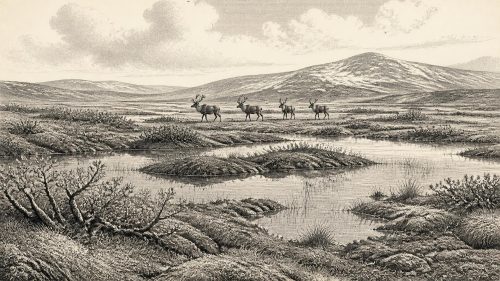
Around 31,815 BCE, Ireland was a regionally varied Late Pleistocene landscape, not a documented society. Low sea levels and fluctuating British–Irish ice permitted intermittent ecological connections, while advancing glaciers altered or destroyed evidence. Inter-till deposits at Derryvree and Greenagho in Fermanagh indicate freshwater wetlands, tundra vegetation and periglacial conditions before later glaciation. Cave assemblages, notably at Castlepook, show that cold-adapted mammals reached Ireland, though their dates and associations remain uncertain. A potentially tool-marked reindeer bone suggests a possible brief human visit, not settlement. No secure evidence supports contemporary communities, politics, religion, trade or enduring occupation; environmental change dominates the record.
Dateline
The label “31,815 BCE” is a modern way of indexing a time far beyond any Irish calendar, written record or annual chronicle. It cannot identify an event that happened in one recoverable year. In the conventional archaeological system, it lies roughly 33,800 years before AD 1950, within the later part of the Late Pleistocene and broadly within Marine Isotope Stage 3 (MIS 3), a fluctuating phase of the last Ice Age. Even that conversion should not imply false precision: radiocarbon determinations at this depth of time calibrate to broad probability ranges, not to a single season or year. The responsible history of Ireland at this point is therefore a history of deposits, bones, landforms and uncertainties.
A Landscape Between Ice Advances
Ireland was not yet the familiar island of woodland, fields, towns and coastlines. Sea level was much lower than today because vast quantities of water were held in northern ice sheets. The present Irish Sea and Celtic Sea basins were correspondingly altered, and Ireland was part of a changing north-west European land-and-sea borderland. This physical connection made animal movement possible at some times, but it does not itself demonstrate a human road, a settled population or regular travel across a particular route.
Nor was the island uniformly buried beneath ice at every moment of the Late Pleistocene. The British–Irish Ice Sheet expanded and contracted over many millennia, and reconstructing its earlier growth remains difficult. Different kinds of evidence can point in different directions: sediments beneath later glacial deposits show that some areas were ice-free during particular intervals, while marine evidence indicates major ice loading and high relative sea levels around parts of the western coast. The safest conclusion is regional complexity rather than a single all-Ireland scene.
The closest evidence for conditions broadly relevant to this date comes from County Fermanagh. At Derryvree, near Maguiresbridge, roadworks exposed organic silts and fine sands trapped between two separate tills: deposits left by glacier ice. The intervening freshwater sediments yielded a radiocarbon determination of 30,500 years BP, with substantial laboratory uncertainty. Published calibrations place the result within a wide range extending approximately from 36,900 to 31,700 calibrated years BP. That range overlaps the broad time represented by 31,815 BCE, but it cannot prove that the Derryvree wetland existed in that exact numbered year.
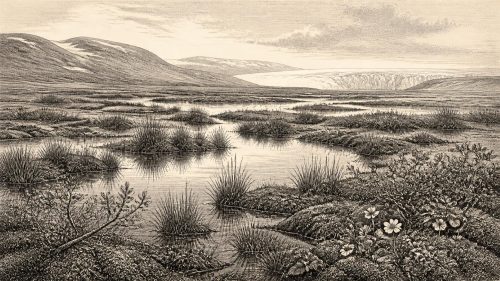
The value of Derryvree is nonetheless considerable. Its mosses, sedges, other plant remains and cold-adapted insect fauna indicate open tundra and a periglacial regime: ground affected by intense freezing and thawing near, rather than necessarily beneath, an ice margin. Nearby Greenagho, close to Belcoo, produced freshwater organic material beneath till with a radiocarbon age of about 32,460 BP. The legacy measurement has cautions attached to it, but alongside Derryvree it shows that parts of north-central Ireland supported freshwater habitats and tundra vegetation before subsequent glaciation sealed those traces below later deposits.
Open Ground and Short Seasons
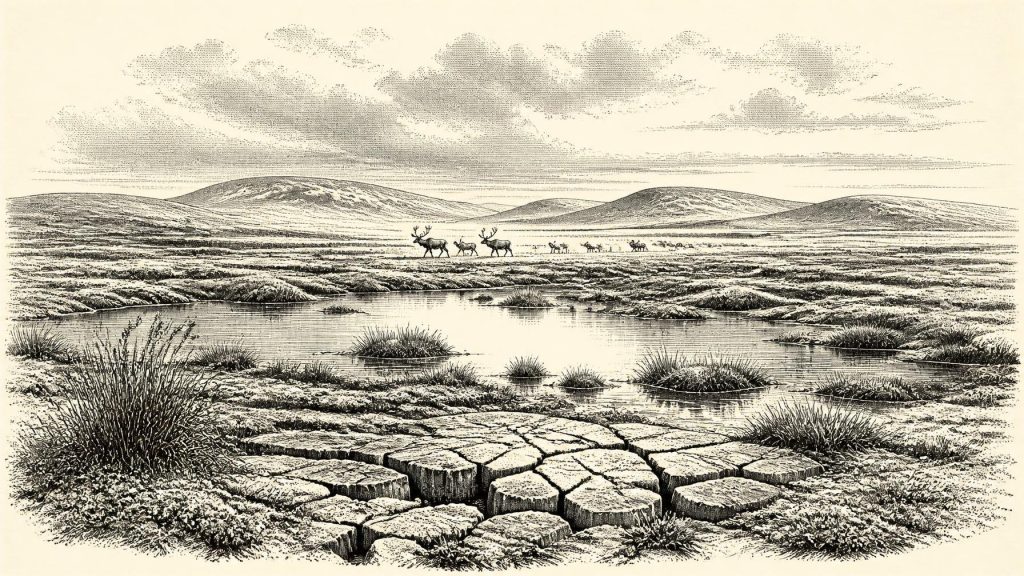
A cautious reconstruction of suitable Irish ground around this era is not one of forest. Pollen, macrofossils and insects from inter-till deposits point instead towards sparse, largely treeless vegetation, including grasses, sedges and moss-rich wet places. Low shrubs may have occupied favourable ground, while frost-shattered rock, exposed mineral soils, shallow pools and seasonally waterlogged hollows made for a patchwork landscape. Conditions were severe, but “tundra” should not be imagined as lifeless white emptiness. During the short growing season, wet ground and herb-rich vegetation could support insects, small animals and grazing mammals.
Climate during MIS 3 was unstable on the scale at which geology can often resolve it: North Atlantic cold phases and milder interludes succeeded one another. Such shifts affected snow persistence, frozen ground, water supply and the reach of glacier margins. The evidence does not permit a reliable weather report for a day in 31,815 BCE, nor does it establish that all regions experienced identical conditions. It does demonstrate that environmental change, rather than political action, was the foremost force shaping Ireland’s possibilities at the time.
Later glacial action also helps explain why the record is fragmentary. Ice eroded, transported and redeposited older surfaces; acidic soils commonly destroy bone and organic matter; rising post-glacial seas drowned former coastal plains. A lack of campsites is therefore not absolute proof that no person ever entered Ireland. Yet preservation problems are not a licence to invent settlements. They make it essential to distinguish an absence of evidence from positive evidence for an occupation.
Animals in a Connected World
Irish cave collections show that a surprisingly varied cold-stage fauna reached the island at different points between roughly 45,000 and 20,000 years ago. Castlepook Cave near Doneraile in north County Cork is especially important. Historic excavations recovered remains attributed to such animals as reindeer, giant deer, mammoth, spotted hyaena, wolf, brown bear, Arctic fox, hare and lemmings. These finds establish that Ireland formed part of a wider Pleistocene ecological zone, with large mammals and predators able to reach suitable territory during portions of the glacial cycle.
They do not, however, amount to a census for 31,815 BCE. Many cave finds were excavated in the nineteenth and early twentieth centuries, before modern recording standards, and bones can be moved by scavengers, water, collapse and earlier digging. Modern redating has also shown that some older Irish radiocarbon results require revision. Reassessment of southern cave fauna has placed some animals much earlier than previously thought and suggests that giant deer and spotted hyaena may have disappeared locally before about 40,000 calibrated years BP. It would therefore be unsound to picture every famous Castlepook species sharing one valley at the same moment.
Reindeer are particularly relevant because their ecology fits the open, cold landscapes indicated at Derryvree. Their presence in the wider Irish record implies seasonal grazing opportunities, but it cannot tell us herd size, migratory timing or the exact character of the Cork landscape at this date. Carnivores and scavengers complicate the story further. A bone in a cave may record predation, scavenging, a natural death, transport by water, or a human act. Taphonomy—the study of what happened to remains after death—is therefore central to Irish Ice-Age history.
The Human Question
There is no securely demonstrated village, house, hearth, burial, lithic workshop or stratified Upper Palaeolithic hunting camp in Ireland dating to about 33,800 years ago. No named people, language, polity or social group can be attached to the period. The first substantial evidence for enduring human settlement in Ireland belongs much later, after deglaciation, in the Mesolithic. That chronological gulf matters: Mesolithic lifeways, tools and identities cannot be projected backwards into MIS 3.
A reindeer femur from Castlepook has nevertheless made this older period archaeologically significant. It has been reported as approximately 33,000 years old and as bearing a mark interpreted as potentially made by a stone tool during butchery. If that interpretation is sustained by further microscopic analysis and contextual investigation, it would be evidence for a brief human encounter with an animal in Ice-Age Ireland. It would not establish continuous residence, a population size, a campsite nearby or an Irish “first settlement” in the ordinary sense. Recent excavation at the cave recovered no cultural artefacts, underlining the need for restraint.
The possible mark is best understood as a research question, not a foundation myth. It is plausible that mobile Upper Palaeolithic hunters occasionally reached an accessible Irish landscape when terrain, ice and sea conditions allowed. It is equally important that the present evidence cannot show frequency, duration, direction of travel or whether any visit led to further occupation. The interpretation is about human presence at most; the bone itself is the primary evidence.
No Politics, No Proven Religion
For this date there can be no responsible account of Irish political affairs, diplomacy, warfare or institutions. Those categories depend on communities whose social organisation can be observed through settlements, graves, monuments, written testimony or repeated material practices. None is available here. Nor is there evidence for ritual sites, deities, religious specialists, artistic traditions or formal learning in Ireland at this time. To ascribe beliefs or ceremonies to a hypothetical passing hunting party would turn silence into invention.
The same caution governs economy and trade. Wild animals and plant resources may have offered food, hides, bone, antler and fuel to any visitors, but there is no securely associated toolkit or habitation deposit from which to reconstruct a local subsistence economy. Low sea level and changing coastlines created opportunities for movement, not proof of commerce. At most, Ireland belonged to a wider environmental sphere in which animals, ice, rivers and coastal corridors connected regions that are now separated by sea.
What This Date Can Mean
The most important development around 31,815 BCE was not an event in the later historical sense, but the making and remaking of habitable ground at the edge of a growing ice-sheet system. Freshwater sediments at Derryvree and Greenagho preserve evidence that cold, open ecosystems existed in parts of Ireland before later ice overran them. Cave faunas demonstrate intermittent ecological connectivity with Britain and continental Europe. The Castlepook reindeer femur raises the possibility of a very early human visit, while also illustrating how much depends on re-examination of old collections and careful new excavation.
Thus Ireland at this point should be imagined neither as a settled prehistoric homeland nor as a simple blank beneath permanent ice. It was a dynamic, regionally varied Ice-Age landscape. Its surviving record is thin, displaced and difficult to date, but it is enough to reveal tundra wetlands, mobile fauna and changing ice margins. Beyond that, the proper historical response is not colourful certainty, but disciplined curiosity.
Primary Sources
- A Middle Midlandian Freshwater Series at Derryvree, Maguiresbridge, County Fermanagh, Northern Ireland
- Middle Midlandian Interstadial Deposits at Greenagho, Near Belcoo, County Fermanagh, Northern Ireland
- Early Midlandian–Middle Midlandian, Pleistocene, Northern Ireland
- A Reconsideration of the Radiocarbon Dating of the Marine Isotope Stage 3 Fauna from Southern Ireland
- Trimlines, Blockfields and the Vertical Extent of the Last Ice Sheet in Southern Ireland
- Radiocarbon Constraints on the History of the Western Irish Ice Sheet Prior to the Last Glacial Maximum
- Late Pleistocene Chronostratigraphy and Ice Sheet Limits, Southern Ireland
- Timing and Pace of Ice-Sheet Withdrawal Across the Marine–Terrestrial Transition West of Ireland During the Last Glaciation
- Pattern and Timing of Retreat of the Last British-Irish Ice Sheet
- Growth and Retreat of the Last British–Irish Ice Sheet, 31,000 to 15,000 Years Ago: the BRITICE-CHRONO Reconstruction
- Bayesian Modelling the Retreat of the Irish Sea Ice Stream
- The Timing and Magnitude of the British–Irish Ice Sheet Between Marine Isotope Stages 5d and 2
- The Irish Quaternary Fauna Project
- New Insights on the Fauna of Ireland’s Younger Dryas and Early Holocene from Alice & Gwendoline Cave
- The Colonization of Ireland: A Human Ecology Perspective
- The IntCal20 Northern Hemisphere Radiocarbon Age Calibration Curve (0–55 cal kBP)
- The IntCal20 Approach to Radiocarbon Calibration Curve Construction: a New Methodology Using Bayesian Splines and Errors-in-Variables
- IntCal Publications
- 2022:564 – Castlepook Cave, Castlepook South, Cork
- Archaeological Heritage of County Cork
- Occurrence of Mammalia Relicts at Site Castlepook Cave
- The Geological Heritage of County Leitrim