Derryvree’s Freshwater Tundra31814 BCE
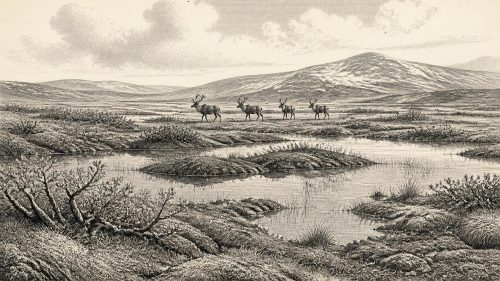
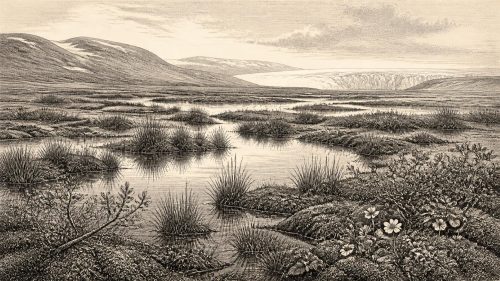
About 31,814 BCE, Ireland lay within the climatically unstable later Marine Isotope Stage 3, although no evidence permits dating events to a single year. Derryvree, County Fermanagh, preserves freshwater silts beneath later tills, indicating a cold, open, treeless tundra with ponds, mosses and sparse vegetation. Southern caves, particularly Castlepook, contain remains of cold-stage mammals, but mixed deposits and revised dates prevent reconstructing one contemporary fauna. A cut-marked reindeer femur may indicate Upper Palaeolithic human processing, yet lacks secure archaeological context and proves neither settlement nor population. Ireland was a shifting, intermittently habitable glacial frontier documented by sediments, bones and ice.

Dateline
31,814 BCE is not a date at which Irish archaeology can identify a particular occurrence. It is a modern calendar label, imposed on a period with no writing, named communities, recorded rulers or usable annual chronology. In radiocarbon practice, ‘before present’ means before AD 1950; the label therefore falls roughly 33,760 calendar years before present (c. 33.8 ka cal BP). That arithmetic conversion must not be mistaken for dating precision. Evidence from this depth of time comes in ranges, often broad ones, and calibrations are revised as methods improve. The responsible subject is Ireland during the later part of Marine Isotope Stage 3 (MIS 3), an unstable phase of the last Ice Age before the Last Glacial Maximum.
Dating a Landscape, Not a Year
The closest important Irish environmental record is at Derryvree, near Maguiresbridge in County Fermanagh. Road-cutting through a drumlin in 1969 exposed organic silts and fine sands sealed between two separate till sheets. The deposit produced a conventional radiocarbon determination of 30,500 +1,170/−1,030 radiocarbon years BP. When calibrated, such an age belongs within a wide span of the later 30,000s to early 30,000s cal BP rather than a single year; it is broadly relevant to the nominal date of 31,814 BCE. The uncertainty is not a failure of scholarship but an honest consequence of the radiocarbon curve, sample limits and the long timescales involved.
Derryvree is valuable precisely because it preserves a natural archive beneath later ice-laid sediment. Pollen, plant macrofossils, mosses and insects indicate a cold, open, largely treeless environment beside freshwater. The original investigators described a periglacial tundra or muskeg landscape: ground affected by severe frost, wet hollows and ponds, sparse dry-land vegetation, and no evidence for mature woodland. Small quantities of tree pollen do not establish a local forest; pollen can travel far, and the wider assemblage points to open country. This was an Irish landscape capable of supporting plants and animals, but it was not the familiar green, wooded island of later millennia.
Ice, Water and Changing Ground
Ireland was not yet at the climatic peak conventionally called the Last Glacial Maximum. The British–Irish Ice Sheet would expand dramatically afterwards, with major growth after about 29 ka and maximum configurations varying between sectors in the following millennia. Yet it would be equally misleading to imagine an entirely ice-free island at 31,814 BCE. The geography of ice was mobile and asynchronous. A freshwater interval at Derryvree proves that the immediate locality was free of overriding glacier when its silts accumulated; it does not map conditions across every Irish region at the same moment.
The sea and adjoining land were changing as well. Lower global sea levels exposed substantial areas now beneath the Atlantic and Irish Sea, but coastlines, ice margins and possible routes shifted through time. Later reconstructions of land connections between Ireland and Britain cannot simply be projected backwards to this particular interval. Nor does exposed shelf automatically mean an easy crossing: routes could have been obstructed by ice, water, rough terrain, river systems or ecological barriers. Ireland should therefore be understood as part of a changing north-west European environmental zone, not as a fixed island with a known land bridge or a known sea crossing.
The Cave Fauna of the South
The complementary record comes from caves in southern Ireland, especially Castlepook Cave near Doneraile in north County Cork. Collections made there in antiquarian and early twentieth-century excavations contain the remains of Ice Age mammals including reindeer, giant deer, brown bear, spotted hyaena, wolf, fox, hare, lemmings and woolly mammoth. These finds establish an important proposition: during parts of MIS 3, Irish habitats supported a changing community of cold-stage animals. Reindeer and small grazing mammals suit the picture of open vegetation; carnivores and scavengers indicate food webs more varied than any simple vision of an empty frozen wilderness.
However, Castlepook is not a photograph of one moment. Caves collect and preserve bones over long periods. Animals may die in or near them, carnivores may carry remains inside, water may move sediment and bone, and old excavations rarely recorded deposits to modern standards. Earlier work already warned that bones had been re-sorted in parts of the cave. More recent radiocarbon re-dating, using improved collagen pretreatment, showed that several older measurements from southern Irish cave fauna were too young. It indicates that some animals, notably giant deer and spotted hyaena, may have disappeared locally before about 40,000 cal BP. Thus it would be unsound to place every Castlepook species together in a herd-and-predator tableau for 31,814 BCE.
The sounder conclusion is more interesting. Ireland had repeated episodes of animal occupation before the great ice expansion, and cave deposits preserve fragments of those episodes. In this setting, the economy was ecological rather than human: grasses, herbs, mosses and sedges fed herbivores; carcasses sustained carnivores and scavengers; caves formed dens, traps, shelters or repositories for bone. The evidence tells us that the island was intermittently habitable for substantial mammals, not that it supported a stable, dense or continuous animal population.
The Castlepook Human Question
The most consequential, and most debated, clue to people at this depth of time is a reindeer femur from the Castlepook collection. Zooarchaeological examination identified a mark interpreted as having been made by a sharp stone tool during carcass processing. The bone has been publicised with a rounded date of about 31,000 BC, placing it broadly in the same pre-Last Glacial Maximum world as the nominal year considered here. If the mark is genuinely anthropogenic and the association is understood correctly, it would show that a person or small party processed a reindeer in Ireland during the Upper Palaeolithic.
That conditional language matters. The bone derives from an old collection, not from a newly excavated, tightly recorded occupation floor. There is as yet no securely associated lithic assemblage, hearth, dwelling, human burial, repeated butchery area or settlement debris. A cut-marked bone can demonstrate a human action more readily than it can demonstrate a resident population. It could represent a brief visit, perhaps involving mobile hunters operating across a larger north-west European range, rather than colonisation. It cannot identify a people’s language, ancestry, political allegiance or relationship to later inhabitants of Ireland.
Nor should absence of evidence be turned into certainty in the opposite direction. Later glaciation eroded landscapes, acidic soils destroy many organic traces, and much former coastal land now lies underwater. Archaeologists are re-investigating Castlepook with modern survey, excavation and dating methods in the hope of finding stratified Pleistocene deposits that can test the interpretation. At present, the femur is best treated as important but provisional evidence of an exceptionally early human encounter with Ireland.
Society Beyond the Evidence
There is no direct basis for describing political affairs, diplomacy, tribal territories, war, formal religion, art, learning, trade networks or permanent settlement in Ireland at this time. No house, hearth, burial ground, tool workshop, ritual site or store of objects can be assigned securely to around 31,814 BCE. Equally, it is wrong to call the landscape ‘uninhabited’ without qualification: that would convert a sparse and damaged record into certainty.
If people did reach Ireland during this interval, comparison with contemporary Upper Palaeolithic groups elsewhere suggests small, highly mobile foraging parties whose survival depended on detailed knowledge of season, animals, raw materials and safe routes. Such a comparison is interpretation, not Irish proof. Reindeer could have offered meat, fat, hide, sinew, bone and antler; caves might have been avoided as carnivore spaces rather than occupied as homes. Nothing presently demonstrates hunting strategy, exchange or spiritual practice within Ireland itself. The most defensible social history is therefore one of possible transient human activity within an animal-rich but climatically demanding frontier.
A Precarious Irish Interval
The enduring importance of this period lies in its fragility. Derryvree records freshwater, mosses and tundra vegetation beneath later glacial deposits. Castlepook records mammals whose dates, identities and contexts are being progressively re-examined. A single modified reindeer bone has opened a serious question about how early people may have entered Ireland, while also showing why a dramatic claim needs equally rigorous testing. Around the modern label 31,814 BCE, Ireland was not yet a historical society waiting to be named. It was a changing cold-stage landscape, briefly legible through silt, pollen, bone and ice.
Primary Sources
- A Middle Midlandian Freshwater Series at Derryvree, Maguiresbridge, County Fermanagh, Northern Ireland
- Palaeoecology
- The subdivision of the Quaternary Period in Ireland
- A reconsideration of the radiocarbon dating of the Marine Isotope Stage 3 fauna from southern Ireland
- The Irish Quaternary Fauna Project
- Phylogeographic, ancient DNA, fossil and morphometric analyses reveal ancient and modern introductions of a large mammal: the complex case of red deer (Cervus elaphus) in Ireland
- First evidence of a Late Upper Palaeolithic human presence in Ireland
- Heritage Artefacts of County Cork
- Archaeology Research Excavation Grant Report
- New insights on the fauna of Ireland's Younger Dryas and Early Holocene from Alice & Gwendoline Cave
- Pattern and timing of retreat of the last British-Irish Ice Sheet
- Growth and retreat of the last British–Irish Ice Sheet, 31,000 to 15,000 years ago: the BRITICE-CHRONO reconstruction
- Extent and deglacial chronology of the last British–Irish Ice Sheet: implications of exposure dating using cosmogenic isotopes
- New data for the Last Glacial Maximum in Great Britain and Ireland
- Growth, dynamics and deglaciation of the last British-Irish ice sheet: the deep-sea ice-rafted detritus record
- The Island of Ireland: Drowning the Myth of an Irish Land-Bridge?
- Ireland: Submerged Prehistoric Sites and Landscapes
- The colonization of Ireland: A human ecology perspective
- The IntCal20 Northern Hemisphere radiocarbon age calibration curve (0-55 kcal BP)
- The IntCal20 Northern Hemisphere radiocarbon age calibration curve (0-55 cal kBP)