Maguirebridge’s Interstadial Waters31849 BCE
Around 31,849 BCE, Ireland lay in the climatically unstable Marine Isotope Stage 3, not a date archaeology can resolve precisely. Freshwater silts at Derryvree, County Fermanagh, dated broadly to 36,900–31,700 cal BP, indicate a locally ice-free interstadial landscape of open vegetation, wetlands and cold conditions. Castlepook Cave, County Cork, preserves remains of reindeer, deer, bear, fox, hare, lemming, wolf, hyaena and mammoth, showing varied Pleistocene fauna. A cut-marked reindeer bone may indicate Upper Palaeolithic butchery, but cannot demonstrate settlement. Subsequent ice-sheet expansion then profoundly transformed Ireland. Evidence supports only cautious reconstruction of transient habitats, animals and possible brief human visits.
Dateline
The numbered year 31,849 BCE cannot be treated as a date that anyone in prehistoric Ireland could have recognised, nor can archaeology distinguish events in one exact calendar year so far back. It is best understood as a modern point within the Late Pleistocene, approximately 33,800 years before 1950 in the conventional ‘BP’ system. Calibration curves, laboratory uncertainty and the nature of surviving deposits mean that the responsible chronology is expressed in broad ranges. Around this notional date, Ireland lay within Marine Isotope Stage 3, a climatically volatile portion of the last Ice Age, before the later maximum expansion of the British–Irish Ice Sheet.
The record is exceptionally thin. There are no known Irish houses, hearths, tool assemblages, graves, named communities or monuments that can securely be assigned to this moment. Consequently, there is no basis for describing kingship, political institutions, diplomacy, organised warfare, formal religion, farming, trade networks or a settled population. What can be described is a changing cold-stage landscape, the animals that occupied parts of it, and one much-debated clue that people may have briefly reached the island.
An Interval, Not a Year
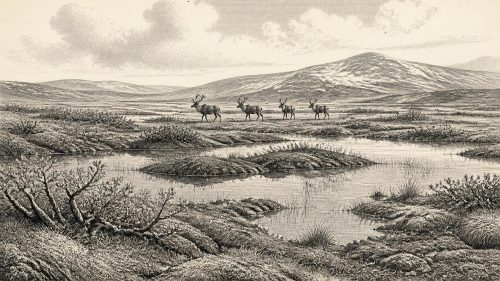
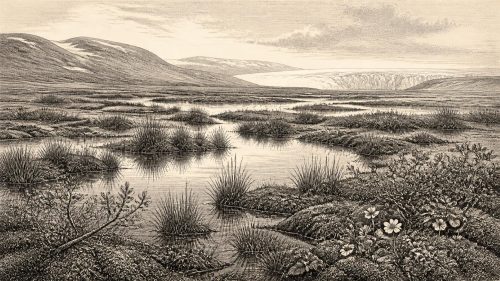
The most useful Irish evidence for the broad environmental setting comes from Derryvree near Maguiresbridge, County Fermanagh. There, organic freshwater silts and sands occur between layers of glacial till. They preserve a rare indication that north-central Ireland experienced an ice-free interval before later ice advances. A published radiocarbon determination associated with the sequence calibrates broadly to about 36,900–31,700 cal BP. The nominal year considered here falls within that wide bracket, but that does not mean the sediments provide a diary entry for 31,849 BCE. They offer a time-window, not a snapshot.
Plant remains, pollen and insect evidence from such interstadial deposits point towards a treeless or very sparsely wooded environment. Sedges, grasses, herbs, mosses and low shrubs were better suited than closed forest to the cold, exposed conditions. Patches of wet ground, shallow water and streamside vegetation could nevertheless have been locally productive. The scene was not an undifferentiated white wilderness: season, shelter, slope, soil and proximity to water would all have mattered. Yet it was far removed from the temperate, wooded Ireland familiar today.
Climate across the North Atlantic changed sharply during Marine Isotope Stage 3. Shorter warmer episodes and colder stadials altered the reach of glaciers, the vigour of rivers, the distribution of vegetation and the routes open to animals. Irish evidence cannot resolve every oscillation at local scale. It does, however, show why a single map of an entirely ice-covered or entirely ice-free island is misleading. Conditions varied over time and from region to region. The glacial history recorded in tills, meltwater deposits, caves and offshore sediments is one of repeated advance, retreat and reorganisation.
Water, Silt and Open Ground
Derryvree’s freshwater deposits are therefore important precisely because they are modest. In a landscape repeatedly eroded and buried by later ice, a protected body of silt can retain traces of organisms and conditions otherwise lost. It indicates freshwater standing or slow-moving water in the locality, with surrounding vegetation capable of supplying organic material. It also demonstrates that later ice did not simply erase every earlier landscape; fragments survived beneath till and can be read with careful stratigraphy, palaeobotany and dating.
At the scale of the island, however, the coastline and travel corridors remain difficult to reconstruct. Global sea level was lower than today during the Ice Age, exposing parts of the continental shelf, but ice margins, glacial lakes, rivers and unstable ground were as consequential as sea level. Whether a practical terrestrial route existed at a particular point depended on far more than a contour line. Researchers continue to debate changing connections among Ireland, Britain and the wider north-west European landmass. No evidence permits a confident account of a journey to Ireland in this specific year.
The later course of events gives the interval added significance. Major reconstructions place rapid growth of the British–Irish Ice Sheet after this phase, with Ireland becoming extensively glaciated by roughly 28,000 years ago and the ice sheet reaching its greatest overall area around 26,000 years ago. Thus the world suggested by Derryvree belongs to an earlier, precarious opening: land and freshwater habitats were available in places, but large-scale glaciation was approaching. The distinction matters. A fauna present in an interstadial was not necessarily able to remain through the ensuing ice-sheet maximum.
The Castlepook Fauna
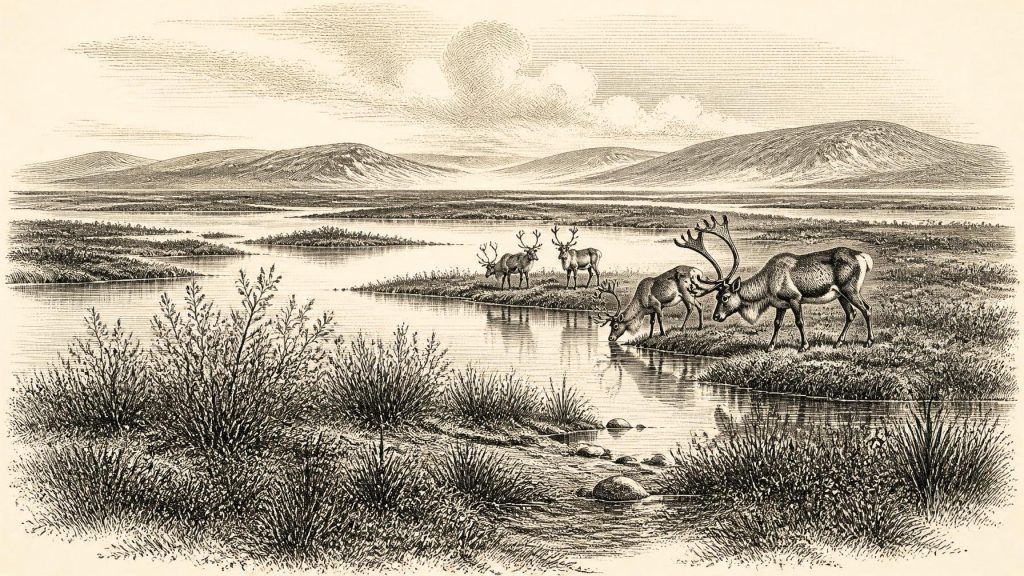
The strongest direct evidence for life in Ireland around this broad period comes from cave collections, above all Castlepook Cave near Doneraile in north County Cork. Excavations conducted in the early twentieth century, and later work in previously explored and newly examined passages, produced a striking assemblage of Pleistocene animal remains. Reindeer, red deer, brown bear, Arctic fox, hare, lemming, wolf and spotted hyaena are among the species reported from the site; woolly mammoth material has also been recovered. Not every species need have lived together at precisely the same time, and antiquarian excavation methods complicate the original contexts. Still, the collection makes clear that parts of Ireland supported, or at least received, a varied cold-stage fauna.
Reindeer are especially evocative but should not be romanticised into proof of vast, predictable herds crossing every valley. Their bones demonstrate presence, not migration routes. Hyaena damage on bone points to carnivores using caves or bringing carcass parts into them. Bears may have used caves as seasonal refuges. Carnivore dens, deaths in shelter, water movement and later disturbance can all accumulate bones without a human camp. A cave assemblage is therefore a record of processes as well as animals: predation, scavenging, sheltering, transport, decay and sediment movement.
For people, Castlepook offers a tantalising but limited possibility. Ruth Carden’s reassessment identified a deep mark on a reindeer femur, recovered from the cave, as consistent with cutting or chopping fresh bone with a sharp stone tool. The bone has been publicised as dating to roughly 33,000 years ago, close in broad terms to the date considered here. If that interpretation is upheld, it would be evidence that a person processed a reindeer in Ireland during the Upper Palaeolithic, far earlier than the formerly accepted archaeological record.
It is not, however, evidence for a permanent settlement, a family group, a village or an enduring Irish population. Nor does it establish the identity, language, ancestry, beliefs or material culture of whoever may have made the mark. No associated lithic toolkit, hearth, built structure or securely stratified occupation floor has yet supplied the wider context that archaeologists would wish for. The cave’s deposits were disturbed by older excavations and natural processes, while several older radiocarbon dates from Irish faunal collections require reassessment under improved methods. The correct formulation is therefore cautious: Castlepook provides a proposed early signal of human activity, not a complete Palaeolithic chapter.
People Beyond the Evidence
If humans did visit the island during this interval, their activity was likely brief, mobile and organised around immediate survival in a cold environment. That is an inference from the likely meaning of a butchered limb bone and from Upper Palaeolithic lifeways elsewhere in north-west Europe, rather than a fact demonstrated by an Irish camp. A party might have exploited a carcass encountered near a cave, hunted locally, or carried portions of an animal to shelter. The single marked bone cannot choose among those possibilities.
Accordingly, everyday life is almost wholly beyond recovery. Clothing, shelters, fire-making, food-sharing, child care, language, social ties and ritual may all have been central to any visitors’ lives, but Ireland has yielded no direct evidence from this date with which to describe them. It would be equally unsafe to project later Mesolithic maritime communities backwards by more than twenty millennia. The securely evidenced human presence at Alice and Gwendoline Cave in County Clare belongs much later, around 10,800–10,500 BCE, after the major ice-sheet episode and within a very different environmental context.
There is likewise no support for discussing an Irish economy or trade in the usual sense. No domesticated animals or crops were present; farming lay far in the future. A possible episode of animal processing would represent subsistence, not an identifiable commercial system. Nor can stone sources, ornaments or imported objects be used to map connections, because none are securely associated with the Castlepook reindeer bone. ‘Ireland’ itself is used here as a geographical convenience for the landmass of the modern island, not as a polity or a cultural community.
What This Date Can Mean
The historical importance of around 31,849 BCE lies in its limits. It directs attention away from retrospective national stories and towards evidence capable of surviving deep time: organic silts between tills, pollen and beetles, animal bones from caves, cut marks examined under magnification, and radiocarbon dates interpreted through calibration. Together they suggest that, during part of late Marine Isotope Stage 3, Ireland contained ice-free habitats occupied by cold-adapted animals and was not necessarily beyond human reach.
But the conclusion remains conditional. Derryvree documents an interstadial landscape within a broad date range. Castlepook documents Pleistocene fauna and preserves a potentially transformative indication of human butchery. Neither source authorises a year-by-year narrative in the ordinary sense. The great development was environmental: an exposed, unstable, biologically active island landscape existed before expanding ice again reshaped it. Continued excavation, secure stratigraphic recording, direct dating, ancient DNA and microscopic taphonomic analysis may refine that picture. For now, uncertainty is not a failure of the story; it is one of the most important facts about Ireland at this depth of time.
Primary Sources
- A Middle Midlandian Freshwater Series at Derryvree, Maguiresbridge, County Fermanagh, Northern Ireland
- Figure 6.— The Subdivision of the Quaternary Period in Ireland
- Trimlines, Blockfields and the Vertical Extent of the Last Ice Sheet in Southern Ireland
- The Timing and Magnitude of the British–Irish Ice Sheet Between Marine Isotope Stages 5d and 2: Implications for Glacio-Isostatic Adjustment, High Relative Sea Levels and ‘Giant Erratic’ Emplacement
- Growth and Retreat of the Last British–Irish Ice Sheet, 31,000 to 15,000 Years Ago: the BRITICE-CHRONO Reconstruction
- Deglaciation Chronology of the Donegal Ice Centre, North-West Ireland
- A Stratigraphic Investigation of the Celtic Sea Megaridges Based on Seismic and Core Data from the Irish-UK Sectors
- The Deglaciation of the Western Sector of the Irish Ice Sheet From the Inner Continental Shelf to its Terrestrial Margin
- The Island of Ireland: Drowning the Myth of an Irish Land-Bridge?
- The Problem of a Late Quaternary Landbridge Between Britain and Ireland
- Deglaciation, Earth Crustal Behaviour and Sea-Level Changes in the Determination of Insularity: A Perspective From Ireland
- The Irish Quaternary Fauna Project
- Evolutionary History and Phylogeography of Red Deer (Cervus elaphus) in Europe
- New Insights on the Fauna of Ireland's Younger Dryas and Early Holocene From Alice & Gwendoline Cave
- Revisiting Alice and Gwendoline Cave, Co. Clare
- The Mesolithic in Ireland: When Was It?
- Heritage Artefacts of County Cork
- Archaeology Research Excavation Grant 2022
- 2022:564 – Castlepook Cave, Castlepook South, Cork
- Ireland's Palaeolithic Archaeology – Fleeting Footprints in a Frozen Land
- A North-Western Habitat: the Paleoethology and Colonisation of a European Peninsula
- The Last Eurasian Ice Sheets – a Chronological Database and Time-Slice Reconstruction, DATED-1