Doneraile’s Cave Archive31850 BCE
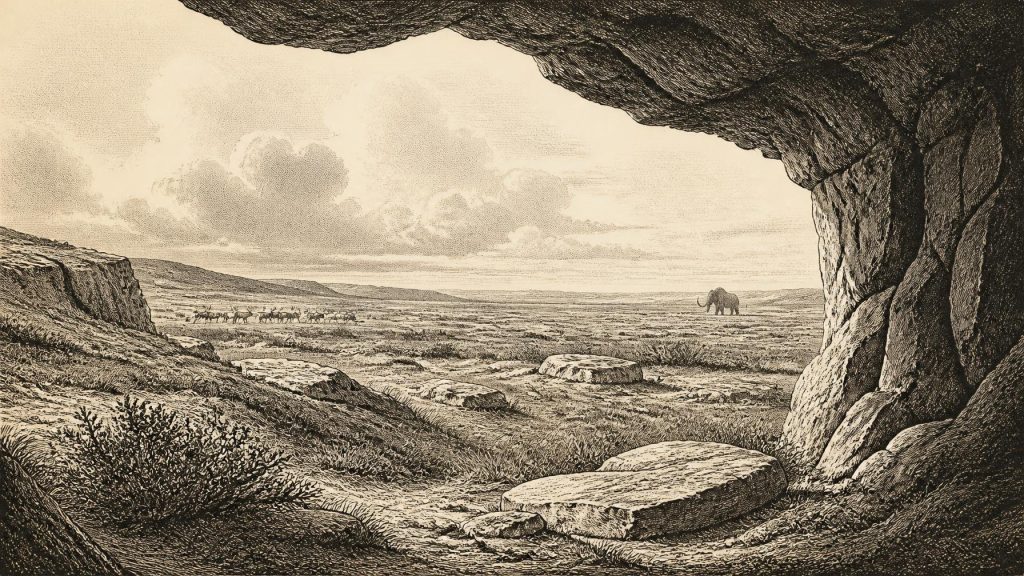
31,850 BCE is a modern label, not a recoverable Irish historical year, within the unstable later Ice Age. Ireland’s shifting climate, ice margins and lowered seas created changing connections with Britain and continental Europe, though routes remain uncertain. Castlepook Cave near Doneraile preserves Ireland’s richest pre-Last Glacial Maximum fauna, including mammoth, reindeer, giant deer, hyaena, wolves and lemmings, indicating recurring cold open habitats. Cave deposits and revised dating caution against treating these animals as contemporaries. A possibly tool-marked reindeer bone suggests, but cannot prove, temporary human activity. No settlement, tools or surface confirms habitation. Research may refine this environmental archive.
Dateline
31,850 BCE is not a year that can be recovered from Ireland’s prehistoric record in the way that a medieval annalistic date can. It is best treated as a modern calendar label for a very remote point, roughly 33,800 calibrated years before 1950. Archaeologists cannot assign an event, a named person or even a human visit to that single year. The responsible setting is the later part of Marine Isotope Stage 3, a fluctuating interval within the last Ice Age. Dates from this period are normally expressed as radiocarbon determinations and calibrated ranges, each with margins of uncertainty. What survives for Ireland is therefore an uneven archive of animal bone, cave sediment, glacial landforms and climate records rather than a narrative of yearly affairs.
A Date Within a Long Cold Age
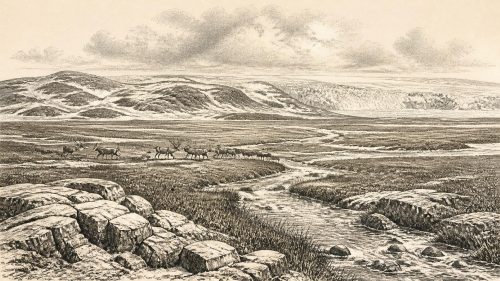
The wider North Atlantic climate was unstable. Greenland ice-core records show repeated swings between colder stadials and comparatively milder interstadials, sometimes over periods much shorter than conventional archaeological eras. Around the notional date used here, conditions in and around Ireland were cold, but “Ice Age” should not suggest a single unchanging white wilderness. Temperature, snowfall, sea level, vegetation and the reach of glaciers varied substantially through time and from one region to another. The landscape that future ice would scour was already being shaped by frost, wind, meltwater and changing ice margins.
This was well before the Last Glacial Maximum, generally placed in the British–Irish region between about 26,000 and 23,000 years ago. Reconstructions of the British–Irish Ice Sheet indicate that major growth occurred after about 31,000 years before present, but evidence for the preceding stages remains patchy and is debated. One recent interpretation argues for significant earlier glaciation; others stress that direct evidence for an extensive Irish ice sheet at particular pre-maximum moments is limited. Consequently, it would be misleading to declare all Ireland either ice-covered or ice-free in 31,850 BCE. The safest conclusion is that Ireland belonged to a dynamic northern environment in which expanding ice, exposed ground and ice-free refuges may all have mattered at different times.
The Changing Shape of Ireland
Global sea level was far lower than it is today because large quantities of water were held in continental ice sheets. Areas now beneath the Irish Sea and Celtic Sea were therefore not simply open sea. Yet the practical geography of movement cannot be reduced to a neat land bridge on a map. Local relative sea level was affected by the weight of nearby ice, while coastlines, estuaries, glaciers and periglacial terrain were continually changing. Ireland’s later separation from Britain, by about 16,000 calibrated years before present, is comparatively well modelled; its connections in the much earlier period remain harder to reconstruct in detail.
For animals, and perhaps for people, the important point is that Ireland was not necessarily as isolated as the modern island. Faunal connections with Britain and continental north-west Europe must have existed during parts of the Late Pleistocene. That does not prove a particular route, season or migration at this date. It does, however, explain why the Irish evidence is considered alongside the wider ice-age worlds of western Britain, the exposed continental shelf and Atlantic Europe.
What Castlepook Preserves
The strongest Irish evidence for this broad period comes from Castlepook Cave, near Doneraile in north County Cork. Excavations conducted mainly between 1904 and 1913, supplemented by later work, recovered a striking concentration of animal remains from limestone passages, sands and deposits separated in places by stalagmite floors. The collection, now principally associated with the National Museum of Ireland, has made Castlepook the richest known Irish archive for pre-Last Glacial Maximum vertebrate fauna.
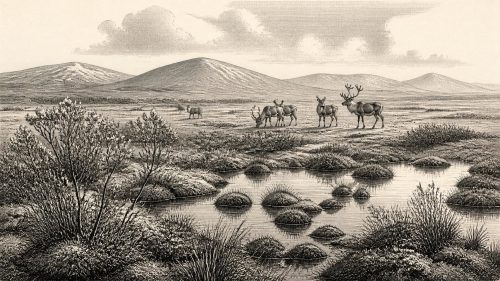
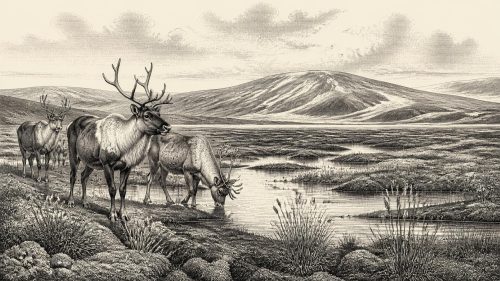
Its recorded fauna includes woolly mammoth, reindeer, giant deer (Megaloceros giganteus), brown bear, wolf, Arctic fox, mountain hare, collared lemming, Norway lemming and spotted hyaena. Other southern Irish caves add important but smaller pieces to the picture, including evidence for horse and further cold-stage animals. Together these finds show that Ireland supported, at intervals during the later Pleistocene, an ecological assemblage far removed from the familiar modern fauna. Mammoth and lemmings point towards open, cold environments; reindeer and giant deer indicate large herbivores with extensive seasonal needs; wolves and hyaenas represent predators and scavengers able to exploit such prey.
That list must not be converted into a census for 31,850 BCE. Cave assemblages accumulate over long periods. Carnivores may drag bones inside; water, roof-fall and sediment movement can rearrange them; nineteenth- and early twentieth-century excavation methods rarely recorded contexts to modern standards. Improved radiocarbon pretreatment has also transformed the chronology. Redating of Castlepook, Foley and Shandon material showed that several earlier determinations were too young, sometimes by thousands of radiocarbon years. The resulting work securely places important southern Irish fauna in Marine Isotope Stage 3, while also demonstrating how cautious any fine-grained reconstruction must be.
Hyaenas and an Open-Country Food Web
Spotted hyaena is among Castlepook’s most evocative inhabitants. Modern associations with African savannah can obscure its Pleistocene range: hyaenas occupied parts of temperate and cold Europe and could thrive in open landscapes where substantial carcasses were available. Their presence in County Cork is evidence for a food web capable of supporting large herbivores and powerful bone-processing carnivores. Gnawing and damage on some bones can illuminate scavenging, but it can also complicate attempts to identify human modification.
Recent reassessment suggests that giant deer and spotted hyaena may have been locally lost from Ireland before about 40,000 calibrated years before present. If that interpretation is correct, the Doneraile hyaenas are especially important for understanding the earlier part of the cave sequence, but they should not be placed automatically in the landscape of 31,850 BCE. Woolly mammoth, giant deer, reindeer and predators may have overlapped at some points, yet the present evidence cannot establish a single simultaneous “mammoth-steppe” scene for one calendar year. The most defensible image is of recurring open-country habitats and changing animal communities across many millennia.
The Human Question
Political affairs, diplomacy, kingdoms and organised warfare leave no identifiable trace in Ireland at this horizon. Nor is there evidence for farming, permanent villages, monuments, writing, formal religion or trade networks within the island. If people entered Ireland, they would have been mobile Upper Palaeolithic hunter-gatherers operating at very small scale, not members of a known Irish population or polity. Such a possibility must be distinguished from demonstrated occupation.
A reindeer femur from Castlepook has attracted attention because an incision on it has been interpreted as consistent with cutting by a sharp stone tool, and the bone has been presented as potentially very early evidence for human activity in Ireland. It is a significant research lead, not a licence to write a settled story of a camp at Doneraile. No securely associated stone-tool assemblage, hearth, built shelter, human burial or undisturbed occupation surface of this age has yet established a sustained human presence there. Cave deposits are precisely the kind of contexts in which the histories of an animal carcass, a mark on bone and a later excavation can be difficult to disentangle.
The distinction matters because a stone-tool cut, if confirmed, would show an encounter with a carcass rather than the full character of a society. It might indicate butchery, scavenging or temporary provisioning by a small visiting group. It would not tell us their language, kinship rules, beliefs, seasonal round or whether they returned. Comparison with contemporary Upper Palaeolithic groups in Britain and continental Europe can suggest that people possessed sophisticated stone technologies, social knowledge and extensive mobility, but it cannot fill the Irish silence with assumed camps, leaders or rituals.
Everyday Life Inferred, Not Seen
The animal evidence nevertheless gives a limited view of the practical opportunities and dangers that any human visitors would have encountered. Reindeer, hare and perhaps migratory large herbivores offered food, hides, sinew, antler and bone; mammoth carcasses, whether hunted elsewhere or scavenged, would have been exceptional resources. Predators, severe weather and the difficulty of travel imposed equally real constraints. A cave may have offered brief shelter, but it was also part of a carnivore landscape and cannot be presumed to have been a human home.
Economy and exchange are therefore subjects of potential rather than proof. A hunter-gatherer party could have carried stone, worked hides and shared food; none of these activities is presently demonstrated in Ireland at this date. Likewise, culture and learning undoubtedly existed among human communities elsewhere in Europe, but no Irish art, ornament, musical object or symbolic deposit belongs securely to this horizon. The responsible history is not empty: it is an account of what the physical archive can illuminate, and of the limits it places on imagination.
An Archive Still Being Tested
Modern excavation and re-examination at Castlepook are valuable precisely because they test old collections rather than merely repeating them. New dating, zooarchaeology, sediment study and careful recording can refine the history of each bone and layer. They may confirm, qualify or overturn earlier readings. The wider lesson for 31,850 BCE is that Ireland’s deep past is neither a blank page nor a finished chronology. It is a difficult record from a landscape repeatedly altered by ice, water and time.
For this notional year, the most important development was environmental rather than political: Ireland lay within a changing Late Pleistocene world whose fauna demonstrates periodic links to wider north-west Europe, while glaciation was moving towards its later maximum. Doneraile’s cave archive preserves traces of that world, especially its vanished animals. It also preserves a salutary uncertainty. Human presence around this point remains a carefully framed possibility, not an annually datable fact.
Primary Sources
- The Irish Quaternary Fauna Project
- A Reconsideration of the Radiocarbon Dating of the Marine Isotope Stage 3 Fauna from Southern Ireland
- Castlepook Cave, County Cork: Geological Site Report
- Irish Quaternary Vertebrates
- Advances in Irish Quaternary Studies
- Investigating Seasonal Mobility in Irish Giant Deer Megaloceros giganteus Through Strontium Isotope Analysis
- New Insights on the Fauna of Ireland's Younger Dryas and Early Holocene from Alice & Gwendoline Cave
- First Evidence of a Late Upper Palaeolithic Human Presence in Ireland
- 2022:564 – Castlepook Cave, Castlepook South, Cork
- Archaeology Research Excavation Grant 2022: Final Report
- Growth and Retreat of the Last British–Irish Ice Sheet, 31,000 to 15,000 Years Ago: the BRITICE-CHRONO Reconstruction
- Timing, Pace and Controls on Ice Sheet Retreat: an Introduction to the BRITICE-CHRONO Transect Reconstructions of the British-Irish Ice Sheet
- The Timing and Magnitude of the British–Irish Ice Sheet Between Marine Isotope Stages 5d and 2
- Stratigraphic and Palaeo-Geomorphological Evidence for the Glacial-Deglacial History of the Last British-Irish Ice Sheet in the North-Western Irish Sea
- Pattern and Timing of Retreat of the Last British-Irish Ice Sheet
- Dimensions and Chronology of the Last Ice Sheet in Western Ireland
- Ireland: Submerged Prehistoric Sites and Landscapes
- Relative Sea-Level Change Around the Irish Coast
- The IntCal20 Northern Hemisphere Radiocarbon Age Calibration Curve (0–55 cal kBP)
- IntCal Publications
- Radiocarbon Dating and Chronological Modelling
- The Colonization of Ireland: A Human Ecology Perspective
- Archaeological Heritage of County Cork