MacArthur, Gregory and Stormont1982 CE
In 1982, Ireland endured two general elections, the collapse of governments and changes between Charles Haughey and Garret FitzGerald amid recession, unemployment, borrowing and tax protests. Haughey’s precarious minority relied on Tony Gregory’s inner-city development agreement before losing confidence; the MacArthur affair and telephone-tapping allegations further damaged public trust. Northern Ireland elected a Stormont Assembly, but nationalist boycotts limited its legitimacy as violence continued, including fatal bombings in London and Ballykelly. Social change included abolition of school corporal punishment and Dublin’s first crematorium. Constitutional debate on abortion intensified, while cultural, neutrality and Falklands issues underscored unresolved political divisions across Ireland.
Dateline
Ireland’s public year was unusually compressed and unsettled. Two general elections, two changes of taoiseach and the collapse of a minority administration made 1982 feel like a prolonged argument over who could govern a state entering deep economic difficulty. Yet politics was not the whole story. Decisions affecting school discipline, burial practice, constitutional morality and public culture registered quieter but consequential changes in everyday Irish life. Across the Border, a new Stormont Assembly was elected amid continuing violence, demonstrating both the persistence of political participation and the severe limits of the institutions then on offer.
Government by Narrow Margins
The year began with the end of Garret FitzGerald’s Fine Gael–Labour coalition. On 27 January, the Government lost its Budget vote by 82 votes to 81. The immediate controversy concerned a proposed extension of VAT to children’s shoes, but the defeat exposed a more fundamental problem: the coalition did not command a secure majority in the Dáil. President Patrick Hillery dissolved the Twenty-second Dáil that day, and the electorate returned to the polls on 18 February.
That election brought no decisive settlement. Fianna Fáil emerged as the largest party with 81 seats in a 166-seat Dáil, short of an overall majority. On 9 March Charles Haughey was elected taoiseach. His minority Fianna Fáil Government depended on support from outside the party, notably the independent TDs Tony Gregory and Neil Blaney and the three TDs of Sinn Féin the Workers’ Party, soon renamed the Workers’ Party. Haughey’s election as taoiseach was therefore a parliamentary achievement, not a popular mandate for stable government.
Tony Gregory’s support gave the new arrangement a striking social dimension. A newly elected independent from Dublin Central, he negotiated what became known as the Gregory deal: commitments directed towards housing, employment and public amenities in the north inner city. Its importance was larger than one constituency. In a Dáil where a small number of votes could decide who governed, an inner-city representative could turn long-standing complaints about dereliction, overcrowding and unemployment into national bargaining power. The episode revealed both the reach of local democratic pressure and the fragility of a Government built on individual agreements.
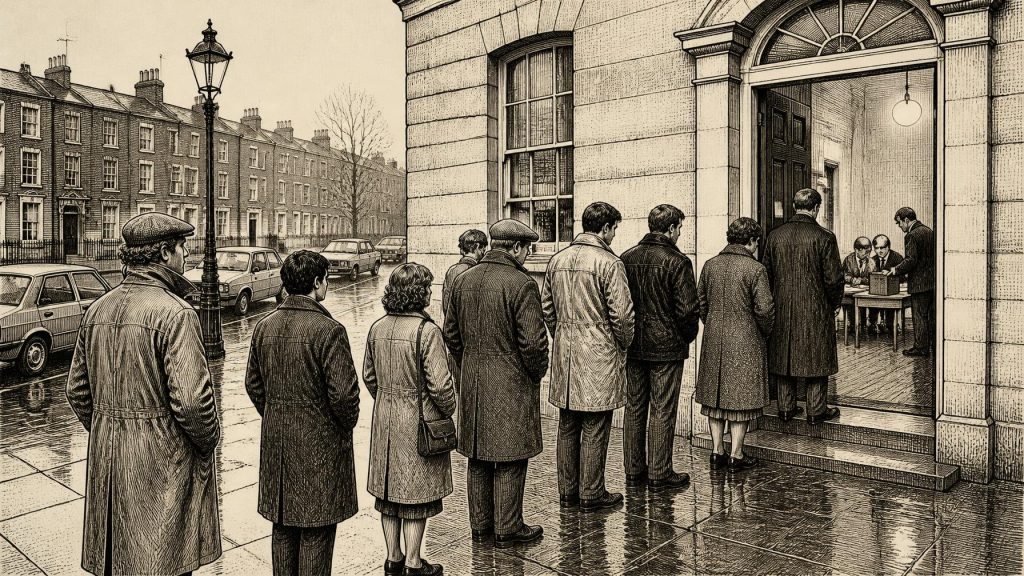
The political year also changed the presentation of elections. On 16 February, two days before the first poll, RTÉ broadcast the first live Irish television debate between rival candidates for taoiseach, FitzGerald and Haughey. The encounter made television a more direct arena of political leadership. Election coverage in November likewise relied increasingly on computer-assisted collection and analysis of results, although the counting itself remained the familiar local, manual and highly public process of proportional representation by the single transferable vote.
An Economy Without Easy Choices
The instability at Leinster House was inseparable from the economic climate. Ireland was suffering the effects of international recession and the second oil-price shock, but domestic imbalances were acute too. Demand had weakened, unemployment had risen sharply, inflation had been severe and the public finances were burdened by borrowing and mounting interest payments. An OECD assessment made during 1982 judged that unemployment would continue to rise and that substantial official borrowing abroad would add to public debt. These were not abstract indicators: they shaped household spending, wage claims, emigration decisions and the insecurity felt by workers, job-seekers and small businesses.
Governments of different political complexions agreed that the scale of the fiscal problem could not simply be ignored, but they disagreed over taxation, expenditure cuts and the distribution of sacrifice. Income tax and Pay Related Social Insurance changes prompted large protests during the year. The central political difficulty was plain: measures intended to restore confidence in the public finances could reduce disposable income and demand in an already weak economy. Conversely, promises of relief or local investment were hard to reconcile with the need to borrow less. The contention was not merely between parties; it ran through workplaces, families and communities concerned about jobs and public services.
The November election was called after the Haughey Government lost a confidence motion on 4 November, by 82 votes to 80. The vote demonstrated how completely the minority arrangement had unravelled. In the election of 24 November, Fianna Fáil remained the largest party, with 75 seats, but Fine Gael won 70 and Labour 16. Together, Fine Gael and Labour had the numbers for office. On 14 December FitzGerald became taoiseach again, heading a new coalition Government. Ireland had thus experienced two elections and three periods under different governments within a single calendar year.
Scandal and Public Confidence
The Haughey administration’s reputation was badly damaged in August by the Malcolm MacArthur affair. MacArthur, wanted in connection with two murders, was arrested while staying at the Dublin home of Patrick Connolly, the Attorney General. Connolly had no involvement in the crimes, but his resignation was unavoidable because the State’s chief legal adviser had inadvertently accommodated the suspect during a major Garda search. Haughey described the episode as grotesque, unbelievable, bizarre and unprecedented: a formulation soon condensed into the memorable acronym “GUBU”.
The phrase endured because it caught a wider public mood. The affair did not cause the Government’s fall by itself, and it should not obscure the economic and parliamentary reasons for that fall. Nevertheless, it added a powerful image of confusion at the centre of the State. Reports during 1982 that journalists’ telephones had been tapped under ministerial warrants compounded questions about governmental judgement and accountability, even though the full political consequences of that issue emerged later. In a year already dominated by close votes and contested economic remedies, confidence in institutions became a matter of public argument.
Stormont and Continuing Conflict
Northern Ireland remained central to Irish politics, family life and public anxiety. In April the British Government published Northern Ireland: A Framework for Devolution, proposing an elected 78-member Assembly at Stormont. Its scheme of “rolling devolution” envisaged powers being transferred gradually from Westminster only where sufficient agreement could be achieved. Until then, the Assembly would scrutinise Northern Ireland departments and advise the Secretary of State. It was an attempt to move beyond direct rule without immediately recreating a full devolved government.
The election on 20 October produced a mixed and difficult result. Turnout was 63.5 per cent. The Ulster Unionist Party won 26 seats and the Democratic Unionist Party 21; the Alliance Party won 10. The SDLP, although it secured 14 seats, maintained a boycott of the institution, judging the arrangement inadequate. Sinn Féin contested an election of this kind for the first time during the Troubles and won five seats, with 10.1 per cent of first-preference votes, but also did not take them. When the Assembly first sat on 11 November, its absence of nationalist participation gravely weakened its claim to offer an agreed political route forward.
Electoral politics unfolded alongside lethal violence. On 20 July, Provisional IRA bombs in Hyde Park and Regent’s Park in London killed eleven members of the armed forces and seven horses. On 6 December, a bomb at the Droppin Well bar in Ballykelly, County Londonderry, killed seventeen people. The attacks underlined a hard reality often lost in constitutional plans: the conflict crossed borders and communities, and its victims included local civilians as well as security-force personnel. For people in both parts of Ireland, news of elections, security measures and diplomatic initiatives was inseparable from the expectation of further loss.
Institutions, Belief and Cultural Life
Some of 1982’s most lasting changes came through administrative decisions rather than dramatic legislation. From 1 February, corporal punishment was forbidden in national and post-primary schools. The relevant primary-school rule instructed teachers to govern pupils through “affections and reason”, not harshness or severity, and prohibited ridicule as well as physical punishment. The change did not settle every later question about children’s rights or institutional discipline, but it was a clear break with the accepted school practices experienced by many previous generations.
On 12 March, the Republic’s first crematorium opened at Glasnevin Cemetery in Dublin. Cremation was presented in practical terms: it cost less than a traditional burial and avoided some difficulties associated with grave burial in poor weather. Its arrival also offered families an option that had previously been unavailable within the State. That development should not be overstated as a sudden religious revolution, but it is evidence of a society beginning to accommodate a wider range of personal choices around death and commemoration.
Questions of morality and constitutional identity were increasingly explicit in electoral politics. Haughey confirmed in March that his Government intended to bring forward a referendum measure concerning constitutional protection for the unborn. During the November campaign, Haughey and FitzGerald both committed themselves to wording promoted by the Pro-Life Amendment Campaign, while Labour leader Dick Spring did not. No abortion referendum took place in 1982; the decisive vote belonged to the following year. But the year’s drafting, legal anxieties and campaign commitments made clear that an issue often framed in religious language was becoming a major constitutional and party-political question.
Cultural life meanwhile continued to make Derry an important place of imaginative debate. On 21 September Field Day Theatre Company premiered Brian Friel’s The Communication Cord at the Guildhall. Set in a Donegal cottage and preoccupied with language, misunderstanding and performance, the comedy did not offer a political programme. Its Derry premiere nonetheless belonged to a wider cultural effort to create serious theatre in a divided city and to address the histories and languages of Ireland without reducing them to slogans.
Neutrality and an Unfinished Year
Ireland’s foreign policy was tested by the Falklands War. As a member of the United Nations Security Council, Ireland participated in efforts to address the crisis, including the Council’s calls for a diplomatic solution. At home, the Haughey Government invoked neutrality while seeking a ceasefire and questioning continued European Economic Community sanctions against Argentina. The dispute sharpened differences with Britain at a moment when Anglo-Irish relations were already strained by Northern Ireland. It also showed that neutrality was not a passive condition: it required choices that could be criticised from opposing directions.
By December, FitzGerald’s return to office brought a measure of institutional resolution, but not an end to the pressures revealed during the year. Debt, unemployment and emigration remained serious; the Stormont experiment lacked the consent it needed; and constitutional disputes were gathering force. What made 1982 distinctive was the way national politics, economic hardship, public scandal and the Northern conflict repeatedly met in the same public space. Ireland changed governments twice, but the larger questions confronting the country remained emphatically unresolved.
Primary Sources
- Dáil and Seanad terms – Houses of the Oireachtas
- Formal Dáil Dissolution 1982 – RTÉ Archives
- FitzGerald Versus Haughey 1982 – RTÉ Archives
- Confidence in Government: Motion, 4 November 1982 – Dáil Éireann
- Ireland: Dates of Elections, 24 November 1982 – Inter-Parliamentary Union
- Haughey, Charles James (C. J.) – Dictionary of Irish Biography
- Gregory, Tony – Dictionary of Irish Biography
- Newly Elected Tony Gregory 1982 – RTÉ Archives
- Haughey No Knowledge Of Phone Bugging 1983 – RTÉ Archives
- Ireland’s abortion debates through the years – RTÉ News
- Abolition of Corporal Punishment in Post-Primary Schools – Department of Education
- Abolition of Corporal Punishment in Primary Schools – Department of Education Circular 9/82
- First Crematorium In Republic Of Ireland 1982 – RTÉ Archives
- OECD Economic Surveys: Ireland 1982
- Population and Economics in Ireland in the Recent Past and in the Near Future (Revised Version, November 1982) – ESRI
- Northern Ireland: A Framework for Devolution, 1982 – CAIN
- Assembly Election (Northern Ireland), 20 October 1982 – CAIN
- The Northern Ireland Assembly, November 1982 to June 1986: A Chronology of Main Events – CAIN
- Sutton Index of Deaths: 1982 – CAIN
- The Communication Cord – PlayographyIreland
- The Falklands Crisis: Statement by Taoiseach, 11 May 1982 – Dáil Éireann
- Resolution 502 (1982) – United Nations Digital Library
- Computerisation of Election Results 1982 – RTÉ Archives
- Twenty-Fourth Dáil – Department of the Taoiseach