The Derryvree Cold Phase31808 BCE
31,808 BCE is a modern label rather than a recoverable Irish year, representing a broad Middle Midlandian interval within Marine Isotope Stage 3. Ireland’s conditions varied as the British–Irish Ice Sheet grew, producing severe, open periglacial landscapes rather than uniform ice cover. Derryvree and other Fermanagh deposits indicate wet treeless tundra, with sedges, grasses, shrubs, insects and freshwater habitats. Castlepook Cave preserves mammoth, reindeer, giant deer, predators and smaller cold-adapted animals, demonstrating intermittent ecological connections with Britain and Eurasia amid lower sea levels. A possibly cut-marked reindeer bone suggests, but does not prove, Upper Palaeolithic human presence without settlement evidence.

Dateline
Chronology Without a Year
31,808 BCE is a modern calendrical label, not a year that can be recovered from Ireland’s Ice-Age record. No document, annual layer sequence or securely dated human occupation allows events to be assigned to that particular year. In archaeological terms it falls approximately 33,750 calendar years before present (cal BP, with “present” conventionally fixed at 1950), within Marine Isotope Stage 3 and the later part of Ireland’s Midlandian glacial history. Even that conversion must not be mistaken for precision: radiocarbon measurements have uncertainties, their calibration produces ranges rather than single dates, and cave deposits or buried sediments may represent long spans of time. The responsible subject, then, is not “Ireland in a year” but Ireland in a broad cold-phase landscape approaching the Last Glacial Maximum.
The evidence is sparse, uneven and unusually difficult to interpret. Most survives as animal bone in caves, pollen and plant remains in sediments, insects, mosses and landforms left by ice. These sources tell us much more reliably about climate, environments and animal presence than about people. They cannot identify a population, language, political community, religion or named place. Ireland at this depth of time was not an island of known tribes or settlements; it was a north-western European landscape repeatedly altered by cold, ice, water and changing sea levels.
A Cold Landscape in Transition
The relevant period preceded the full peak of the last British–Irish Ice Sheet. Older syntheses placed its principal build-up after roughly 35,000–32,000 years ago and its maximum broadly between 27,000 and 21,000 years ago. More recent BRITICE-CHRONO work reinforces the larger point while stressing regional variation: ice growth, maximum extent and retreat did not occur simultaneously across Ireland, Britain and their continental shelves. Around the notional date represented by 31,808 BCE, the island should therefore not be pictured either as wholly ice-free or as uniformly entombed beneath a single fixed ice cap. Ice margins and local conditions were dynamic, and the available chronology cannot map their position for one calendar year.
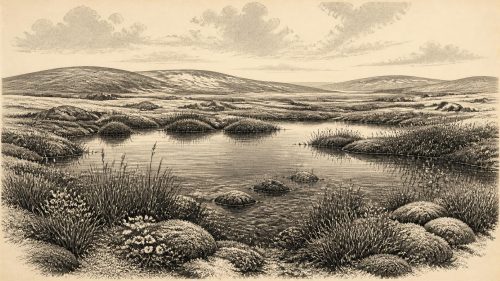
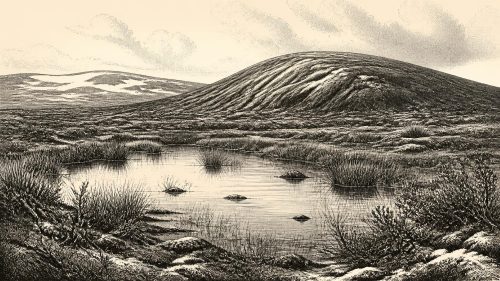
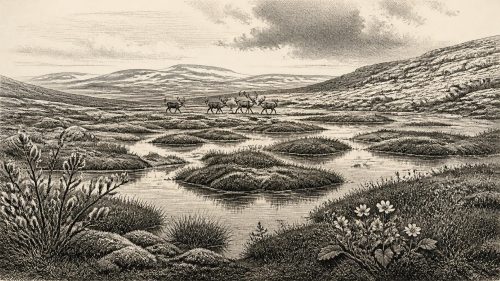
What the Irish deposits do support is an image of severe, open country. At Derryvree near Maguiresbridge in County Fermanagh, organic silts and fine sands were found between two tills: direct evidence that freshwater and vegetation existed during an interval separating glacial advances. A radiocarbon determination of 30,500 +1,170/−1,030 BP dates this deposit to a broad part of the Middle Midlandian cold phase rather than to the numbered year in this article. Its pollen, plant macrofossils, mosses and insect evidence point to treeless tundra or muskeg: wet, mossy ground with pools, sedges, grasses, herbs and scattered low shrubs, under a periglacial climate. It is a valuable regional analogue, not a photograph of all Ireland at once.
Other Fermanagh localities reinforce the impression of a cold but biologically active terrain. Deposits at Hollymount, Aghnadarragh and Greenagho contain evidence for open ground flora and cold-adapted insects. Their dates and stratigraphic contexts differ, so they must not be compressed into one simultaneous national ecosystem. Nevertheless, grasses and sedges, dwarf birch or willow, heaths, juniper and Arctic-alpine plants fit an environment in which woodland was absent or exceedingly limited. Summer growth could sustain herbivores in favourable places, while winters were long and harsh. Wet hollows, shallow lakes, river margins and exposed mineral soils created a patchwork of habitats rather than a featureless snowfield.
Animals at the Atlantic Edge
Castlepook Cave, also called Mammoth Cave, near Doneraile in north County Cork is the principal Irish archive for the larger animals of this broad period. Its early twentieth-century excavations recovered more than 2,000 bones from a complex limestone cave system. Identified remains include woolly mammoth, reindeer, giant deer, brown bear, wolf, foxes including Arctic fox, mountain hare, lemmings and spotted hyaena. The range itself is important: it demonstrates that Ireland could be part of a wider late Pleistocene faunal world, rather than an empty outpost beyond Europe. But it does not demonstrate that every listed species lived together, at Castlepook, in 31,808 BCE. Different bones have different dates, deposits were disturbed, and carnivores as well as water and collapse could move material within caves.
The Castlepook fauna also warns against easy climatic stereotypes. Reindeer, lemmings and Arctic fox indicate cold conditions, yet spotted hyaena and mammoth reveal a richer food web than the word “tundra” may suggest. Hyaenas could transport carcass parts into dens, while wolves and other scavengers likewise altered the bone record. Mammoths and giant deer were not guaranteed neighbours on a single day; nor can their presence be used to calculate herd sizes. The most defensible conclusion is that, during episodes within MIS 3, parts of southern Ireland offered routes and resources sufficient for large grazing animals and formidable predators. The ecological community was mobile and repeatedly reshaped by climatic deterioration and advancing ice.
Connections to Britain and continental Europe mattered greatly. Lower global sea levels altered the outlines of the Irish and Celtic seas, exposing areas now submerged and changing the distances, channels and possible corridors between landmasses. Faunal movement into Ireland is therefore plausible and is supported by the wider distribution of cold-stage mammals. Yet “plausible” is not the same as a proven continuous land bridge at every moment. The exact configuration of coast, sea ice, rivers, shallow water and dry ground varied over millennia. Recent sedimentary ancient-DNA work from Castlepook, currently published as a preprint, supports the broader inference that Irish megafauna were connected genetically with Eurasian populations before the Last Glacial Maximum; it does not supply a route map for one date.
The Human Question at Castlepook
The most consequential possible evidence for people is a reindeer femur from Castlepook. The County Cork heritage catalogue places it at about 31,000 BCE and presents a deep mark on the bone as consistent with cutting by a sharp stone implement. Zooarchaeologist Ruth Carden’s interpretation has raised the prospect that Upper Palaeolithic hunter-gatherers may have processed a reindeer in Ireland far earlier than the previously secure record of human activity. If that interpretation is confirmed, it would show an episode of human presence or visitation in the broad era represented by this article, perhaps connected with the pursuit or scavenging of large game.
It must, however, be stated with equal force what the find does not establish. The specimen came from an old collection, not from a modern excavation of an intact living floor. No securely associated stone-tool assemblage, hearth, shelter, burial, repeated occupation layer or human remains has been published from Castlepook for this period. A radiocarbon date fixes the age of the animal’s death within a range; it does not by itself date the making of a surface mark, the place of butchery, or the duration of any human visit. Nor should a single modified bone be turned into a settled “first Irish” population. Renewed fieldwork at Castlepook is designed precisely to seek undisturbed deposits and test such questions with modern methods.
Life Beyond Historical Categories
Accordingly, political affairs, diplomacy, formal warfare and institutions cannot be described for Ireland in 31,808 BCE: there is no evidence for them. There is likewise no basis for claiming agriculture, livestock keeping, permanent villages, trade ports, monuments, priests, artistic traditions or systems of formal learning. These absences are not proof that no people ever crossed the landscape. They reflect the difference between a possible brief Palaeolithic encounter with a carcass and the dense archaeological evidence required to reconstruct a society.
If people did reach Ireland during this wider interval, their most likely economy would have been mobile foraging and hunting, drawing on seasonally available animals and plant resources. Reindeer could have yielded meat, marrow, fat, hide, sinew and bone, but the Castlepook femur cannot tell us whether its animal was hunted, found dead, butchered in the open or carried partly into the cave by carnivores. Stone technology is inferred only from the proposed cut mark; no Irish toolkit of this age has yet been recovered. It is therefore better to speak of a possible human action than to invent camps, weapons, kin groups or routes of travel.
What This Date Can Mean
The historical importance of this remote point lies in scale rather than incident. Around 31,808 BCE, Ireland belonged to an Ice-Age north-west Europe in which climates shifted rapidly, ice sheets were growing, sea levels were lower and animal ranges could expand or contract across changing landscapes. Fermanagh’s buried freshwater deposits preserve the vegetation of cold wet ground; Castlepook preserves evidence of large mammals and carnivores in the south; glacial geomorphology records the advance that would later transform much of the island. Together they replace the misleading image of a timeless, blank prehistoric Ireland with one of ecological change, uncertainty and intermittent connection.
The honest conclusion remains deliberately limited. There is no recoverable Irish “year” for 31,808 BCE and no year-specific event to narrate. There is, however, compelling evidence for a severe but inhabited-by-animals landscape in the wider Middle Midlandian world, and a provocative yet unconfirmed indication that people may have entered it. The distinction between those two propositions—well-attested Ice-Age ecology and tentative human presence—is the key to understanding Ireland at this extraordinary distance in time.
Primary Sources
- A reconsideration of the radiocarbon dating of the Marine Isotope Stage 3 fauna from southern Ireland
- The Irish Quaternary Fauna Project
- Castlepook Cave, County Cork: Geological Site Report
- The Exploration of Castlepook Cave, County Cork
- Occurrence of mammalia relicts at site Castlepook Cave
- Heritage Artefacts of County Cork
- 2022:564 – Castlepook Cave, Castlepook South, Cork
- Extent and timing of the Last Glacial Maximum (LGM) in Britain and Ireland: a review
- Growth and retreat of the last British–Irish Ice Sheet, 31,000 to 15,000 years ago: the BRITICE-CHRONO reconstruction
- Maximum extent and dynamic behaviour of the last British–Irish Ice Sheet west of Ireland
- Pattern and timing of retreat of the last British-Irish Ice Sheet
- Stratigraphic and palaeo-geomorphological evidence for the glacial-deglacial history of the last British-Irish Ice Sheet in the north-western Irish Sea
- Trimlines, blockfields and the vertical extent of the last ice sheet in southern Ireland
- Palaeoecology
- Figure 6.— The subdivision of the Quaternary Period in Ireland
- Soils of County Waterford
- Dublin Radiocarbon Dates II
- Irish Cave Exploration
- Spatio-temporal dynamics of speleothem growth and glaciation in the British Isles
- Timing, pace and controls on ice sheet retreat: an introduction to the BRITICE-CHRONO transect reconstructions of the British-Irish Ice Sheet
- BSBI: Menyanthes trifoliata
- BSBI: Dryas octopetala
- Sedimentary ancient DNA reveals Late Pleistocene faunal connectivity between Ireland and Eurasia