Greenagho’s Buried Fen31789 BCE
Around 31,789 BCE, Ireland lay within a volatile later Pleistocene landscape rather than a precisely datable historical year. Ice-free phases supported treeless tundra-steppe wetlands, freshwater pools and open vegetation, as preserved beneath tills at Derryvree and Greenagho. Lower sea levels altered coasts and routes, though no simple land bridge is established. Castlepook Cave yields mammoth, reindeer, giant deer and carnivores, evidencing productive cold open country. A marked reindeer femur may indicate Upper Palaeolithic butchery, but cannot prove settlement. Later glaciation destroyed much evidence while preserving rare deposits. No evidence supports farming, political institutions, permanent communities, or identifiable societies in Ireland.
Dateline
Modern calendar-year precision is not available for Ireland in 31,789 BCE. The number is a convenient point on a modern retrospective scale, not a date at which an Irish chronicle, settlement layer or identifiable event can be placed. In radiocarbon terms it falls at roughly 33,700 years before AD 1950, within the later Pleistocene, broadly Marine Isotope Stage 3. At this depth in time, dates must be calibrated and expressed as ranges; moreover, a bed of peat, silt or cave bone may represent an accumulation or episode spanning far more than one year. The responsible history of Ireland at this point is therefore a history of changing environments, preserved animal remains and a very small, much-debated body of possible evidence for people.
A Landscape Between Ice Advances
Ireland was in the last Ice Age, but that does not mean that the whole island was necessarily sealed beneath one unbroken sheet of ice at this precise moment. Ice extent changed markedly through the glacial cycle and did not advance or retreat everywhere at once. Recent reconstructions of the British–Irish Ice Sheet suggest that much of the last Irish ice sheet expanded from relatively ice-free conditions from about 34,000 years ago, with ice reaching the south coast only substantially later, after about 24,000 years ago. That broad reconstruction is more secure than any claim about a single winter or summer in 31,789 BCE.
The period belongs to a volatile climatic world rather than a stable “Ice Age climate”. Greenland ice-core records and north-west European deposits show repeated abrupt shifts between colder stadials and comparatively milder interstadials across Marine Isotope Stage 3. In Ireland, the sparse terrestrial record has been repeatedly disturbed, covered or removed by later glacier activity. What survives is therefore unusually valuable but discontinuous: sediment trapped beneath later tills, cave deposits protected in limestone, and marine material preserved offshore. These traces show that parts of the country could sustain freshwater habitats and open vegetation before later ice remade the surface.
At Derryvree in County Fermanagh, organic silts lay between two deposits interpreted as tills. The material produced a conventional radiocarbon determination of 30,500 ± 1,200 radiocarbon years before present, calibrated in one published synthesis to approximately 36,900–31,700 calendar years before present. That long calibrated interval encompasses the approximate time represented by 31,789 BCE, but it does not identify a particular calendar year. Its importance is environmental: the deposits accumulated when this part of north-central Ireland was ice-free, before a subsequent glacier overrode and preserved them beneath its debris.
Sedges, Mosses and Open Water
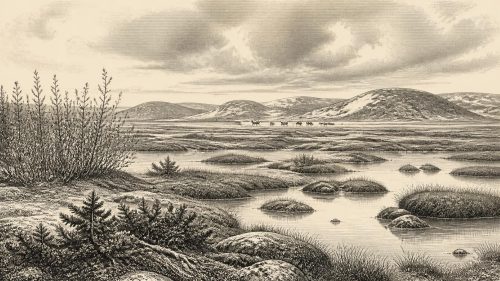
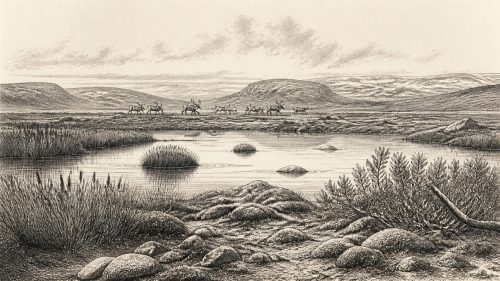
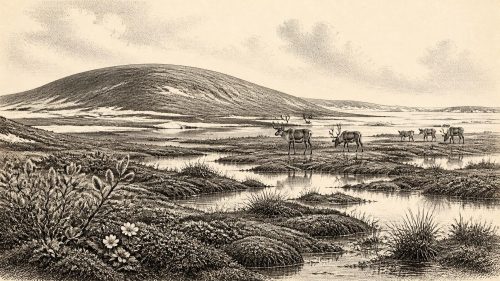
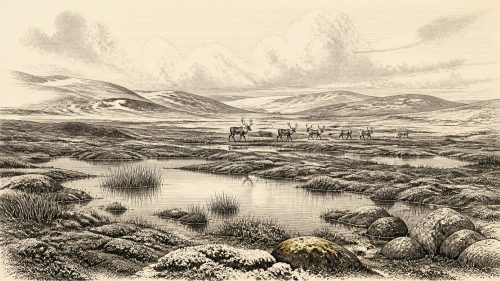
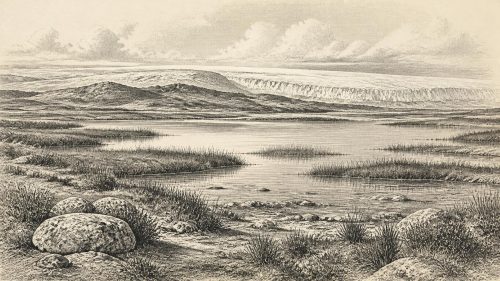
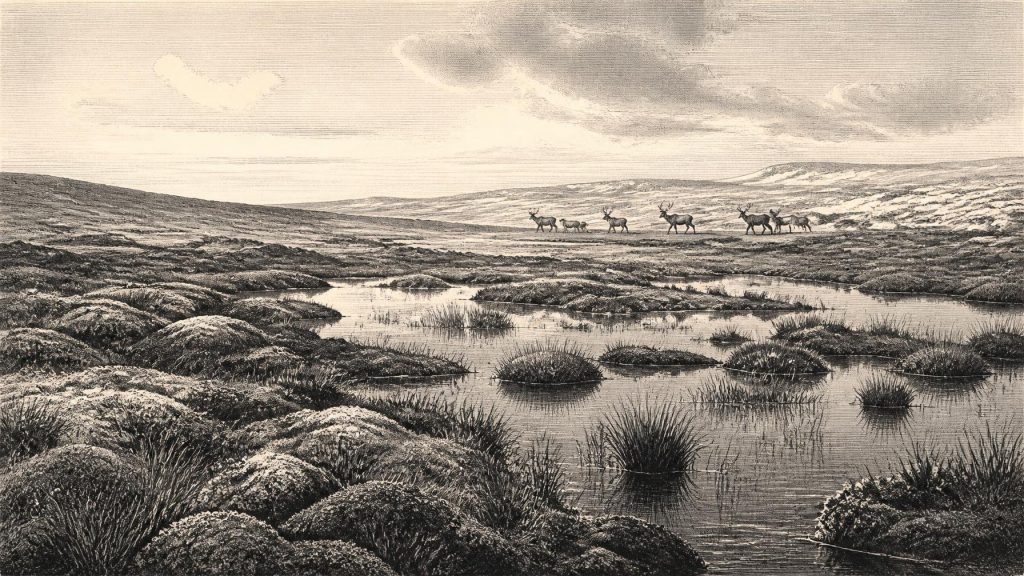
The Derryvree sediments preserve a treeless, cold-country assemblage rather than a woodland. Pollen and plant remains include grasses, sedges, juniper and herbs; mosses and beetles point to wet ground with pools, abundant plant matter and marshy margins. This was not an empty white wilderness. It was a tundra or tundra-steppe-like mosaic in which shallow water, saturated ground and more open, drier patches offered different resources to plants and animals. Winters were severe, while the growing season was short and conditions could change rapidly.
Greenagho, near Belcoo in Fermanagh, supplies a related though earlier benchmark. Organic detritus from lacustrine deposits beneath till has been calibrated to about 37,200–35,700 years before present. It does not date precisely to the notional year considered here, and should not be treated as doing so. Yet, taken with Derryvree, it demonstrates that freshwater basins and cold open habitats existed in the region during phases before the major later expansion of ice. The deposits also demonstrate the fragility of the evidence: without burial beneath later glacial sediments, much of this ecological record might have vanished.
The physical map was unlike that of modern Ireland. Sea level was lower than today, shorelines lay farther out on the continental shelf in some areas, and ice, exposed ground and water barriers altered potential routes between Ireland, Britain and continental Europe. It is unsafe, however, to turn this into a simple story of a permanent land bridge or an easy migration corridor. Routes varied with sea level and ice margins, while cold seas, glaciers and open terrain could all hinder movement. The evidence establishes a changing north-west European landscape, not a mapped road into Ireland.
Castlepook’s Animal World
For the animal life of this broad phase, Castlepook Cave near Doneraile in north Cork is indispensable. Its old cave collections contain one of Ireland’s richest pre-Last Glacial Maximum faunal assemblages. Among the animals identified from the cave are woolly mammoth, reindeer, giant deer, brown bear, wolf, foxes, hares, lemmings and spotted hyaena. Such a list should not be read as a photograph of one day’s landscape. Cave deposits can combine material carried in over long periods by carnivores, water, gravity and excavators. Nevertheless, the assemblage establishes that Ireland, or at least accessible parts of it, supported a striking mixture of cold-adapted and large grazing animals during the later Pleistocene.
Spotted hyaena is especially revealing. Now associated in popular imagination with African grasslands, Ice Age spotted hyaenas ranged across parts of Europe and could occupy caves as dens. Castlepook is Ireland’s principal hyaena site. Their presence helps explain why bones accumulated in caves and why a cave need not have been a human camp. Carnivores could drag prey or scavenged carcass parts underground, gnaw and scatter bones, and leave deposits subsequently mixed by natural processes. Mammoths, reindeer and giant deer indicate productive open country somewhere within their ranges; they do not prove that every species stood together around Castlepook at 31,789 BCE.
For people, the most consequential object is a reindeer femur from Castlepook. It has been dated to around 33,000 years ago and bears a deep mark interpreted by zooarchaeologist Ruth Carden as damage made to fresh bone by a sharp stone tool during carcass processing. If that interpretation and its association with the animal’s death are sustained, it would be evidence that one or more Upper Palaeolithic people handled a reindeer in Ireland during this broad period. It would push the known human story of the island far back beyond the better-established post-glacial record.
What One Mark Can—and Cannot—Say
The reindeer bone is important precisely because it is so exceptional. No securely associated stone-tool assemblage, hearth, dwelling floor, burial, artwork or stratified campsite of comparable age has yet been recovered in Ireland. The bone was part of an old cave collection shaped by early twentieth-century excavation, while the cave itself was a place of natural disturbance and carnivore activity. Dating an animal bone also dates the animal’s life, not automatically the precise instant at which a mark was made. A cut-mark interpretation can be plausible and still require continuing testing against carnivore damage, breakage and the complicated history of the deposit.
Accordingly, the evidence does not justify a settled Palaeolithic population, an Irish tribe, or a named migration. It cannot tell us what language any visitors spoke, how many there were, whether they returned seasonally, or whether they left descendants. The strongest cautious inference is narrower: if the mark is anthropogenic, a small mobile party possessed a sharp stone edge and processed at least part of a reindeer carcass. Such people would have been participants in the wider Upper Palaeolithic worlds of western Europe, where hunting, scavenging, animal butchery and movement through large territories were established practices. That wider comparison provides context, not proof of a particular Irish society.
No Polities, No Proven Diplomacy
There is no evidence for political institutions, rulers, territories, warfare, diplomacy or formal trade in Ireland at this time. Nor can archaeology identify religion, stories, music, kinship rules or systems of learning from the available Irish material. It would be misleading to fill these silences with later Gaelic traditions, Celtic imagery or generic Stone Age scenes. All of those belong to much later historical and prehistoric contexts. Even the term “Ireland” is geographical shorthand here, not the name of a recognised community or state.
Likewise, there was no agriculture demonstrated for this period: no fields, crops, livestock management or farming settlement. If people were present, their economy would have depended on mobility and on immediate access to animal and plant resources, rather than production on permanent farms. Reindeer are often associated with seasonal movement, but the Castlepook evidence cannot establish a local migration calendar. The caves and wetlands instead show the ecological setting within which animals, carnivores and possibly human hunters moved.
A Record Preserved by Destruction
The later advance of the Irish ice sheet gives this distant period much of its historical meaning. Glaciers stripped and rearranged soils, altered valleys, deposited till and obscured former land surfaces. They destroyed countless traces while sealing a few organic deposits below later sediments. Ireland’s evidence for the time around 31,789 BCE is therefore sparse not because nothing occurred, but because preservation is heavily biased. Caves such as Castlepook and sub-till basins such as Derryvree and Greenagho are rare survival zones within a landscape subsequently transformed by ice.
What can responsibly be said is both modest and remarkable. Around the notional date of 31,789 BCE, Ireland was part of a cold, shifting north-west European environment, with ice-free ground in at least some phases and regions, open wetland vegetation, freshwater pools, and large mammals adapted to Pleistocene conditions. Cave deposits attest to a formidable animal world; one modified reindeer bone raises the serious possibility of human activity. Beyond that lies uncertainty. This is not yet a year of kings, conflicts or monuments, but a deep environmental threshold whose scattered deposits continue to redefine the earliest possible human chapter of Ireland.
Primary Sources
- Trimlines, blockfields and the vertical extent of the last ice sheet in southern Ireland
- Exploring controls of the early and stepped deglaciation on the western margin of the British-Irish Ice Sheet
- Growth and retreat of the last British–Irish Ice Sheet, 31,000 to 15,000 years ago: the BRITICE-CHRONO reconstruction
- Growth and retreat of the last British–Irish Ice Sheet, 31,000 to 15,000 years ago: the BRITICE-CHRONO reconstruction
- Timing, pace and controls on ice sheet retreat: an introduction to the BRITICE-CHRONO transect reconstructions of the British–Irish Ice Sheet
- Timing, pace and controls on ice sheet retreat: an introduction to the BRITICE-CHRONO transect reconstructions of the British–Irish Ice Sheet
- Early deglaciation of the British-Irish Ice Sheet on the Atlantic shelf northwest of Ireland driven by glacioisostatic depression and high relative sea level
- Irish Pleistocene biostratigraphy
- The Irish Quaternary Fauna Project
- New insights on the fauna of Ireland's Younger Dryas and Early Holocene from Alice & Gwendoline Cave
- Quaternary Science Reviews 339 (2024) 108827
- Castlepook Cave, Doneraile, Cork: Excavation report, 2022
- Heritage Artefacts of County Cork
- A North-Western Habitat: the Paleoethology and Colonisation of a European Peninsula
- Pleistocene vertebrates in the British Isles
- Proceedings: Postglacial colonisation of Ireland
- Biogeography of Ireland: Past, Present and Future
- BRITICE-CHRONO: Introduction
- Irish Quaternary Association
- About the Irish Quaternary Association