Derryvree’s Bogbean Margin30550 BCE
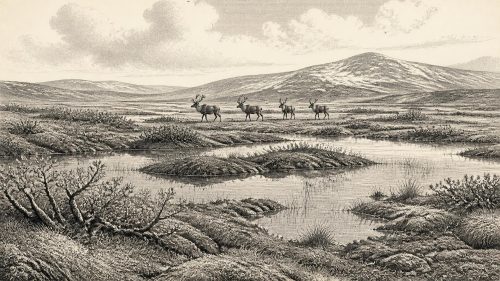
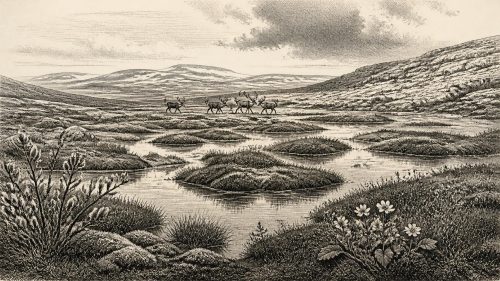
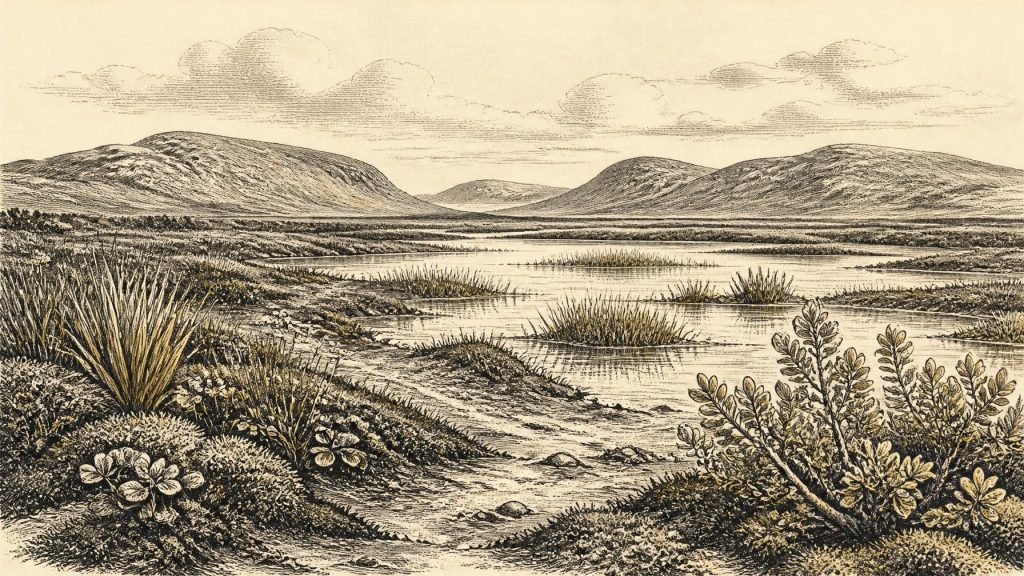
About 30,550 BCE, Ireland was experiencing unstable Late Pleistocene conditions, not a datable historical event. At Derryvree, County Fermanagh, freshwater sediments between glacial tills preserve evidence of a locally persistent wetland amid open tundra: bogbean, dwarf willow, mountain avens, mosses and insects. The sequence proves that ice cover was intermittent, though severe periglacial climates prevailed. Castlepook Cave, County Cork, contains pre-Last Glacial Maximum remains of mammoth, giant deer, reindeer, bear and hyaena, indicating varied cold-stage ecosystems. Human presence remains unproven: a possibly cut-marked reindeer bone is inconclusive. Together, these archives reveal an ecologically diverse, repeatedly glaciated Ireland during this interval.
Dateline
A Date Beyond Calendar History
30,550 BCE cannot responsibly be treated as a date on which a recoverable Irish event occurred. No written calendar, named community, political institution or year-by-year record existed in Ireland at this depth of time. Indeed, the apparent precision of the modern date is misleading. It is a point selected within a vast prehistoric span, not an anniversary. The evidence belongs broadly to the Late Pleistocene, within Marine Isotope Stage 3 (MIS 3), a climatically unstable part of the last Ice Age. It consists chiefly of sediments, plant and insect remains, animal bones, cave deposits and traces of ice movement.
The closest important Irish environmental archive is at Derryvree, near Maguiresbridge in County Fermanagh. Road works in 1969 exposed freshwater silts and fine sands caught between two thick layers of glacial till within a drumlin. Organic material from the deposit, catalogue number BIRM-166, returned a conventional radiocarbon determination of 30,500 years BP, with a substantial uncertainty of +1,170/−1,030 years. “BP” means before AD 1950, and a radiocarbon age is not a calendar age. Calibration using modern curves is essential, but at this antiquity it produces broad probability ranges rather than a precise historical year. The Derryvree deposit is therefore an exceptionally valuable window on an interval around this date, not proof of conditions on one particular day, season or generation.
Water Between Ice Advances
The sequence at Derryvree establishes one fact with particular clarity: south Fermanagh was not under continuous ice throughout the whole later Ice Age. An earlier glacier had deposited the lower till. Afterwards, freshwater sediments accumulated in a hollow or shallow basin, supporting plants and small invertebrates. Later, advancing ice and associated meltwater laid down proglacial sands and another till above it. The wetland was thus sealed beneath glacial deposits and preserved by chance until the road cutting revealed it.
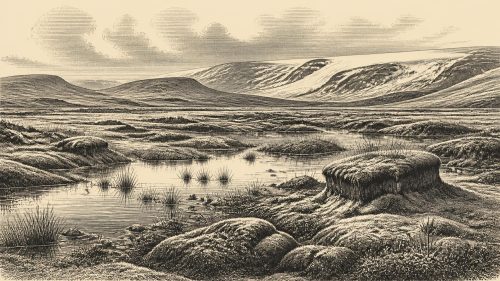
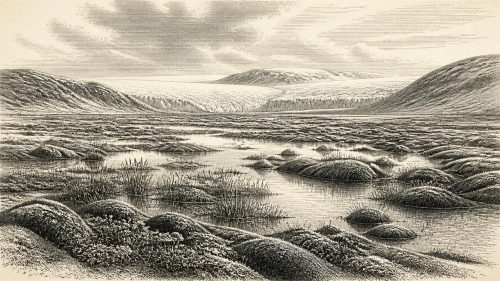
This is not evidence for a mild Irish landscape. The plants and animals recovered from the freshwater layer point instead to open tundra and periglacial conditions: a cold environment shaped by seasonal freezing, thawing, sparse cover and exposure to strong winds. Yet it was not a featureless frozen waste. Mosses, sedges and wet-ground plants grew around persistent water. Fossil remains include bogbean (Menyanthes trifoliata), dwarf willow (Salix herbacea) and mountain avens (Dryas octopetala), all plants suited to cold, open conditions. Aquatic and waterside vegetation shows that a pool, marsh or slow-moving water body survived locally, even while the broader landscape was treeless and severe.
That distinction matters. Derryvree records a particular sheltered setting, not an entire island mapped in minute detail. Pollen can travel far; plant fragments may have been moved by water; and a wet hollow can support species absent from nearby slopes. Nevertheless, taken together with the insect evidence, the assemblage strongly supports a tundra-like mosaic of wet ground, bare mineral sediment, herb-rich patches and shallow freshwater. It is among the rare direct records of Irish life during this older part of the last glacial period.
An Island in a Changing Ice World
Ireland’s geography was very different from that of the modern republic and Northern Ireland. Global sea levels were lower than today because enormous quantities of water were stored in ice sheets. But it would be unsafe to draw a simple, permanent land bridge from Ireland to Britain or continental Europe for 30,550 BCE. Shorelines, sea passages, ice margins and relative land levels changed repeatedly, while the timing and extent of pre-Last Glacial Maximum ice remain subjects of active research.
What can be said securely is that this was before the fullest late-Pleistocene expansion of the British–Irish Ice Sheet, conventionally associated with roughly 26,000–23,000 years ago. Ice was already a decisive force in the region, however. The Derryvree succession itself records more than one phase of glaciation, and wider work on the British–Irish Ice Sheet shows that ice growth was neither simple nor synchronous across Ireland, Britain and the surrounding seas. Around the date represented by this article, different parts of the island and shelf may have experienced very different conditions: ice-covered uplands and lowlands, periglacial terrain, meltwater basins, and perhaps ice-free habitats capable of sustaining plants and animals.
Such change helps explain why Ireland’s Pleistocene record is patchy. Later glaciers eroded, redeposited and buried many older surfaces. The survival of an organic layer beneath till at Derryvree is therefore exceptional. It does not mean that the site was the only place where life persisted; rather, it is one of the few places where the evidence escaped destruction.
The Cave Fauna of Cork
County Cork provides another, different kind of archive. Castlepook Cave, near Doneraile in the Awbeg valley, has yielded Ireland’s richest assemblage of vertebrate remains from the period before the Last Glacial Maximum. Its long, narrow limestone galleries became a repository for bones over many millennia. The fauna includes woolly mammoth, giant deer, reindeer, brown bear and spotted hyaena, while later Ice Age deposits include Arctic fox, wolf and lemmings. Re-dating has shown that some of the older bones are appreciably earlier than formerly thought, and that mammal communities occupied or reached Ireland during MIS 3.
These remains should not be turned into a single crowded scene. A cave bone collection may represent carcasses brought in by hyaenas, animals dying naturally, water disturbance and deposits accumulated at separate times. Some historic excavations also disturbed the original deposits. Castlepook demonstrates that these species occurred in Ireland during the broader pre-maximum Ice Age, but it cannot prove that every species lived together near the cave in 30,550 BCE. Nor does it establish the size, density or seasonal movements of their populations.
Even so, the evidence is striking. Reindeer and giant deer imply grazing opportunities in open landscapes; mammoth is consistent with the broad, cold-steppe and tundra environments of north-west Europe; and spotted hyaena indicates a carnivore capable of accumulating bones in caves. These animals belonged to ecological systems far removed from the densely wooded Ireland of later millennia. Their presence also shows that the island was not biologically sealed off for the whole Pleistocene, even if routes of movement and the precise configuration of land and sea varied over time.
People: A Possibility, Not a Population
There is no securely documented settlement, hearth, stone-tool assemblage, grave or dwelling in Ireland that can be assigned to 30,550 BCE. This is the central limitation on any human history of the date. Political affairs, diplomacy, warfare, formal leadership, religion, teaching and trade cannot be reconstructed from the available Irish evidence. There were no known states, boundaries or written traditions on the island, and it would be misleading to supply them by analogy with much better-known Upper Palaeolithic societies elsewhere in Europe.
A reindeer femur from the older Castlepook collections has attracted attention because a deep incision has been interpreted as a possible cut or chopping mark made with a sharp stone tool. If that reading, and the association of the mark with the bone’s original age, are upheld, it may indicate that a person processed a reindeer in Ireland during the earlier Upper Palaeolithic, dramatically earlier than the island’s previously accepted human evidence. But it remains an isolated and difficult claim. Cave deposits have complex histories, and distinguishing human modification from damage caused by carnivores, sediment, excavation or later handling requires rigorous taphonomic analysis. One marked bone cannot demonstrate a resident population, identify a culture, or describe a social world.
The responsible conclusion is consequently twofold. Human presence in Ireland around this broad period is possible and deserves continued investigation; sustained human occupation at 30,550 BCE has not been demonstrated. The best-established Irish story is environmental: cold-adapted plants at a Fermanagh wetland, large mammals and carnivores represented in Cork caves, and landscapes repeatedly transformed by ice.
Life Without Later Institutions
There is no evidence for farming, livestock, permanent villages, metalworking, long-distance exchange networks or ritual monuments. Any people who briefly reached the island, if they did, would have depended on mobile foraging, local knowledge and the ability to travel through difficult cold-stage terrain. That is an inference from the ecological setting, not an excavated Irish campsite. Derryvree itself offers no tools, houses or human remains: it speaks of water, vegetation and climate rather than domestic life.
Its greatest significance lies precisely there. A bogbean seed, fragments of moss, insect remains and fine sediment preserve a world normally invisible in conventional history. They show that, amid major ice advances, local freshwater habitats could endure in Ireland and nourish a specialised cold-climate flora. Castlepook complements that northern wetland record with a southern archive of Ice Age mammals. Together, they make 30,550 BCE intelligible not as a year of kings or battles, but as part of a long interval in which Ireland was an intermittently habitable, ecologically varied and profoundly changing edge of Ice Age Europe.
Primary Sources
- A Middle Midlandian Freshwater Series at Derryvree, Maguiresbridge, County Fermanagh, Northern Ireland
- Palaeoecology: The Middle Midlandian Palaeoenvironment of South Fermanagh
- Exploring Controls of the Early and Stepped Deglaciation on the Western Margin of the British–Irish Ice Sheet
- Growth and Retreat of the Last British–Irish Ice Sheet, 31,000 to 15,000 Years Ago: The BRITICE-CHRONO Reconstruction
- The Timing and Magnitude of the British–Irish Ice Sheet Between Marine Isotope Stages 5d and 2: Implications for Glacio-Isostatic Adjustment, High Relative Sea Levels and ‘Giant Erratic’ Emplacement
- Maximum Extent and Dynamic Behaviour of the Last British–Irish Ice Sheet West of Ireland
- Stratigraphic and Palaeo-Geomorphological Evidence for the Glacial-Deglacial History of the Last British-Irish Ice Sheet in the North-Western Irish Sea
- A Reconsideration of the Radiocarbon Dating of the Marine Isotope Stage 3 Fauna from Southern Ireland
- The Irish Quaternary Fauna Project
- Castlepook Cave: Cork County Geological Site Report
- The Exploration of Castlepook Cave, County Cork
- First Evidence of a Late Upper Palaeolithic Human Presence in Ireland
- New Insights on the Fauna of Ireland’s Younger Dryas and Early Holocene From Alice & Gwendoline Cave
- 2022:564 – Castlepook Cave, Castlepook South, Cork
- The IntCal20 Northern Hemisphere Radiocarbon Age Calibration Curve (0–55 cal kBP)
- Figure 6: The Subdivision of the Quaternary Period in Ireland
- Menyanthes trifoliata
- Salix herbacea
- Dryas octopetala
- County Cork Heritage Grant Scheme 2023