
Castlepook’s Earliest Question31636 BCE
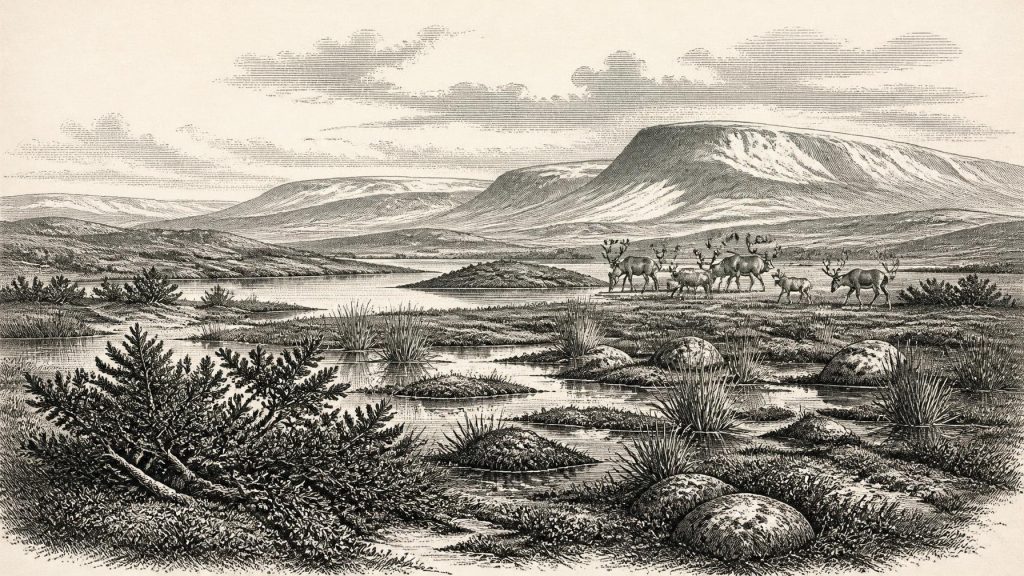
Thirty-one thousand six hundred and thirty-six BCE is best treated as an imprecise late MIS 3 interval, not a recoverable Irish calendar year. Derryvree sediments in Fermanagh record cold, treeless freshwater landscapes between glacial advances, while Kerry speleothems show intermittent milder conditions. Altered coastlines, ice margins and sea levels shaped uncertain access to Ireland. Castlepook and other southern caves preserve faunas including reindeer, mammoth and carnivores, although assemblages span long periods and are disturbed. A marked Castlepook reindeer femur may indicate Upper Palaeolithic butchery, but lacks secure context. No settlements, tools, hearths or institutions are evidenced; hunter-gatherer visits remain possible.
Dateline
31,636 BCE is a modern chronological label, not a year that can be recovered from the Irish archaeological record. It corresponds roughly to 33,585 years before AD 1950, the conventional reference point for “BP” dating, but neither radiocarbon science nor glacial deposits can identify happenings in a single calendar year at this depth of time. The responsible frame is a broad interval in the later part of Marine Isotope Stage 3 (MIS 3), during the last Ice Age and before the Last Glacial Maximum. Ireland’s evidence is sparse, discontinuous and often disturbed by later ice. It can illuminate landscapes, animals and a disputed clue to human activity; it cannot provide a year-by-year narrative of rulers, battles or settlements.
An Interval Rather Than a Date
The most relevant dated Irish environmental sequence lies at Derryvree near Maguiresbridge, County Fermanagh. Roadworks in 1969 exposed organic freshwater silts and fine sands enclosed between two thick beds of till, sediment left by glacier ice. The order matters. Ice had occupied the locality, then freshwater and vegetation developed there, and later ice sealed the deposits beneath another till. A radiocarbon result of about 30,500 ± 1,100 radiocarbon years BP has been calibrated to a broad range of approximately 36,900–31,700 calendar years BP. The nominal date of 31,636 BCE falls within that range, but the deposit is not a diary entry for that year: it accumulated across an interval and carries both laboratory uncertainty and the limits of calibration.
Derryvree is especially valuable because later glaciation erased or buried so much of the contemporary land surface. Plant macrofossils, pollen, mosses and insects indicate a cold, open environment. Grasses, sedges, herbs, juniper and low-growing plants could survive where closed woodland could not; wet ground and shallow freshwater were locally important. This was not simply a limitless white waste. Seasonal snow, exposed mineral soils, pools, streams, peat-like ground, slope and shelter would have created patches of differing productivity. Yet it was a treeless, periglacial world, far removed from the temperate, wooded island familiar today.
That local evidence should not be turned into a single map for the whole island. Ireland’s climate was shaped by the Atlantic, changing sea level, relief and the shifting margins of the British–Irish Ice Sheet. Conditions could differ sharply between northern basins, southern limestone country, uplands and the then altered coastal margins. Crag Cave in County Kerry adds an important but different line of evidence: uranium-thorium dates show episodes of stalagmite growth during MIS 3. In this shallow cave, calcite growth required liquid water and is interpreted as evidence for intermittent climatic amelioration. It demonstrates instability rather than sustained warmth. Cold stadials and milder interstadials repeatedly reorganised water, vegetation, animal habitat and ice.
Ice, Water and Altered Coasts
There was no political Ireland in any meaningful later sense, and the physical outline of the land was not the modern coastline. Global sea level was lower during the Ice Age, exposing parts of the continental shelf, while ice, local crustal movement and changing drainage complicated the geography of the Irish Sea. It would be unsafe to picture a simple, permanent dry “land bridge” linking every part of Ireland to Britain or continental Europe. Equally, the present sea crossings cannot be projected unchanged into the past. Any movement of animals or people depended on a changing combination of exposed ground, water barriers, ice margins and favourable seasons.
Glacial reconstructions suggest that the bulk of the last Irish ice sheet expanded from relatively restricted or ice-free conditions around 34,000 years ago, with its advance unfolding unevenly over millennia; the southern coast was not crossed by inland Irish ice until much later, after about 24,000 years ago. Those are regional reconstructions, not a claim that every locality was open at 31,636 BCE. The Derryvree sediments nevertheless show that at least part of north-central Ireland had supported freshwater habitats during a pre-LGM interval. This is the principal environmental fact behind any responsible account of the island at this time.
Animals in the Cave Record
Southern Irish limestone caves supply the other major body of evidence. Castlepook Cave, near Doneraile in north County Cork, became known as Mammoth Cave after antiquarian excavations between 1904 and 1912 produced a remarkable accumulation of Ice Age bones. Much material entered the National Museum of Ireland’s collections, where later zooarchaeological study and improved radiocarbon methods have transformed understanding of the assemblage. The Irish Quaternary Fauna Project showed that a wide range of mammals had reached Ireland between at least about 45,000 and 20,000 years ago. Subsequent re-dating, however, has also demonstrated that some earlier determinations were too young.
The lesson is caution. Cave bones do not necessarily represent one living community, one hunting episode or even one generation. Carnivores may drag carcass parts into a den; flowing water, collapse, excavation and museum curation can further disturb their context. At Castlepook and neighbouring caves, remains of animals including reindeer, brown bear, hare, fox, wolf, woolly mammoth, giant deer and spotted hyaena document changing Ice Age faunas across a very long span. Re-dating suggests that giant deer and spotted hyaena may have disappeared locally before around 40,000 calibrated years ago. They should therefore not automatically be placed beside a reindeer at the later point represented by this article.
Reindeer are the most important animals for the present question. Their presence is compatible with open, cold landscapes and with movements through north-west Europe during favourable phases. But even a reindeer bone cannot, by itself, tell us whether herds were resident, seasonal visitors or represented a brief range expansion. The bones establish that Ireland was part of wider ecological networks, not that it possessed a stable or uniform animal population.
The Marked Reindeer Femur
Castlepook has acquired wider historical importance through one fragment of reindeer femur from the old collection. It has been reported as dating to about 33,000 years ago and bears a deep linear mark interpreted by zooarchaeologist Ruth Carden as damage made while fresh bone was being cut or chopped with a stone tool. If that interpretation is confirmed, it would be evidence that people handled and processed a reindeer in Ireland during the Upper Palaeolithic, many millennia before the well-established post-glacial settlement record.
“If” is indispensable. The fragment came from an old and disturbed cave assemblage rather than an excavated occupation floor. No stone tool has been found with it; nor is there a securely associated hearth, dwelling, human bone, butchered assemblage or stratified campsite. Recent work at Castlepook has sought intact deposits and further traces of activity, but the 2022 excavation also underlined the damage caused by early investigations and the scarcity of surviving undisturbed material. The femur is therefore a significant research prospect, not proof of a settled Palaeolithic population.
The older, better-published evidence for human presence is a cut-marked brown-bear kneecap from Alice and Gwendoline Cave in County Clare, directly dated to about 12,810–12,590 calibrated BP. That find is much later than 31,636 BCE, but it provides an important methodological contrast: it was independently dated and analysed in a focused peer-reviewed study. The Castlepook reindeer claim invites further testing to the same demanding standard. Responsible history should preserve the distinction between a compelling interpretation and a demonstrated occupation.
What Society Can, and Cannot, Be Seen
No known Irish house, camp surface, hearth, tool kit, grave, ornament, image or monument can securely be assigned to this interval. There is consequently no evidence for political authority, diplomacy, organised warfare, formal religious practice, farming, craft specialisation or trade within Ireland. There were no states, kingdoms or named peoples to describe. Conflict with animals or other people cannot be inferred from a marked bone, and hunting must not be recast as warfare.
If the Castlepook modification was made by people, the most economical interpretation is a brief encounter by mobile hunter-gatherers exploiting animal resources. Upper Palaeolithic communities elsewhere in Europe used stone tools, clothing, shelters and extensive social connections, but those facts are comparative context, not discoveries from Ireland. They cannot establish the language, identity, beliefs, numbers, route or duration of any visitors here. Nor can they show whether a group returned after one successful hunt. The word “settlement” is particularly misleading unless future excavations produce evidence of repeated or sustained occupation.
A Fragile Historical Horizon
The economy visible in Ireland was ecological rather than agricultural: wild plants and animals, freshwater and seasonal opportunity shaped what was possible. There is no evidence for crops, livestock, pottery, metalworking or exchange of manufactured goods. Caves may have served carnivores more often than humans. A carcass processed in the open could have had parts carried into a cave by hyaenas or wolves, which is one reason the Castlepook evidence must be read with taphonomic care.
For this period, Ireland’s history is therefore a history of evidence as much as of the past itself. Silts below a drumlin reveal a wet tundra landscape; calcite in a Kerry cave records episodes when water could drip and freeze-thaw conditions eased; bones from Cork caves disclose faunal change; one modified reindeer femur raises the possibility of a far earlier human presence than previously recognised. None supplies calendar-year precision. Together, they show an island—or a changing north-western peninsula and shelf landscape—at the edge of ice, intermittently habitable for cold-adapted life, and perhaps briefly reached by people whose story has almost entirely vanished.
Primary Sources
- A Middle Midlandian Freshwater Series at Derryvree, Maguiresbridge, County Fermanagh, Northern Ireland
- Middle Midlandian Interstadial Deposits at Greenagho, Near Belcoo, County Fermanagh, Northern Ireland
- The Irish Quaternary Fauna Project
- A Reconsideration of the Radiocarbon Dating of the Marine Isotope Stage 3 Fauna from Southern Ireland
- Episodic Speleothem Deposition Tracks the Terrestrial Impact of Millennial-Scale Last Glacial Climate Variability in SW Ireland
- Trimlines, Blockfields and the Vertical Extent of the Last Ice Sheet in Southern Ireland
- Late Pleistocene Chronostratigraphy and Ice Sheet Limits, Southern Ireland
- Maximum Extent and Dynamic Behaviour of the Last British–Irish Ice Sheet West of Ireland
- The Timing and Magnitude of the British–Irish Ice Sheet Between Marine Isotope Stages 5d and 2
- Growth and Retreat of the Last British–Irish Ice Sheet, 31,000 to 15,000 Years Ago: the BRITICE-CHRONO Reconstruction
- BRITICE-CHRONO Maps and GIS Data of the Last British-Irish Ice Sheet 31 to 15 ka
- Spatio-Temporal Dynamics of Speleothem Growth and Glaciation in the British Isles
- The IntCal20 Northern Hemisphere Radiocarbon Age Calibration Curve (0–55 cal kBP)
- The Island of Ireland: Drowning the Myth of an Irish Land-Bridge?
- First Evidence of a Late Upper Palaeolithic Human Presence in Ireland
- New Insights on the Fauna of Ireland's Younger Dryas and Early Holocene From Alice & Gwendoline Cave
- 2022:564 – Castlepook Cave, Castlepook South, Cork
- Archaeology Research Excavation Grant 2022: Castlepook Cave Project Final Report
- Heritage Artefacts of County Cork
- Figure 6: The Subdivision of the Quaternary Period in Ireland