
The Derryvree Silt Lens31589 BCE
Labelled 31,589 BCE, this Late Pleistocene interval cannot be reconstructed as a recorded year but through environmental archaeology. Organic silts at Derryvree, County Fermanagh, lying between glacial tills, indicate a temporary ice-free freshwater tundra of sedges, mosses, herbs and cold-adapted plants, dated broadly to 36,900–31,700 calibrated years BP. Greenagho provides comparable regional evidence. Expanding ice sheets nevertheless made conditions transitional and increasingly glacial. Cave remains at Castlepook demonstrate wider Ice Age fauna, including reindeer and mammoth. A possibly cut-marked reindeer bone may indicate fleeting human activity there, but disturbed contexts and absent occupation evidence preclude claims of settled Palaeolithic society.
Dateline
31,589 BCE is a modern calendar label, not a year that people in prehistoric Ireland could have named or recorded. In the conventional system that counts backwards from AD 1950, it lies roughly 33,500 years before present. That places it in the Late Pleistocene, within Marine Isotope Stage 3: a long, climatically variable part of the last Ice Age. Modern calendar-year precision is not available for Ireland at this depth of time. There are no contemporary written records, named individuals, political communities, monuments, houses, hearths or securely dated artefact assemblages from which to reconstruct a single twelve-month interval.
The responsible history of Ireland around this point is therefore an archaeological and environmental reconstruction, expressed through calibrated ranges rather than a diary of events. It rests on buried sediments, pollen, plant macrofossils, beetles, animal bones, cave deposits, stratigraphy and radiocarbon measurements. Those sources show that parts of Ireland could still have supported ice-free landscapes before the later major expansion of the British–Irish Ice Sheet. They cannot establish a state, a people called “the Irish”, a war, a diplomatic encounter, or a permanent human settlement in 31,589 BCE.
A Freshwater Deposit Between Ice Sheets
The most revealing evidence comes from Derryvree, near Maguiresbridge in County Fermanagh. Road works in 1969 cut through a drumlin and exposed organic silts and fine sands enclosed between two thick tills, deposits laid down directly by ice. The sequence tells a compelling relative story: glaciation had occurred; an ice-free freshwater environment subsequently existed at the site; and later ice overrode and sealed it beneath another till. This is not evidence for a benign climate. It is evidence that the local landscape was not continuously buried beneath an ice sheet.
The Derryvree organic layer produced the legacy radiocarbon measurement Birm-166, 30,500 radiocarbon years BP, with a substantial laboratory uncertainty. Subsequent calibration has placed it broadly at about 36,900–31,700 calibrated years BP. The notional modern date of 31,589 BCE, approximately 33,539 years before AD 1950, falls within that broad calibrated interval. It must not be mistaken for the precise date of the deposit, much less for a specific episode represented in it. Radiocarbon calibration, sample quality, disturbance, and the fact that sediment accumulates over time all require caution.
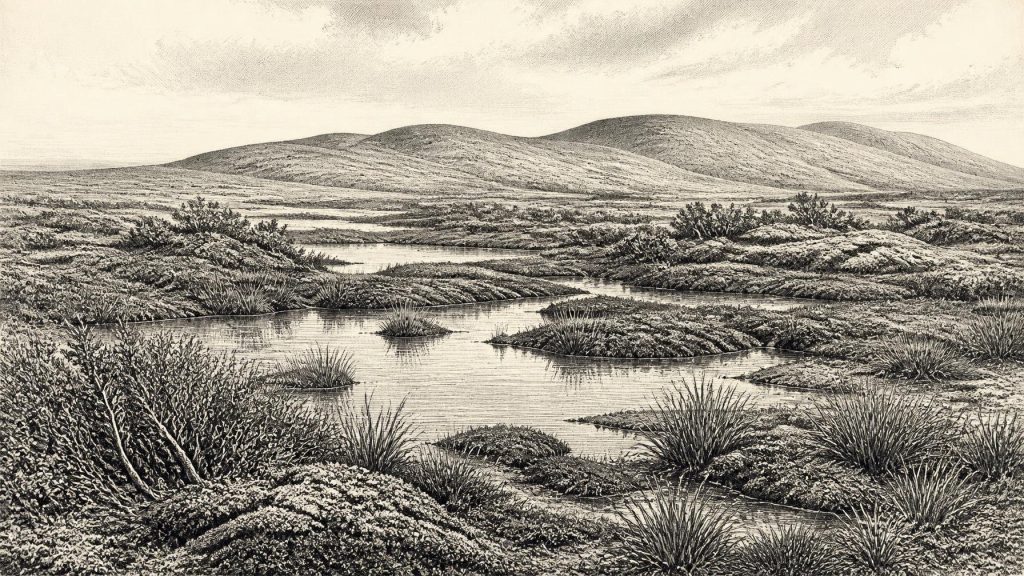
Even so, Derryvree matters because its plant and animal evidence is unusually informative. The original investigators recovered poorly preserved pollen dominated by herbaceous plants, together with seeds and other plant remains, mosses and insects. Their interpretation was an open, treeless tundra or muskeg landscape: wet, cold ground with pools, mossy vegetation and patches of sparse terrestrial cover. Sedges and grasses occurred alongside plants adapted to cold conditions. Dwarf willow, mountain avens, arctic sandwort, bogbean and water-milfoil are among the taxa reported from the broader assemblage. These remains do not furnish a complete map of Ireland, but they make a forested, temperate Fermanagh implausible for this phase.
Cold Ground, Not an Empty Island
The landscape around Derryvree was probably seasonally severe. Periglacial conditions imply repeated freezing and thawing, frozen or waterlogged soils, short growing seasons and a vegetation cover unlike modern Irish pasture, woodland or bog. Open ground would have exposed plants and animals to wind, frost and marked seasonal change. Yet “tundra” should not be read as lifeless uniformity. Wet hollows, open water, sedge beds, moss carpets and better-drained patches created different habitats over short distances. The freshwater silts preserve precisely this local variety.
Greenagho, also in County Fermanagh, supplies a useful older comparison. Organic lacustrine material beneath till there has been calibrated to roughly 37,200–35,700 years BP. Together, Greenagho and Derryvree support the conclusion that north-central Ireland retained ice-free areas during part of late Marine Isotope Stage 3. That conclusion is important, but it remains regional. A buried wetland at one locality cannot tell us whether every valley, upland or coast was equally hospitable at the same time. Nor does it identify the exact extent of glaciers elsewhere on the island.
Recent reconstructions of the British–Irish Ice Sheet add a dynamic wider context. They suggest that substantial ice masses were building in the wider archipelago around 32,000–30,000 years ago, while the timing and pattern of expansion differed from region to region. Some reconstructions infer ice advancing over northern and central Ireland by about 30,000 years ago; other work stresses that the direct chronological constraints on the earliest growth remain sparse. For the period represented by 31,589 BCE, the safest picture is one of transition: exposed, cold Irish terrain persisted in places, but a more extensive glacial regime was approaching or developing. Later, by roughly 28,000 years ago in some reconstructions, much of Ireland was covered by ice.
Animals and the Cave Record
Cave deposits, especially at Castlepook Cave near Doneraile in north Cork, show that large mammals had reached Ireland during the broader pre-Last Glacial Maximum period. The Irish Quaternary Fauna Project assembled evidence for a range of mammals between at least about 45,000 and 20,000 years ago. Castlepook has produced remains attributed to woolly mammoth, reindeer, spotted hyaena, brown bear, fox, hare and other Ice Age fauna. Direct dates and later reassessment place some Castlepook animals in the broad interval relevant to this article, although the cave’s old excavations and disturbed deposits make association and chronology difficult.
Such fauna show ecological possibility rather than a census for 31,589 BCE. Reindeer, for example, fit an open, cold environment and may have ranged across landscapes that now lie under sea or were later glacially altered. Mammoth and hyaena remains likewise demonstrate that Ireland was connected to wider north-west European animal movements at different points in the Late Pleistocene. They do not prove that all these species lived together at one place, or that they were present in every part of the island on the same day. Caves are also biased archives: carnivores may accumulate bones, water may redeposit them, and nineteenth- or early twentieth-century digging rarely met modern standards of stratigraphic recording.
The Human Question
A reindeer femur from Castlepook has made this period especially significant. Zooarchaeologist Ruth Carden identified a deep incision on the bone as potentially consistent with cutting by a sharp stone tool, and the bone has been presented as dating to around 33,000 years ago. If the mark is confirmed as humanly made and contemporary with the animal’s death, it would indicate an extraordinarily early human presence in Ireland, far before the well-established post-glacial archaeological record. It could represent the processing of an animal by visiting Upper Palaeolithic hunters.
That conditional wording is essential. The specimen comes from an old cave collection, not a modern excavation of an intact occupation surface. No securely associated lithic toolkit, hearth, dwelling, burial, repeated food debris or artwork establishes a residential camp of this age. The National Museum of Ireland continues to state that no clear evidence has yet demonstrated human presence in Ireland during the Palaeolithic. The apparent cut mark is therefore a potentially transformative observation, not proof of continuous occupation, a settled population or a distinct Irish Palaeolithic society. It cannot support claims about leaders, kin groups, language, ritual, political affairs or organised conflict.
Society Beyond the Evidence
If people did briefly enter Ireland in this broad period, comparison with contemporary Upper Palaeolithic groups elsewhere in Europe suggests mobile hunter-gatherers equipped with stone tools and knowledgeable about animal behaviour, seasonal movement and cold-weather survival. But that is comparative interpretation, not direct Irish evidence. There is no basis for assuming trade routes, formal diplomacy or regular crossings. Lower sea levels altered the surrounding seas and exposed land on continental shelves, but the practical routes between Ireland, Britain and the European mainland changed over time and remain a research question. A person who reached Ireland need not have come by a simple, dry land bridge.
There is equally no direct Irish evidence for formal religion, ceremonial practice, learning traditions or artistic production at this date. The absences are historically meaningful. Later ice advances eroded landscapes, while coastlines shifted and many potential coastal sites were drowned or destroyed. Acid soils and the rarity of securely stratified Pleistocene deposits further narrow the record. Archaeology can confidently illuminate climate, vegetation, fauna and the possibility of transient human activity; it cannot fill silence with imagined tribes or customs.
An Uncertain Threshold
For Ireland, 31,589 BCE is best understood as a threshold rather than an event. Derryvree preserves a cold freshwater world between episodes of glaciation. Greenagho confirms that such ice-free environmental windows existed in Fermanagh. Castlepook preserves traces of a wider Ice Age fauna and a debated clue to human butchery. Together they replace the outdated image of an island simply blanketed by ice throughout the last glacial cycle. They also demand restraint: the evidence reveals shifting habitats and possible visits, not a calendar of prehistoric Irish affairs. The strongest history of this distant moment is one that acknowledges both the remarkable survival of its evidence and the vastness of what it cannot tell us.
Primary Sources
- A Middle Midlandian Freshwater Series at Derryvree, Maguiresbridge, County Fermanagh, Northern Ireland
- Middle Midlandian Interstadial Deposits at Greenagho, Near Belcoo, County Fermanagh, Northern Ireland
- A Reconsideration of the Radiocarbon Dating of the Marine Isotope Stage 3 Fauna from Southern Ireland
- The Irish Quaternary Fauna Project
- Trimlines, Blockfields and the Vertical Extent of the Last Ice Sheet in Southern Ireland
- Growth and Retreat of the Last British–Irish Ice Sheet, 31,000 to 15,000 Years Ago: the BRITICE-CHRONO Reconstruction
- Dimensions and Chronology of the Last Ice Sheet in Western Ireland
- Late Pleistocene Chronostratigraphy and Ice Sheet Limits, Southern Ireland
- The Deglaciation of the Western Sector of the Irish Ice Sheet from the Inner Continental Shelf to its Terrestrial Margin
- Exploring Controls of the Early and Stepped Deglaciation on the Western Margin of the British Irish Ice Sheet
- Glaciation and Sea-Level Change for Ireland and the Irish Sea Since Late Devensian/Midlandian Time
- Ireland: Submerged Prehistoric Sites and Landscapes
- Irish Pleistocene Biostratigraphy
- Palaeoecology
- Figure 6—The Subdivision of the Quaternary Period in Ireland
- New Insights on the Fauna of Ireland’s Younger Dryas and Early Holocene from Alice & Gwendoline Cave
- First Evidence of a Late Upper Palaeolithic Human Presence in Ireland
- Prehistoric Details
- Castlepook Cave, Co. Cork, 2022:0032564
- Ireland’s Palaeolithic Archaeology – Fleeting Footprints in a Frozen Land