BIRM-166’s Asymmetric Uncertainty30217 BCE
30,217 BCE cannot identify a specific Irish event, as radiocarbon dates require calibration and retain broad uncertainty. Derryvree, County Fermanagh, records a cold, treeless wetland between glacial advances during Marine Isotope Stage 3. Ireland likely comprised uneven ice-free ground, wetlands, snowfields and expanding glaciers, while access routes remained uncertain. Castlepook Cave, County Cork, preserves diverse cold-stage fauna, though its disturbed deposits and revised dates demand caution. A modified reindeer femur may indicate exceptionally early human activity, but cannot prove settlement. No evidence supports named communities, political structures or sustained habitation. Ireland’s past is reconstructed from fragmentary environmental and faunal evidence.
Dateline
30,217 BCE is a modern calendar label imposed on a depth of time that no Irish community recorded in years, reigns or named generations. It falls roughly 32,166 years before AD 1950, the reference point conventionally used for “before present” dating, but that arithmetic does not turn the date into an archaeologically precise moment. No excavated Irish sequence can identify the weather, inhabitants or events of this particular year. The responsible approach is instead to consider a wider Late Pleistocene window: the unstable middle part of the last glacial cycle, usually termed Marine Isotope Stage 3 (MIS 3), when cold environments, animal ranges and expanding ice repeatedly reshaped Ireland.
A Date Beyond Annual History
Radiocarbon dates from this period are not calendar years. They measure residual carbon-14 against AD 1950 and must be calibrated because atmospheric carbon-14 levels changed markedly through time. IntCal20, the internationally used Northern Hemisphere curve, extends to 55,000 calibrated years before present, but its older section necessarily combines several kinds of evidence and retains substantial uncertainty. A single laboratory determination can therefore calibrate to broad probability ranges, sometimes with separate possible spans, rather than to one year. It would be misleading to describe 30,217 BCE as the date of a known Irish occurrence, or to convert an old radiocarbon age directly into a BCE date.
The nearest important Irish environmental record is not annual either. In 1969 roadworks cut through a drumlin at Derryvree, near Maguiresbridge in County Fermanagh, exposing freshwater silts and fine sands sealed between two distinct sheets of glacial till. Organic material from the deposit, BIRM-166, gave a conventional age of 30,500 radiocarbon years BP, with a large uncertainty of +1,170/−1,030 years. When considered through modern calibration, that determination belongs broadly to the middle-to-later part of MIS 3, approximately the mid- to high-30,000s calibrated years BP, rather than to one precisely locatable calendar year. It is invaluable evidence for an ice-free interval in this locality, but not proof that all of Ireland shared identical conditions at the same time.
Derryvree’s Cold Wetland
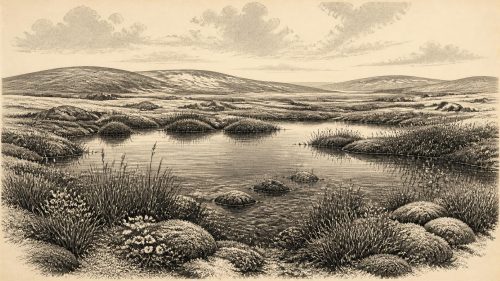
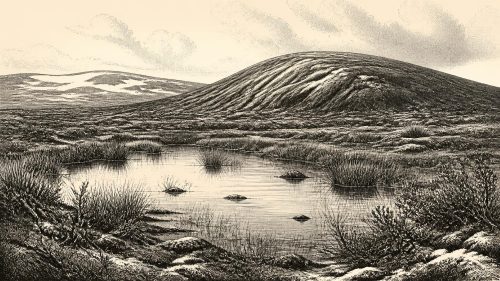
Derryvree gives the clearest picture of a northern Irish landscape broadly relevant to this date. Its preserved plant remains, pollen and associated small fossils point to open, treeless tundra or muskeg: wet ground with sedges, grasses, mosses and cold-adapted herbs, interrupted by shallow freshwater. Finds included bogbean (Menyanthes trifoliata), water-milfoil, dwarf willow, mountain avens, lesser clubmoss and numerous mosses. Such plants should not be assembled into a neat modern landscape. They represent communities living around waterlogged ground under a severe periglacial regime, with frost, snow cover, short growing seasons and likely intense seasonal contrasts. Sparse pollen of trees such as pine and hazel is generally treated cautiously, since it may have travelled long distances or been reworked from older sediments.
The Derryvree deposit therefore records resilience as well as cold. Freshwater organisms and wetland plants could occupy a sheltered basin between episodes of glacier advance. Its enclosing tills demonstrate the larger instability of the period: ice had already overridden the area, a tundra wetland later formed, and ice subsequently returned. The sequence is evidence for environmental change over long intervals, not a scene frozen at one instant. It also cautions against picturing Ireland as wholly buried beneath an ice sheet throughout the thirty-second millennium BCE. Some terrain was ice-free at some times; the timing, extent and duration varied regionally.
Ice on the Horizon
Recent reconstructions of the British–Irish Ice Sheet place this era close to a major transition. Sub-till organic dates suggest that much of Ireland remained ice-free until about 32,000 years ago, after which ice grew substantially; newer British–Irish synthesis likewise identifies sustained ice-sheet growth from roughly 31,000 to 26,000 years ago, before maximum extent around 23,000 years ago. These are regional reconstructions, not a timetable for every valley. Around the nominal year in question, Ireland may have contained an uneven mosaic of open ground, wet basins, snowfields and developing ice masses rather than a single uniform climate.
Sea level was much lower than today, but neither this fact nor proximity to Britain proves a convenient overland route for people or animals. The relationship of land, sea and ice in the Irish Sea changed repeatedly, while glaciers and meltwater could obstruct movement as effectively as open water. Earlier research found no convincing southern or central Irish Sea land bridge for the later glacial period; modern ice-sheet work further underlines how dynamic the northern and western marine margins were. For this period, the safest conclusion is that access to Ireland is a geographical problem under investigation, not a demonstrated migration corridor.
The Animals of Castlepook
In southern Ireland, Castlepook Cave near Doneraile, County Cork, supplies a complementary but very different archive. Antiquarian excavations recovered a rich assemblage later studied through the Irish Quaternary Fauna Project and subsequent redating. The cave has yielded remains attributed to woolly mammoth, reindeer, giant deer, brown bear, wolf, Arctic fox, mountain hare, collared and Norwegian lemmings, and spotted hyaena. This is compelling evidence that Ireland periodically supported cold-stage animal communities far richer than the later historic fauna. Yet it is not a census of one living landscape: caves gather bone over long periods through natural deaths, carnivore denning, scavenging, water movement, collapse and excavation disturbance.
Improved pretreatment and accelerator dating have transformed the chronology. A 2020 reassessment found that several Castlepook dates obtained in the 1990s were between about 5,000 and 12,000 radiocarbon years too young, indicating a much earlier MIS 3 presence for some mammals. The authors concluded that species including giant deer and spotted hyaena may have disappeared locally before the Last Glacial Maximum, around 40,000 calibrated years BP. The lesson is important: Castlepook establishes recurrent Ice Age faunas in Ireland, but individual bones must be redated and tied to secure stratigraphy before being used to reconstruct a particular phase.
The Reindeer Femur
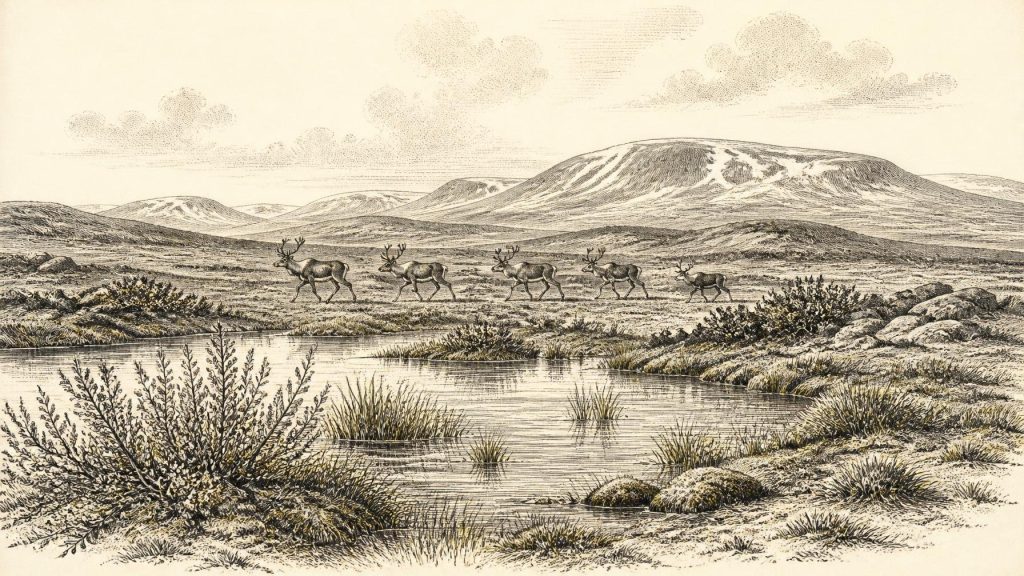
The most arresting possible human evidence is a reindeer femur from Castlepook. Ruth Carden identified a deep linear modification interpreted as damage from a sharp stone tool used while processing fresh bone. Public accounts have described the specimen as about 33,000 years old and have linked it broadly with about 31,000 BCE. If the mark is confirmed as anthropogenic and broadly contemporary with the animal’s death, it may show that people handled a reindeer carcass in Ireland during the Upper Palaeolithic—far earlier than the island’s formerly accepted human record. It would be an extraordinary find, but it remains a single, consequential object rather than proof of a settled population.
The distinction between evidence and interpretation is decisive. The bone itself demonstrates a reindeer; its radiocarbon result dates the animal’s death, not automatically the incision; and the identification of the incision as a human cut mark rests on zooarchaeological assessment. Moreover, the femur came from an old cave collection, not a sealed modern excavation containing a hearth, stone-tool scatter, habitation surface, human remains and multiple butchered animals in one dated layer. Renewed fieldwork at Castlepook is locating and examining surviving deposits, but no securely associated Upper Palaeolithic settlement has been published. The femur may record a brief visit, carcass processing or another interaction; it cannot establish hunting strategy, group size, permanence or ancestry.
Society Without a Political Record
There is no evidence from Ireland around this time for rulers, territories, diplomacy, warfare, formal religion, language, trade networks, villages or learned institutions. Nor can archaeology responsibly name a people as “the first Irish” on the basis of one possible cut-marked bone. If humans did reach the island in this period, they were most plausibly highly mobile Upper Palaeolithic foragers operating in a broader north-west European world, equipped with perishable and stone technologies suited to cold landscapes. That proposition is an inference from the continental archaeological context and the Castlepook interpretation, not a directly excavated Irish lifeway.
Everyday life is consequently better approached through constraints than invented detail. A short human visit would have required knowledge of animal movement, shelter, fuel, weather and route-finding in a landscape with little woodland. Reindeer, if present in accessible herds, would have offered meat, hide, sinew, bone and antler; but Castlepook does not prove that people killed them or stayed at the cave. No Irish evidence of this age demonstrates houses, clothing styles, ornament, burial rites, art, exchange or sustained seasonal settlement. The absence of such evidence is not proof that no person ever arrived, but it prevents a historical narrative of communities, chiefs or beliefs.
An Evidence-Led Ireland
Ireland around 30,217 BCE is thus illuminated by sediments, spores, seeds, bones, ice and methodological caution. Derryvree indicates a cold, open wetland between glacial advances. Castlepook shows that varied Ice Age mammals occupied southern Ireland across parts of MIS 3, while the debated reindeer femur raises the possibility of an exceptionally early human episode. None of this supports a dated event in 30,217 BCE. It does reveal a changing country at the edge of expanding ice, where ecological opportunities existed intermittently and where a single bone may yet alter the chronology of human presence.
Primary Sources
- A Middle Midlandian Freshwater Series at Derryvree, Maguiresbridge, County Fermanagh, Northern Ireland
- The Irish Quaternary Fauna Project
- A Reconsideration of the Radiocarbon Dating of the Marine Isotope Stage 3 Fauna from Southern Ireland
- The Last Irish Ice Sheet: Extent and Chronology
- Growth and Retreat of the Last British–Irish Ice Sheet, 31,000 to 15,000 Years Ago: the BRITICE-CHRONO Reconstruction
- The IntCal20 Northern Hemisphere Radiocarbon Age Calibration Curve (0–55 cal kBP)
- The IntCal20 Approach to Radiocarbon Calibration Curve Construction: A New Methodology Using Bayesian Splines and Errors-in-Variables
- The Problem of a Late Quaternary Landbridge Between Britain and Ireland
- Pleistocene Glaciations in Ireland
- Palaeoecology: The Middle Midlandian Palaeoenvironment of South Fermanagh
- Figure 6: The Subdivision of the Quaternary Period in Ireland
- Archaeology Research Excavation Grant 2022: Castlepook Cave Final Report
- 2022:564 – Castlepook Cave, Castlepook South, Cork
- County Cork Heritage Grant Scheme 2023
- The Archaeological Heritage of County Cork
- Heritage Artefacts of County Cork
- New Insights on the Fauna of Ireland’s Younger Dryas and Early Holocene from Alice & Gwendoline Cave
- The Brown Bear (Ursus arctos L.) in Ireland
- Ireland’s Palaeolithic Archaeology – Fleeting Footprints in a Frozen Land
- Reindeer Bone Found in Cork Cave Shows Human Activity in Ireland 33,000 Years Ago
- Ice Age Ireland: Cool Fossils!
- Ice Age Ireland: What Happened to the Irish Spotted Hyena?
- Ice Age Ireland: Did Woolly Mammoths Walk in Wicklow?
- Prehistoric Details: Mell Flint Flake