Derryvree’s Waterline30258 BCE
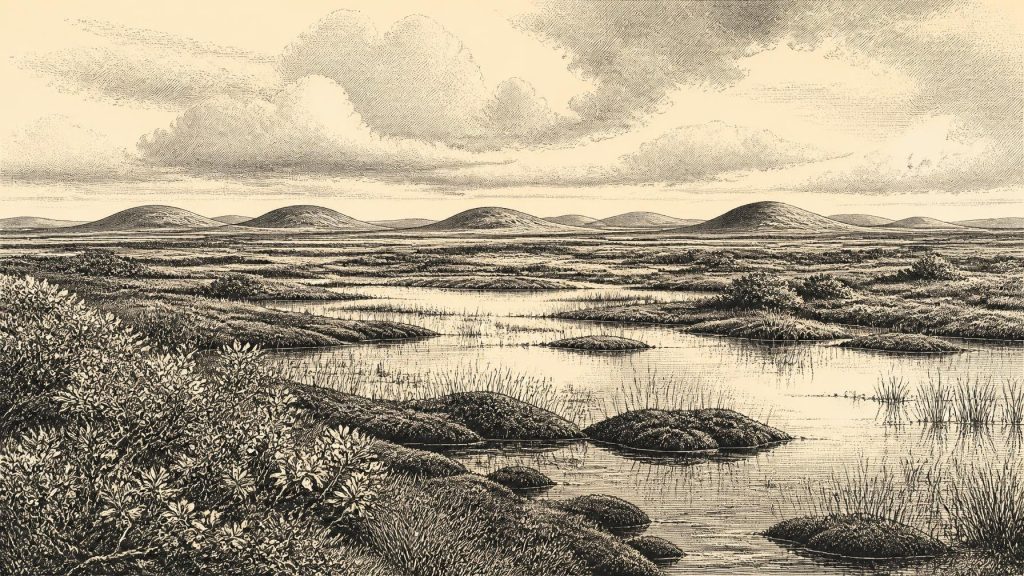
Thirty thousand years BCE, Ireland lay within the unstable cold conditions of Marine Isotope Stage 3, not a recoverable historical year. At Derryvree, County Fermanagh, organic freshwater sediments between glacial tills indicate temporary ice-free wetlands supporting tundra vegetation, including mosses, sedges, dwarf willow and juniper, before ice returned. Castlepook Cave, County Cork, preserves remains of reindeer, mammoth, giant deer and predators, showing open grassland-tundra habitats. A modified reindeer femur may indicate early human butchery, but no associated camp or settlement is known. Evidence therefore suggests precarious ecosystems and possible transient hunter-gatherer visits, while social, political and cultural life remains undocumented.
Dateline
30,258 BCE is not a year that can be recovered as an event in Irish history. It is a modern calendar label, roughly 32,207 years before AD 1950, the conventional reference point for radiocarbon chronology. No written record, seasonal diary, named community or securely dated occupation layer permits a narrative for that single year. The responsible approach is to place it within a much broader Late Pleistocene horizon: Marine Isotope Stage 3, during the Midlandian cold stage and before the greatest expansion of the last British–Irish Ice Sheet.
The closest relevant Irish evidence is environmental rather than historical. It comes from sediments, pollen and plant remains, animal bones, cave deposits, glacial landforms and radiocarbon measurements. These sources establish sequences and ranges, not annual precision. Around this notional date, Ireland was a cold, changeable north-western landscape, with local ice-free ground and wetlands in some regions but with the prospect of renewed glaciation shaping the island’s future.
A Date Within a Range
Radiocarbon ages are not calendar dates in themselves. They measure the remaining carbon-14 in once-living material, and atmospheric carbon-14 has varied over time. Calibration against independently dated records therefore converts a laboratory result into one or more probability ranges. At more than 30,000 years ago those ranges are inevitably broad. A numerical BCE date can be useful for organising a long chronology, but it must not create a false impression of precision.
For this period, one of Ireland’s most important records is Derryvree, near Maguiresbridge in County Fermanagh. Roadworks exposed a drumlin section in which organic freshwater silts and fine sands lay between two bodies of till, the unsorted sediment deposited directly by glacier ice. Organic material from the intervening deposits produced the radiocarbon determination BIRM-166, conventionally reported as 30,500 radiocarbon years before present, with a substantial error margin. Later discussion has expressed its calibrated implications broadly as about 36,900–31,700 cal BP, or approximately 34,950–29,750 BCE.
Thus 30,258 BCE falls within the wide window illuminated by Derryvree, but it cannot be attached to a particular pool, plant, animal or day. The sequence does establish something important: glacier ice had occupied the locality; a freshwater environment then developed and accumulated organic sediment; and ice later returned. It is evidence for a changing landscape over millennia, not a snapshot of all Ireland at once.
Fresh Water Beneath Future Ice
Derryvree is valuable precisely because organic deposits from this depth of time are rare in Ireland. The preserved plant macrofossils indicate a cold, open and treeless environment, often described as tundra or tundra-like muskeg. Mosses, sedges and other hardy wetland plants occupied waterlogged ground around shallow freshwater bodies. Finds reported from the deposit include bogbean, water-milfoil, dwarf willow, juniper, mountain avens and other plants able to tolerate short growing seasons, severe winters and exposed terrain.
This was not the green, wooded Ireland familiar today. There is no evidence here for continuous forest, settled farmland or a stable countryside. Rather, the evidence suggests a mosaic of wet hollows, sedgy margins, low vegetation and bare or sparsely vegetated ground. The exact appearance varied with drainage, altitude, proximity to ice and season. A drumlin basin in Fermanagh cannot simply stand for every coast, upland and lowland of the island, but it decisively complicates the popular image of Ireland as permanently buried beneath ice throughout the last Ice Age.
The waterline at Derryvree also records environmental instability. A shallow wetland could exist only where local conditions allowed liquid water and vegetation to persist through at least part of the year. Yet the tills above and below it show that such conditions were not secure. The wider North Atlantic climate repeatedly shifted during Marine Isotope Stage 3. Ireland lay at the meeting point of Atlantic moisture, continental cold and growing ice masses; ecological opportunity and glacial danger could alternate on timescales far longer than a human lifetime.
Castlepook’s Animal World
County Cork provides a complementary, though very different, archive. Castlepook Cave near Doneraile, long also called Mammoth Cave, yielded a large Pleistocene bone assemblage during excavations conducted in the late nineteenth and early twentieth centuries. Later radiocarbon work on material from its various chambers showed that the cave contains remains from more than one episode. It is therefore not a single perfectly sealed deposit, and every specimen must be interpreted with care.
Nevertheless, the fauna demonstrates that parts of Ireland supported a striking cold-stage community during broadly comparable millennia. The assemblage includes reindeer, woolly mammoth, giant deer, brown bear, wolf, Arctic fox, mountain hare, lemmings and spotted hyaena. This is strong evidence for open landscapes with enough grazing and browsing resources to sustain large herbivores, alongside predators and scavengers. It does not mean all these species stood together at one moment, nor that the cave was a peaceful natural census. Caves accumulate remains through death, scavenging, carnivore activity, sediment movement and later disturbance.
Spotted hyaena is especially revealing. Its bones, gnawed remains and the character of some cave deposits suggest that carnivores played a major role in bringing animal material underground. Castlepook may have been used as a den or scavenging place rather than as a human home. Mammoth and reindeer remains speak of a wider grassland-tundra economy in ecological terms: mobile herbivores following seasonal forage, carnivores following prey and carcasses, and a landscape where food resources were dispersed across great distances.
The Reindeer Femur Question
A reindeer femur from Castlepook has made this period unusually important for Irish archaeology. Zooarchaeologist Ruth Carden identified a linear modification on the bone and interpreted it as a cut made by a sharp stone tool during fresh-bone butchery. Public heritage accounts place the bone broadly around 31,000 BCE, while reports have described a radiocarbon age of about 33,000 years. If that interpretation is upheld, it suggests that people reached Ireland during the Upper Palaeolithic, far earlier than the formerly accepted evidence for terminal-Pleistocene human presence.
But the claim must be expressed exactly as strongly as the evidence allows. A marked bone is not a settlement. No securely associated hearth, stone-tool assemblage, dwelling, burial, camp floor, boat or hunting weapon has yet been established for this Irish horizon. Nor can the bone identify the number, language, ancestry, sex or social organisation of the people who may have processed the animal. Even the locality of butchery remains uncertain: the animal could have been cut elsewhere, with a discarded or scavenged limb later carried into the cave.
The evidence therefore supports a possibility of brief human activity, not a story of continuous occupation. If people were present, the most economical interpretation is of highly mobile hunter-gatherers moving through a wider north-west European world, exploiting reindeer or encountered carcasses when conditions, routes and resources allowed. That interpretation is plausible because Upper Palaeolithic communities elsewhere in Europe used stone tools, followed animal movements and adapted to severe climates. It remains an inference, however, rather than a directly excavated Irish camp.
Society Without a State
Political affairs, diplomacy and warfare cannot responsibly be described for Ireland in 30,258 BCE. There were no known kingdoms, borders, chiefs, treaties or named peoples on the island, and no evidence for permanent territorial institutions. If transient human groups visited, their decisions would have concerned movement, food, shelter, safety and knowledge of terrain rather than government in any later sense. Competition with large carnivores for carcasses or shelter was a real ecological pressure, but it is not evidence for organised conflict.
Likewise, there is no Irish evidence from this period for formal religion, monuments, art, literacy or a distinct ritual tradition. The deep time-depth should not be mistaken for cultural emptiness: Upper Palaeolithic people elsewhere had rich social lives and sophisticated symbolic practices. Yet it would be unsound to transfer their caves, figurines or art directly to Ireland without local finds. Ireland’s evidence can speak of habitats and animals; it is largely silent about belief, language, kinship and learning.
There was no demonstrable farming, herding, metalworking, market exchange or trade network in Ireland. The economy revealed by the fauna and environments was ecological rather than institutional: plants growing in wet ground, herbivores finding seasonal fodder, predators and scavengers exploiting animal populations, and perhaps occasional human foragers processing meat. Any contact with Britain or continental Europe remains conjectural for this exact horizon, though lower sea levels and the changing geography of the Irish Sea meant that Ireland’s separation and accessibility differed greatly from the modern island.
An Unfinished Irish Past
The most important development around this date was neither a battle nor a dynasty, but a landscape in transition. Derryvree preserves local fresh water and tundra vegetation between glacial episodes; Castlepook preserves a cold-adapted animal community and a debated clue to human butchery. Together they show that Ireland’s Ice Age history was more varied than a simple narrative of total ice cover followed by sudden recolonisation.
For 30,258 BCE, certainty lies in the layered evidence: cold conditions, open habitats, wetland refuges in at least some places, large mammals and an unstable glacial setting. Interpretation begins when those traces are assembled into a wider picture of animal movement and possible human visits. Future excavation, improved dating and renewed study of museum collections may alter that picture. For now, Derryvree’s buried waterline remains the clearest Irish reminder that life persisted, locally and precariously, in the long interval before the ice returned.
Primary Sources
- The Stratigraphic Position and Age of the Gortian
- Trimlines, Blockfields and the Vertical Extent of the Last Ice Sheet in Southern Ireland
- The Timing and Magnitude of the British–Irish Ice Sheet Between Marine Isotope Stages 5d and 2
- Growth and Retreat of the Last British–Irish Ice Sheet, 31,000 to 15,000 Years Ago: The BRITICE-CHRONO Reconstruction
- Pleistocene Glaciations in Ireland
- Radiocarbon Constraints on the Age of the Maximum Advance of the British–Irish Ice Sheet in the Celtic Sea
- Dimensions and Chronology of the Last Ice Sheet in Western Ireland
- The IntCal20 Northern Hemisphere Radiocarbon Age Calibration Curve (0–55 cal kBP)
- IntCal History
- Figure 6: The Subdivision of the Quaternary Period in Ireland
- A Field Guide to Some Aspects of the Quaternary History of South Fermanagh
- Archaeological Heritage of County Cork
- Heritage Artefacts of County Cork
- 2022:564 — Castlepook Cave, Castlepook South, Cork
- The Irish Quaternary Fauna Project
- Ireland’s Palaeolithic Archaeology – Fleeting Footprints in a Frozen Land
- First Evidence of a Late Upper Palaeolithic Human Presence in Ireland
- New Insights on the Fauna of Ireland’s Younger Dryas and Early Holocene from Alice & Gwendoline Cave
- Timing and Pace of Ice-Sheet Withdrawal Across the Marine–Terrestrial Transition West of Ireland During the Last Glaciation
- The Deglaciation of the Western Sector of the Irish Ice Sheet from the Inner Continental Shelf to its Terrestrial Margin
- BRITICE-CHRONO Project Introduction
- Irish Quaternary Association: Outreach and Education Resources