Threeleaf Pools at Maguiresbridge30183 BCE
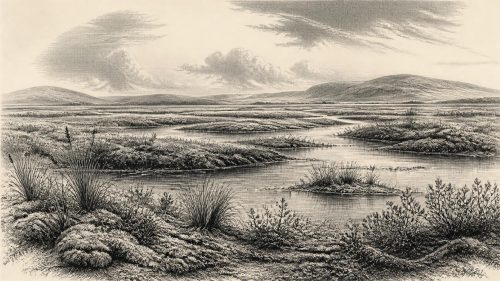
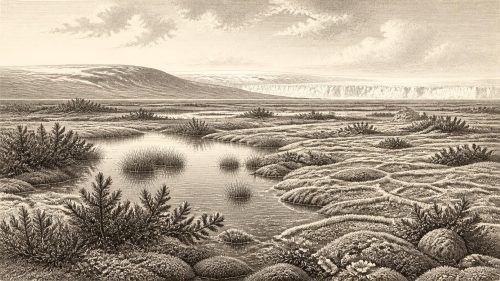
At 30,183 BCE, Ireland has no recoverable annual history or confirmed human settlement. Derryvree, near Maguiresbridge, provides evidence from freshwater sediments between glacial tills, dated broadly to 36,900–31,700 calibrated years BP. These reveal a locally ice-free, treeless wetland of pools, sedges, mosses, grasses and cold-adapted plants, subject to severe seasonal conditions before renewed glaciation. Ice extent elsewhere remained variable and uncertain. Castlepook Cave’s mixed fauna demonstrates intermittent availability to mammoth, reindeer and predators, while a possibly cut-marked reindeer bone suggests unproven brief human activity. No evidence supports resident communities, political life or reconstructed society; ecological remains form the principal archive.
Dateline
30,183 BCE is not a date to which Irish prehistory can attach a recoverable event. No calendar, written record, settlement sequence or archaeological layer allows historians to identify a particular year, season, leader or encounter. In conventional chronological terms it falls roughly 32,100 calibrated years before present (where “present” is AD 1950), within the Late Pleistocene and Marine Isotope Stage 3. The responsible history of Ireland at this point must therefore be told through dated ranges, buried sediments, fossil remains and the limits of what those traces can demonstrate.
A Date Within a Range
The closest direct chronological guide is not a human site but a road-cut through a drumlin at Derryvree, near Maguiresbridge in County Fermanagh. In 1969, excavations exposed freshwater silts and fine sands trapped between two separate layers of glacial till. Organic matter from the intervening deposit produced a conventional radiocarbon determination of 30,500 +1,170/−1,030 radiocarbon years BP, known as Birm-166. Subsequent calibration places the evidence broadly within about 36,900–31,700 calibrated years BP. The modern label 30,183 BCE falls within that wide range, near its younger end, but it does not date a single day or even necessarily one generation in the life of the wetland.
The Derryvree sequence establishes a substantial point. Before a later glacier covered the area, part of north-central Ireland was ice-free long enough for fresh water, sediment, plants and small animals to accumulate in a basin. Beneath the organic layer lay an older till, deposited by ice; above it lay another till, left by a later advance. Ireland’s Ice Age was consequently not a uniform, permanent white cover. At least locally, ice advanced, retreated or thinned sufficiently to leave exposed ground and freshwater habitats, before renewed glaciation buried much of the evidence.
A Treeless Freshwater Landscape
The fossils at Derryvree give the clearest picture available for an Irish landscape broadly contemporary with this notional year. Poorly preserved pollen, plant macrofossils, mosses and insects indicate an open, predominantly treeless environment. Grasses, sedges and herbs were important; recorded plant remains include bogbean, water-milfoil, mountain avens, dwarf willow and lesser clubmoss. Together they suggest a mosaic of shallow pools, wet sedge margins, mossy ground and sparsely vegetated, frost-affected terrain. It has often been described as tundra or muskeg-like, useful comparisons provided they are not mistaken for exact modern equivalents.
This was not an empty wilderness. Water-milfoil points to freshwater; bogbean and sedges to saturated margins; dwarf willow and mountain avens to cold-tolerant vegetation on nearby ground. Insects add evidence for plant-rich wet conditions around open pools. Yet the combination also implies rigorous winters, short growing seasons and seasonal freeze–thaw. Sparse dry-land vegetation would have left much soil exposed to wind, frost heave and runoff. Woodland cannot responsibly be reconstructed here: occasional tree pollen grains may have travelled long distances, while the overall assemblage strongly favours an open landscape.
Ice in Motion
This landscape existed during a volatile part of the last glacial cycle. The older Irish term “Derryvree Cold Phase” reflects the importance of the Fermanagh deposit, though modern research more often places it within the shifting climatic episodes of Marine Isotope Stage 3. The exact extent of ice over Ireland at any one moment remains debated. Recent work on the British–Irish Ice Sheet indicates that ice-sheet growth was neither simple nor simultaneous around these islands. Scottish ice was expanding rapidly through the North Minch around 32,000–31,000 years ago, while other sectors developed on different schedules.
For Ireland, Derryvree is firm evidence of locally ice-free conditions during its dated interval, not a map of the whole island. Offshore evidence, raised shorelines, landforms and sediments indicate that glaciers and ice margins were dynamic during the broader cold stage. The great late-glacial expansion that reshaped much of Ireland lay ahead or was still developing in many regions; its maximum was also asynchronous rather than a single island-wide moment. The key fact for 30,183 BCE is uncertainty bounded by evidence: north Fermanagh could sustain a cold freshwater ecosystem, but the wider geography of ice, coast and exposed land changed across centuries and millennia.
Cave Fauna and Cautious Comparisons
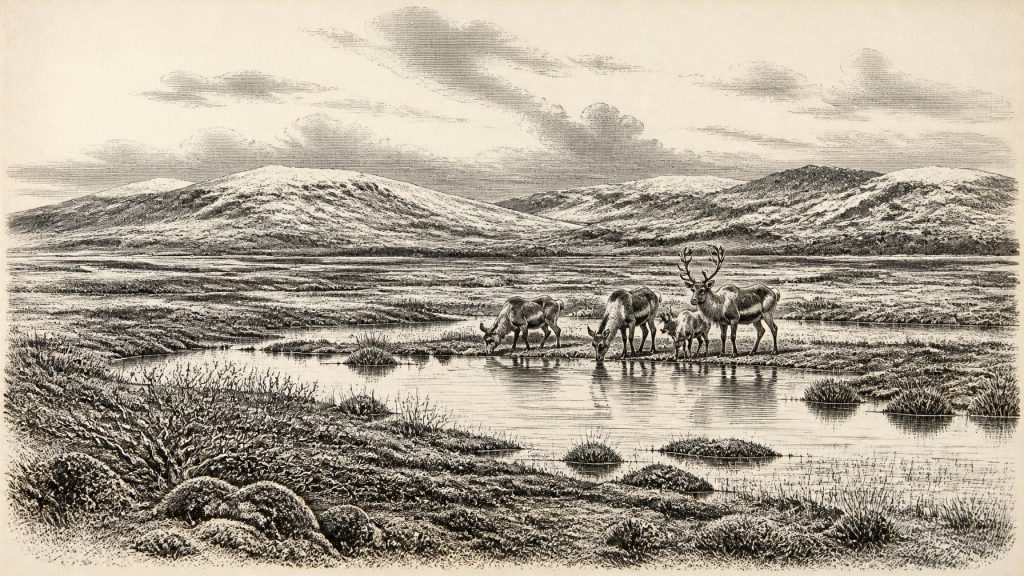
Castlepook Cave, near Doneraile in north County Cork, supplies a complementary but less precisely contemporary record of Late Pleistocene life. Its old collections include remains of woolly mammoth, reindeer, spotted hyaena, brown bear, wolf, Arctic fox, lemmings and other animals. Some dated remains belong to earlier portions of the wider middle-last-glacial interval rather than precisely to 30,183 BCE. They should not be treated as a census of animals standing together in one Cork valley at this particular point. Cave deposits can accumulate over long spans through carnivore activity, natural death, water movement and excavation disturbance.
Even so, Castlepook demonstrates that Ireland was repeatedly available to cold-adapted mammals during portions of the Late Pleistocene. Reindeer, mammoth and hyaena evoke an open grass-and-herb landscape capable of supporting large herbivores and their predators, rather than dense forest. Their presence also raises questions about changing routes into and out of Ireland when sea levels were lower and coastlines differed greatly from those of today. But fossil occurrence does not reveal whether a route was dry, coastal, seasonal or crossed by water. The movements of animals must not be converted automatically into a demonstrated land bridge or a human migration route.
The Human Question
Political affairs, diplomacy and warfare cannot be written for Ireland at this date. There are no known states, named communities, monuments, cemeteries, villages, tool industries or securely dated occupation floors from around 32,100 calibrated years BP. The National Museum of Ireland accordingly continues to state that no clear evidence has emerged for human presence in Palaeolithic Ireland. That caution is essential, particularly because later glaciers eroded, redistributed and buried older landscapes.
There is, however, an intriguing claim from Castlepook. A reindeer femur, publicly reported as about 33,000 radiocarbon years old, bears a deep linear mark interpreted by palaeozoologist Ruth Carden as damage made by a sharp stone implement during fresh-bone butchery. If that interpretation is confirmed, it would indicate that people handled a reindeer in Ireland during the Upper Palaeolithic, vastly earlier than the island’s well-established post-glacial settlement record. It would not prove a permanent population. The bone came from an old, complex cave assemblage, without a securely associated hearth, stone-tool collection, built shelter, human remains or occupation surface. Its radiocarbon date records the animal’s death, not the precise instant of any incision.
The sound conclusion is therefore deliberately modest. Humans may have made brief incursions into Ireland in this broad period, perhaps following or exploiting animal resources, but no evidence presently establishes a resident community at 30,183 BCE. Nor can archaeology identify their language, ancestry, social organisation or links with groups in Britain or continental Europe. A single possible act of carcass processing is not evidence for a tribe, a polity or a continuing settlement.
Life Without a Recorded Society
For the same reason, there is no responsible basis for describing farms, trade, formal religion, learning, property or diplomacy. If people were present, their immediate economy would almost certainly have depended on highly mobile hunter-gatherer practices familiar elsewhere in Upper Palaeolithic Europe: acquiring food, fuel and workable stone in a demanding seasonal environment. But that is a comparative inference, not an observed Irish settlement pattern. Ireland supplies no contemporary house, hearth, clothing, ornament, ritual site or exchange network from which to reconstruct everyday life.
The more securely visible economy was ecological. Plants fixed energy in short summer seasons; herbivores grazed open ground; carnivores and scavengers used caves and carcasses; freshwater pools supported their own small communities. Derryvree’s mosses, seeds and insect remains are therefore not minor background details. They are the primary archive for how life persisted in a difficult northern landscape. In a period without texts or conventional historical actors, a buried seed and a layer of silt can be more informative than any later legend.
An Archive Buried by Ice
Ireland around 30,183 BCE was a changing Pleistocene landscape, not a nation with a recoverable annual history. The Derryvree freshwater deposits provide the strongest evidence: a cold, open wetland in Fermanagh, present during a calibrated range that includes this modern date and subsequently sealed beneath glacial sediment. Castlepook broadens the setting with an extraordinary, though chronologically mixed, cave fauna and a possible trace of human butchery. Together they show why certainty must remain proportional to the evidence. The island was not simply lifeless beneath ice, but neither can it be furnished with an invented population, event or political past.
Primary Sources
- A Middle Midlandian Freshwater Series at Derryvree, Maguiresbridge, County Fermanagh, Northern Ireland
- Growth and Retreat of the Last British–Irish Ice Sheet, 31,000 to 15,000 Years Ago: The BRITICE-CHRONO Reconstruction
- The Timing and Magnitude of the British–Irish Ice Sheet Between Marine Isotope Stages 5d and 2: Implications for Glacio-Isostatic Adjustment, High Relative Sea Levels and ‘Giant Erratic’ Emplacement
- New Insights on the Fauna of Ireland’s Younger Dryas and Early Holocene from Alice & Gwendoline Cave
- Pleistocene Glaciations in Ireland
- Quaternary Deposits and Glacial Stratigraphy in Ireland
- Maximum Extent and Dynamic Behaviour of the Last British–Irish Ice Sheet West of Ireland
- Depositional Evidence for Marginal Oscillations of the Irish Sea Ice Stream in Southeast Ireland During the Last Glaciation
- Irish Pleistocene Biostratigraphy
- The Irish Quaternary Fauna Project
- Regional Pleistocene Geology
- Palaeoecology
- Prehistoric Details: Mell Flint Flake
- The Archaeological Heritage of County Cork
- Exploring the Continental Shelves Around Ireland: The Geomorphology and Sedimentary Architecture of the Malin Sea and Donegal Bay Ice Streams
- Irish Ice Sheet Dynamics During Deglaciation of the Central Irish Midlands: Evidence of Ice Streaming and Surging from Airborne LiDAR
- Ireland Under the Ice
- Deposits of the Last Glaciation
- Menyanthes trifoliata
- Dryas octopetala