Maguirebridge’s Arctic Waterline30128 BCE
30,128 BCE is a modern label for a Late Pleistocene interval, not a recoverable Irish historical date. Environmental evidence from Derryvree, County Fermanagh, records a cold, treeless wetland between glacial advances, with sedges, grasses, mosses, aquatic plants and hardy shrubs. Castlepook Cave, County Cork, preserves MIS 3 fauna including mammoth, reindeer, giant deer, predators and scavengers, indicating productive open habitats. A possibly tool-marked reindeer bone suggests, but does not establish, early human presence. Lower sea levels altered routes, while later ice destroyed evidence. These fragile archives reveal changing ecosystems before extensive glaciation, not named communities, events or institutions in Ireland.
Dateline
30,128 BCE is a modern calendar label, not a date at which an Irish event can be recovered. No written calendar, named community, ruler, settlement or historical episode is available for Ireland at this depth of time. The date falls within the Late Pleistocene, during Marine Isotope Stage 3 (MIS 3), one of the climatically volatile phases of the last Ice Age. Modern calendar-year precision is not possible: even the best evidence consists of deposits and bones dated within broad statistical ranges, then calibrated against changing levels of atmospheric radiocarbon. The responsible task is therefore to examine what can illuminate Ireland around this point, rather than inventing a day, season or event for it.
The strongest Irish evidence is environmental rather than archaeological. It comes chiefly from a buried wetland sequence at Derryvree, near Maguiresbridge in County Fermanagh, and from animal remains recovered at Castlepook Cave near Doneraile in County Cork. These archives are separated by much of the island and do not describe one contemporaneous landscape. Yet both show that Late Pleistocene Ireland was not simply a timeless ice desert. In particular places and intervals, cold-adapted plants and animals occupied ground that was ice-free, seasonally wet or otherwise available between glacial advances.
A Point Within a Long Range
In archaeological convention, “before present” means before 1950. The nominal date of 30,128 BCE is therefore roughly 32,077 years before present in simple calendar arithmetic. That calculation must not be confused with a radiocarbon age. The principal Derryvree determination, BIRM-166, was reported as 30,500 radiocarbon years BP, with a substantial error range of +1,170 and −1,030 years. Because radiocarbon years and calendar years diverge markedly this far back, it cannot be converted into a single trustworthy BCE year. Calibration using modern curves indicates a broad span, commonly expressed at approximately 36,900–31,700 calibrated years BP. The numbered year considered here lies within that wide chronological neighbourhood, but cannot be assigned to one plant, pool, animal or layer of sediment.
This uncertainty matters because the climate of MIS 3 altered repeatedly, sometimes rapidly in geological terms. Terms such as the “Derryvree Cold Phase” are useful labels for a body of evidence, but not names for a uniformly cold, island-wide episode with sharp borders. Irish glacial stratigraphy is difficult: later ice frequently eroded, redeposited or buried earlier landscapes. The Derryvree sequence is valuable precisely because a small environmental archive survived that destructive history.
The Wetland Beneath the Drumlin
Roadworks exposed the Derryvree deposits in 1969. A lower till, formed by glacier ice, lay beneath fine sediments and organic material; a later till sealed the sequence above. This order provides firm relative evidence. Ice had affected the locality, an interval followed in which sediment accumulated in freshwater or waterlogged conditions, and later glaciation overrode the site. It does not prove that all Ireland was ice-free at the same time. It does prove that this part of Fermanagh preserved a non-glacial environment between phases of ice occupation.
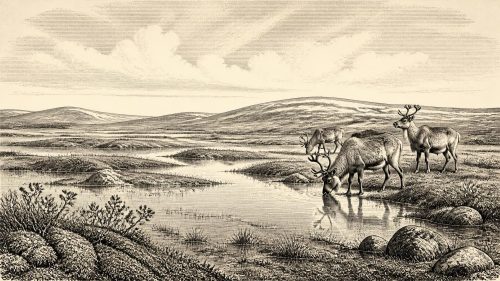
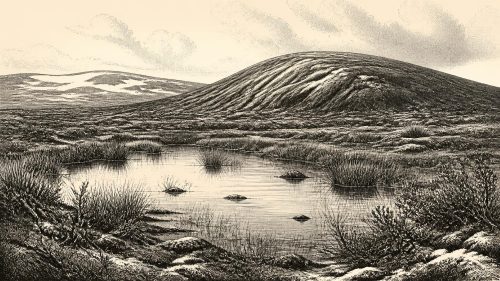
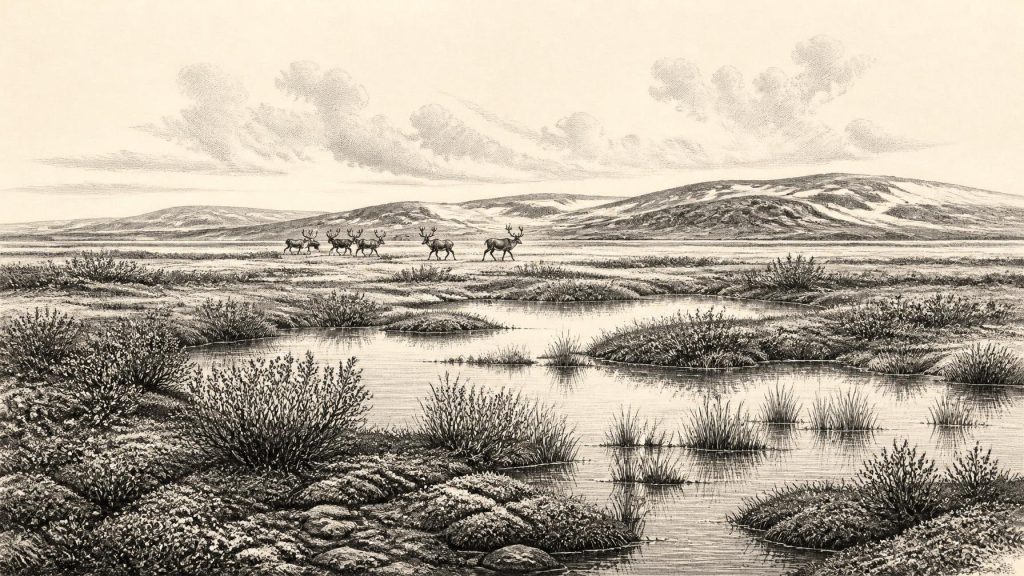
Fossil pollen, plant macrofossils, mosses and insects suggest open, treeless and wet ground. Grasses and sedges were important; juniper and hardy herbs occurred; aquatic plants, including alternate water-milfoil and bogbean, point to shallow water or wet margins. Mosses, insects and organic detritus support the interpretation of a cold muskeg-like mosaic: saturated ground, pools, mossy edges and sparse vegetation rather than woodland. Dwarf willow, mountain avens and lesser clubmoss belong to the broader picture of vegetation capable of enduring cold, exposed conditions.
Such evidence should not be made more precise than it is. It cannot tell us whether a particular summer was mild, whether snow lay in a specified valley, or how far each plant extended across Ireland. It does, however, rule out familiar modern scenery. There were no oak woods, hedged fields, farms or permanent villages at Derryvree. The landscape was likely shaped by frost, thaw, shallow standing water and a short productive growing season. In places, vegetation could sustain herbivores; in others, frozen ground, wind exposure and changing drainage would have made life difficult.
Animals in the Cork Caves
Castlepook Cave, also called Mammoth Cave, provides a different but complementary archive. Antiquarian excavations begun by Richard J. Ussher in the early twentieth century recovered a remarkably varied assemblage of Ice Age animal remains. Animals represented in the wider Castlepook record include woolly mammoth, reindeer, giant deer, brown bear, wolf, foxes, hare, lemmings and spotted hyaena. Older radiocarbon work placed a mammoth and a hyaena bone at roughly 35,000 and 34,300 radiocarbon years BP respectively. More recent ultrafiltration dating has shown that several earlier cave determinations were too young, strengthening the conclusion that some Irish fauna belongs to MIS 3 and, in some cases, was present before the Last Glacial Maximum.
That does not mean every species stood together outside the cave in 30,128 BCE. Cave deposits can accumulate over long periods. Carnivores may drag in carcass parts; water, frost, collapse and excavation can disturb layers; and many early excavations did not record contexts to modern standards. Castlepook is therefore evidence for a regional succession of animals in cold-stage Ireland, not a census for a particular year. Its hyaenas are particularly significant: the cave could function as a carnivore den as well as a place into which bones arrived by other processes.
Together, the Fermanagh wetland and Cork cave fauna indicate a productive but demanding environment. Reindeer and mammoth imply open habitats with adequate forage, while large predators and scavengers point to a food web richer than Ireland’s later historical fauna. Giant deer may have moved seasonally across broad ranges, though direct evidence does not map their routes. These animals were part of north-west Europe’s shifting Ice Age biogeography, not creatures isolated within a stable Irish refuge.
The Human Question
A reindeer femur from Castlepook has been publicised as bearing a deep mark interpreted by zooarchaeologist Ruth Carden as made by a sharp stone tool during butchery. Public heritage material has associated the specimen with an age of about 31,000 BC. If the mark is confirmed as human-made and contemporary with the animal’s death, it would be important evidence that Upper Palaeolithic people reached Ireland far earlier than the long-established record of terminal-Pleistocene activity.
For this date, however, the conclusion must remain narrow. A bone date establishes when an animal died, not automatically when any surface mark was made. Identifying a cut mark also requires comparison with damage caused by carnivores, trampling, sediment movement and excavation. No securely associated stone-tool assemblage, hearth, dwelling floor, burial, human bone, artwork or stratified settlement of this age has been demonstrated in Ireland. The 2022 Castlepook investigations found surviving deposits but also confirmed how extensively earlier work had depleted the cave’s Pleistocene sediments.
It follows that political affairs, diplomacy, warfare, formal religion, learning, trade and institutions cannot responsibly be described for Ireland in 30,128 BCE. There is no evidence for chiefs, tribes, alliances, ritual sites, exchange networks or a resident population. If people did enter the island during a more favourable interval, they may have been highly mobile hunter-gatherers familiar with animal behaviour, stone cutting edges and severe seasonal conditions. That is an inference from contemporary Upper Palaeolithic lifeways elsewhere in Europe, not a demonstrated Irish society.
An Island in Transition
Ireland’s position also differed from today’s. Global sea level was lower during the Ice Age, exposing wider coastal plains on parts of the continental shelf, but the precise configuration of routes between Ireland, Britain and mainland Europe at this early stage remains uncertain and changed through time. It would be unsafe to claim a simple land bridge or an easy migration corridor. Any animal or human arrival depended on the shifting relationship of sea, ice, coastal lowlands and climate, not on modern shorelines.
The major expansion of the British–Irish Ice Sheet still lay ahead. Syntheses place its maximum Irish extent broadly around 27,000–23,000 calibrated years BP, when ice covered the island and much of its shelf. In the period represented by Derryvree and Castlepook, some landscapes were therefore available to plants and animals, but this opportunity was precarious. Later ice would scour terrain, rearrange sediments and conceal much of the evidence needed to recover a fuller account.
What the Evidence Preserves
The historical importance of this notional year lies not in a named event but in the survival of unusually fragile clues. Derryvree preserves water, moss, sedges and cold-tolerant plants between tills. Castlepook preserves the remains of animals that crossed or inhabited an unstable Ice Age landscape, alongside a provocative but unconfirmed indication of human butchery. These records reveal an Ireland of open wetland, cold grassland and moving fauna, poised before more extensive glaciation. They also set a necessary limit: for 30,128 BCE, evidence can recover environments and possibilities, but not a year-by-year human history.
Primary Sources
- The subdivision of the Quaternary Period in Ireland
- Introduction to the Quaternary of Fermanagh
- A reconsideration of the radiocarbon dating of the Marine Isotope Stage 3 fauna from southern Ireland
- New insights on the fauna of Ireland’s Younger Dryas and Early Holocene
- 2022:564 – Castlepook Cave, Castlepook South, Cork
- Heritage Artefacts of County Cork
- Pattern and timing of retreat of the last British-Irish Ice Sheet
- Pleistocene glaciations in Ireland
- New data for the Last Glacial Maximum in Great Britain and Ireland
- Trimlines, blockfields and the vertical extent of the last ice sheet in southern Ireland
- Dimensions and chronology of the last ice sheet in western Ireland
- Deglaciation chronology of the Donegal Ice Centre, north-west Ireland
- Ireland: Submerged Prehistoric Sites and Landscapes
- Quaternary deposits and glacial stratigraphy in Ireland
- Irish Pleistocene biostratigraphy
- The Geology of Ireland: Cenozoic, Tertiary and Quaternary
- The Irish Quaternary Fauna Project
- The exploration of Castlepook Cave, Co. Cork. With 3 plates
- Introduction to the Late Quaternary and Holocene of Northern Ireland
- Introduction to the glacial Sand and Gravel Landscapes of Northern Ireland
- The IntCal20 Northern Hemisphere Radiocarbon Age Calibration Curve (0–55 cal kBP)
- Response of the Irish ice sheet to abrupt climate change during the last deglaciation