Greenagho’s Tundra Archive31383 BCE
At the notional date of 31,383 BCE, Ireland was within the climatically unstable MIS 3 of the Late Pleistocene, not a historically documented society. Buried deposits at Greenagho and Derryvree in County Fermanagh indicate locally ice-free freshwater wetlands, tundra vegetation and periglacial conditions before later ice-sheet expansion. Plant, insect and sediment evidence reveals cold but productive, varied habitats. Castlepook Cave in County Cork preserves remains of mammoth, reindeer, giant deer, predators and scavengers, accumulated across long periods. A cut-marked reindeer bone suggests possible transient human activity, but cannot prove settlement. Mobile ice, changing seas and remains preclude conclusions about settlement.

Dateline
Modern calendar-year precision is not available for Ireland in 31,383 BCE. No people on the island kept a calendar that can be connected to that numerical year, and neither radiocarbon dating nor glacial deposits can identify an event within a single year so far back. The label is best treated as a point within a much wider Late Pleistocene interval: roughly 33,333 years before AD 1950, the conventional radiocarbon reference date. In archaeological terms, this belongs to Marine Isotope Stage 3 (MIS 3), a climatically unstable part of the last Ice Age, long before the later maximum expansion of the British–Irish Ice Sheet.
The most responsible account of Ireland at this horizon is therefore not a chronicle of rulers, battles or settlements. It is a reconstruction from scattered physical traces: sediments trapped beneath glacial deposits, pollen and plant remains, insects, cave bones, radiocarbon measurements and the shapes of landforms. These sources show that parts of Ireland could support cold-climate ecosystems during this broad period. They cannot demonstrate a continuous population, a named people, a political community or a year-specific human event.
A Date Inside Broad Ranges
The closest particularly useful Irish record comes from Derryvree, near Maguiresbridge in County Fermanagh. Road cutting in 1969 exposed fine sands, freshwater silts and organic material sealed between two distinct beds of till, the stony debris deposited by glacier ice. The sequence gives a secure relative order: ice occupied the locality; an ice-free interval then allowed water, mud and organic remains to accumulate; later ice overrode and buried the deposit. That survival is exceptional, because subsequent glaciation removed or disturbed much of Ireland’s older Pleistocene landscape.
The Derryvree organic layer produced a conventional radiocarbon result of 30,500 years BP, with a large uncertainty. Subsequent calibration has placed it broadly at about 36,900–31,700 calendar years BP, approximately 34,950–29,750 BCE. The requested year falls within that range, but it must not be treated as a date for any individual sediment layer, plant, animal or activity. It simply means that Derryvree can illuminate the environmental world around this notional point.
Greenagho, near Belcoo in the same county, provides a related but older regional indication. Organic material from a lake deposit beneath till has been calibrated to roughly 37,200–35,700 calendar years BP. Together, Greenagho and Derryvree show that north-central Ireland had experienced intervals of exposed land and freshwater conditions before the later, much more extensive ice-sheet growth. They do not prove that every Irish valley, coast and upland was simultaneously ice-free. Ice margins were mobile, and conditions varied considerably by district, elevation and proximity to the sea.
Wet Ground in a Cold Land
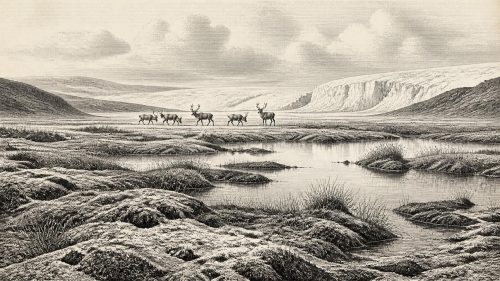
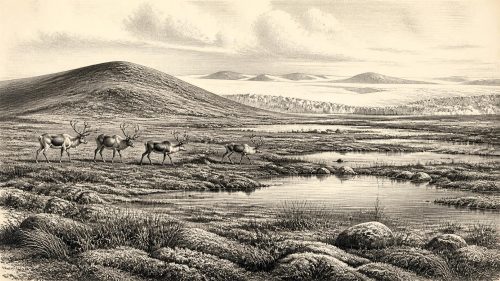
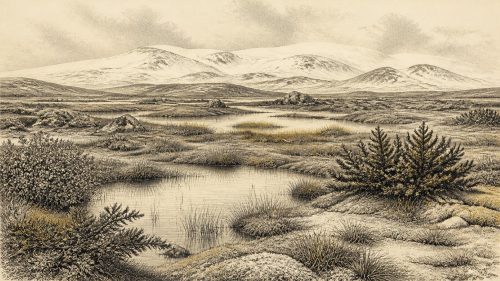
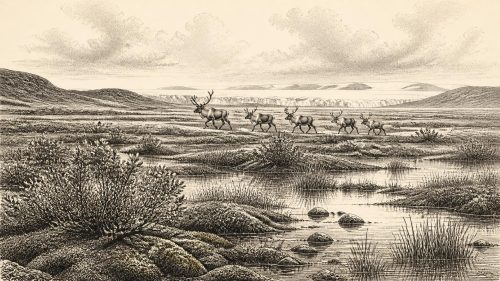
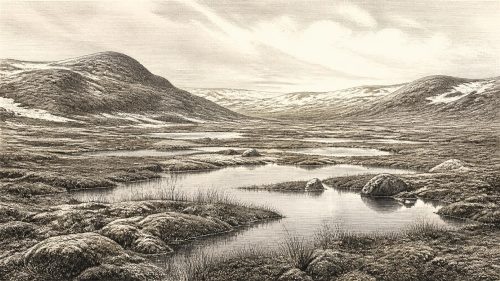
Derryvree’s plant and animal remains point to open tundra vegetation and a periglacial climate. “Periglacial” does not mean a landscape permanently covered by glacier ice. It denotes country shaped by intense cold, frequent freezing and thawing, seasonal meltwater and often frozen or unstable ground near an ice margin. The site was not the familiar green, wooded Ireland of recent millennia. It was a treeless setting of wet hollows, shallow freshwater, sedges, mosses, herbs and low-growing shrubs, with exposed ground beyond the waterlogged margins.
Fossil evidence includes mosses, arctic-alpine plants and aquatic species. A seed of bogbean, a plant now associated with wet, peaty ground, is among the striking finds. Such evidence supports the presence of standing or slow-moving freshwater and vegetated marshy edges. Pollen and macrofossils preserve what was growing locally or nearby; beetle and other invertebrate remains add evidence about temperature, moisture and habitat. Taken together, they indicate that this was not a sterile polar desert. Brief summers could sustain productive wetland and herb-rich ground, although winters were severe and the growing season was short.
This evidence is stronger for local landscape than for exact weather. It is reasonable to infer repeated seasonal stress: snow cover, frozen soils, spring thaw, changing drainage and strong winds across open terrain. It is not responsible to assign a particular temperature, rainfall total or snow depth to 31,383 BCE. Nor should “tundra” imply a single uniform habitat. Wet pools and sedge beds at Derryvree would have differed from drier slopes, limestone ground and coastal plains elsewhere.
Animals of Castlepook
County Cork supplies the other major Irish window onto this deep past. Castlepook Cave, near Doneraile in the Awbeg valley, has produced Ireland’s richest recorded assemblage of Pleistocene vertebrate remains. Its cave deposits include woolly mammoth, reindeer, giant deer, brown bear, wolf and spotted hyaena. Some specimens date broadly to the MIS 3 world relevant to this article; others are substantially older or younger. A cave collection accumulated over long periods is not a photograph of one living landscape, so the complete species list must not be imagined as one herd assemblage seen on a single day.
Even with that caution, Castlepook demonstrates the ecological possibilities of Ice Age Ireland. Reindeer were adapted to cold, open environments and could move over long distances. Mammoths and giant deer indicate that substantial herbivores could at times use parts of the island, while wolves and spotted hyaenas reveal a predator and scavenger guild. Caves were not necessarily human homes: they could collect bones through carnivore activity, natural deaths, water movement and later disturbance. The presence of a bone is evidence for an animal or its remains reaching a site, not automatically for a living population in the immediate neighbourhood.
The locations of Derryvree and Castlepook, in Fermanagh and north Cork, also warn against portraying Ireland as a fixed island in the modern sense. Global sea level was much lower during the Ice Age, and the Irish Sea basin, shelves and routes towards Britain were configured differently. Yet lower sea level did not create a simple, permanently dry road from Ireland to continental Europe. Ice, marine water, changing coastlines and difficult terrain all mattered. Any movement of animals or people depended on conditions that changed over centuries and millennia.
The Human Question
A reindeer femur from Castlepook has transformed discussion of the earliest possible human presence in Ireland. Excavated in the early twentieth century and held in the National Museum of Ireland’s collections, it was later recognised as bearing a mark interpreted as having been made by a stone tool. Radiocarbon dating was publicised as placing the bone at about 33,000 years old. County Cork heritage material consequently describes it as evidence that humans hunted or butchered reindeer in Ireland around 30,000 BCE.
The evidence deserves both attention and restraint. A cut-marked, dated reindeer bone is important evidence consistent with a human encounter with an animal carcass. It makes a transient Upper Palaeolithic human presence plausible around the broad period in question, far earlier than the formerly accepted Irish record. It does not establish a permanent settlement at Castlepook, a population size, a camp layout, a route into Ireland, or an unbroken line of occupation leading to later peoples. No securely associated dwelling, hearth, stone-tool assemblage or burial presently permits such claims. Ongoing archaeological work at Castlepook seeks precisely the contextual evidence that could test and refine this interpretation.
If people did visit, their way of life is better understood as highly mobile foraging than as village life. Across north-west Europe, Upper Palaeolithic groups used portable equipment, detailed knowledge of animal movements and seasonal landscapes, and social networks extending beyond any one campsite. That broader comparison can suggest possibilities for Ireland, but it is not direct proof of Irish language, kinship, belief, clothing, technology or ritual. The Castlepook femur cannot tell us whether its modification resulted from a hunt, scavenging, a short stop beside a carcass or activity elsewhere before the bone reached the cave.
No States, No Recorded Conflict
There is no evidence from Ireland around this time for political institutions, chiefs, diplomacy, warfare, territorial boundaries, formal religion, writing, schools, farming or trade in the later historical senses. It would be misleading to fill those absences with imagined Ice Age tribes or assign modern regional identities to mobile groups. The relevant human scale, if humans were present at all, was likely small and temporary. Ecological pressures rather than political affairs dominate the available record: access to freshwater, shelter, fuel, animal resources and routes through a cold, changing landscape.
Culture and learning nevertheless need not have been absent. Mobile hunter-gatherers elsewhere in Upper Palaeolithic Europe possessed sophisticated practical knowledge and rich symbolic traditions. But Ireland has not yielded evidence that can responsibly identify comparable art, ceremony or teaching at this date. The careful conclusion is not that no such life existed, but that the Irish record is too sparse and too damaged by later glaciation to recover it.
Before the Great Ice Expansion
At 31,383 BCE, Ireland lay before the peak of the last glaciation, not after it. The broad build-up of the final British–Irish Ice Sheet is reconstructed between about 31,000 and 26,000 years ago, while the ice sheet’s greatest total volume came later, around 23,000 years ago. Different sectors advanced and retreated asynchronously, rather than as one uniform wall. Thus the most defensible picture is of an unstable threshold: locally ice-free tundra wetlands and animal corridors survived in some areas, while colder conditions and expanding ice were increasingly reshaping the wider region.
Greenagho’s buried lake deposits and Derryvree’s silts preserve the environmental side of that transition; Castlepook preserves its fauna and a provocative possible trace of people. Their combined lesson is modest but momentous. Ireland was not beyond the reach of Ice Age ecosystems, nor necessarily beyond the reach of human visitors. Yet it was not a documented human country in the historical sense. The archive for this date is written chiefly in mud, pollen, bone and ice.
Primary Sources
- A Middle Midlandian Freshwater Series at Derryvree, Maguiresbridge, County Fermanagh, Northern Ireland
- Middle Midlandian Interstadial Deposits at Greenagho, Near Belcoo, County Fermanagh, Northern Ireland
- The Quaternary History of Ireland: Field Guide 17
- Growth and Retreat of the Last British–Irish Ice Sheet, 31 000 to 15 000 Years Ago: the BRITICE-CHRONO Reconstruction
- Pattern, Style and Timing of British–Irish Ice Sheet Advance and Retreat Over the Last 45 000 Years: Evidence from NW Scotland and the Adjacent Continental Shelf
- Trimlines, Blockfields and the Vertical Extent of the Last Ice Sheet in Southern Ireland
- New Data for the Last Glacial Maximum in Great Britain and Ireland
- Dimensions and Chronology of the Last Ice Sheet in Western Ireland
- Cosmogenic 10Be Chronology of the Last Deglaciation of Western Ireland, and Implications for Sensitivity of the Irish Ice Sheet to Climate Change
- Episodic Speleothem Deposition Tracks the Terrestrial Impact of Millennial-Scale Climate Variability During the Last Glacial Period
- The Nature and Timing of MIS 3 Interstadials; New Constraints from U-Series Dated Speleothems from Crag Cave, S.W. Ireland
- Castlepook Cave, County Cork: County Geological Site Report
- Heritage Artefacts of County Cork
- Archaeology Research Excavation Grant Report: Castlepook Cave, County Cork
- The Irish Quaternary Fauna Project
- Castlepook Caves
- Mammoth Cave, County Cork
- First Evidence of a Late Upper Palaeolithic Human Presence in Ireland
- The Mesolithic in Ireland: When Was It?
- Menyanthes trifoliata: Bogbean in Fermanagh