
Maguirebridge’s Brief Thaw31451 BCE
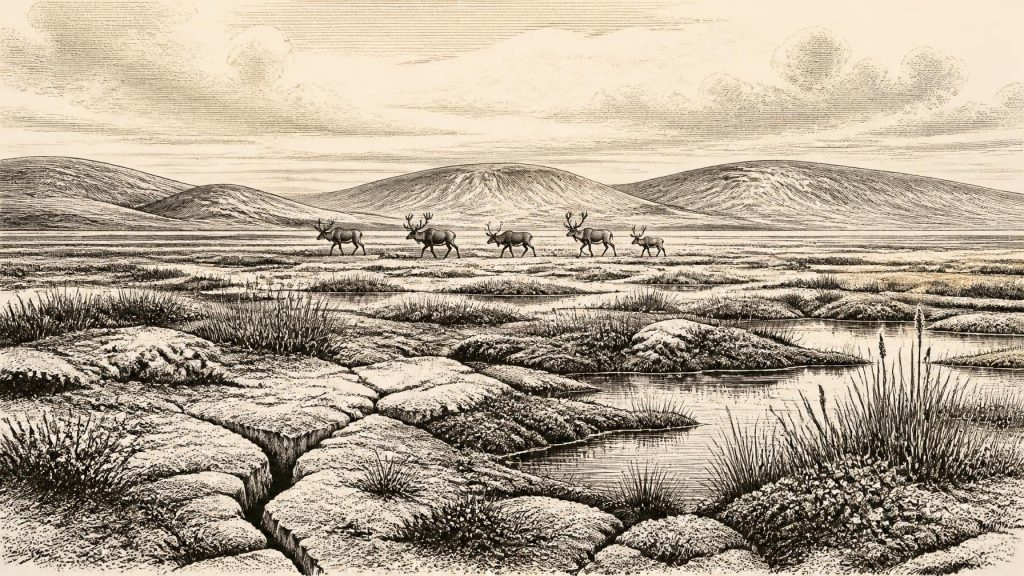
31,451 BCE is a modern label for a broad Late Pleistocene interval, not a recoverable Irish historical year. Derryvree, County Fermanagh, preserves freshwater sediments between glacial tills, indicating a temporary ice-free, periglacial landscape of tundra wetlands, sparse vegetation and invertebrates before renewed glaciation. Castlepook Cave fauna demonstrate that reindeer, giant deer, mammoth, predators and other open-country animals occurred in MIS 3, though deposits span time. A cut-marked reindeer femur may indicate brief Upper Palaeolithic human activity, but cannot prove settlement. Shifting ice, low sea levels and uncertain routes linked Ireland variably to north-west Europe, while later ice destroyed much evidence.
Dateline
31,451 BCE is a modern chronological label, not a year that can be recovered from Ireland’s prehistoric record. No community then used a calendar resembling the BCE system, and no archaeological deposit can identify a political act, journey, birth, death or season within this particular year. In the conventional conversion used by archaeologists, it falls roughly 33,400 calendar years before AD 1950. That places it in the Late Pleistocene, within Marine Isotope Stage 3 (MIS 3), a cold but unstable part of the last glacial cycle. Greenland ice-core chronology places this broad point near the end of Greenland Interstadial 6, a relatively milder episode bracketed at about 33.74–33.36 thousand years before AD 2000. That comparison is useful for framing North Atlantic climate, but it must not be mistaken for a precise weather record for Ireland.
Evidence, Not Annals
Ireland at this depth of time has no written sources, named peoples, monuments, villages, graves or securely excavated camps. Its history must instead be assembled from the traces that endured later ice movement: sediments exposed in cuttings, pollen and seeds preserved in mud, insect fragments, animal bones from caves, and the landforms left by glaciers. These fragments illuminate a changing environment more securely than they illuminate human affairs. They also demand care. A bone dates the life of an animal, not necessarily the moment it entered a cave; an ice-core event records Greenland conditions, not a local Irish thermometer; and material recovered in nineteenth- or early twentieth-century cave excavations may have lost much of its original context.
The best local environmental anchor for this broad period is Derryvree, near Maguiresbridge in County Fermanagh. Roadworks in 1969 cut through a drumlin and revealed fine sands and organic freshwater silts between two substantial tills: unsorted deposits laid down directly by glacier ice. Organic material from the freshwater bed produced the radiocarbon determination Birm-166, 30,500 radiocarbon years BP, with a wide error range. Published calibration places the deposit broadly at about 36,900–31,700 calendar years BP. Thus the notional date of 31,451 BCE lies within the range associated with this archive, but cannot be pinpointed inside it. Derryvree records an interval, not an annual event.
A Wetland Between Ice Advances
The Derryvree sequence establishes a basic fact of great importance: at some time during the middle of the last glacial cycle, this part of Fermanagh was not continuously buried beneath ice. Freshwater sediment accumulated in a hollow after an earlier glacial episode and before a later one. The organic beds preserve evidence of cold-climate vegetation and invertebrates, indicating open, treeless ground with wet hollows, pools and peaty or mossy surfaces. Sedges, aquatic plants and hardy tundra flora could exploit waterlogged margins during favourable intervals, while the surrounding terrain remained exposed to cold, frost action and sparse cover.
This was not modern Ireland in miniature. There is no basis for imagining green fields, broadleaf woodland, hedgerows or familiar bogland. The local landscape was periglacial: shaped by repeated freezing and thawing at its surface, subject to strong seasonal contrasts, and vulnerable to abrupt climatic shifts. The word “tundra” is useful if understood as a description of open, cold-adapted vegetation rather than an exact replica of any modern Arctic region. Water was nevertheless crucial. In a largely bare landscape, pools, marshy ground and slow-moving channels created concentrated habitats for plants, insects and animals.
The later upper till at Derryvree is as significant as the freshwater bed beneath it. It shows that the favourable local interval did not last indefinitely. Ice subsequently returned and sealed the deposits, preserving them while erasing or burying much of the wider landscape. This cycle of exposure, wetland formation and glacial override explains both why Derryvree is valuable and why the Irish record is sparse. Much evidence that might once have existed on open ground was destroyed, displaced or concealed by later ice-sheet activity.
Animals of Open Country
Caves in southern Ireland offer another, imperfect window on MIS 3. Castlepook Cave near Doneraile, County Cork, has yielded a remarkably varied Pleistocene fauna. Re-dating using improved bone pretreatment has shown that several remains are substantially older than dates obtained during earlier programmes suggested. The broader assemblage includes reindeer, giant deer, brown bear, wolf, Arctic fox, mountain hare, lemmings, woolly mammoth and spotted hyaena. These species do not all prove a single, simultaneous animal community at one place or one season; cave collections can combine material accumulated over long periods and by carnivores as well as natural processes. Collectively, however, they demonstrate that Ireland supported or received cold-adapted and open-country mammals during MIS 3.
Reindeer are particularly important to the picture around this date. They are suited to open, often seasonal environments and would have found forage in sparse vegetation across a varied terrain of upland, basin, river margin and exposed limestone country. Giant deer and mammoth indicate that at least some landscapes could sustain large herbivores, while hyaenas and wolves point to predator-scavenger networks around carcasses. Cave deposits should not be read as a census of animals living at the cave mouth. Hyaenas, for example, could transport bones into sheltered dens. But their contents make clear that Ice Age Ireland was biologically active, not a featureless white void.
At Castlepook, the most discussed specimen is a reindeer femur carrying a deep linear mark interpreted by zooarchaeologist Ruth Carden as damage made by a sharp stone tool during carcass processing. County Cork heritage material has associated the bone with approximately 31,000 BCE, and the find has understandably attracted attention as possible evidence of a very early human visit to Ireland. The claim deserves notice, but its limits are equally important. The specimen comes from an old collection rather than a newly excavated, sealed occupation surface; no associated stone-tool assemblage, hearth, dwelling floor, human bone, grave or repeated butchery deposit of comparable age has yet been found.
The Human Question
If the incision is accepted as a fresh-bone tool mark, it would show that someone used a sharp lithic edge on a reindeer carcass during the Upper Palaeolithic. It would not show whether that person killed the animal, found it already dead, removed meat, hide, sinew or marrow, or processed it elsewhere before the bone reached the cave. Nor would it establish a permanent settlement, a named culture or an ancestral connection to later inhabitants of Ireland. The responsible interpretation is therefore modest: brief human incursions into Ireland during MIS 3 are possible, and the marked femur may be evidence for one. Continuous residence remains unproven.
Such a possibility is historically meaningful because people elsewhere in north-west Europe were highly mobile Upper Palaeolithic hunter-gatherers, equipped with stone technologies and able to organise movement through severe landscapes. Yet this wider European context cannot fill Ireland’s evidential gaps. We cannot responsibly assign a language, ethnicity, kinship system, leader, political territory or population size to any potential visitors. There is no evidence for diplomacy, warfare, alliances, law or government. If people reached the island or its adjoining ice-age landscapes, their social organisation is archaeologically invisible here.
The same restraint applies to everyday life. Hunting and carcass processing are plausible conditional inferences from a genuinely human-made cut mark, especially where reindeer and other large mammals were available. A small travelling party would probably have depended on flexible knowledge of animal movements, weather, shelter and suitable stone, rather than farming or fixed settlement. But Ireland has yielded no securely dated campfire, hut, food store, clothing fragment, worked bone tool, ornament or lithic workshop from around 33,400 calendar years BP. It is better to describe potential activity than to create an imagined camp.
Coasts, Ice and Connections
The geography of this period also differed sharply from that of the modern island. Lower global sea levels exposed parts of the continental shelf, while expanding and shifting glaciers occupied other routes. Models of Irish relative sea level and ice extent indicate that corridors of ice and low-lying land probably existed before 16,000 BP, though the precise routes available around 33,400 years ago remain uncertain and could have been hazardous or periodically blocked. Ireland should therefore be seen as part of a wider north-west European environmental zone, but not assumed to have enjoyed a simple, permanent dry-land bridge to Britain or the Continent.
There was no trade in the later historic sense that can be demonstrated for Ireland at this time: no imported objects, exchange network, market site or maritime route is known. Nor is there evidence for religion, formal learning, art or ceremonial practice on the island. Caves mattered ecologically as dens, traps for sediment and repositories for bone; whether any were meaningful places to occasional people is unknowable. The absence of evidence is not proof that humans lacked beliefs or culture, but it does prevent historians from attaching specifically Irish rites or traditions to this remote date.
An Unstable Threshold
The principal development around 31,451 BCE was environmental rather than political. Ireland occupied a precarious interval within the last glacial cycle: locally ice-free in some places, cold and treeless, supporting wetland habitats and large mammals, yet increasingly vulnerable to renewed ice-sheet growth. The British–Irish Ice Sheet later expanded to a much greater extent, reaching its overall maximum during the Last Glacial Maximum, broadly between 27,000 and 23,000 years ago. That later advance transformed landscapes and removed much of the evidence of what came before.
For Ireland, then, this is not a year of kings, battles or monuments. It is a point within a broad calibrated interval represented most clearly by Derryvree’s freshwater sediments and, more tentatively, by the animal archive of Castlepook Cave. Those records reveal an Ireland of tundra wetlands, roaming herbivores, carnivores and changing ice margins. They also preserve one compelling but unresolved possibility: that Upper Palaeolithic people may have briefly entered this difficult landscape long before the securely established terminal-Pleistocene human evidence. The distinction between what the deposits prove and what they merely permit is the essential history of the time.
Primary Sources
- A Middle Midlandian Freshwater Series at Derryvree, Maguiresbridge, County Fermanagh, Northern Ireland
- A Reconsideration of the Radiocarbon Dating of the Marine Isotope Stage 3 Fauna from Southern Ireland
- The Irish Quaternary Fauna Project
- First Evidence of a Late Upper Palaeolithic Human Presence in Ireland
- New Insights on the Fauna of Ireland's Younger Dryas and Early Holocene from Alice & Gwendoline Cave
- Growth and Retreat of the Last British–Irish Ice Sheet, 31,000 to 15,000 Years Ago: The BRITICE-CHRONO Reconstruction
- Late Pleistocene Chronostratigraphy and Ice Sheet Limits, Southern Ireland
- Stratigraphic and Palaeo-Geomorphological Evidence for the Glacial-Deglacial History of the Last British-Irish Ice Sheet in the North-Western Irish Sea
- The Deglaciation of the Western Sector of the Irish Ice Sheet from the Inner Continental Shelf to its Terrestrial Margin
- Last Glacial Maximum Cirque Glaciation in Ireland and Implications for Reconstructions of the Irish Ice Sheet
- Extent and Deglacial Chronology of the Last British–Irish Ice Sheet: Implications of Exposure Dating Using Cosmogenic Isotopes
- Dimensions and Chronology of the Last Ice Sheet in Western Ireland
- The Island of Ireland: Drowning the Myth of an Irish Land-Bridge?
- The Problem of a Late Quaternary Landbridge Between Britain and Ireland
- Ireland: Submerged Prehistoric Sites and Landscapes
- The Greenland Ice Core Chronology 2005, 15–42 ka. Part 1: Constructing the Time Scale
- Synchronisation of Palaeoenvironmental Records Over the Last 60,000 Years, and an Extended INTIMATE Event Stratigraphy to 48,000 b2k
- Consistently Dated Atlantic Sediment Cores Over the Last 40 Thousand Years
- Independent Tephrochronological Evidence for Rapid and Synchronous Oceanic and Atmospheric Temperature Rises Over the Greenland Stadial-Interstadial Transitions Between ca. 32 and 40 ka b2k
- Advances in Irish Quaternary Studies
- Heritage Artefacts of County Cork
- Radiocarbon Constraints on the Age of the Maximum Advance of the British-Irish Ice Sheet in the Celtic Sea