

The BIRM-166 Silt Bed31503 BCE
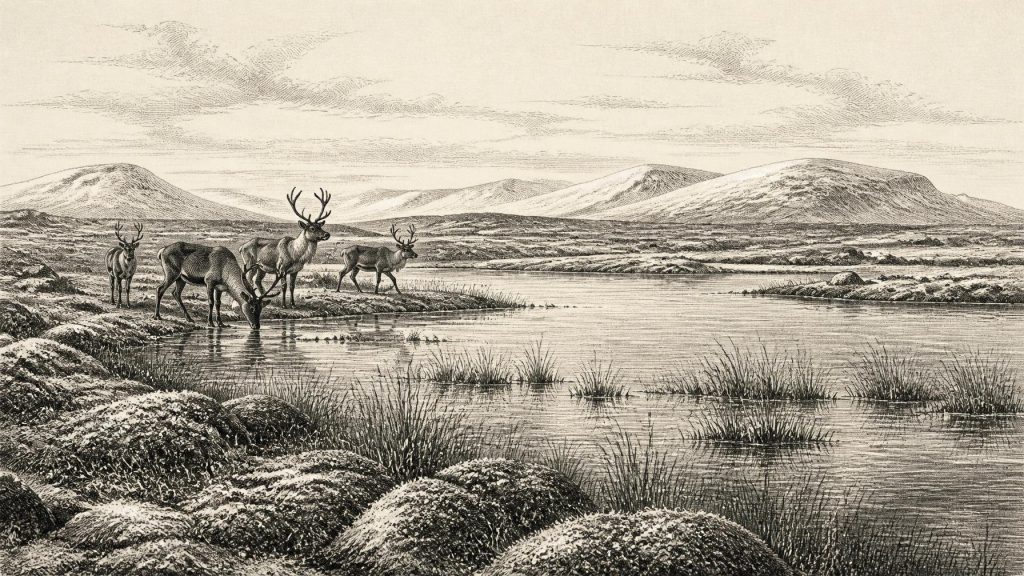
Around 31,503 BCE, Ireland’s history is reconstructed from environmental evidence rather than annual chronology. At Derryvree, County Fermanagh, the BIRM-166 organic silt bed, dated broadly to 36,900–31,700 calendar years BP, records an ice-free freshwater wetland between glacial advances. Its plants and animal traces indicate cold, largely treeless tundra with pools and saturated ground. Castlepook Cave, County Cork, preserves mixed remains of mammoth, reindeer, giant deer, bears, wolves and hyaenas, reflecting changing populations over millennia. A possibly cut-marked reindeer bone may indicate brief human visits, but no secure settlement evidence exists. Later ice both preserved and destroyed Ireland’s sparse Pleistocene record.
Dateline
31,503 BCE is a useful modern label, not a year that can be identified in Ireland’s archaeological record. No community on the island counted time by a calendar resembling ours, and the surviving evidence cannot distinguish one year from the next. In radiocarbon practice, the date falls roughly 33,450 calendar years before AD 1950, within the later part of Marine Isotope Stage 3 (MIS 3), a fluctuating cold interval of the last glacial cycle. The responsible way to approach this point is therefore through dated ranges, sediments and fossils rather than a supposed event of 31,503 BCE. Ireland was approaching, but had not yet reached, the most extensive phase of the last British–Irish Ice Sheet, which occurred substantially later.
A Date Within a Range
The closest unusually informative Irish environmental record is not a settlement but a buried freshwater deposit at Derryvree, near Maguiresbridge in County Fermanagh. Road-cutting in 1969 exposed fine sands and organic silts enclosed between two thick deposits of glacial till within a drumlin. The lower and upper tills show that ice occupied the locality before and after the freshwater interval. Organic material from the silts produced the conventional radiocarbon determination BIRM-166, 30,500 ± 1,100 radiocarbon years BP. Subsequent calibration has placed it broadly between about 36,900 and 31,700 calendar years BP. That wide span includes the modern filing-date of 31,503 BCE, but does not demonstrate that the bed formed in that particular year.
This distinction matters. Radiocarbon years are not identical to calendar years, because atmospheric carbon-14 has varied through time. Calibration curves, assembled from independently dated records including tree rings, corals, cave deposits and sediments, translate a laboratory result into one or more probable calendar ranges. At depths of more than thirty millennia, both measurement uncertainty and the uneven form of the calibration curve are significant. BIRM-166 is consequently a window on an episode of late Pleistocene Ireland, rather than a stopwatch reading for it. The sediment sequence is powerful evidence for changing ice, water and vegetation; it is not evidence for a named generation, an annual political chronology or a precisely dated human camp.
Fermanagh Between Ice Advances
At Derryvree, a low basin held freshwater long enough for fine sediment, plant remains and small animal traces to accumulate. Pollen was poorly preserved, but the combined botanical and faunal evidence points to open tundra or tundra-like vegetation in a periglacial climate. Mosses, sedges and other herbs dominated the picture. Fossil evidence includes bogbean, an aquatic plant, and alternate water-milfoil, indicating at least some standing or slow-moving fresh water. The landscape was not a featureless expanse of snow: it contained wet hollows, shallow pools and saturated ground, with sparse terrestrial cover beyond them. Yet it was also a harsh place, exposed to frost and probably marked by long, severe winters.
Tree pollen occasionally recorded in such deposits should not be converted into a local forest. Small amounts of pine or hazel pollen can travel considerable distances, and old sediments may contain material moved from elsewhere. The stronger inference is of largely treeless country, not woodland comparable with modern Ireland. This was an environment in which wetland plants survived beside bare or thinly vegetated ground, and in which seasonal thaw and freezing helped shape soils and drainage. The familiar green, wooded island of later prehistory did not yet exist. Nor should the modern political boundary be projected backwards: Derryvree lies in present-day Northern Ireland, but its evidence belongs to a landscape tens of thousands of years older than states, counties and even the later island geography people would recognise.
Ice Was Advancing, Not Yet Supreme
The Derryvree silts establish that this part of north-central Ireland was ice-free when they accumulated. They do not prove that every part of Ireland was ice-free at the same moment. Ice-sheet growth during MIS 3 is still debated, because later glaciers eroded, buried and rearranged many older landforms and deposits. Recent syntheses nonetheless place the major expansion of the last British–Irish Ice Sheet after this broader interval, with its maximum volume and shelf-edge extent reached around 23,000–22,000 years ago; the traditionally defined Last Glacial Maximum is generally placed between roughly 26,000 and 19,000 years ago. In 31,503 BCE, Ireland was in a dynamic pre-maximum glacial world, not necessarily under a single uniform blanket of ice.
The sequence at Derryvree also reveals a regional transformation. First, ice laid down till. Later, ice-free freshwater conditions permitted a wetland to form. Then a renewed advance covered and sealed the organic silts beneath another till. That simple succession is one of the clearest pieces of evidence available for the rhythm of Irish environmental change at this depth of time. It shows that glacial history was episodic rather than a single uninterrupted freeze. It cannot, however, tell us how long the wetland lasted, whether people ever saw it, or exactly how rapidly climate altered at its beginning and end.
Animals and the Cave Record
County Cork provides the other major body of evidence relevant to this age. Castlepook Cave, near Doneraile, has yielded a remarkably mixed late Pleistocene fauna from old excavations: woolly mammoth, reindeer, giant deer, brown bear, wolf and spotted hyaena are among the animals represented in its deposits. Radiocarbon dating of individual specimens has shown that the cave material spans long periods rather than a single occupation or catastrophe. Some remains fall in MIS 3; others are younger. Cave assemblages are especially difficult to interpret because carnivores, water, collapses, earlier excavators and later disturbance can all combine bones from different moments and places.
The fauna nevertheless makes the scale of the Irish environment clearer. Reindeer and mammoth are consistent with open, cold-country habitats and mobile grazing herds; hyaenas and wolves point to a predator-rich food web. Giant deer, often called Irish elk though not confined to Ireland, were also part of the wider fauna. These animals should not be imagined as permanently sharing every valley at once. Their dated remains represent shifting populations through millennia. Even so, the contrast with the restricted large-mammal fauna of later post-glacial Ireland is striking. At this time, Ireland’s ecological links with neighbouring north-west Europe were shaped by low sea levels, ice movement and changing coastlines, although the precise availability of overland, icy or sea crossings remains uncertain.
A Possible Human Trace
A reindeer femur from Castlepook has been reported as bearing marks consistent with chopping or butchery by a stone tool and as dating to about 33,000 years ago. If those marks are confirmed as human-made, the specimen would push the known Irish human story far deeper into the Upper Palaeolithic than the formerly accepted evidence from a cut-marked brown-bear bone at Alice and Gwendoline Cave in County Clare, dated to about 12,800–12,600 calendar years BP. But the caution is central, not incidental: the Castlepook bone comes from a historic collection rather than a modern excavation of an intact occupation surface, and the cave’s deposits have complicated histories. The ongoing Castlepook project seeks decisive, securely contextualised evidence such as lithics, hearths or further modified bones.
For 31,503 BCE, then, it is not responsible to describe a settled Irish population, a tribe, a chiefdom or a migration. There is no known house, hearth, grave, tool assemblage or repeated camp on the island that can be securely assigned to this precise horizon. The strongest permissible interpretation is narrower: humans may have made brief visits to a cold, ecologically demanding Ireland before the later great ice expansion, perhaps following or exploiting large animals. A cut-marked reindeer bone, if ultimately sustained by further work, would suggest carcass processing rather than reveal a whole society. It would not establish permanent residence.
What Cannot Be Recovered
Political affairs, diplomacy and organised warfare leave no identifiable evidence for Ireland at this date. Neither can religion, language, art, formal learning, exchange networks or social rank be reconstructed from the Derryvree wetland and the cave bones. It is possible that any visiting people possessed rich knowledge, social ties and beliefs, as Upper Palaeolithic communities elsewhere certainly did; it is not possible to assign those cultural practices to Ireland without Irish evidence. Likewise, no trade can be demonstrated. The only potential economy visible here is the most immediate one: the use of animal resources by predators, scavengers and, very tentatively, people.
The real historical importance of this distant point lies in its restraint. Around the date filed as 31,503 BCE, Ireland is illuminated not by chronicles but by a sealed Fermanagh wetland, an uncertain Cork bone mark, cave fauna and the later ice that covered so much earlier ground. Together they show an island-region of open cold landscapes, freshwater refuges, large mammals and climatic instability. They also explain why the archive is so thin. Later ice could both preserve a rare deposit beneath till and destroy countless others. The BIRM-166 silt bed is therefore not the record of a year; it is a rare surviving fragment of the changing world in which any earliest Irish visitors, if they came, had to live.
Primary Sources
- A Middle Midlandian Freshwater Series at Derryvree, Maguiresbridge, County Fermanagh, Northern Ireland
- Palaeoecology
- Figure 6.— The Subdivision of the Quaternary Period in Ireland
- Trimlines, Blockfields and the Vertical Extent of the Last Ice Sheet in Southern Ireland
- A Reconsideration of the Radiocarbon Dating of the Marine Isotope Stage 3 Fauna from Southern Ireland
- The Irish Quaternary Fauna Project
- Growth and Retreat of the Last British–Irish Ice Sheet, 31,000 to 15,000 Years Ago: the BRITICE-CHRONO Reconstruction
- Last Glacial Maximum Cirque Glaciation in Ireland and Implications for Reconstructions of the Irish Ice Sheet
- Extent and Timing of the Last Glacial Maximum (LGM) in Britain and Ireland: a Review
- Timing and Pace of Ice-Sheet Withdrawal Across the Marine–Terrestrial Transition West of Ireland During the Last Glaciation
- The Timing and Magnitude of the British–Irish Ice Sheet Between Marine Isotope Stages 5d and 2
- The Problem of a Late Quaternary Landbridge Between Britain and Ireland
- Deglaciation, Earth Crustal Behaviour and Sea-Level Changes in the Determination of Insularity: A Perspective from Ireland
- Ireland: Submerged Prehistoric Sites and Landscapes
- First Evidence of a Late Upper Palaeolithic Human Presence in Ireland
- New Insights on the Fauna of Ireland's Younger Dryas and Early Holocene from Alice & Gwendoline Cave
- Ireland's Palaeolithic Archaeology – Fleeting Footprints in a Frozen Land
- Archaeology Research Excavation Grant 2022: Castlepook Cave Final Report
- Castlepook Cave, Co. Cork, 2022 Excavation Report
- The IntCal20 Northern Hemisphere Radiocarbon Age Calibration Curve (0–55 cal kBP)
- The IntCal20 Approach to Radiocarbon Calibration Curve Construction
- Radiocarbon Dating
- A Stratigraphic Framework for Abrupt Climatic Changes During the Last Glacial Period Based on Three Synchronized Greenland Ice-Core Records
- The Colonization of Ireland: A Human Ecology Perspective