
Derryvree’s Glacial Interlude31504 BCE
Around 31,504 BCE, Ireland lay within the climatically unstable Late Pleistocene MIS 3 phase, before the Last Glacial Maximum. Derryvree, County Fermanagh, preserves freshwater sediments between glacial tills, demonstrating a local ice-free interval with treeless tundra, wetland plants and shallow pools. Cave finds in southern Ireland indicate cold-adapted fauna, including reindeer, mammoth, giant deer and hyaena, although deposits span long periods and dating remains uncertain. A marked reindeer bone from Castlepook may suggest human activity, but cannot prove settlement or permanent occupation. Evidence records changing environments and occasional animal access, not calendar-year events, political communities, trade or established human societies.
Dateline
Modern calendar-year precision is not available for Ireland in 31,504 BCE. The label is a convenient point in a modern sequence, not a date preserved by people living then: there were no Irish written records, calendars, named polities or recoverable annual events. Expressed in the archaeological convention of calibrated years before AD 1950, it falls at roughly 33,450 cal BP. That approximation should not be mistaken for a precise correspondence. At this depth in time, radiocarbon measurements require calibration and normally yield wide ranges; deposits may themselves have accumulated over decades, centuries or longer. The responsible subject is therefore Ireland during a broad phase of the Late Pleistocene, not a fictional episode in one twelve-month year.
Within a Changing Ice Age
This was Marine Isotope Stage 3 (MIS 3), a long, climatically unstable portion of the last glacial cycle. Ireland’s older name for this cold-stage sequence is the Midlandian. MIS 3 was neither one unbroken winter nor a simple prelude to the ice at its greatest extent. Temperatures and ice margins changed repeatedly across north-west Europe. The full Last Glacial Maximum came later: current reconstructions place the final maximum advance of the Irish Ice Sheet broadly between about 27,000 and 23,000 cal BP. Around the notional date considered here, some Irish districts could support ice-free or ice-marginal environments, while glaciers and ice caps existed elsewhere and the regional picture was changing.
That distinction matters. Ireland was not yet the familiar island of woodland, fields, towns and coasts. Nor can it responsibly be pictured as uniformly buried beneath a single, motionless sheet of ice. Its topography, proximity to the Atlantic and connections with the wider British–Irish Ice Sheet made conditions highly regional. Glaciers could advance, thin, stagnate and retreat; meltwater altered drainage; frost fragmented exposed ground; and later ice frequently eroded or sealed the evidence of earlier landscapes. Much of what can now be said comes from rare protected pockets beneath glacial deposits and from animal bones recovered in limestone caves.
Freshwater Between the Tills
The most informative Irish archive close to this broad horizon is at Derryvree, near Maguiresbridge in County Fermanagh. Road excavations in 1969 cut through a drumlin and revealed a remarkable sequence. Organic freshwater silts and fine sands lay between two deposits of till, the unsorted debris left by glacial ice. The stratigraphy provides a secure relative order: an earlier glacier laid down the lower till; a period followed in which standing or slow-moving freshwater and sediment accumulated; and a later ice advance covered the deposit with another till. Derryvree therefore demonstrates an interval of non-glacial conditions at that particular locality between two episodes of glaciation.
Organic material from the deposit produced a conventional radiocarbon determination of 30,500 ± 1,170/1,030 BP. Later calibration has been discussed as a broad span of approximately 36,900–31,700 cal BP, equivalent in modern BCE notation to about 34,950–29,750 BCE. The notional year 31,504 BCE falls within that wide bracket. It cannot be assigned to a particular layer, pool edge, plant or season. What Derryvree supplies is evidence for an environmental interval, not a diary entry. It is nonetheless exceptionally important, because much of Ireland’s pre-maximum Pleistocene record was removed or disturbed by subsequent glaciation.
A Treeless Wetland World
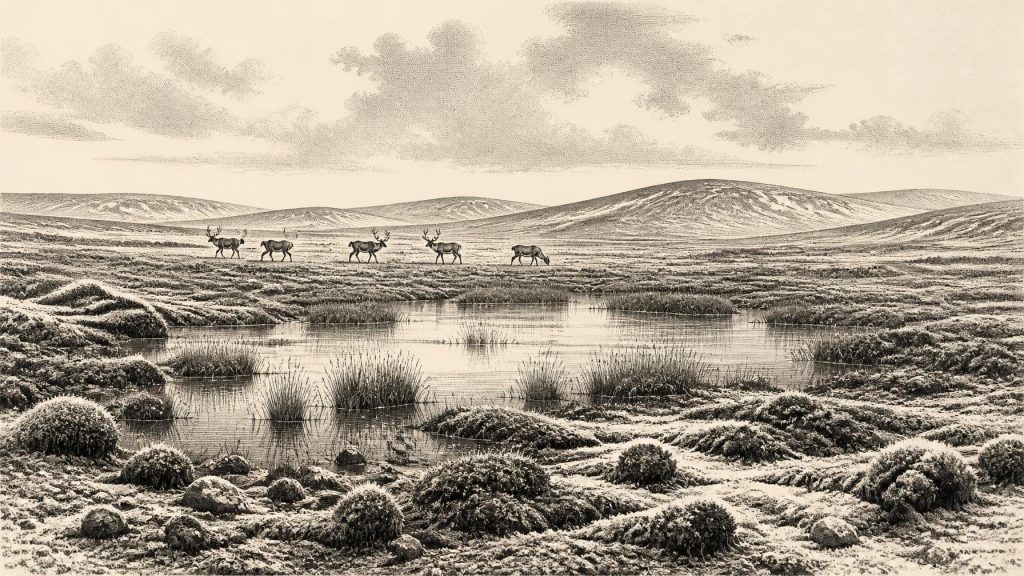
The plant and animal micro-remains preserved at Derryvree indicate open tundra vegetation and a periglacial climate. Pollen was poorly preserved but largely herbaceous. Macrofossils included several mosses, while other evidence pointed to sedges and wet-ground plants around freshwater. The assemblage is not evidence for dense forest. A few grains of pine or hazel pollen were judged unlikely to represent local woodland; long-distance transport is a more cautious explanation. The landscape was instead a mosaic of exposed ground, frost-affected soils, wet hollows, shallow pools and plant-rich margins. Even dry ground may have carried only sparse cover.
Such a setting should not be reduced to a blank white wilderness. During favourable parts of the year, water and vegetation sustained small but functioning ecological communities. Mosses, sedges, grasses, herbs and low shrubs could exploit sheltered or damp places; insects and other invertebrates occupied these niches; grazing animals could use the wider open country. Winter cold, wind and frozen ground would nevertheless have imposed severe constraints. The evidence supports a cold, largely treeless Irish landscape with freshwater habitats in south Fermanagh. It does not establish identical conditions across the entire island at one moment, still less a precise annual temperature or snowfall total for 31,504 BCE.
Caves and Cold-Stage Animals
Southern Irish cave assemblages offer a second, more fragmentary view. Castlepook Cave near Doneraile, County Cork—long known as Mammoth Cave—has produced remains attributed to the pre-Last Glacial Maximum fauna of Ireland. Reindeer, woolly mammoth, giant deer, brown bear, spotted hyaena, fox and hare are among the animals represented in cave records from the wider period. The Irish Quaternary Fauna Project concluded that a comparatively broad range of mammals reached Ireland between at least about 45,000 and 20,000 years ago. This does not mean that every species lived together at Castlepook, or throughout Ireland, in 31,504 BCE. Cave deposits can accumulate over very long spans, and bones can be moved by carnivores, water, sediment and excavation.
Recent re-dating is especially salutary. Improved ultrafiltration methods showed that several older radiocarbon determinations on Irish cave bones were too young, in some Castlepook cases by thousands of radiocarbon years. The revised work placed important southern Irish faunal remains in MIS 3 and suggested that giant deer and spotted hyaena may have disappeared locally before the Last Glacial Maximum, around 40,000 cal BP. These results make clear that the older fauna belongs to a deep and changing timespan rather than a single uniform ‘mammoth age’. They also show why precise claims based on antiquarian collections must be tested again as laboratory techniques improve.
Reindeer are particularly evocative because their presence fits an open, cold-adapted landscape. Their movements would have linked forage, season and terrain. Yet fossil bones do not map a herd’s route, population size or annual migration. Nor does a mammoth remain prove that herds regularly crossed every Irish valley. The animal record establishes that suitable habitats and occasional pathways existed during parts of MIS 3; it does not turn the island into a well-observed version of the continental mammoth-steppe. Ireland’s position at the north-western edge of Europe, with shifting sea levels, ice and coastlines, makes questions of access particularly difficult.
The Human Question
A reindeer femur from Castlepook has brought the possibility of a much earlier human presence into the discussion. On re-examination, it was reported to bear a deep mark interpreted as having been made on fresh bone with a sharp stone implement during carcass processing. If that interpretation is upheld, the object may indicate that people handled a reindeer in Ireland during the pre-maximum Pleistocene, dramatically earlier than the substantial post-glacial archaeological record. It is an important hypothesis, not a licence to write a settled Irish Palaeolithic history.
The limitations are substantial. The bone is not part of a securely associated camp floor with hearths, stone-tool concentrations, dwellings, burials or repeated butchered carcasses. Castlepook’s deposits have a complicated history, and one modified bone cannot determine the number, identity, origin or duration of any visitors. A radiocarbon result dates the animal bone, not necessarily the exact instant at which a surface mark was made. Taphonomic analysis must also distinguish deliberate tool damage from carnivore activity, sediment abrasion, breakage and marks introduced during recovery or curation. The evidence is best described as a serious but limited indication of possible human activity, awaiting corroboration from securely excavated contexts.
Comparison with Upper Palaeolithic Europe can suggest possibilities but cannot fill the Irish gap with borrowed detail. On the continent and in Britain, groups using stone tools hunted large mammals, travelled widely and created varied symbolic works. Nothing presently found in Ireland around this period permits an equally detailed account of dwellings, clothing, language, kinship, art or ritual. It would be reasonable to infer that any people capable of reaching this far-western environment needed considerable ecological knowledge and mobility. It would not be responsible to identify their cultural group, reconstruct a voyage, or claim that they maintained a permanent population.
No Politics, No Proven Trade
Political affairs, diplomacy and formal warfare are absent from the evidence. There are no named leaders, territories, monuments of authority, weapons caches or written traditions from which to infer them. The word ‘Ireland’ itself is used here only for the landmass that now bears that name, not for a nation, people or community known to have existed. Equally, there is no secure evidence for settlements, farming, animal domestication, exchange networks or maritime trade at this date. Lower global sea levels do not by themselves prove an easy land route to Ireland: local crustal movement, sea basins, ice streams and changing shorelines all shaped the regional geography.
Everyday life can therefore be described only negatively and conditionally. If people did enter Ireland during this MIS 3 interval, their contact with the landscape was probably brief and mobile rather than demonstrably permanent. They may have followed animal resources or explored seasonally usable terrain, but that remains interpretation. What is directly evidenced is more fundamental: freshwater existed in at least one protected Fermanagh basin between ice advances; tundra plants and cold-climate fauna occupied parts of the country during the wider period; and cave archives preserve a sparse, difficult record of those ecosystems.
A Landscape Before History
The chief development illuminated by 31,504 BCE is not a political event but the changing capacity of Irish landscapes to sustain life before the Last Glacial Maximum. Derryvree’s buried freshwater deposits prevent a simplistic image of permanent island-wide ice. Castlepook’s fauna confirms that large mammals entered Ireland during the wider MIS 3 world. The potentially modified reindeer bone keeps open the possibility of an early human encounter at Europe’s Atlantic edge. None of these discoveries provides calendar-year history. Together, they show why the deepest Irish past must be written with precision about evidence, restraint about interpretation, and attention to the environments from which later human history eventually emerged.
Primary Sources
- New Insights on the Fauna of Ireland’s Younger Dryas and Early Holocene from Alice & Gwendoline Cave
- A Reconsideration of the Radiocarbon Dating of the Marine Isotope Stage 3 Fauna from Southern Ireland
- The Irish Quaternary Fauna Project
- Palaeoecology
- Our Ancient Landscapes: Hunter-Gatherers in Ireland
- Response of the Irish Ice Sheet to Abrupt Climate Change During the Last Deglaciation
- Pattern and Timing of Retreat of the Last British-Irish Ice Sheet
- Trimlines, Blockfields and the Vertical Extent of the Last Ice Sheet in Southern Ireland
- Dimensions and Chronology of the Last Ice Sheet in Western Ireland
- The Deglaciation of the Western Sector of the Irish Ice Sheet from the Inner Continental Shelf to its Terrestrial Margin
- Ireland: Submerged Prehistoric Sites and Landscapes
- Investigating Seasonal Mobility in Irish Giant Deer Megaloceros Giganteus Through Strontium Isotope Analysis
- The IntCal20 Northern Hemisphere Radiocarbon Age Calibration Curve (0–55 cal kBP)
- Radiocarbon Constraints on the Age of the Maximum Advance of the British-Irish Ice Sheet in the Celtic Sea
- Sedimentology and Chronology of the Advance and Retreat of the Last British-Irish Ice Sheet on the Continental Shelf West of Ireland
- Reconstructing the Last Irish Ice Sheet 2: A Geomorphologically-Driven Model of Ice Sheet Growth, Retreat and Dynamics
- Last Glacial Maximum Cirque Glaciation in Ireland and Implications for Reconstructions of the Irish Ice Sheet
- The Exploration of Castlepook Cave, County Cork
- Heritage Artefacts of County Cork
- Outreach and Education Resources