Membership is completely free, giving members unlimited access to all available resources, services, features, and benefits without any restrictions or fees.
Welcome back. Sign in to continue enjoying unlimited access to all available resources, services, features, and member benefits at no cost.
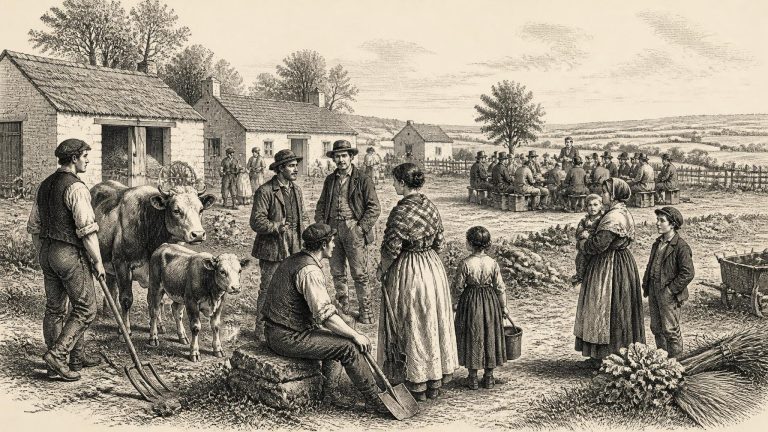
The immediate source of much conflict was the tithe. Agricultural occupiers were obliged to pay it for the support of the established Church of Ireland, although most of the population was Roman Catholic and, in Ulster, many Protestants were Presbyterian. The Tithe Composition Act of 1823 had aimed to substitute fixed money payments for payments in kind, but it did not remove the fundamental resentment felt by people asked to finance a church to which they did not belong. It also left collection dependent on local legal processes, distraint of livestock and sales which neighbours could obstruct.
O’Connell’s admission did not mean that political equality had suddenly been achieved. The 1829 settlement allowed Roman Catholics to sit in Parliament and hold many civil offices, but it retained significant exclusions, particularly around the established church, the universities and certain great offices of state. Nor did it restore an Irish parliament: Irish representatives still travelled to Westminster under the Union of 1801. The importance of O’Connell’s seat was therefore symbolic as well as practical. It showed that the Catholic majority could no longer be wholly excluded from the legislature governing Ireland, while also concentrating hopes and grievances upon a small number of MPs in London.
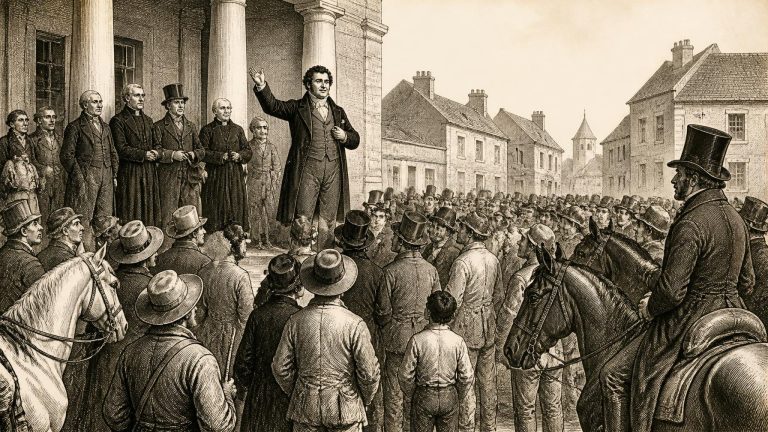
The immediate background belonged to the years before 1829, but it determined the shape of this one. Daniel O’Connell, a Kerry-born barrister and leader of the Catholic Association, had been elected for County Clare in July 1828. As a Catholic, he could not take the existing oath required of a member of parliament. His election nonetheless demonstrated that a Catholic candidate could defeat the nominee of major Protestant property and government influence through open, legal electoral mobilisation. The result placed the ministry of the Duke of Wellington and the home secretary, Robert Peel, under pressure to find a settlement which they had previously resisted.
The position of Irish Catholics in 1828 contained a glaring contradiction. Since 1793, qualifying Catholics in Ireland had been able to vote in parliamentary elections, and Catholic candidates could put themselves before an electorate. But a successful Catholic could not take the parliamentary oaths required at Westminster without denying principles of his religion. The franchise thus gave Catholic freeholders a voice in choosing representatives while excluding a Catholic whom they might choose from sitting as one.
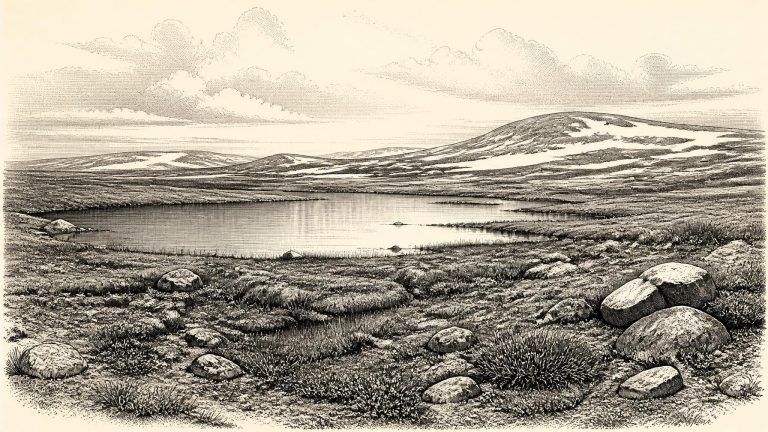
Modern Ireland is used here as a geographical shorthand. There was no Irish state, no people called Irish, and no political territory with fixed borders. The island’s present coastlines were also a poor guide to the land and sea of the time. Global sea level was substantially lower than today because immense volumes of water were stored in continental ice sheets. Yet lower sea level did not automatically create a convenient dry crossing between Ireland and Britain: local land levels and water depths were altered by the changing weight of ice, while the Irish Sea basin remained a major environmental barrier. Any discussion of travel or contact must therefore remain conditional rather than imagining a simple land bridge.