Castlepook’s Earliest Claim31165 BCE
Around 31,165 BCE, Ireland was a climatically unstable Late Pleistocene landmass, not a defined island or society. Derryvree, County Fermanagh, preserves tundra wetland sediments, broadly dated to this period, showing locally ice-free ground between glacial advances. Castlepook Cave, County Cork, contains a long, disturbed assemblage of Ice Age fauna, including reindeer, mammoth, giant deer, bear and hyaena. A marked reindeer femur, roughly 33,000 years old, may indicate stone-tool butchery and Ireland’s earliest human presence. However, it dates the animal rather than the incision, and no associated settlement evidence exists. Lower seas altered routes, while later glaciation destroyed much surviving evidence.
Dateline
To place 31,165 BCE on an Irish timeline is useful only as a modern filing device. No Irish person, animal bone, wetland layer or ice margin can be dated to that individual calendar year. In simple calendar arithmetic it falls about 33,114 years before AD 1950, the conventional reference point for “before present” dating, but the evidence available for this remote period is expressed in broad radiocarbon and calibrated ranges. The responsible history of Ireland at this horizon is therefore not a chronicle of named events. It is a reconstruction of a cold, changing Pleistocene landscape, drawn from sediments, fossils, cave deposits and the contentious possibility that people briefly entered it.
Modern Ireland did not exist as a country, society or island with fixed shores. “Ireland” here means the landmass and surrounding shelf that would later form the island. Its Late Pleistocene history belongs to Marine Isotope Stage 3, a long and climatically unstable part of the last glacial cycle. Temperatures, sea levels and ice margins altered over centuries and millennia; an apparently precise BCE label must not conceal that uncertainty.
A Date Inside a Wide Window
The strongest environmental evidence near this chronological horizon comes from Derryvree near Maguiresbridge, County Fermanagh. Roadworks in 1969 exposed freshwater silts and fine sands trapped between two thick tills within a drumlin. Eric Colhoun, James Dickson, A. M. McCabe and F. W. Shotton identified plant and animal remains which indicated open tundra vegetation and a periglacial climate. The deposit is exceptionally valuable because it proves that this part of Ireland was ice-free long enough for a cold wetland ecosystem to form between glacial advances.
A conventional radiocarbon determination on the organic material, BIRM-166, was reported as 30,500 ± 1,100 radiocarbon years BP. Calibrated expressions of its possible age span a very wide interval, commonly given as roughly 36,900–31,700 calendar years BP. Thus 31,165 BCE lies within the broad chronological neighbourhood of the Derryvree deposits, rather than at a securely identifiable level within them. The date was obtained from total organic carbon in a legacy sample, and recent ice-sheet studies sensibly treat it with caution when modelling the exact timing of glacier movement. It remains compelling evidence for pre-Last Glacial Maximum ice-free ground, but it is not a calendar.
The wider ice-sheet picture is similarly provisional. Modern reconstructions of the British–Irish Ice Sheet begin around 31,000 years ago because earlier constraints are sparse. They suggest that ice was building on high ground in parts of Ireland and Britain, while the final maximum extent was still to come several thousand years later. This means that Ireland around the present horizon should not be imagined either as wholly sealed beneath ice or as a uniformly open plain. Conditions differed sharply by region, elevation and time. Fermanagh’s buried wetland and the southern cave fauna instead reveal short-lived or regional ecological opportunities within a severe glacial world.
Wetlands, Tundra and Cave Fauna
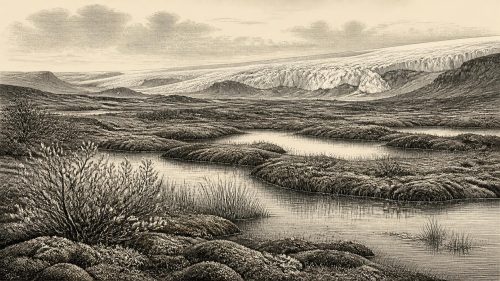
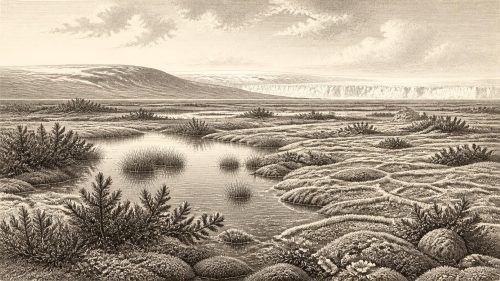
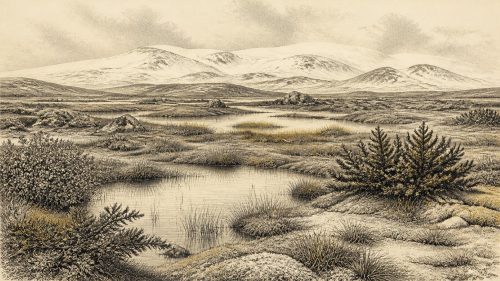
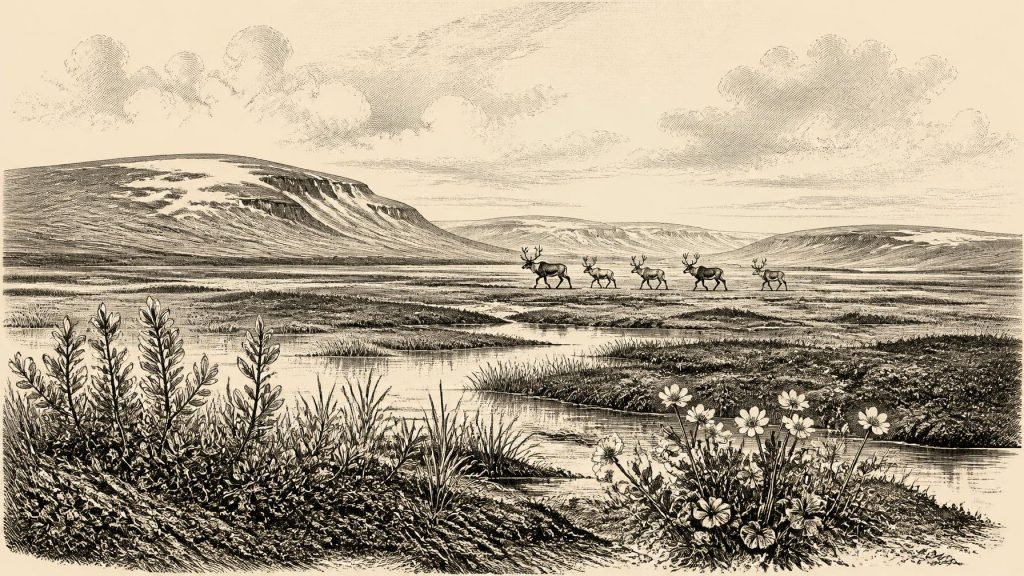
Derryvree gives the clearest picture of vegetation. Its organic silts preserved remains of mosses, sedges, dwarf willow, mountain-avens, Arctic clubmoss and aquatic plants including bogbean and water-milfoil. Such a list does not describe a forested Ireland. It points to low, open ground with shallow pools, sedge-rich margins and patches of tundra or muskeg-like vegetation. Insects and small animals could exploit these wet places, while grazing mammals could move through a wider, sparse landscape. The evidence supports local water, plants and seasonal biological productivity; it does not allow historians to calculate the weather on a particular day in 31,165 BCE.
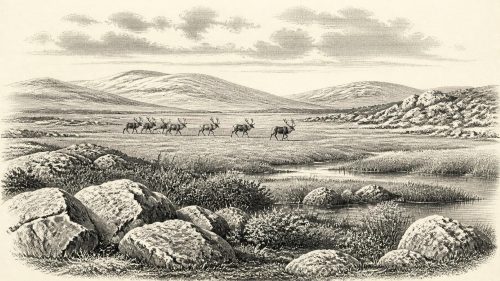
Far to the south, Castlepook Cave near Doneraile in County Cork preserves the richest known Irish vertebrate archive from the time leading towards the Last Glacial Maximum. More than 2,000 bones have been recovered from its chambers and galleries. Its dated remains extend across a very long span, approximately 45,700 to 19,950 years BP, so the assemblage is not a single community frozen in one moment. Nevertheless, it establishes that southern Ireland was visited by, or could support, animals including woolly mammoth, giant deer, reindeer, brown bear and spotted hyaena. Later deposits include Arctic fox, wolf, Norwegian lemming and collared lemming.
The cave’s distinctive gallery names—Hyaena Hall, Elephant Hall and the Gallery of Aged Carnivores—are modern labels from exploration, not prehistoric place-names. They are reminders that cave deposits require taphonomic care. Hyaenas and other carnivores could have dragged carcass parts underground; water repeatedly disturbed sediments and bones; nineteenth- and early twentieth-century excavations recovered material before modern recording methods. A reindeer bone in the cave is reliable evidence that reindeer existed in the wider region at some point; it is not, by itself, proof of a hunting camp inside the chamber where it was found.
The Reindeer Femur Question
One Castlepook find makes this period unusually important for Irish history. A fragment of reindeer femur has been reported as about 33,000 years old and bears a deep linear mark that zooarchaeologist Ruth Carden has interpreted as damage made by a sharp stone tool while fresh bone was being processed. County Cork’s heritage record identifies the object as a Palaeolithic reindeer femur from Castlepook, now in the National Museum of Ireland’s Natural History collection. If the interpretation is sustained by further study, it would be the earliest known indication that people handled an animal in Ireland, by a very large margin.
That is a major claim, but it must be stated accurately. The radiocarbon result dates the animal bone, not the exact moment that a mark was made. A single modified bone cannot reveal how many people were present, whether they killed the reindeer or encountered an already dead animal, where the carcass was first processed, what tools they carried, or whether their visit lasted hours, days or longer. No securely associated stone-tool assemblage, hearth, dwelling surface, burial or intact butchered bone concentration has yet demonstrated a settlement in Ireland at this age. Castlepook’s undisturbed deposits, where they survive, are therefore more important than ever.
It is also necessary to distinguish this early claim from the better-published evidence of later Palaeolithic activity. At Alice and Gwendoline Cave in County Clare, a brown-bear kneecap with cut marks produced two calibrated ranges centred around 12,800–12,600 cal BP. That find has been published in a peer-reviewed study. It shows human butchery much later than the Castlepook reindeer horizon, during the terminal Pleistocene. It cannot confirm people in Cork around 31,165 BCE; equally, the existence of later visitors does not make the earlier claim impossible.
People Without a Settlement
There is no responsible basis for describing political affairs, leaders, territories, warfare or diplomacy in Ireland at this date. There are no written records, human remains, settlements or artefact groups from which to infer a named community. Nor is there evidence for religion, formal ritual, art, schooling, long-distance trade or exchange networks on the island. The absence is not a judgement on the intellectual capacities of Upper Palaeolithic people elsewhere in Europe; it is a limit imposed by the Irish record.
If the Castlepook incision is anthropogenic, the most that can be said about everyday life is both modest and significant: one or more mobile hunter-gatherers may have had a practical encounter with a reindeer carcass in Ireland. Reindeer offered meat, marrow, hide, sinew, antler and bone, but the particular resource sought cannot be identified from one surviving mark. Comparison with contemporary hunter-gatherers in north-west Europe makes seasonal movement, close knowledge of animal behaviour and portable stone equipment plausible possibilities. Those comparisons are interpretation, however, not direct evidence that a defined group followed a regular route into Ireland.
Economically, the secure record is ecological rather than human. Large herbivores, predators and scavengers moved through an open landscape in which local wetlands supplied vegetation and water. Carnivores had their own influence on what survived in caves. Such ecological relationships were not “trade” or “politics”, but they determined where a short human incursion, if it occurred, might have been viable. The reindeer femur may record an episode of carcass processing; it cannot show a permanent economy.
Changing Coasts and Vanishing Evidence
Lower global sea levels altered the shape of the Irish landmass and exposed areas now beneath the Irish Sea and Atlantic shelf. Yet lower sea level should not be converted automatically into a simple, continuous land bridge at every stage. Ice loading, local crustal movement, changing shorelines and uncertain ice margins complicate palaeogeography. Any people who reached Ireland around this period may have crossed exposed terrain, narrow water barriers or a shifting combination of both. The physical route remains unresolved.
Later glacial expansion is part of the explanation for the fragmentary record. Ice eroded and redeposited sediments over extensive areas, while acidic soils destroy bone and organic remains. Caves and rare deposits sealed beneath till have consequently become disproportionally important archives. Derryvree preserves plants and freshwater conditions; Castlepook preserves a time-averaged animal assemblage and one provocative bone. Neither offers the sort of continuous archaeological landscape that would permit a conventional year-by-year narrative.
The central development around 31,165 BCE was therefore environmental instability on the threshold of major ice-sheet growth. Ireland contained at least some ice-free, treeless and biologically active terrain, though its extent changed through time. In County Cork, reindeer and other Ice Age mammals formed part of that world. The marked Castlepook femur raises the possibility that humans entered it too. For now, it should be treated as an earliest claim under investigation, not as proof of an established Irish population. The future history of this date will depend on new excavation, direct dating, microscopic study of bone surfaces and the recovery—if it survives—of securely stratified tools or occupation evidence.
Primary Sources
- A Middle Midlandian Freshwater Series at Derryvree, Maguiresbridge, County Fermanagh, Northern Ireland
- A Reconsideration of the Radiocarbon Dating of the Marine Isotope Stage 3 Fauna from Southern Ireland
- The Irish Quaternary Fauna Project
- Castlepook Cave, County Geological Site Report
- Areas of Scientific Interest in County Cork: Castlepook Caves
- Growth and Retreat of the Last British–Irish Ice Sheet, 31,000 to 15,000 Years Ago: the BRITICE-CHRONO Reconstruction
- The Timing and Magnitude of the British–Irish Ice Sheet Between Marine Isotope Stages 5d and 2
- Timing, Pace and Controls on Ice Sheet Retreat: an Introduction to the BRITICE-CHRONO Transect Reconstructions of the British-Irish Ice Sheet
- Exploring Controls of the Early and Stepped Deglaciation on the Western Margin of the British Irish Ice Sheet
- Maximum Extent and Dynamic Behaviour of the Last British–Irish Ice Sheet West of Ireland
- Extent and Retreat History of the Barra Fan Ice Stream Offshore Western Scotland and Northern Ireland During the Last Glaciation
- First Evidence of a Late Upper Palaeolithic Human Presence in Ireland
- First Evidence of a Late Upper Palaeolithic Human Presence in Ireland (PDF)
- New Insights on the Fauna of Ireland’s Younger Dryas and Early Holocene from Alice & Gwendoline Cave
- The Archaeology of Caves in Ireland
- Castlepook Cave, Cork, 2022 Excavation Report
- Figure 6.— The Subdivision of the Quaternary Period in Ireland
- Heritage Artefacts of County Cork
- Reindeer Bone Found in Cork Cave Shows Human Activity in Ireland 33,000 Years Ago
- Occurrence of Mammalia Relicts at Site Castlepook Cave
- Ireland: Submerged Prehistoric Sites and Landscapes
- First Evidence of a Late Upper Palaeolithic Human Presence in Ireland – Atlantic Technological University Research Portal