Castlepook Fauna31045 BCE
31,045 BCE is a modern label within unstable MIS 3, not a precisely documented Irish year. Derryvree, County Fermanagh, preserves freshwater sediments between glacial tills, demonstrating a temporary, cold, treeless wetland during an ice-free local interval. Castlepook Cave, County Cork, contains mixed pre-Last Glacial Maximum remains of reindeer, mammoth, giant deer, bears, wolves, lemmings and hyaenas, evidencing intermittently habitable cold-country environments. A marked reindeer bone may indicate human carcass processing, but remains inconclusive and proves neither settlement nor community. Later ice transformed these landscapes. The evidence supports an environmental and zoological history, demanding caution over dates, deposits and human presence.
Dateline
31,045 BCE is not a date at which Ireland can be described through an annual chronicle. No contemporary writing, settlement sequence or securely dated human event permits that degree of precision. It is better understood as a modern calendar label falling within the Late Pleistocene, during Marine Isotope Stage 3 (MIS 3), a climatically unstable part of the last Ice Age. The relevant evidence comes in broad calibrated ranges, from buried sediments and animal bones rather than from named people or recorded actions. A responsible account must therefore distinguish what those remains demonstrate from what may be inferred from them.
A Date Within Deep Time
In arithmetic terms, 31,045 BCE lies nearly 33,000 years before the radiocarbon reference year of AD 1950. But archaeological chronology is not simple arithmetic. Radiocarbon laboratories report ages in radiocarbon years before present, not calendar years; changing atmospheric carbon levels mean that results need calibration against independently dated records. At this antiquity, a single measurement can calibrate across a substantial span. The internationally used IntCal20 curve extends to 55,000 calibrated years before present, but it does not transform a sparse Irish record into an annual timetable.
The closest major Irish environmental archive is Derryvree, near Maguiresbridge in County Fermanagh. Roadworks in 1969 cut through a drumlin and revealed a remarkable sequence: freshwater silts and fine sands, with organic material, lay between two thick and distinct deposits of till. Till is debris deposited directly by glacier ice. The order is unambiguous: an earlier ice advance laid down the lower till; an interval without local glacier cover allowed water, sediment and vegetation to accumulate; a later advance sealed the deposit under fresh till.
Organic material from the Derryvree succession, laboratory determination BIRM-166, produced a conventional radiocarbon age of about 30,500 years BP, with a large error margin. Modern calibration and the original stratigraphy make it appropriate to place the deposit broadly within later MIS 3, rather than attach it to a particular year. A calibrated range often cited for this determination is approximately 36,900–31,700 cal BP, or roughly 34,950–29,750 BCE. Thus 31,045 BCE belongs within the broad time represented by the archive, but cannot be assigned to a particular pool, plant or season in it.
Water Between the Ice Sheets
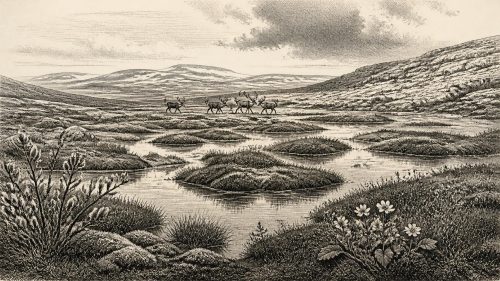
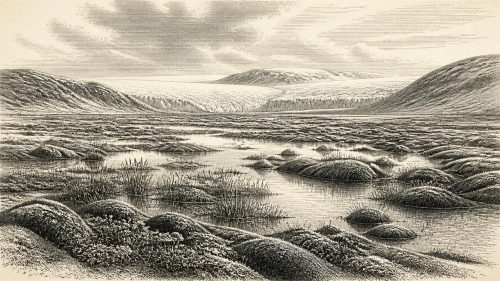
Derryvree is important because it refutes a simple picture of an island continuously buried beneath ice. It does not show that all of Ireland was ice-free at once, nor that conditions were mild. It does show that, during part of the interval between glacial advances, the Fermanagh locality supported freshwater and wet-ground communities. Plant macrofossils, pollen, mosses and insect remains point to cold, open, largely treeless country: a periglacial mosaic of shallow water, sedge-rich or mossy margins, damp ground and exposed mineral soils.
Among the plants identified from the Derryvree material are species associated with cold or wet environments, including mountain avens, bogbean and aquatic or waterside vegetation. Their presence is evidence for a functioning local ecosystem, sustained at least seasonally by liquid water. It should not be romanticised into a sheltered lakeside landscape. The wider climate was severe, with short growing seasons, substantial frost action and little woodland. Sparse tree pollen in a deposit of this kind cannot safely be read as proof of nearby forest: pollen can travel far, and older grains can be redeposited.
The landscape was also inherently temporary. A freshwater basin existed because ice, melting water, drainage and sediment had created it; later ice overwhelmed and preserved its sediments. The drumlin visible today is consequently not merely a landform but part of the historical evidence. It embodies repeated transformations of the ground by ice flow, thaw, standing water and renewed glaciation. Ireland around this broad horizon was environmentally varied over time and regionally uneven, not a stable stage on which a settled society can be placed.
Castlepook and the Animal World
County Cork provides the other indispensable window. Castlepook Cave, near Doneraile and also known as Mammoth Cave, produced a large collection of Ice-Age bones during excavations directed by Richard J. Ussher and colleagues in the early twentieth century. Subsequent study, including the Irish Quaternary Fauna Project and later radiocarbon redating, has shown both the value and the difficulty of the collection. The cave preserves evidence of animals reaching Ireland before the Last Glacial Maximum, but many bones came from old excavations in complex cave sediments whose original associations were incompletely recorded.
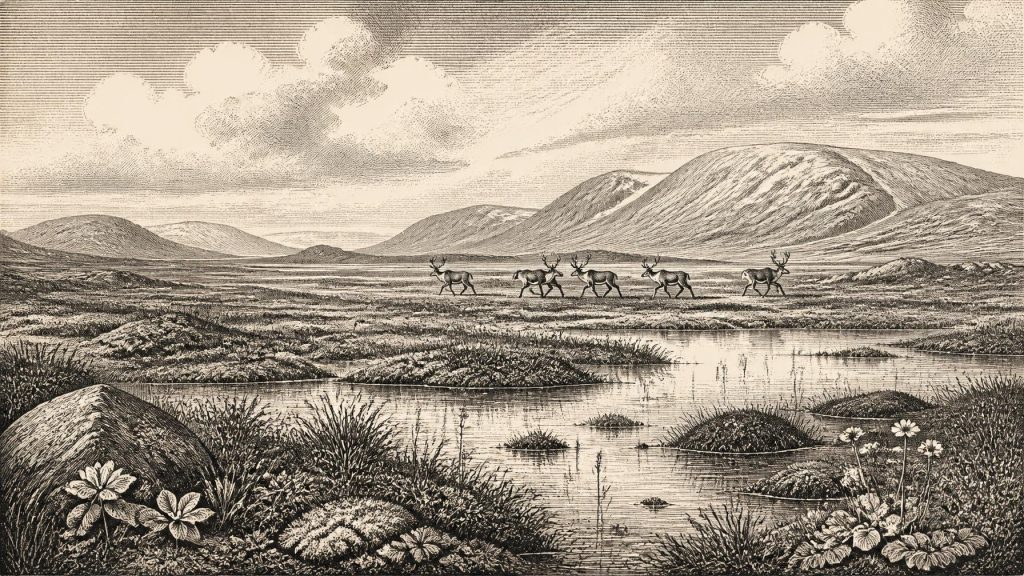
The pre-Last Glacial Maximum fauna associated with Castlepook and comparable Irish evidence includes reindeer, woolly mammoth, giant deer, brown bear, wolf, foxes, mountain hare, lemmings and spotted hyaena. These species should not be imagined as one perfectly simultaneous herd or food chain. Direct dates and modern reanalysis show that cave assemblages accumulated over long periods; carnivores, water movement, natural deaths and human excavators could all mix material. Nevertheless, the fauna establishes that parts of Ireland offered routes, forage and shelter to cold-adapted mammals during portions of MIS 3.
Reindeer are particularly evocative, but they were not alone in defining this world. Lemmings signal cold, open habitats; mammoth and giant deer indicate the potential for large herbivores; hyaena and wolves reveal predation and scavenging. A cave may have served as a den, trap, refuge or place where bones were brought in, rather than as a straightforward record of animals living immediately outside its entrance. The cautious interpretation is a mobile Ice-Age fauna moving through an intermittently habitable western peninsula, not a fixed local menagerie.
This was before the fullest expansion of the last British–Irish Ice Sheet. The global Last Glacial Maximum is generally defined as about 26,500–19,000 years ago, while evidence indicates that the British–Irish Ice Sheet reached maximum local extent at roughly 27,000 years ago. At 31,045 BCE, that major advance still lay ahead, though ice masses and changing sea levels already shaped the region. Sea level was lower than today, and Ireland’s physical relationship with Britain and the continental shelf differed greatly from the modern island setting. Exact routes across the wider landscape remain uncertain, and no simple, continuously dry ‘land bridge’ should be assumed for every phase.
The Human Question
Castlepook is also central to the unresolved question of whether people reached Ireland at this early date. A reindeer femur from the cave has been reported as bearing a deep linear mark interpreted as a fresh-bone cut or chopping trace made by a sharp stone tool. The bone has been publicised as about 33,000 years old. If microscopic and taphonomic study ultimately confirms that the mark was made by a person at the time of the animal’s death, it would be exceptionally early evidence for human handling of a carcass in Ireland.
That conclusion remains conditional. A radiocarbon determination dates the death of the animal, not automatically the act that marked the bone. Nor can one modified specimen from an early excavated, mixed cave collection establish a camp, a resident population, a journey, hunting strategy or language. No securely associated stone-tool assemblage, hearth, dwelling floor, burial or repeated food-processing area has yet demonstrated a human community in Ireland at this horizon. The National Museum of Ireland accordingly continues to state that clear evidence of Palaeolithic human presence has not emerged.
The distinction matters especially for society and everyday life. There is no evidence from 31,045 BCE for Irish political institutions, leaders, territories, warfare, diplomacy, religious observance, trade systems, farming, permanent settlements or artistic traditions. It would be misleading to supply them by analogy with better-known Upper Palaeolithic communities in Britain or continental Europe. Should the Castlepook modification prove anthropogenic, the most that can presently be said is that one or very few highly mobile people may have visited or used the island’s cold-country resources. It would not demonstrate colonisation.
What Can Be Said
The most substantial history of Ireland at this point is environmental and zoological. Freshwater sediment at Derryvree records an ice-free interval in Fermanagh; Castlepook’s bones record a varied cold-stage fauna in Cork; later glacial deposits show that these habitable patches were vulnerable to transformation or destruction by returning ice. Museum collections, field records, improved bone pretreatment, radiocarbon calibration, palaeobotany and renewed cave excavation continue to refine that picture.
For this reason, 31,045 BCE should be treated neither as a blank nor as the beginning of a conventional national story. It illuminates an Ireland without demonstrable states or communities, but not without history: a shifting land of tundra-like wetlands, cave-dwelling carnivores, grazing herbivores and advancing ice. The most important lesson is methodological. Deep prehistory is not made more meaningful by forcing it into precise calendar events. Its achievement lies in recovering, carefully and provisionally, the changing conditions that eventually made later human settlement possible.
Primary Sources
- A Middle Midlandian Freshwater Series at Derryvree, Maguiresbridge, County Fermanagh, Northern Ireland
- A Reconsideration of the Radiocarbon Dating of the Marine Isotope Stage 3 Fauna from Southern Ireland
- The Irish Quaternary Fauna Project
- Irish Quaternary Vertebrates
- New Insights on the Fauna of Ireland's Younger Dryas and Early Holocene from Alice & Gwendoline Cave
- Prehistoric Details
- 2022:564 – Castlepook Cave, Castlepook South, Cork
- Archaeology Research Excavation Grant 2022: Castlepook Cave, Co Cork
- Heritage Artefacts of County Cork
- Figure 6: The Subdivision of the Quaternary Period in Ireland
- The Timing and Magnitude of the British–Irish Ice Sheet Between Marine Isotope Stages 5d and 2
- Timing and Pace of Ice-Sheet Withdrawal Across the Marine–Terrestrial Transition West of Ireland During the Last Glaciation
- Growth and Retreat of the Last British–Irish Ice Sheet, 31,000 to 15,000 Years Ago: the BRITICE-CHRONO Reconstruction
- Extent and Deglacial Chronology of the Last British–Irish Ice Sheet: Implications of Exposure Dating Using Cosmogenic Isotopes
- Stratigraphic and Palaeo-Geomorphological Evidence for the Glacial-Deglacial History of the Last British-Irish Ice Sheet in the North-Western Irish Sea
- The IntCal20 Northern Hemisphere Radiocarbon Age Calibration Curve (0–55 cal kBP)
- The IntCal20 Approach to Radiocarbon Calibration Curve Construction: A New Methodology Using Bayesian Splines and Errors-in-Variables
- The Colonization of Ireland: A Human Ecology Perspective
- Occurrence of Mammalia Relicts at Site Castlepook Cave
- Maximum Extent and Dynamic Behaviour of the Last British–Irish Ice Sheet West of Ireland