
Derryvree Pools and Castlepook Reindeer31043 BCE
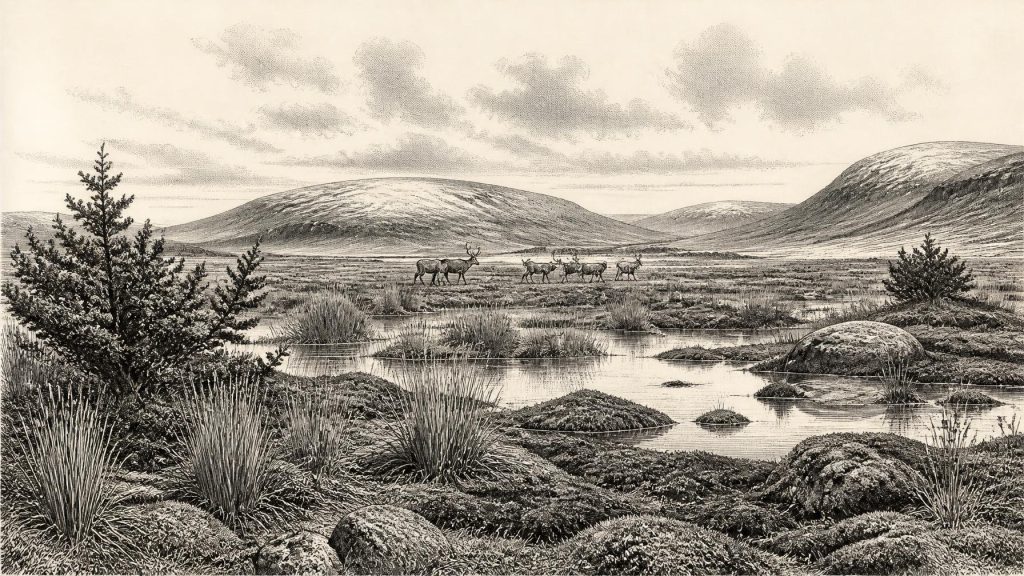
31,043 BCE is a modern label within Marine Isotope Stage 3, not a date tied to an Irish event. Derryvree, County Fermanagh, preserves freshwater sediments between glacial tills, indicating a cold, treeless tundra wetland with grasses, sedges, juniper, aquatic plants and insects during an ice-free interval. Castlepook Cave, County Cork, contains Pleistocene fauna including mammoth, reindeer, giant deer, hyena, Arctic fox and lemmings, accumulated over extended periods. A marked reindeer femur, dated about 33,000 years ago, may indicate human butchery, but cannot prove settlement. Evidence instead depicts environmentally unstable Ireland, intermittently accessible to cold-adapted animals and possibly mobile people alike.
Dateline
31,043 BCE is a modern calendar label imposed on a time for which Ireland has no annual chronicle. It cannot responsibly be tied to a named ruler, community, battle, migration, ceremony or even a particular season. In radiocarbon terms, the label falls roughly 32,990 years before AD 1950, but the evidence available for Ireland comes in broad calibrated ranges, not year-by-year dates. The most useful comparison is the freshwater sequence at Derryvree, near Maguiresbridge in County Fermanagh, whose organic deposits are generally placed within a wide interval of about 36,900–31,700 calibrated years before present. Thus this numbered year lies within the broader horizon potentially represented by the deposit, not at a securely identifiable point inside it.
A Cold Interval, Not a Calendar Year
This was the later part of the Late Pleistocene, within Marine Isotope Stage 3: a climatically unstable period before the fullest development of the Last Glacial Maximum. Ireland was not a uniform icebound land at every moment, nor was it a country of forests and settled valleys. Ice expanded and contracted regionally over long periods; exposed ground, periglacial terrain, wetlands and local glaciers formed a changing mosaic. Modern reconstructions of the British–Irish Ice Sheet suggest that, around 31,000 years before present, substantial ice caps and mountain glaciers existed in parts of Ireland, especially in northern and upland districts, while the exact limits and timing of ice advance remain uncertain in many regions.
The year therefore belongs to a phase of approaching glacial severity rather than to the Last Glacial Maximum itself, which came later. This distinction matters. A map showing an ice sheet at its greatest extent cannot simply be projected backwards onto 31,043 BCE. Conversely, the survival of a wetland deposit at one site cannot demonstrate that all Ireland was ice-free or habitable. The island’s Pleistocene history has been repeatedly disturbed by ice, erosion and changing sea levels. Many former soils, campsites and shorelines will have been removed, buried or drowned. What remains is exceptionally valuable, but fragmentary.
Fresh Water Beneath a Drumlin
Derryvree is the clearest environmental archive close to this date. Roadworks in 1969 cut through a drumlin and exposed fine sands, silts and organic deposits lying between two substantial tills: unsorted sediments left by glacier ice. The sequence records an earlier glacial episode, followed by an interval in which freshwater sediment accumulated, then a later return of ice. That order of deposits is direct evidence that the precise locality was not continuously glacier-covered. It does not show how extensive the ice-free area was, how long it lasted in human generations, or what occurred in any single year.
The plants and small organisms preserved in the Derryvree sediments give the landscape its most intelligible character. Pollen, seeds, mosses and insect remains indicate open, treeless vegetation rather than woodland. Grasses, sedges, herbs and juniper formed part of the vegetation, while aquatic and wetland plants, including bogbean, point to pools, slow water and waterlogged ground. Mosses and insect evidence have been interpreted as a cold muskeg or tundra-wetland environment: a patchwork of saturated ground, plant-rich shallows and open water, subject to long hard winters and short productive summers.
This was not an empty white wilderness. In a severe climate, sheltered wet ground could still sustain plants, insects and the food chains dependent on them. Yet it was a low-productivity world, exposed to frost, wind and abrupt climatic change. There is no evidence of fields, livestock, crops, built houses or managed woodland. The material at Derryvree represents natural environmental processes, not a settled cultural landscape. Its importance lies precisely in preserving a living community of plants and invertebrates from a period for which such Irish evidence is rare.
Castlepook’s Animal World
At the opposite end of the island, Castlepook Cave near Doneraile in north County Cork offers a different kind of archive. Also known as Mammoth Cave, it yielded one of Ireland’s richest collections of Pleistocene vertebrate remains during excavations in the early twentieth century. The assemblage includes animals now absent from Ireland, among them woolly mammoth, reindeer, giant deer, spotted hyena, Arctic fox and lemmings. Some re-dating has shown that parts of the faunal record belong to Marine Isotope Stage 3, before the Last Glacial Maximum.
These animals should not be imagined as a single herd photographed at one instant. Cave collections accumulated over long periods, and old excavations often removed bones with far less stratigraphic control than modern archaeology requires. Individual dates can differ considerably, and some deposits or collections contain material from more than one phase of the Pleistocene. Castlepook nevertheless demonstrates that cold-adapted mammals reached Ireland during episodes when conditions and routes of access allowed them to do so. Spotted hyenas, in particular, indicate not merely grazing country but a functioning predator-and-scavenger ecology.
The cave itself was probably more important as a carnivore den and bone trap than as a human home. Hyenas can transport carcass parts into caves, gnaw bones and scatter material through repeated occupation. That makes the assemblage invaluable for reconstructing fauna but difficult to turn into a simple scene of hunting. Mammoth bones establish that these great animals occurred in the wider Irish region during the period represented by the cave fauna; they do not prove that people hunted them, watched them, or encountered them in this particular year.
The Reindeer Femur and the Human Question
A reindeer femur from Castlepook has transformed discussion of Ireland’s earliest possible human presence. It has been radiocarbon dated to around 33,000 years ago and bears a deep mark interpreted by zooarchaeologist Ruth Carden as a modification made on fresh bone by a sharp stone tool. If that interpretation is confirmed, it would indicate that people processed a reindeer carcass in Ireland or handled the limb before it entered the cave system. It would push evidence for human activity on the island far earlier than the previously secure terminal-Pleistocene traces.
Its significance needs careful limits. The dated bone is not a stone-tool assemblage, hearth, dwelling floor, burial, structured deposit or repeatedly occupied camp. No associated spear point, butcher’s knife, charcoal-rich fire-place or concentration of food waste has been published from a secure Castlepook context for this horizon. Nor does the date of an animal’s death automatically establish the exact timing of a surface mark. The femur can support a serious hypothesis of human carcass processing; it cannot yet furnish a full narrative of permanent settlement.
Accordingly, society and everyday life remain mostly unknown. If people were present, the cautious inference is of a small, highly mobile Upper Palaeolithic group able to use a sharp stone edge and exploit large game. They may have removed meat, hide, sinew or marrow from a carcass, whether hunted or scavenged. Such behaviour is well known elsewhere in Upper Palaeolithic Europe, but applying it to Ireland is interpretation rather than direct observation. There is no basis for identifying a language, ethnic identity, household structure, social hierarchy or population size.
No Polities, No Trade Network
Political affairs, diplomacy and organised warfare leave no identifiable evidence for Ireland at this depth of time. No chiefdoms, territories, alliances, forts or formal boundaries can be reconstructed. Equally, no trade network is known. A human crossing to Ireland, if the Castlepook evidence reflects one, would imply knowledge of movement across a changing seaway or coastal landscape, but it does not prove regular maritime exchange. Lower global sea levels altered the configuration of coasts, yet Ireland was not simply an extension of continental Europe on a secure land bridge. The character and difficulty of any crossings varied with local ice, sea level and route.
There is also no direct evidence for religion, art, burial practice, formal learning or ritual at 31,043 BCE. It would be wrong to fill that silence with later Irish myths or with images borrowed uncritically from famous French cave art. Palaeolithic people elsewhere possessed rich cultural traditions, but Ireland’s evidence does not currently reveal whether comparable practices occurred here. The appropriate historical emphasis is not on imagined beliefs but on the material conditions that made survival, animal movement and perhaps brief human visits possible.
An Island in Ecological Transition
The decisive development around this date was environmental instability. Derryvree records a cold wetland existing between glacial advances; Castlepook preserves evidence of a northern animal community capable of occupying the island during favourable windows. Together they contradict any simple picture of a permanently sealed landscape, while also warning against the opposite fantasy of a continuously populated Ice Age Ireland. Conditions were variable, regional and liable to change on timescales far longer than a calendar year.
For 31,043 BCE, then, Ireland’s story is one of pools beneath later ice, open tundra vegetation, roaming cold-climate mammals and a disputed but consequential sign of human action on a reindeer bone. The evidence is enough to show that Ireland participated in the wider ecological world of north-western Europe during Marine Isotope Stage 3. It is not enough to name its inhabitants, narrate an event, or claim an enduring society. The most responsible account preserves both achievements: the extraordinary depth of the record and the boundaries of what it can say.
Primary Sources
- A Middle Midlandian Freshwater Series at Derryvree, Maguiresbridge, County Fermanagh, Northern Ireland
- A Reconsideration of the Radiocarbon Dating of the Marine Isotope Stage 3 Fauna from Southern Ireland
- The Irish Quaternary Fauna Project
- The Colonization of Ireland: A Human Ecology Perspective
- First Evidence of a Late Upper Palaeolithic Human Presence in Ireland
- New Insights on the Fauna of Ireland's Younger Dryas and Early Holocene from Alice & Gwendoline Cave
- Growth and Retreat of the Last British–Irish Ice Sheet, 31,000 to 15,000 Years Ago: The BRITICE-CHRONO Reconstruction
- Late Pleistocene Chronostratigraphy and Ice Sheet Limits, Southern Ireland
- Trimlines, Blockfields and the Vertical Extent of the Last Ice Sheet in Southern Ireland
- Ireland: Submerged Prehistoric Sites and Landscapes
- The IntCal20 Northern Hemisphere Radiocarbon Age Calibration Curve (0–55 cal kBP)
- Irish Pleistocene Biostratigraphy
- Spotted Hyena Skull
- Archaeology Research Excavation Grant 2022: Castlepook Cave Final Report
- 2022:564 – Castlepook Cave, Castlepook South, Cork
- Heritage Artefacts of County Cork 2021
- The Timing and Magnitude of the British–Irish Ice Sheet Between Marine Isotope Stages 5d and 2
- Early Deglaciation of the British-Irish Ice Sheet on the Atlantic Shelf Northwest of Ireland Driven by Glacioisostatic Depression and High Relative Sea Level
- A Critical Review and Re-Investigation of the Pleistocene Deposits Between Cranfield Point and Kilkeel, Northern Ireland
- Proceedings of the Postglacial Colonisation Conference
- The Quaternary of Western Ireland: Field Guide
- The Last British–Irish Ice Sheet, 31,000 to 15,000 Years Ago