Reindeer, Hyenas and Cave Mud31047 BCE
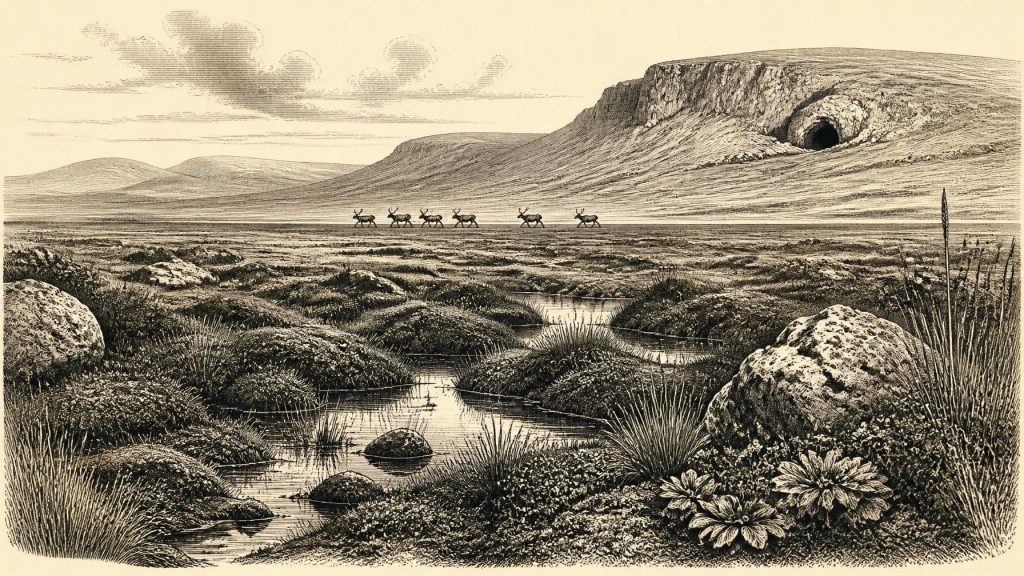
Around 31,047 BCE, Ireland experienced unstable Late Pleistocene conditions before maximum glaciation. Derryvree, County Fermanagh, preserves freshwater sediments between glacial tills, indicating cold, open wetlands with sedges, mosses, dwarf shrubs and Arctic-alpine plants during an ice-free interval. Castlepook Cave, County Cork, yielded reindeer, mammoth, giant deer, hyaena and other fauna, reflecting intermittent connections with continental populations. A possibly cut-marked reindeer femur may indicate brief human carcass processing around 33,000 years ago, but remains unconfirmed. No settlement, tools, hearths, burials or evidence for society, trade, religion or language survives. The evidence describes environmental change, animal presence and possible fleeting human activity.
Dateline
The label 31,047 BCE gives a useful position in a modern chronological sequence, but it cannot identify an event that happened in Ireland in one knowable year. There was no calendar, writing, named people or dated political history on the island. In archaeological terms, the label falls about 32,996 years before 1950, conventionally expressed as c. 33,000 calibrated years before present (cal BP), within the Late Pleistocene and Marine Isotope Stage 3 (MIS 3). At such depth, radiocarbon dates must be calibrated and normally yield probability ranges rather than a single calendar year. The responsible subject is therefore a changing environmental and archaeological horizon, not an annual chronicle.
A Cold Island Before the Maximum
Ireland was in the last Ice Age, but this does not mean that the whole island was necessarily buried beneath an unchanging ice cap at this particular point. The fullest Last Glacial Maximum came later, broadly between c. 26,500 and 19,000 years ago globally; work on the British–Irish Ice Sheet shows that its advance, peak extent and retreat differed by region. Around c. 33,000 cal BP, climates and ice margins were unstable. Parts of the wider British–Irish system were growing, while other localities could retain ice-free ground, wetlands or periglacial terrain. Ireland’s Atlantic setting, varied relief and changing sea levels made conditions especially regional.
This was a landscape heading towards more severe glaciation, not a stable ‘frozen Ireland’. Later ice repeatedly eroded and rearranged older deposits, leaving a difficult record. That destruction matters historically: the scarcity of very early archaeological sites may indicate thin or intermittent human use, but it also reflects the poor survival of campsites, soils and coastlines through glaciation, erosion and later sea-level change. Caves and sediments sealed beneath glacial deposits are consequently disproportionately important. They preserve fragments of a world that open-air archaeology has mostly lost.
Derryvree’s Wetland Archive
The most informative environmental evidence near this broad horizon comes from Derryvree, near Maguiresbridge in County Fermanagh. Roadworks in 1969 cut through a drumlin and revealed fine sands, silts and organic layers lying between two tills: unsorted sediment deposited by glaciers. The sequence establishes a straightforward fact. Ice affected the site; then freshwater deposits and organic material accumulated during an interval in which the locality was not overridden; later glacial action buried the record. It is a rare Irish archive of environmental change between episodes of glaciation.
Organic material from the Derryvree deposit returned a conventional radiocarbon age of 30,500 radiocarbon years BP, with a large reported uncertainty of +1,170 and −1,030 years. Radiocarbon years at this age are not calendar years. With modern calibration, the deposit is broadly placed in a range of roughly 36,900–31,700 cal BP, or about 34,950–29,750 BCE. Thus 31,047 BCE can be used as a point within the wide interval illuminated by Derryvree, but cannot be attached to a particular season, pool, plant or animal there.
Its pollen, plant macrofossils and mosses indicate open, treeless, cold-country vegetation rather than woodland. Sedges, mosses, dwarf shrubs and herbs were associated with shallow freshwater and wet ground; finds reported from the deposit include mountain avens, an Arctic-alpine plant, and bogbean, an aquatic or wetland species. Such evidence supports a patchwork of marshy hollows, shallow pools, exposed mineral ground and low vegetation. It does not justify painting every part of Ireland as identical tundra. The record is local, and conditions would have varied with altitude, drainage, proximity to ice and the changing North Atlantic climate.
Animals on an Open Range
Southern Ireland provides a complementary, though differently formed, archive. Castlepook Cave near Doneraile in north County Cork produced Ireland’s most important known collection of last-cold-stage mammal remains. Excavated principally in the early twentieth century and now substantially held by the National Museum of Ireland, the assemblage includes reindeer, woolly mammoth, giant deer, brown bear, wolf, foxes, mountain hare, Arctic and Norwegian lemmings, and spotted hyaena. These finds demonstrate that Ireland was intermittently connected to continental north-west European animal populations during the Late Pleistocene.
They should not, however, be treated as a census from one moment. A cave can be a den, a refuge, a trap, a place into which water or scavengers move bone, and a repository built up over thousands of years. Revised radiocarbon work has shown that some older dates from Castlepook required reconsideration, while the fauna itself spans more than one climatic phase. Mammoth, reindeer and hyaena remains therefore establish that these species reached Ireland during parts of the pre-Last Glacial Maximum period; they do not prove that every species shared the same valley, season or food web in 31,047 BCE.
Nonetheless, the combined Fermanagh and Cork evidence supports a demanding open-country ecology. Reindeer could exploit sparse vegetation and move across broad ranges; mammoth implies access, at least episodically, to productive herb-rich ground; small mammals help confirm cold conditions. Spotted hyaena is a useful corrective to romantic views of an empty wilderness. Large carnivores and scavengers competed for carcasses and could carry bones into caves. The cave bone record is as much a history of animal behaviour, death and scavenging as it is of species presence.
The Castlepook Reindeer Claim
The date is especially significant because a reindeer femur from Castlepook has been publicly reported as bearing a deep linear mark consistent with cutting or chopping by a stone implement while the bone was fresh. The femur has been described as dating to about 33,000 years ago. If the identification of the mark as human-made, and its association with the animal’s death, are sustained by full specialist publication and further analysis, it would be evidence that people processed a reindeer in Ireland in this broad period. It would substantially pre-date the securely published terminal-Pleistocene evidence from Alice and Gwendoline Cave, County Clare, where a butchered brown-bear patella has calibrated dates around 12,800–12,600 cal BP.
The correct conclusion remains narrower than many popular accounts. One modified bone, from a cave collection with a complicated excavation and depositional history, cannot demonstrate a permanent settlement, a camp, a population descended from later Irish communities, or a named Upper Palaeolithic culture. No securely associated hearth, stone-tool assemblage, dwelling floor, burial or human remains has yet shown that a community lived at Castlepook around this time. Stone marks on bone are assessed through their morphology, placement and comparison with carnivore damage, trampling, abrasion and excavation effects; the claim merits careful scrutiny rather than automatic acceptance or rejection.
People Without a Recorded Society
If people did reach Ireland at this time, the evidence is compatible only with a brief visit by a very small, mobile hunting group, perhaps taking meat, marrow, hide, sinew or other useful material from a reindeer carcass. That is an interpretation, not an established fact. The island’s lower sea levels altered coastlines and narrowed some sea crossings in the wider region, but neither a simple dry-land route nor a particular journey to Cork can be inferred from the bone. Hunters elsewhere in Upper Palaeolithic Europe possessed sophisticated stone technologies and rich social traditions; that wider context cannot be used to supply missing Irish evidence.
There is no basis for political history in the usual sense. No Irish evidence identifies rulers, chiefdoms, territories, alliances, diplomacy, warfare, law or ethnic names. Nor can trade be demonstrated: the Castlepook fauna show animal movement and possible human access, not exchange networks. There were no farms, crops or domestic livestock; Ireland’s farming communities lay more than twenty-five millennia in the future. A possible carcass-processing episode is economy at its most immediate, not proof of markets or organised provisioning.
Culture Beyond Recovery
Religion, art, language and formal learning are equally beyond direct recovery for Ireland around this date. Cave art and carefully made objects elsewhere in Europe show that Ice-Age people could sustain powerful symbolic lives, but no Irish evidence of this age demonstrates an equivalent shrine, image, ritual deposit or teaching tradition. It is reasonable to recognise that any visitors were fully social human beings with knowledge, relationships and cultural practices. It is not reasonable to assign them a language, beliefs or ritual system.
What survives instead is a disciplined outline: an island of changing ice margins, open and wet cold-country habitats, intermittent large mammals and predators, and perhaps a fleeting human encounter with a reindeer near Castlepook. Derryvree’s plants and Castlepook’s bones are not a narrative of a single year. Together, they make 31,047 BCE historically meaningful precisely because they reveal both the richness of deep Irish time and the limits of what the evidence can say.
Primary Sources
- A Reconsideration of the Radiocarbon Dating of the Marine Isotope Stage 3 Fauna from Southern Ireland
- The Irish Quaternary Fauna Project
- Growth and Retreat of the Last British–Irish Ice Sheet, 31,000 to 15,000 Years Ago: the BRITICE-CHRONO Reconstruction
- The Timing and Magnitude of the British–Irish Ice Sheet Between Marine Isotope Stages 5d and 2: Implications for Glacio-Isostatic Adjustment, High Relative Sea Levels and ‘Giant Erratic’ Emplacement
- Trimlines, Blockfields and the Vertical Extent of the Last Ice Sheet in Southern Ireland
- Stratigraphic and Palaeo-Geomorphological Evidence for the Glacial-Deglacial History of the Last British-Irish Ice Sheet in the North-Western Irish Sea
- Advance and Retreat of the Marine-Terminating Irish Sea Ice Stream into the Celtic Sea During the Last Glacial: Timing and Maximum Extent
- Maximum Extent and Readvance Dynamics of the Irish Sea Ice Stream and Irish Sea Glacier Since the Last Glacial Maximum
- Maximum Extent and Dynamic Behaviour of the Last British–Irish Ice Sheet West of Ireland
- Oscillating Retreat of the Last British-Irish Ice Sheet on the Continental Shelf Offshore Galway Bay, Western Ireland
- The IntCal20 Northern Hemisphere Radiocarbon Age Calibration Curve (0–55 cal kBP)
- First Evidence of a Late Upper Palaeolithic Human Presence in Ireland
- New Insights on the Fauna of Ireland's Younger Dryas and Early Holocene from Alice & Gwendoline Cave
- A Middle Midlandian Freshwater Series at Derryvree, Maguiresbridge, County Fermanagh, Northern Ireland
- The Quaternary Period in Ireland: Figure 6
- Menyanthes trifoliata: Bogbean in Fermanagh
- Heritage Artefacts of County Cork 2021
- Archaeology Research Excavation Grant Report 2023: Richard Jennings
- Ice Age Ireland
- Guide to the National Museum of Ireland – Natural History