
Derryvree’s Pleistocene Herbarium30845 BCE
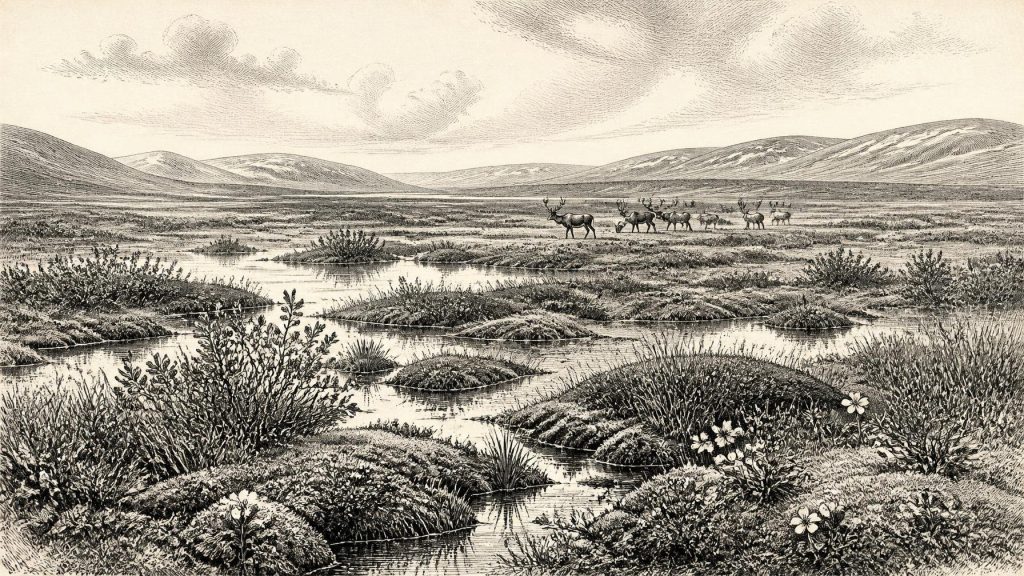
Around 30,845 BCE, Ireland’s evidence is environmental rather than historical. At Derryvree, County Fermanagh, freshwater sediments between glacial tills, radiocarbon dated broadly to 29,750–34,950 BCE, preserve an ice-free periglacial wetland. Pollen and plant remains indicate open tundra with mosses, sedges, dwarf willow, mountain avens and aquatic vegetation. Castlepook Cave, County Cork, yielded bones of diverse Ice-Age mammals, though their dates and associations require reassessment. A marked reindeer femur may indicate brief human carcass processing, but proves neither settlement nor population continuity. Growing British–Irish ice eventually reshaped and buried these landscapes, leaving evidence of climatic instability, wildlife and possible human activity.
Dateline
“30,845 BCE” is a modern chronological label, not a recorded Irish year. No calendar, written testimony, named community or datable event permits history at annual precision this far back. In radiocarbon terms it falls about 32,795 years before AD 1950, within the Late Pleistocene, Marine Isotope Stage 3 (MIS 3), and the Irish Midlandian cold stage. The responsible question is therefore not what happened in a particular year, but what dated deposits can reveal about Ireland during the broad interval around it.
The most relevant evidence is environmental rather than political or archaeological. It comes chiefly from Derryvree, near Maguiresbridge in County Fermanagh, where road-cutting in 1969 exposed freshwater silts and fine sands trapped between two layers of glacial till in a drumlin. The lower till records an earlier ice advance; the overlying sediments accumulated during an interval when the locality was not occupied by glacier ice; the upper till records a later advance that sealed the wetland archive. This is an unusually valuable sequence because it preserves a fragment of a vanished Ice-Age landscape beneath later glacial deposits.
A Date Range, Not a Moment
Organic material from Derryvree produced a conventional radiocarbon determination of 30,500 years BP, with a large laboratory uncertainty. Published discussion converts this broadly to about 31,700–36,900 calibrated years BP, or roughly 29,750–34,950 BCE. The notional date of 30,845 BCE lies within that wide span. Yet the range should not be mistaken for a precise age of every fossil in the deposit, still less for a single season in Irish history. Radiocarbon years and calendar years are not interchangeable: they must be calibrated against changing atmospheric carbon levels, and calibration at this depth carries substantial uncertainty.
Derryvree consequently illuminates conditions around this point in time, not the whole island on one exact day. Its fossils demonstrate that a part of south Fermanagh supported freshwater and terrestrial life during an ice-free interval. They do not prove that every Irish region was free of ice, that the climate was uniform, or that the island had a continuous human population. Such limits are not shortcomings of the evidence; they are the central facts that a careful account must preserve.
A Cold Wetland in Fermanagh
The plant remains indicate open tundra or muskeg-like country under periglacial conditions: ground shaped by intense cold, seasonal freezing and thawing, but not necessarily beneath permanent glacier ice. The pollen record is dominated by herbaceous plants, while the macrofossils include a notable moss flora. Finds reported from the Derryvree sequence include mountain avens (Dryas octopetala), dwarf willow, sedges, bogbean and alternate water-milfoil. Together, such evidence points to a low, wet mosaic of shallow water, sedge-rich margins, mossy ground and sparse open vegetation rather than forest.
This was not the featureless white wasteland often imagined by later generations. A freshwater basin capable of preserving aquatic plant remains had open water at least seasonally. Around it grew cold-adapted plants able to withstand short growing seasons and exposed ground. Dry-land cover may have been thin, but the assemblage records a functioning ecosystem: water plants rooted in pools, mosses spreading across saturated surfaces, and herbs occupying tundra soils. The environment was severe by modern Irish standards, but it contained habitats, food webs and seasonal variation.
Climate was also unstable. MIS 3 contained repeated abrupt swings between relatively milder Greenland interstadials and colder stadials. Irish deposits are sparse and difficult to correlate exactly with those rapid North Atlantic changes, so it is unsafe to attach Derryvree to a named climatic event with certainty. What can be said is that the sediments belong to a long cold-stage sequence in which glaciers advanced and retreated, water bodies formed locally, and vegetation repeatedly adjusted to changing temperature, moisture and ice cover.
Animals and the Cave Record
County Cork provides a complementary, though more problematic, window. Castlepook Cave near Doneraile produced a remarkable antiquarian collection of Late Pleistocene animal bones, including remains attributed to woolly mammoth, reindeer, giant deer, brown bear, wolf, Arctic fox, mountain hare, lemmings and spotted hyaena. These animals show that Ireland was at times connected ecologically to the wider north-west European world and could support a much richer cold-stage fauna than survives today. The cave also reminds us that bones were accumulated by many processes: carnivores, natural deaths, water movement, cave collapse and human excavation all affect what survives.
Older radiocarbon programmes assigned several Castlepook specimens ages in the broad MIS 3 range. However, recent scholarship stresses that many Irish Pleistocene bone dates produced before modern ultrafiltration methods require reassessment. A bone assemblage is therefore powerful evidence for the presence of species, but a less secure guide to whether all species lived together, exactly when they did so, or how long they occupied a locality. A new Castlepook research project has returned to the cave to seek stratified deposits and better chronological control.
The Human Question
Castlepook has nonetheless become important to the earliest possible human history of Ireland. A reindeer femur from the old collection has been reported as roughly 33,000 years old and as bearing a deep mark interpreted by zooarchaeologist Ruth Carden as damage made by a sharp stone tool while a carcass was processed. If that interpretation and chronology are sustained by further work, it would be evidence for an Upper Palaeolithic human action in Ireland near the period considered here: someone used a cutting edge on a reindeer.
That is a significant possibility, but it is a deliberately narrow conclusion. The femur does not demonstrate a village, a permanent population, a named people, a migration route or regular hunting territory. The old excavations lack the stratigraphic standards expected today, and the date of an animal bone does not by itself date the making of every surface mark. No securely associated hearth, stone-tool assemblage, dwelling floor, burial or repeated occupation horizon of this age has yet established a settled Upper Palaeolithic community in Ireland. The most defensible wording is therefore “possible brief human activity”, not “the first Irish settlement”.
No Polities, No Proven Conflict
There is no evidence for political affairs, diplomacy, formal leadership, warfare or territorial states in Ireland at this date. There is likewise no evidence from which to reconstruct language, kinship rules, religious rites, art, teaching or exchange networks. Any detailed account of camps, clothing, beliefs or social organisation would have to borrow general possibilities from contemporary Upper Palaeolithic societies elsewhere in Europe; it could not be presented as Irish evidence.
If people did enter Ireland briefly, they would have lived by mobile foraging and possessed the practical knowledge needed to move through a cold landscape and work animal carcasses. That is an inference from the proposed marked bone, not a demonstrated Irish economy. Nor can the evidence establish whether any visitors hunted the reindeer, found it already dead, removed meat, hide, marrow or sinew, or merely passed through the region. The archaeological silence is especially understandable because later glacier activity could erode, redeposit or bury fragile traces of open-air occupation.
Ice Was Gathering
The broader trajectory matters. Around this time the British–Irish Ice Sheet was growing towards its last maximum, but it had not reached its fullest known extent. Reconstructions place major build-up after roughly 35–32 thousand years ago, with maximum extent varying by sector and broadly falling between about 27 and 21 thousand years ago. Ireland’s later landscape—its drumlins, tills, meltwater channels and reworked sediments—would be profoundly shaped by that expansion. Derryvree’s organic beds survived precisely because they were sealed between ice-laid deposits, while countless other environmental and archaeological traces may have been destroyed.
Sea level was lower than today, and coastlines differed radically, but the exact availability of routes into Ireland cannot be reconstructed from Derryvree or Castlepook alone. It would be wrong to claim either a proven land bridge or a necessary sea crossing for a particular human visit at 30,845 BCE. Geography changed with ice-sheet growth, sea level, isostatic movement and shifting coastlines; the relevant shorelines now lie partly beneath the sea and are difficult to date securely.
An Evidence-Based Ireland
For Ireland around 30,845 BCE, the most important development was environmental instability on the approach to fuller glaciation. In Fermanagh, an ice-free freshwater basin supported a distinctly cold-adapted plant community. In Cork, cave deposits preserve a reminder of large mammals and carnivores that once entered the island’s changing landscapes. A single disputed-looking but potentially consequential reindeer bone raises the prospect of a fleeting human encounter.
That is already an extraordinary history, even without invented chiefs, battles or settlements. The Ireland of this period was a landscape of tundra waters, mosses, sedges, herb-rich ground and roaming Ice-Age animals, vulnerable to being overwritten by advancing ice. Its historical record survives not in chronicles but in silts below tills, old cave collections and the careful re-examination of evidence whose uncertainty is as important as its promise.
Primary Sources
- A Middle Midlandian Freshwater Series at Derryvree, Maguiresbridge, County Fermanagh, Northern Ireland
- Palaeoecology
- The Irish Quaternary Fauna Project
- New Insights on the Fauna of Ireland's Younger Dryas and Early Holocene from Alice & Gwendoline Cave
- 2022:564 – Castlepook Cave, Castlepook South, Cork
- Heritage Artefacts of County Cork
- Ireland's Palaeolithic Archaeology – Fleeting Footprints in a Frozen Land
- Reindeer Bone Found in Cork Cave Shows Human Activity in Ireland 33,000 Years Ago
- The IntCal20 Northern Hemisphere Radiocarbon Age Calibration Curve (0–55 cal kBP)
- Extent and Timing of the Last Glacial Maximum (LGM) in Britain and Ireland: A Review
- Pattern and Timing of Retreat of the Last British-Irish Ice Sheet
- Growth and Retreat of the Last British–Irish Ice Sheet, 31,000 to 15,000 Years Ago: the BRITICE-CHRONO Reconstruction
- Character of Advance and Retreat of the Southwest Sector of the British-Irish Ice Sheet During the Last Glaciation
- Character of Advance and Retreat of the Southwest Sector of the British-Irish Ice Sheet During the Last Glaciation
- Timing and Pace of Ice-Sheet Withdrawal Across the Marine–Terrestrial Transition West of Ireland During the Last Glaciation
- Early Deglaciation of Western Ireland
- Trimlines, Blockfields and the Vertical Extent of the Last Ice Sheet in Southern Ireland
- Dimensions and Chronology of the Last Ice Sheet in Western Ireland
- Landscapes and Environments of the Last Glacial-Interglacial Transition: a Time of Amazingly Rapid Change in Ireland
- The Quaternary of the Irish Midlands
- Field Guides
- Biogeography of Ireland: Past, Present, and Future