Castlepook’s Mountain Hare30239 BCE
Around 30,239 BCE, Ireland was undergoing climatic instability before extensive Last Glacial Maximum ice growth. Evidence cannot support a calendar-year narrative, but Derryvree’s deposits show cold, open freshwater wetlands with mosses, sedges and dwarf willow between glacial advances. Castlepook Cave preserves a mixed, long-term fauna including mammoth, reindeer, giant deer, bear, wolf, Arctic fox, lemmings and spotted hyaena, demonstrating changing connections with Britain and Europe. A marked reindeer bone may indicate episodic Upper Palaeolithic human activity, but cannot prove settlement or continuity. No evidence exists for agriculture, politics or society; the period is chiefly reconstructed through environmental and faunal remains.
Dateline
30,239 BCE is a modern label imposed on a time far beyond any Irish calendar, chronicle or named generation. It cannot responsibly be treated as a date on which a recorded event occurred. In radiocarbon and palaeoenvironmental scholarship, it falls broadly around 32,000 calibrated years before present, within Marine Isotope Stage 3 of the Late Pleistocene. Even that conversion must be used cautiously: radiocarbon results are measurements with margins of error, calibration curves are periodically revised, and deposits accumulated across spans of time rather than in a single year.
For Ireland, the evidence nearest to this point is not an archive of settlements but a sparse and difficult combination of cave fauna, glacial sediments, fossil plants, insects, landforms and laboratory dates. It permits a responsible reconstruction of an Ice Age landscape in flux. It does not permit a year-by-year account of rulers, battles, tribes or beliefs. The most important question is therefore not what happened in Ireland in one numbered year, but what the island’s environment, animals and possible human visitors can tell us about this deep interval.
An Island Approaching Maximum Cold
Ireland lay on the Atlantic edge of north-west Europe during a climatically volatile part of the last Ice Age. Temperatures did not simply decline in a smooth progression towards a single frozen maximum. Greenland ice-core records and North Atlantic evidence show abrupt warmings and coolings, while Irish glaciers advanced, altered their margins and later grew into the much larger British–Irish Ice Sheet. Modern reconstructions place the major build-up of that ice sheet in the period after roughly 32,000 years ago, with its greatest extent later, during the Last Glacial Maximum.
Thus, around this notional year, Ireland should not be imagined either as a wholly ice-covered blank or as a familiar green island. Conditions varied markedly between regions and through time. Some ground was occupied by ice or affected by its growth; elsewhere there were cold, exposed, treeless or nearly treeless environments. Permafrost, seasonal freezing, meltwater and strong winds shaped soils and drainage. Sea level was far lower than today, so coastlines and shallow seas had different outlines. Yet low sea level did not automatically create an easy, dry land route into Ireland at every moment: ice, water, changing shorelines and difficult terrain all mattered.
The uncertainty is significant. Recent work on the British–Irish Ice Sheet has greatly improved the chronology of its growth and retreat after about 31,000 years before present, but the exact extent and timing of earlier ice in particular Irish regions remain debated. A single point such as 30,239 BCE therefore cannot be mapped with false precision. The sound conclusion is that Ireland was entering, or already experiencing regionally, the severe environmental transformation that culminated in extensive glaciation.
Derryvree’s Buried Wetland
One of the most informative Irish records for the wider period comes from Derryvree near Maguiresbridge in County Fermanagh. Roadworks exposed organic silts and fine sands enclosed between two thick sheets of glacial till within a drumlin. This exceptional stratigraphic position matters: the freshwater deposits formed after one phase of ice action and before another advance buried them. They are evidence for an interval when open water, wet ground and living vegetation existed locally, not evidence for an unchanging island-wide climate.
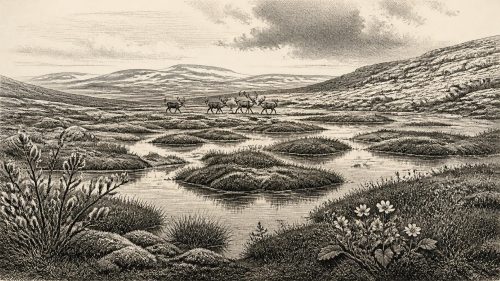
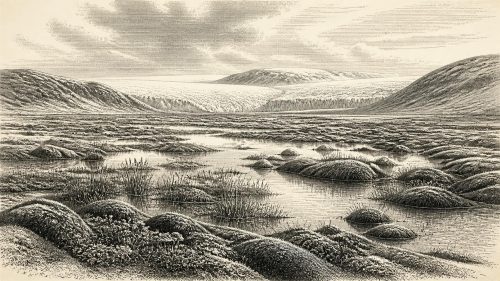
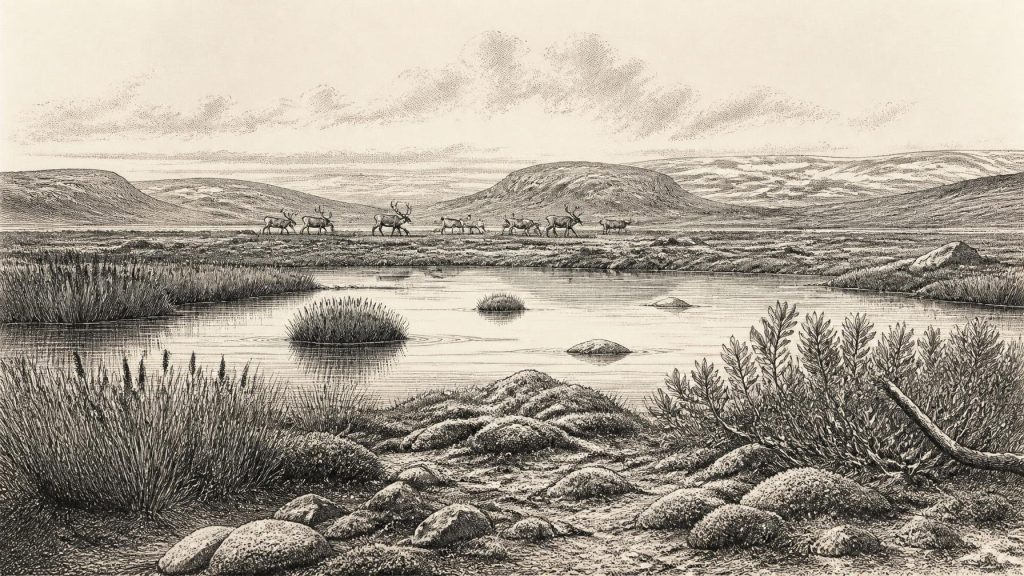
The Derryvree deposit produced a conventional radiocarbon determination of 30,500 radiocarbon years before present, with a substantial uncertainty range. Its fossil assemblage included mosses, sedges and cold-environment plants, among them bogbean or buckbean (Menyanthes trifoliata), water-milfoil and dwarf willow. Insects and plant remains together indicate a cold, open, periglacial freshwater margin: a landscape with pools, saturated sediment and short productive seasons rather than closed forest. Earlier descriptions used terms such as tundra or muskeg. They remain useful comparisons if they are not mistaken for a precise modern habitat transplanted into Ice Age Fermanagh.
Derryvree does not date precisely to 30,239 BCE, and its radiocarbon age cannot be converted into an exact historical anniversary. Nevertheless, it provides a rare environmental window close enough in the long chronology to illuminate the kind of country that could occur in Ireland during this cold phase. It also demonstrates why the idea of a permanently ice-locked island is misleading. Before later ice overran the site, freshwater ecosystems briefly persisted or developed there.
Castlepook’s Animal World
Nearly 300 kilometres to the south-west, Castlepook Cave near Doneraile, County Cork, provides the richest Irish record of pre-Last Glacial Maximum vertebrate life. Also known as Mammoth Cave, it is a limestone cave system whose deposits and collections preserve remains of woolly mammoth, reindeer, giant deer, brown bear, wolf, Arctic fox, mountain hare, lemmings and the only securely recorded Irish spotted hyaena. Not every species belongs to one moment or one undisturbed deposit. Many bones were recovered in nineteenth- and early twentieth-century excavations, when recording methods did not meet modern standards, and parts of the cave assemblage were mixed or reworked.
That limitation is central, not incidental. Direct radiocarbon dating and later re-dating have shown that individual Castlepook animals belong to different phases of the Late Pleistocene. Improved pretreatment of bone collagen has altered some previously accepted ages by thousands of years. The cave therefore documents a long-lived regional faunal archive, not a perfectly preserved snapshot of one season. Even so, it establishes beyond doubt that Ireland supported, at overlapping times during Marine Isotope Stage 3, a striking community of large herbivores, smaller cold-adapted mammals and formidable predators.
This was an ecological world structured by grazing, browsing, scavenging and predation. Mammoths and giant deer would have required substantial forage; reindeer could exploit open, cold-country resources; hyaenas and wolves occupied carnivorous and scavenging roles. Their presence implies repeated biological connections with Britain and continental Europe when conditions allowed animals to reach Ireland. It does not show that every species travelled together, nor that the island had a continuous resident fauna. Populations could arrive, disappear locally and be replaced as climate, ice and access changed.
A Reindeer Bone and a Human Question
Castlepook has particular importance because a reindeer femur has been reported as bearing a deep linear mark interpreted by zooarchaeologist Ruth Carden as damage made by a sharp stone tool on fresh bone. The specimen has been publicly associated with an age of roughly 33,000 years ago. If the incision is confirmed as a cut mark made soon after the animal’s death, it would be remarkable evidence that people reached Ireland during the Upper Palaeolithic, far earlier than the well-established post-glacial occupation of the island.
But the interpretation must remain proportionate. A radiocarbon date on the bone establishes an age range for the animal’s death, not automatically the date, agent or purpose of a surface mark. Nor can one modified bone prove a settlement, a camp, a hunting party’s size, an ancestral population, a language or continuous occupation. Castlepook’s complicated excavation history further limits contextual certainty. The evidence supports the possibility of episodic human presence; it does not yet support a detailed story of a resident Irish society in 30,239 BCE.
That distinction is especially important because Ireland’s later archaeological record contains a long gap. Secure evidence for sustained settlement belongs to the post-glacial world, millennia later, when Mesolithic hunter-gatherers occupied a warming and increasingly wooded island. A putative Upper Palaeolithic visit at Castlepook would not make those later colonists culturally or genetically continuous with earlier visitors. The ice sheet and severe climatic changes between the two periods may have erased landscapes and interrupted any human presence.
Everyday Life: What Cannot Be Recovered
No houses, hearths, stone-tool assemblages, burials, artworks or food-processing sites securely attributable to this exact Irish interval are known. Accordingly, there is no evidence for political institutions, leaders, territorial states, diplomacy, organised warfare, formal religion, monuments, writing, schools or trade networks within Ireland. Claims about clans, languages, ritual customs or named peoples would be inventions. Even if a small Upper Palaeolithic group did visit, its social life cannot be reconstructed from the Castlepook bone alone.
Some broader inferences are reasonable, provided they remain conditional. People living in comparable cold-climate Upper Palaeolithic settings elsewhere in Europe used stone, bone, hide, fire and shared knowledge to obtain food, maintain shelter and move through difficult terrain. If humans reached Ireland, they likely required similarly flexible skills and intimate knowledge of seasonal animal behaviour. Yet those continental comparisons are context, not direct proof of particular Irish practices. Ireland has not yielded the material traces needed to turn them into local facts.
Economy Without Farms or Markets
There was no agriculture in Ireland at this time. No evidence supports crops, livestock, permanent fields, cereal storage, metalworking, pottery, roads or market exchange. The productive base revealed by the environmental record was wild: wetland plants and invertebrates, grazing animals, carnivores and scavengers, all operating within a sparse, cold ecosystem. If people were present, hunting and the processing of animal resources are the only plausible economic activities suggested by the debated Castlepook evidence.
Animal movement was the more demonstrable form of connection. Ice Age mammals reached Ireland during intervals when geography and climate permitted dispersal from neighbouring lands. Their bones show that Ireland was not ecologically isolated, although its separation, sea crossings and glacial barriers changed repeatedly. The arrival of fauna is not evidence of human commerce, and it should not be described as trade. It is evidence for shifting biogeographical corridors in an unstable North Atlantic world.
A Record of Survival and Erasure
The Ireland of around 30,239 BCE is best understood as an environment of survival, movement and impending transformation. Derryvree preserves a small freshwater world later sealed below ice-related deposits. Castlepook preserves the bones of animals whose habitats and routes were repeatedly altered by cold, ice and sea-level change. Together, they show that Late Pleistocene Ireland contained living landscapes rather than an empty abstraction, but also that those landscapes were vulnerable to rapid environmental change.
The chief historical lesson of this remote date is methodological. Sediment layers can reveal water, plants and climate; bones can reveal species and sometimes human or animal modification; radiocarbon can place materials within calibrated ranges. None can supply a calendar-year narrative where none exists. Around 30,239 BCE, Ireland’s story is not one of recorded politics or known communities. It is the deeper, more cautious history of cold-country wetlands, wandering mammals, advancing ice and a tantalising, still unresolved possibility that human hands once cut into a reindeer bone in a Cork cave.
Primary Sources
- A Middle Midlandian Freshwater Series at Derryvree, Maguiresbridge, County Fermanagh, Northern Ireland
- The Irish Quaternary Fauna Project
- A Reconsideration of the Radiocarbon Dating of the Marine Isotope Stage 3 Fauna from Southern Ireland
- The Colonization of Ireland: A Human Ecology Perspective
- Growth and Retreat of the Last British–Irish Ice Sheet, 31,000 to 15,000 Years Ago: the BRITICE-CHRONO Reconstruction
- The Timing and Magnitude of the British–Irish Ice Sheet Between Marine Isotope Stages 5d and 2: Implications for Glacio-Isostatic Adjustment, High Relative Sea Levels and ‘Giant Erratic’ Emplacement
- Deglaciation Chronology of the Donegal Ice Centre, North-West Ireland
- The Deglaciation of the Western Sector of the Irish Ice Sheet from the Inner Continental Shelf to its Terrestrial Margin
- Trimlines, Blockfields and the Vertical Extent of the Last Ice Sheet in Southern Ireland
- Dimensions and Chronology of the Last Ice Sheet in Western Ireland
- Radiocarbon Constraints on the Age of the Maximum Advance of the British–Irish Ice Sheet in the Celtic Sea
- The IntCal20 Northern Hemisphere Radiocarbon Age Calibration Curve (0–55 cal kBP)
- New Insights on the Fauna of Ireland’s Younger Dryas and Early Holocene from Alice & Gwendoline Cave
- Castlepook Cave: County Geological Site Report
- Quaternary Site Descriptions: Ireland
- The Quaternary of Ireland: Figure 6, Subdivision of the Quaternary Period in Ireland
- Occurrence of Mammalia Relicts at Site Castlepook Cave
- Castlepook Cave Excavation, 2022
- Irish Palaeolithic Archaeology – Fleeting Footprints in a Frozen Land
- The Dungarvan Valley Caves Project: Second Interim Report
- Irish Animals Exhibition Galleries
- The Irish Stone Age: The Antiquity of Man in Ireland