A Fragile Lordship1217 CE
In 1217, Ireland was a fragile lordship governed for the child Henry III from Dublin, alongside powerful Anglo-Norman magnates and resilient Irish kingdoms. Royal orders promised liberties to loyal subjects, promoted markets, Waterford settlement, land claims, engineers, castle defence and exchequer control. Strategic tensions surrounded the Lacys, Carrickfergus and Carlingford. Government policy sought English dominance in senior church appointments, despite continuing local influence. Annals record Irish fishermen killed on Man, Anglo-Norman raiding near Armagh, retaliatory cattle seizures and a favourable harvest. Marriage, commerce, ecclesiastical links and maritime travel connected communities, but coercion, exclusion and contested authority exposed the Crown’s reach.
Dateline
In 1217 Ireland stood at the meeting-point of several worlds: the lordship governed in the young Henry III’s name from Dublin, powerful Anglo-Norman lordships in Leinster, Meath and Ulster, and resilient Irish kingdoms whose rulers, churches and learned communities retained their own authority. The evidence for the year is unusually varied but uneven. Royal letters disclose what the government wanted done; Irish annals preserve raids, deaths, harvest and seaborne disaster. Together they show a country neither securely conquered nor simply divided into two sealed communities. It was connected by law, ships, marriage, church office, cattle-raiding and castles—and marked by sharp inequalities of power.
A New King’s Irish Settlement
Henry III had succeeded his father, King John, in October 1216, while still a child and while England was in civil war. Ireland was not the main battlefield of that struggle, but its administration and magnates mattered to the royal government. Geoffrey de Marisco, justiciar of Ireland since 1215, remained the Crown’s chief executive on the island. His job joined military command, financial supervision, judicial authority and the management of royal land. The regime in England, led by the aged William Marshal during Henry’s minority, needed the Irish lordship to remain loyal, solvent and defensible.
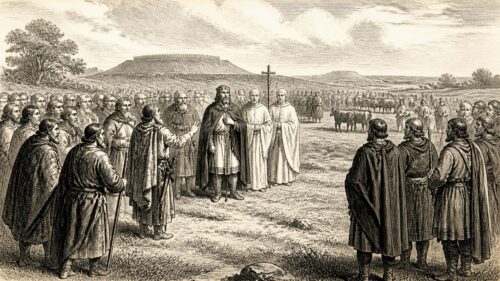
In February 1217 the government addressed Ireland’s archbishops, bishops, abbots, earls, barons, knights, free tenants and other subjects. It praised their fealty to John and invited the same loyalty to Henry, promising that they and their heirs should enjoy the liberties granted in England. This was the Irish transmission of the charter politics of the new reign. A text later known as Magna Carta Hiberniae adapted the English charter’s language to Ireland, naming Dublin and the Liffey where its model named London, the Thames and Medway. Yet historians rightly urge caution. The surviving Irish-form text is known from a much later exchequer compilation, now lost in the destruction of the Public Record Office in 1922; it remains debated whether its Irish substitutions were all present in the document sent in 1217. What is firmly established is the government’s February promise of liberties to the king’s Irish subjects.
Those subjects were not the whole population in any modern sense. The charter’s political language principally addressed people within the Crown’s feudal and administrative orbit: churchmen, settlers, tenants and magnates able to hold land, bring suits and offer service. It did, nevertheless, reveal a priority of the new regime. After John’s troubled final years, ministers wanted the lordship’s elites to regard the new king as a source of lawful custom rather than arbitrary disruption. The promise did not dissolve local conflict, nor did it place Gaelic Irish communities on equal terms with the colonists and royal officers.
Orders from Across the Sea
The royal records make 1217 appear as a stream of practical commands crossing the Irish Sea. On 3 February Simon, bishop of Meath, received a grant of a Wednesday market at New Meath. A market was a privilege, not merely an occasion for buying food: it concentrated tolls, exchange, legal regulation and settlement. The grant points to the Crown’s interest in organised commercial places in Meath, a lordship long dominated by the Lacy family. It should not be mistaken for evidence that every inhabitant prospered, but it shows that market-building was part of the colonial landscape.
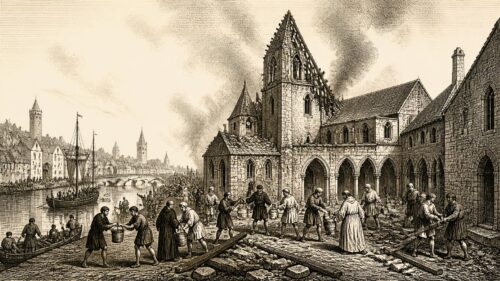
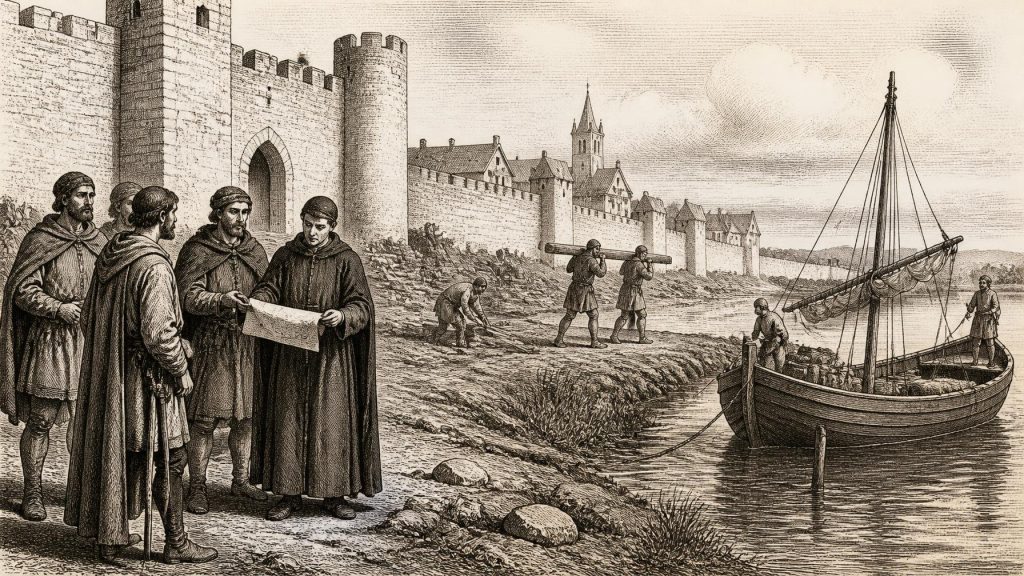
Waterford provides an even more physical glimpse of planned urban growth. On 15 February Henry instructed Geoffrey de Marisco to give the vacant strip between the river and the city wall to people willing to live there. The instruction did not guarantee that houses were immediately built, but it sought to turn unused defended waterfront ground into habitation. Such a move joined defence, population and trade: Waterford was a port linking south-east Ireland to Bristol, south Wales and wider English and continental routes. The city’s walls, river frontage and potential residents were therefore matters of royal policy rather than merely local concern.
Other writs concerned rights in land and the maintenance of officials. Isolda Biset was to receive seisin of two carucates in Fingal and of lands for which she had made a fine with John. Margery Cogan’s proposed payment for her inherited land in Desmond was to be considered by the justiciar and the king’s Irish counsellors. On 21 March, Geoffrey was ordered to ensure that Petronilla Bloet received the marriage portion given to her when she married Diarmait Mac Carthaig, described in the writ as king of Cork. The order is a striking reminder that marriage joined Anglo-Norman and Gaelic dynastic politics, and that a woman’s landed entitlement could be pursued through royal government. It is not evidence of social equality: rather, it shows elite women using recognised legal claims in a political world structured by lordship and kin.
Administration also required people, animals and expertise. Ralph de Norwich, a royal clerk and messenger, travelled to Ireland under safe conduct in February and was to be maintained in royal service. Master Otto de Havering, identified as the king’s engineer, was likewise sent with a companion, horse and groom. The record does not say precisely what work Otto undertook. It does show that the government regarded technical skill and mounted transport as necessary resources in Ireland, where fortifications, ports and royal residences required continual attention.
Castles, Revenue and the Northern Frontier
Security was a particular concern in the north-east. On 13 February William de Serland was confirmed in the annual £100 assigned by John for the custody of Carrickfergus Castle. He was to follow the justiciar’s advice over keeping and strengthening the fortress and, if necessary, station a force there. Carrickfergus commanded an important harbour and sea passage towards Scotland and western Britain. Its upkeep demonstrates that royal authority in Ulster depended not simply upon claims of overlordship but upon money, garrisons, supplies and a defensible coastal base.
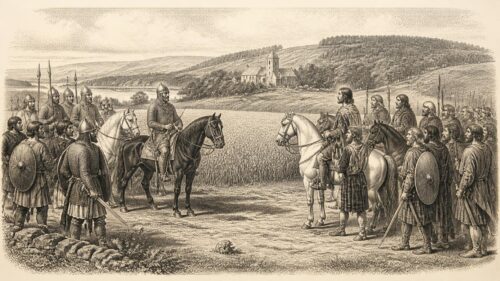
That need was heightened by the unresolved Lacy question. Hugh de Lacy, earl of Ulster, remained dispossessed after his conflict with John; his brother William had returned to Ireland and was acting in Meath. During 1217 William was ordered to surrender Carlingford and Rath castles to Geoffrey de Marisco, while Walter de Lacy undertook to make compensation for his brother’s actions. The order tells us less about a completed transfer than about royal anxiety. Carlingford, on the lough of the same name, guarded another strategic maritime gateway. Control of such castles was inseparable from the political rivalry among Crown officers, Lacys and other great lords.
The government was equally alert to cash. Geoffrey de Marisco was reminded in 1217 that rents and fines were to be received through the exchequer. This may sound technical, but it goes to the heart of power. Fines paid for land, justice and concessions; rents came from royal estates and rights. Routing them through the Dublin exchequer limited a justiciar’s private discretion and made revenues available for garrisons and government. Geoffrey’s later difficulties over accounting should not be projected backwards as a proven crime in this year, but the reminder itself suggests close concern at the centre about the custody of Irish income.
Church Office and Exclusion
The most consequential policy of 1217 concerned the church. On 14 January the English government approved Robert Travers, a kinsman of Geoffrey de Marisco, for the see of Killaloe. Three days later it directed that no Irishman should be elected or promoted in any Irish cathedral, on the stated ground that this might disturb the king’s land. This was an explicit attempt to reserve senior ecclesiastical advancement for men acceptable to the English administration. Church office carried spiritual responsibility, but also land, revenues, influence, legal jurisdiction and access to royal power. Excluding Irish candidates was therefore a political as well as an ethnic act.
The policy should not be presented as effortless or universally effective. Irish-born bishops continued to hold sees, and local chapters, rulers and clerics possessed considerable leverage beyond the areas most tightly controlled from Dublin. But the directive is revealing precisely because it records a governing ambition: to bind the institutional church more firmly into an English-led lordship. The custody of Armagh was placed in the hands of Richard de Marisco on 22 January, while Luke de Netterville, an Englishman, was elected archbishop later in the year. Competition for Armagh’s temporalities and primatial prestige would continue well beyond 1217.
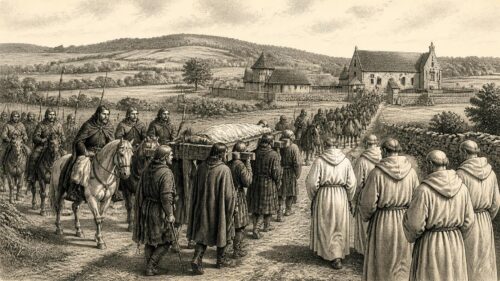
Henry of London, archbishop of Dublin, returned to Ireland by July after being appointed papal legate on 29 April. His position brought together two loyalties that could reinforce each other: he was a leading royal administrator and the pope’s representative. Pope Honorius III charged him in May to work faithfully and prudently for peace between the Irish and the king. The wording recognised that royal authority depended on negotiation as well as coercion. Yet Henry and Geoffrey also helped advance a church policy that privileged English control. In 1217, diplomacy, reform and exclusion were not opposites; they were entangled instruments of rule.
Conflict, Sea and Seasonal Plenty
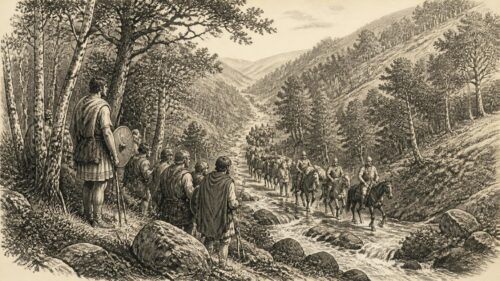
Irish annals give the year a very different texture. The Annals of Loch Cé report that fishermen from across Ireland—from Waterford in the south and Wexford northwards to Derry—went to Man to fish, committed violence there and were all killed in retaliation. The claim that all were slain may be annalistic compression rather than a literal census, but the episode is important. It reveals a fishing economy capable of seasonal movement across the Irish Sea, and the lethal risks of operating beyond one’s own shores. The sea was a route for trade, food and travel, but also for quarrels outside the reach of Dublin’s writs.
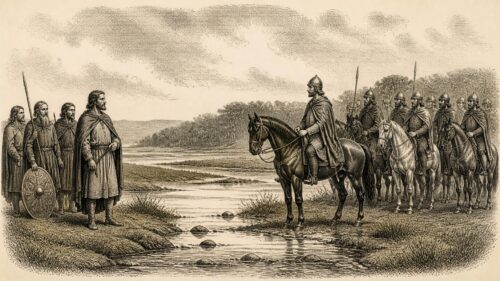
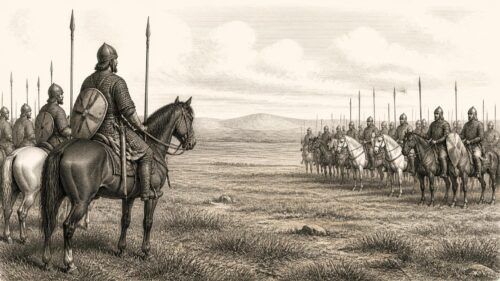
In Ulster, the same annal records a predatory force of ‘Foreigners’—the usual Gaelic annalistic term for Anglo-Normans—plundering Armagh under the guidance of Ó Fothadáin, despite his alleged assurance to its community that it would be spared. A week later Niall Ruadh Ó Néill and a son of Mac Mathghamhna took 1,200 cattle from the raiders. When pursuit followed, the Eoghanacht killed fourteen armoured men, including the constable of Dealgan, and Ó Fothadáin was killed. The figures and moral colouring belong to the annalist, but the sequence plainly conveys warfare conducted through plunder, cattle seizure, pursuit and the contest for honour. Even a major ecclesiastical centre such as Armagh was exposed.
Not every notice is of violence. Loch Cé says that every fruit-bearing tree produced a full crop in 1217. Such a statement cannot yield a modern harvest statistic, but it is reasonable evidence that the year was remembered for abundance. Fruit, livestock, grain and fish sustained households, monasteries, markets and military retinues alike. The death of Oissín, abbot of the canons of Mainistir Dearg, and the reported overseas journey of Irish abbots to a general chapter also remind us that religious life continued through local communities and transnational connections, even amid political strain.
One final source warning matters. The Annals of Inisfallen, under its heading for 1217, notes John’s death and the arrival in England of the French king’s son—events belonging to 1216. Its dating illustrates the hazards of medieval annal chronology. For Ireland, 1217 is best understood not as a single neat turning point but as a year in which royal promises, bureaucratic orders, contested castles, discriminatory church policy, maritime activity and northern raiding all exposed the fragility of the lordship. The Crown could write to every rank of society; it could not make every shore, church, market or cattle-road obey.
Primary Sources
- Calendar of Documents Relating to Ireland, 1171–1307, Volume I
- Annals of Inisfallen
- Annals of Loch Cé, Part 9 (English translation)
- Annals of Loch Cé, Part 9 (Irish text)
- Annals of Ulster Otherwise Annala Senait, Annals of Senat
- Annals of Ulster, Part 3
- Marisco, Geoffrey de
- Henry of London
- Lacy, William de
- Mac Carthaig (MacCarthy), Domnall Mór
- The Pope, a Knight and a Bishop on the Edge of Christendom: The Politics of Exclusion in Thirteenth-Century Ireland
- From Runnymede to County Meath—Magna Carta and Magna Carta Hiberniae
- Exporting Magna Carta: Exclusionary Liberties in Ireland and the World
- Statute Law Revision Act 2007, Schedule 2
- Calendar of the Patent Rolls, Henry III, 1216–1225
- Chartularies of St. Mary's Abbey, Dublin: With the Register of Its House at Dunbrody
- A New History of Ireland: Volume II, Medieval Ireland 1169–1534
- Dublin Castle
- Carlingford Castle
- Anglo-Norman Trail
- County Kerry Urban Archaeological Survey
- The Hospital in Medieval Ireland, 1170–1540: An Archaeology