Knockmoy and Trim1224 CE
In 1224, Cathal Crobhderg Ua Conchobair’s death at Knockmoy ended a Connacht reign and enabled his son Áed’s swift, but contested, succession. Cathal had combined authority with diplomacy towards Henry III, seeking security for Connacht and recognition of Áed. Meanwhile William Marshal suppressed Hugh de Lacy’s rebellion, retaking Trim Castle through campaigning supported by Anglo-Norman and Gaelic allies. Áed joined these wider struggles, attacking castles and resisting rivals backed by Áed Ua Néill. Church life included Cathal’s Cistercian burial, learned clerics, and the arrival of Dominicans. War, weather and livestock disease disrupted agriculture, exposing dependence on cattle, supplies and alliances.
Dateline
In 1224, Ireland’s political map was altered by two linked crises: the death of Cathal Crobhderg Ua Conchobair, the long-serving king of Connacht, and the Crown’s recovery from Hugh de Lacy’s revolt in the Anglo-Norman lordship. These were not separate worlds. Gaelic kings, Anglo-Norman magnates, churchmen and townsmen made alliances across cultural and regional boundaries, while castles, hostages, ecclesiastical patronage and the food supply all mattered to the exercise of power.
Cathal Crobhderg’s Last Months
Cathal Crobhderg Ua Conchobair died at the monastery of Knockmoy, near modern Tuam, on 28 May 1224. The date is securely supplied by the Irish annals, which give the fifth day before the Kalends of June. His death closed a reign that had endured, with interruptions and challenges, since the later twelfth century. Cathal had ruled Connacht through the profound changes brought by Anglo-Norman intervention in Ireland, defending his dynasty while also negotiating with English kings and colonial lords when circumstance required.
In the months before his death, Cathal was still pursuing diplomacy at the highest level. Two letters sent in 1224 to King Henry III survive. In one he complained of the actions of Walter de Lacy; in another he sought confirmation of Connacht as a holding under the English crown. Their language is revealing. Cathal called himself Kathaldus Rex Conacie, king of Connacht, while using the documentary and legal forms expected by the Plantagenet administration. His apparent objective was not submission in a simple sense, but security: to preserve Connacht and to establish acceptance of his son Áed as successor.
The annalists’ obituary is both a memorial and a political statement, not an impartial biography. They praised Cathal as an upholder of peace, a punisher of thieves and wrongdoers, a protector of the poor and clergy, and a ruler in whose time tithes were properly collected. Its assertion that tithes were first received lawfully throughout Ireland during his reign should be read as praise for religious order rather than a literal, island-wide administrative fact. Nevertheless, the tribute shows what contemporaries and later writers expected of effective kingship: protection, justice, generosity, church patronage and the capacity to control armed followers.
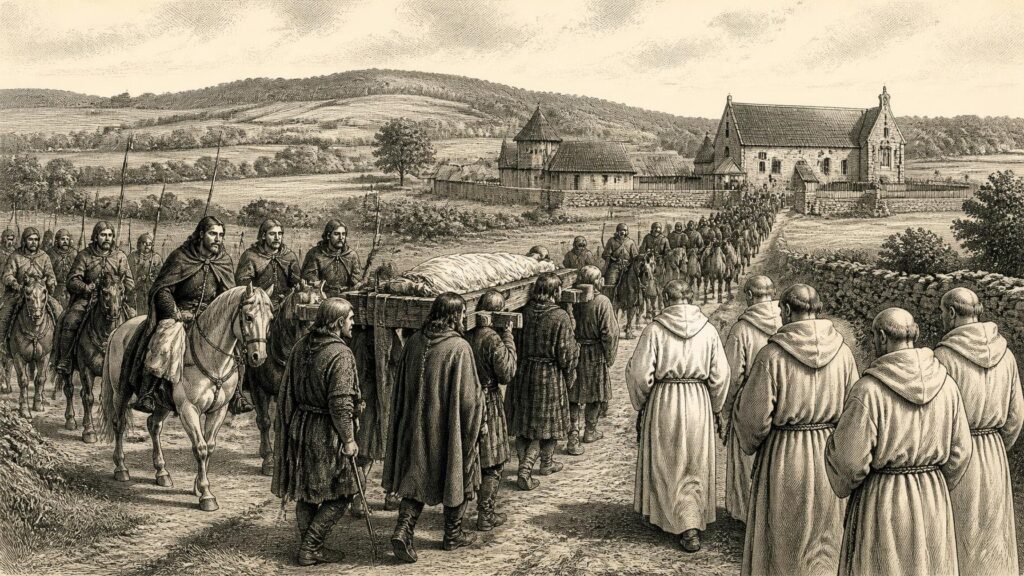
Cathal died, the annals say, in a monastic habit and was buried at Knockmoy, the Cistercian house to which he had been a benefactor. Such a deathbed religious profession was a recognised aristocratic ideal. It joined the worldly ruler’s reputation to monastic intercession and made a royal burial place a focus of dynastic memory. In Connacht, where political authority depended on personal relationships as much as fixed institutions, the burial of a king at a favoured monastery carried real political as well as devotional weight.
Áed’s Fast Succession
Áed, Cathal’s son, assumed the kingship of Connacht without a recorded interval. This was an important achievement rather than an automatic inheritance. Gaelic kingship was dynastic, but it was not governed by strict primogeniture: adult males of a ruling kindred could possess rival claims, and support from leading families mattered. Áed’s advantage, according to the annals, was that he had already exercised royal dignity alongside his father and held the hostages of Connacht. Hostages were not merely captives. Their custody represented the submissions of subordinate rulers and gave a king leverage over a province whose constituent territories retained strong local identities.
The same account celebrates the absence of disorder at the moment of succession, but its details make the standard of order clear. It records brutal judicial punishments for robbery and sexual violence: mutilation in one case, blinding in another. These reports should not be treated as a complete record of justice in Connacht, nor as proof that such penalties were invariably carried out. They show, however, that the new ruler’s authority was publicly expressed through exemplary punishment. A king had to demonstrate that protection on the roads, security within households and control of predation were his responsibilities.
Succession did not end the danger. Other branches of the Ua Conchobair family, especially descendants of Cathal’s half-brother Ruaidrí, remained potential rivals. The death of Domnall Ua Cellaig, king of Uí Maine, and of other local rulers in the same year further underlined the fragility of regional alliances. In a landscape where livestock, tribute, military service and hostages moved between kingdoms, a death in one lordship could quickly alter the calculations of its neighbours.
War Around the Lordship
While Connacht faced a transition, the English lordship of Ireland was dealing with Hugh de Lacy. De Lacy, deprived of the earldom of Ulster under King John, had returned in late 1223 without royal permission. He drew support from settlers in Meath and from Áed Ua Néill of Cenél nEógain, and his challenge threatened the royal administration from Ulster through Meath towards Dublin. The annals remember the conflict in Gaelic terms as a struggle involving both Galla, or foreigners, and Irish rulers; it was never simply an ethnic contest.
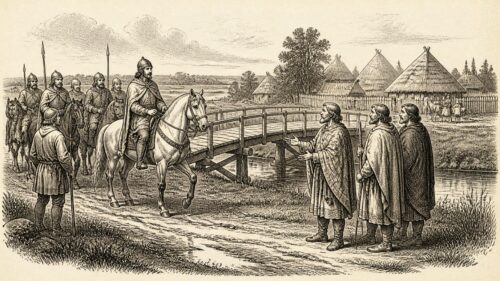
Henry III’s government replaced the archbishop of Dublin, Henry of London, with William Marshal, earl of Pembroke and lord of Leinster, as justiciar on 2 May 1224. Marshal reached Waterford on 19 June and moved rapidly towards Meath with Walter de Lacy, Hugh’s brother and rival. The royal response centred on fortified places. Trim Castle, the caput of the liberty of Meath, had been occupied by men outside the authorised garrison. Marshal besieged it, while a detachment was sent north to relieve Carrickfergus, which Hugh de Lacy had besieged. Trim surrendered in August after weeks of operations.
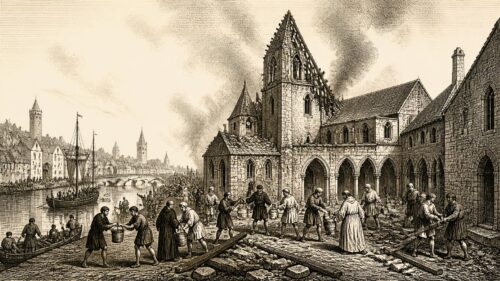
These were expensive undertakings. Marshal’s report to the king stressed the cost of maintaining the siege, men and supplies. Warfare was not confined to cavalry charges or castle walls: it consumed food, horses, wages, tools, carts and local produce. A later inquiry at Dublin provides an unusually close glimpse of this practical economy. It heard that supporters of Hugh de Lacy had bought helmets, arms and clothing in the city; information was carried from Dublin to the rebel camp; and a cart, horses and a tun of wine were sent out from the religious house of St Thomas. Even urban religious communities could be drawn into a civil war through provisioning, coercion, sympathy or divided allegiance.
The campaign also depended on Irish alliances. Geoffrey de Marisco, a major Anglo-Norman lord, supported Marshal. So did Cathal Ó Raigillig of east Breifne. The Annals of Loch Cé further place Áed Ua Conchobair, Donnchad Cairprech Ua Briain of Thomond and Diarmait Cluasach Mac Carthaig of Desmond among those assembled against Hugh de Lacy and Áed Ua Néill. This coalition did not produce a decisive conquest of northern Ireland. Its leaders advanced to Muirtheimhne and Dundalk, sought pledges and hostages, and then accepted peace terms to be determined by the king of England. The settlement recognised the limits of every participant’s power.
Connacht Drawn into Conflict
Áed Ua Conchobair was therefore not an isolated successor, but an active participant in the broader crisis. The annals record his attack on Ard-abla castle in Breifne, where his force entered, burned the stronghold and killed those found inside, Gaelic and Anglo-Norman alike. The episode demonstrates that castles were not exclusively ‘English’ instruments imposed upon a passive countryside. They were strategically valuable nodes in contested territories, and Gaelic rulers could attack, occupy or exploit them as circumstances demanded.
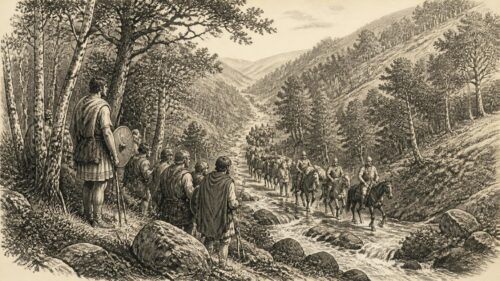
Yet conflict soon returned to Connacht itself. An army led by Áed Ua Néill, acting with sons of Ruaidrí Ua Conchobair and supported by much of Síl Muiredaig, raided deep into the province, carrying off valuables associated with the Ua Conchobair household at Loch Nen. Áed of Connacht and Mac Diarmada received help from Munster forces under Donnchad Cairprech and Geoffrey de Marisco, but did not catch Ua Néill. The expedition drove the rival descendants of Ruaidrí back towards Ua Néill’s protection. It exposed the weakness beneath the smooth succession narrative: Áed held the kingship, but he had to defend it through coalition warfare.
Church, Learning and New Friars
Religion was prominent in the year’s record beyond Cathal’s burial. Maurice, a canon and son of Ruaidrí Ua Conchobair, died and was buried at Cong. He was remembered for reading, psalm-singing and verse-making, a valuable reminder that learning and literary accomplishment flourished within ecclesiastical settings connected to ruling families. The killing of Máel Ísu, a priest of Uí Fiachrach and Uí Amhalgaidh, by a member of the Ua Dubhda kindred was recorded as especially shocking. Clerical status carried moral importance, but it did not make churchmen immune from local feuds.
The Annals of Ulster make a short but significant entry: ‘the Preachers entered Ireland’. This is firm evidence for the arrival of the Dominican order in 1224. The new mendicant friars differed from older monastic communities. Their work centred on preaching, pastoral care, study and urban or populous settings rather than landed seclusion. Their arrival belonged to a wider European religious movement, but its Irish significance would emerge gradually through foundations, patronage and relationships with bishops, towns and Gaelic lords.
Later tradition also placed Franciscan foundations at Youghal and Athlone in 1224, associating them with Maurice FitzGerald and Cathal Crobhderg. The Annals of the Four Masters repeat such claims. They should not be presented as securely dated events, however. Modern research finds the evidence for Franciscans in Ireland in 1224 uncertain and generally places their organised arrival later. The Dominican entry is the safer landmark for this calendar year.
Weather, Cattle and Labour
The Connacht annals report an ominous shower over Tír Maine, Soghan, Uí Diarmada and Clann Taidg. After cattle ate grass and foliage affected by it, the chronicler says, disease spread among the animals, and milk and meat caused illness among people. Medieval observers naturally interpreted such an event through the visible connections between weather, pasture, animals and human health. Its precise cause cannot now be diagnosed. What can be said is that cattle were central to subsistence, wealth and political exchange, so a livestock sickness could affect households, tribute and military capacity at once.
The same annalistic record speaks of heavy mortality and of grain being left until the feast of St Brigid while ploughing was under way, attributing disruption to war and severe weather. It does not permit a confident reconstruction of harvest totals or a national famine. It does reveal the vulnerability of ordinary production. Warfare did not only kill in battle: it interrupted sowing, harvesting, travel and access to livestock, just when adverse weather could make delay especially dangerous.
Thus 1224 was a year in which authority changed hands but did not settle. Cathal Crobhderg’s death opened a difficult new chapter for Connacht; Áed inherited both hostages and enemies. William Marshal’s campaign restored royal control over key castles, but only through negotiated coalitions that crossed the supposed divide between Gaelic Ireland and the lordship. The entry of Dominican friars, meanwhile, signalled a quieter but enduring transformation in Irish religious life.
Primary Sources
- Annals of Ulster otherwise Annala Senait, Annals of Senat
- Annals of the Four Masters
- Annals of Loch Cé, Part 9
- Calendar of Documents Relating to Ireland, 1171–1251
- Ua Conchobair, Cathal Mór Crobderg
- Marshal, William
- Lacy, Hugh de
- Marisco, Geoffrey de
- O'Connor (Ó Conchobair), Áed
- O'Brien (Ó Briain), Donnchad Cairprech
- Burgh, Richard de
- The Pope, a Knight and a Bishop on the Edge of Christendom: The Politics of Exclusion in Thirteenth-Century Ireland
- Civil Disobedience: The Citizens and Archbishop of Dublin During Hugh de Lacy’s Irish Rebellion, 1223–4
- Trim Castle, 1172–1542: An Architectural and Historical Study
- Annals of Connacht (AD 1224–1544)
- A History of the Franciscan Order in Ireland
- Two Nations, One Order: The Franciscans in Medieval Ireland
- Youghal (Co. Cork)
- Athlone
- Hugh de Lacy
- Mark Hagger PhD Thesis
- Records, Administration