
Liberty Hall’s Printed Republic1916 CE
In 1916, Ireland was transformed by the Easter Rising, launched in Dublin after plans for German arms support failed and Eoin MacNeill’s countermand limited mobilisation. Rebels proclaimed a republic from the GPO, but British artillery, street fighting and fires devastated the city, killing many civilians. Pearse surrendered on 29 April; martial law, secret courts martial, executions, arrests and internment subsequently increased republican sympathy and organisation. Casement was executed in August. Meanwhile, Irish soldiers fought and died at the Somme, while Home Rule negotiations between Redmond, Carson and Lloyd George collapsed. Changes reflected a divided society with an altered political future.
Dateline
In 1916 Ireland experienced a year in which constitutional politics, global war and a short-lived insurrection collided with unusual force. The Easter Rising in Dublin was the year’s defining event, but it did not erase other Irish realities: thousands of Irishmen were serving in the British Army, unionist and nationalist leaders still attempted a Home Rule settlement, and civilian households endured the restrictions and rising costs of wartime. The year became historically decisive not because every Irish person embraced rebellion, but because the Rising, its destruction, the military response and the executions that followed altered the terms on which Irish politics would thereafter be argued.
A Rising Delayed, Then Begun
The insurrection was planned by a secret Military Council associated with the Irish Republican Brotherhood, working with elements of the Irish Volunteers and James Connolly’s Irish Citizen Army. It was intended to coincide with a German arms landing on the Kerry coast. That plan collapsed: the arms ship Aud was intercepted and scuttled, while Roger Casement, who had travelled from Germany in an attempt to assist the operation, was arrested soon after landing at Banna Strand on Good Friday.
Confusion then threatened the entire enterprise. Eoin MacNeill, chief of staff of the Irish Volunteers and not party to the inner conspiracy, learned of the proposed rising and issued a countermanding order. His decision severely reduced mobilisation beyond Dublin. The Military Council nevertheless resolved to proceed, postponing the action by one day. On Easter Monday, 24 April, Volunteers, Citizen Army members, members of Cumann na mBan, Fianna Éireann boys and a small number of allied activists seized a series of positions in Dublin.
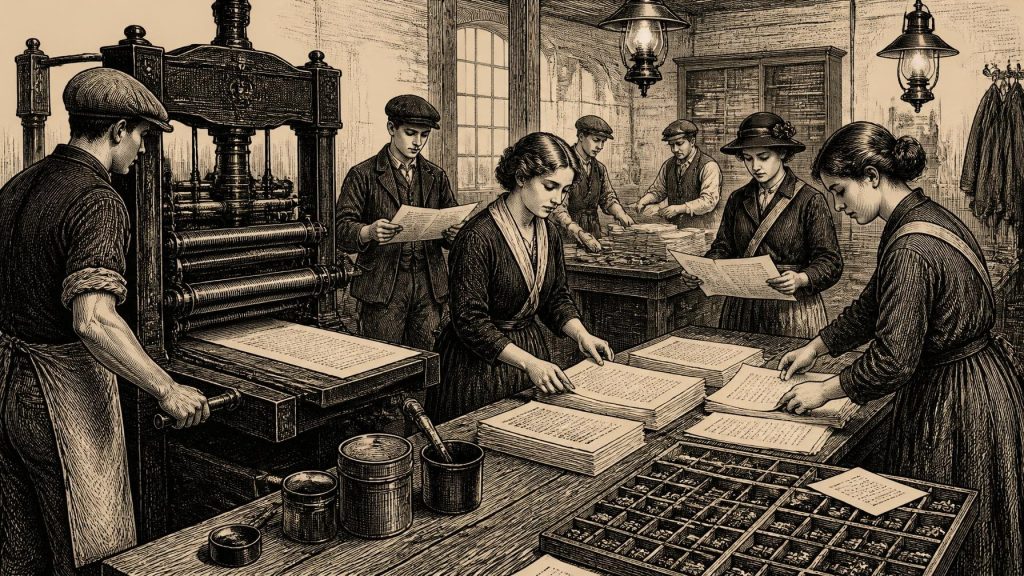
The General Post Office on Sackville Street became the headquarters of the Provisional Government. There Patrick Pearse read the Proclamation of the Irish Republic, declaring an independent republic and naming seven signatories: Thomas J. Clarke, Seán Mac Diarmada, Thomas MacDonagh, Pearse, Éamonn Ceannt, James Connolly and Joseph Plunkett. Its language was strikingly expansive for its moment. It invoked Irishmen and Irishwomen, promised religious and civil liberty, equal rights and equal opportunities, and asserted national ownership of Ireland. The text was printed at Liberty Hall under difficult conditions after a press breakdown forced the printers to complete it in two halves.
Dublin Under Fire
The Rising was never simply a drama inside the GPO. Rebel garrisons occupied Boland’s Mill, Jacob’s Biscuit Factory, the Four Courts, the South Dublin Union, the Mendicity Institution, City Hall, St Stephen’s Green and other sites. The insurgents’ strategic aim was to obstruct British troop movements and hold key points rather than defeat the British Army in open battle. Their numbers were limited, their weapons uneven and their communications fragile. Outside the capital, planned activity was uneven because of MacNeill’s countermand, though important actions occurred at Ashbourne in County Meath and Enniscorthy in County Wexford, while intended operations in Galway did not develop into a sustained rising.
British forces initially available in Dublin were also few, but reinforcements rapidly arrived. Fighting concentrated around roads, bridges, railway approaches and strong buildings. At Mount Street Bridge, Volunteers inflicted serious losses on troops attempting to enter the city from Dún Laoghaire. At Ashbourne on 28 April, Thomas Ashe’s North County Dublin Volunteers attacked the Royal Irish Constabulary barracks and defeated a relieving force, making it the Rising’s largest engagement outside Dublin.
By contrast, the centre of Dublin suffered the heaviest material damage. British artillery and the gunboat Helga shelled rebel-held areas; fires consumed much of Sackville Street and neighbouring commercial streets. Civilians were trapped between combatants, caught by gunfire or driven from their homes. The human cost was consequently borne above all by non-combatants. Later official tabulations recorded hundreds dead during Easter Week, with civilians forming the largest category. Individual deaths, including those in disputed or unlawful circumstances, and the destruction of homes and shops gave the Rising an immediate social reality far removed from the idealised language of the Proclamation.
Surrender and Martial Rule
The GPO became untenable after fire spread through the building on Friday, 28 April. Pearse, Connolly and the headquarters party escaped through adjoining buildings and moved towards Moore Street. With the city’s inhabitants facing continued bombardment and mounting danger, Pearse agreed to a general surrender on Saturday, 29 April. Elizabeth O’Farrell carried the surrender terms through British lines. The order ended organised resistance in Dublin and was subsequently transmitted to outlying garrisons.
The end of fighting did not bring an immediate return to ordinary civil government. Martial law gave the military exceptional authority. General Sir John Maxwell, appointed to command British forces in Ireland, oversaw arrests, courts martial and deportations. The trials were held in secret under field general court martial procedures; defendants had no legal representation in the way ordinarily expected in civilian trials. The speed and opacity of the process became as politically consequential as the sentences themselves.
From 3 to 12 May, fourteen Rising leaders were executed by firing squad at Kilmainham Gaol. A fifteenth, Thomas Kent, was shot in Cork on 9 May after resisting arrest at his family home. James Connolly, severely wounded during the fighting, was executed on 12 May. The executions did not occur in a political vacuum. Parliamentarians at Westminster, including Irish Parliamentary Party figures who had opposed the Rising, protested at the continuing deaths. The British government ultimately halted further executions, commuting other capital sentences.
It is important not to impose a simple story of instant popular conversion. Many Dubliners had resented the disruption, feared for relatives and livelihoods, or condemned an uprising launched during a European war. Yet the executions, mass arrests and deportations gave the defeated rebels a new public significance. By 11 July, contemporary reporting recorded more than 3,000 arrests; many prisoners were interned in Britain, notably at Frongoch in Wales. Detention brought activists from different districts into contact, helped preserve networks and contributed to the political reorganisation that followed. Those developments belonged chiefly to later years, but their immediate foundations were laid in 1916.
Casement and the Wider War
Roger Casement’s fate connected the Dublin rebellion directly to international diplomacy and wartime law. A former British consul celebrated for exposing atrocities in the Congo and Putumayo, he had sought German aid for Irish independence and tried unsuccessfully to recruit an Irish Brigade from prisoners of war. Tried in London for high treason, he was hanged at Pentonville Prison on 3 August. His execution extended the year’s punitive sequence beyond Ireland and sharpened arguments over loyalty, empire and the legitimacy of armed resistance.
Meanwhile, Ireland’s involvement in the First World War was neither interrupted nor politically uniform. On 1 July, the opening day of the Battle of the Somme, the 36th (Ulster) Division attacked near Thiepval and the Schwaben Redoubt. It suffered more than 5,000 casualties in the opening fighting. Its sacrifice became a central unionist memory, rooted in the pre-war Ulster Volunteer Force and in the defence of the Union. The year therefore carried two powerful, and often separately remembered, Irish experiences of war: the republican proclamation in Dublin and the devastating service of Irish soldiers in British uniform in France.
The 16th (Irish) Division, associated with the National Volunteers, also entered the Somme campaign later in the year. It fought at Guillemont and Ginchy in September. Among those killed at Ginchy on 9 September was Tom Kettle, former Irish Parliamentary Party MP, professor, writer and supporter of Home Rule. His death encapsulated the tragic overlap between parliamentary nationalism and imperial war service. Irish political identities in 1916 were not neatly divided between rebels and loyalists; they contained constitutional nationalists, unionists, labour activists, soldiers’ families and people whose allegiances were contingent or conflicted.
Home Rule’s Failed Summer
After the Rising, the British government recognised that the existing machinery of Irish administration had been badly shaken. David Lloyd George conducted negotiations with John Redmond, leader of the Irish Parliamentary Party, and Edward Carson, leader of Irish unionism, over bringing the suspended Home Rule Act of 1914 into operation. The proposed settlement contemplated the exclusion of part of Ulster, but agreement foundered amid incompatible understandings of whether exclusion would be temporary or permanent and over which counties would be affected.
The negotiations had broken down by the end of July. Their failure mattered greatly in 1916 itself. Redmond’s party remained the principal constitutional nationalist force, but it had failed to secure the self-government it had promised, while the Rising had demonstrated that a smaller separatist tradition could seize the political initiative. The later electoral eclipse of the Irish Parliamentary Party was not inevitable in the summer of 1916, but the year dealt its authority a profound blow.
Culture, Clocks and Aftermath
Cultural responses were already beginning. W. B. Yeats dated his poem Easter, 1916 to 25 September. It neither offered uncomplicated praise nor dismissal: its meditation on sacrifice, political transformation and death captured the unsettled quality of the year. The poem was privately printed in 1916, although its wider public circulation came later. Its careful ambivalence is a useful reminder that the Rising was interpreted, mourned and argued over from the start.
Even timekeeping registered Ireland’s wartime connection to Britain. On 1 October, under the Time (Ireland) Act 1916, Dublin Mean Time was replaced by the time used in Great Britain. Irish clocks, previously twenty-five minutes behind Greenwich Mean Time, were brought into alignment. It was a modest administrative measure beside the violence of spring and the losses in France, but it touched everyday routines in homes, workplaces, railways and farms.
By the close of the year, the physical ruins of central Dublin were being cleared, bereaved families were living with losses from both the Rising and the Western Front, and constitutional settlement remained elusive. The republic proclaimed at the GPO had not been established. Yet 1916 had supplied symbols, prisoners, graves, arguments and memories that would shape Irish public life for decades. Its importance lay not in a single unanimous national response, but in the way a week of rebellion transformed the political possibilities available thereafter.
Primary Sources
- The 1916 Rising: Personalities and Perspectives
- The Rising
- The Rising Day by Day
- Documents Relating to British and Irish Military Operations During the Easter Rising in Dublin, 1916 April
- Eyewitness Statements of Easter Week 1916
- The Keogh Photographic Collection
- General Post Office Garrison Photographic Collection
- The Battle of Ashbourne
- Bureau of Military History 1913–1921
- Papers of The O’Rahilly
- Documents of 1916
- House of Commons Hansard, 3 May 1916
- Disturbances in Ireland, 10 May 1916
- Commons Chamber, 11 May 1916
- Clemency to Prisoners, 8 May 1916
- The Executions After the Easter Rising
- Easter Rising 1916—the Trials
- The Roll of Honour of 1916
- Prime Minister’s Statement, 10 July 1916
- Road to Partition: The Plan to Divide Ireland
- The 36th (Ulster) Division on 1 July 1916
- Heroic Ulster Division Suffer Huge Losses at the Somme
- Irish Divisions at the Somme: The National Archives
- Easter, 1916
- Easter, 1916 by William Butler Yeats
- Top Secret MI5 Files of First World War Go Online