
Six Days on Ireland’s Roads1710 CE
In 1710, Ireland’s Protestant parliament, operating under Queen Anne amid changing Whig and Tory influence, passed measures affecting revenue, property, trade and local administration. Its roads act required rural householders and tenants to provide up to six days’ unpaid labour, reflecting reliance on communal maintenance rather than modern infrastructure. Legislators promoted linen, regulated cattle, rents and timber, and imposed duties on consumer goods. Dublin Castle also suppressed Catholic assemblies in Meath, punished damage to William III’s statue, pursued tobacco thieves, and managed Palatine refugee settlement. Quarantine regulations for Baltic shipping showed Ireland’s exposure to continental war, migration, commerce and disease.
Dateline
The Irish parliament’s legislation of 1710 made an unglamorous but revealing demand upon rural people: six days’ work on the roads each year. The rule was only one part of a short parliamentary session, held in Dublin from 19 May to 28 August, yet it offers an unusually direct view of government touching ordinary lives. Roads, linen, cattle, timber, rents, debt and criminal procedure all appeared in the statute book. At the same time, proclamations from Dublin Castle recorded religious unease in Meath, an attack on William III’s statue in Dublin, the difficult settlement of German-speaking refugees, and precautions against infection arriving by sea. Ireland in 1710 was not peaceful simply because it was free of open war: its authority was Protestant and closely policed, its economy was regulated, and its public symbols remained contested.
A Parliament Under Queen Anne
Queen Anne was sovereign, but Ireland retained its own parliament and executive. Neither arrangement meant broad political participation. The parliament meeting in 1710 was overwhelmingly Protestant in membership and outlook, while Roman Catholics, who formed the great majority of the population, were excluded from political power by the penal laws already enacted in the preceding years. Its legislative scope was also constrained by the constitutional relationship with England and, after 1707, Great Britain. Nonetheless, an Irish parliamentary session mattered: it voted revenue, remade rules governing land and local administration, and furnished opportunities for the interests of landlords, merchants and office-holders.
The session opened amid a change in the Commons. Alan Brodrick, its former Speaker and a powerful Irish Whig, had become lord chief justice of the queen’s bench. On 19 May the members chose John Forster, recorder of Dublin and attorney general for Ireland, as Speaker. The appointment was more than a ceremonial change. Forster belonged to an administration shaped by Thomas Wharton, the Whig lord lieutenant, whose government had promoted allies in Irish office. Yet the larger political wind was turning. Wharton’s Irish viceroyalty ended later in 1710, as Tory influence revived at court; James Butler, second duke of Ormond, succeeded him. Thus the statutes of the summer were passed during a transition in both Dublin and London, not during a settled political ascendancy.
The printed acts show a practical, revenue-conscious programme. Parliament first secured payment of the duties it was granting to the Crown. On 28 August it approved additional duties on beer, ale, spirits, tobacco and other goods and merchandise. Such taxes were felt in shops, taverns, ports and households as well as in official accounts. They also underline Ireland’s place within a wartime Atlantic and European economy. The War of the Spanish Succession still continued, and customs revenue, imported commodities and secure shipping remained matters of state.
Six Days’ Labour
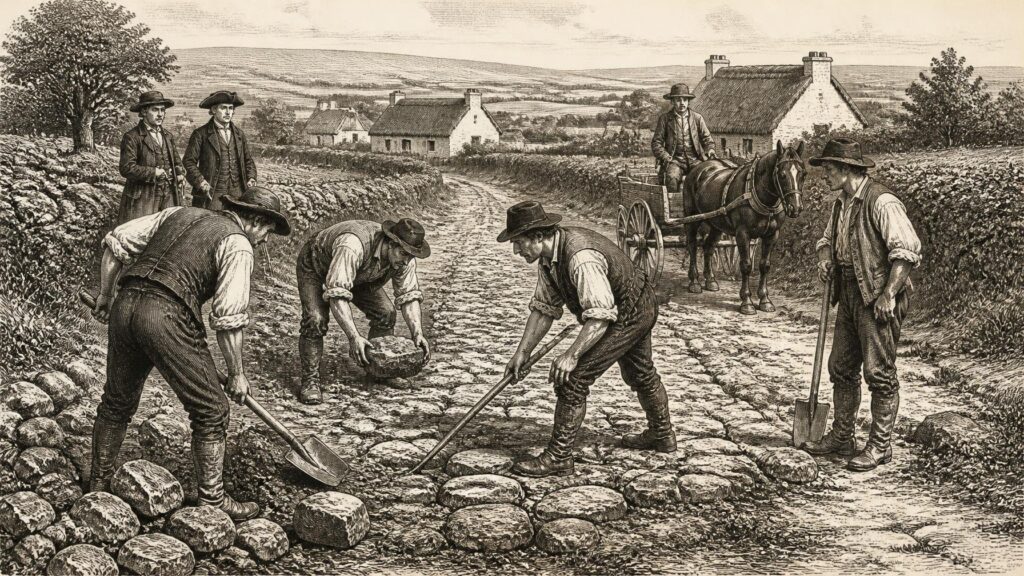
The Highways and Roads Amendment Act was especially close to village life. It retained compulsory local road labour but limited it to six days in a year. The limit did not make the burden trivial. Tenants and householders could be required to leave their own work to break stones, mend surfaces, clear routes or provide transport. The act extended the area in which labour might be demanded from the parish to a radius of two miles beyond it, and prolonged the working season to 1 August. Parish vestries could raise small sums for tools, including iron crowbars. These provisions belonged to an older system of unpaid public service, rather than to a modern professional road authority.
It would be misleading to picture a swift transformation of Ireland’s communications in 1710. The statute did not create a network of engineered turnpikes, and compulsory labour was often unpopular and inefficient. Still, the law recognised that passable routes mattered beyond an individual parish. Farmers needed them to bring grain, animals, turf and flax to market; merchants needed them to move cloth and imported goods; officials, soldiers and judges needed them to travel. The six-day obligation makes visible an economy in which movement depended heavily on the physical labour of people who had little influence over the laws that required it.
Flax, Cattle and Timber
Parliament also passed an act to enforce and further regulate the linen manufacture. This did not yet establish the Linen Board, which followed in 1711, but it confirms that linen was already considered a national economic priority. Linen linked cultivation, household work and commerce. Flax had to be grown, retted and prepared; yarn was commonly spun in homes; weavers and merchants then connected scattered producers to markets. The statute should not be read as proof that every district was becoming a linen centre. Its significance is that legislators sought to discipline quality and encourage an industry they believed could expand Ireland’s exports, particularly in Ulster but not only there.
The same session renewed and strengthened regulation of butchers and graziers, addressing abuses in the buying and selling of cattle and in the slaughtering and packing of beef, tallow and hides. Cattle were mobile wealth, food and an export resource; hides and tallow supported leather-making and candle-making as well as overseas trade. An act to prevent the maiming of cattle points to anxieties about damage to valuable animals, although the statute alone cannot tell us how frequent the offence was. An act concerning rents and tenants likewise reveals official concern with the security of landlord income and with fraud in tenancies. Together, these measures show government attending less to a single ‘Irish economy’ than to particular commodities, property claims and transactions.
Another act sought to put earlier timber-planting and woodland-preservation law more effectively into operation. It is reasonable to see this as evidence that timber was strategically and economically valued—for building, estates, fuel and maritime needs—but not as a simple measure of how wooded Ireland was in any particular county. Lawmakers were trying to preserve and increase a resource they judged useful. That concern sat beside a culture of improvement in which landlords, officials and writers increasingly treated land, woods and labour as things to be ordered for profit.
Faith, Memory and Public Order
The most vivid incidents of 1710 came not from parliamentary debate but from proclamations. On 26 June Dublin Castle ordered the suppression of what it termed riotous assemblies of ‘papists’ in County Meath, and issued a separate proclamation concerning a ‘tumultuous, dangerous and unlawful assembly’ at St John’s Well. The language is that of a Protestant government and should not be mistaken for a neutral account of what participants did. It does, however, firmly establish official alarm at a Catholic gathering or gatherings connected with the well. Holy wells were embedded in local devotional practice, and the episode demonstrates how easily popular religion could be construed as a threat under the penal regime.
The same day, government offered a reward for information about the defacing of the equestrian statue of William III on College Green. On the night of 25 June, the statue’s face was smeared with mud and its sword and truncheon removed or damaged. The monument, erected by Dublin citizens after William’s death, represented the Revolution settlement and Protestant security. To insult it was therefore politically charged, whatever the immediate motives. The perpetrators were later identified as Trinity College students and punished. The affair is a useful warning against imagining neat confessional blocs: the offenders came from the university associated with Protestant elite education, while the authorities treated an attack on William’s image as an affront requiring exemplary correction.
Public order also had a commercial dimension. In October a proclamation offered a reward for robbers who had taken seized tobacco in County Antrim. Tobacco was both a prized imported commodity and a taxable one; theft from official seizure struck at revenue as well as private property. The incident hints at the points where smuggling, customs enforcement and local opportunity met along Ireland’s coasts and trading routes.
Refugees and Sea-Borne Risk
On 5 July, a proclamation addressed the settlement of Palatine refugees. These German-speaking Protestant families had reached Ireland from late 1709 into early 1710 after displacement and hardship in the Rhineland-Palatinate. Several thousand were in Ireland by the opening months of 1710, initially dependent on public support and temporary accommodation. Their arrival was welcomed by some officials and landowners as an opportunity to reinforce Protestant settlement and add agricultural skill. It was also expensive, logistically difficult and socially disruptive. The July proclamation shows that the project remained an active governmental problem, not a completed plantation.
The refugees’ story should not be flattened into an easy success. Some families obtained tenancies on estates; others left Ireland in the following period. In 1710 itself, what can securely be said is that the state was still trying to place people whose language, religion, expectations and needs set them apart from many neighbours. Their presence connected Ireland to continental war, migration and imperial schemes, even while most Irish lives continued within local parishes and townlands.
That international connection was evident again on 28 November, when Ireland required quarantine for ships arriving from the Baltic Sea. The order belonged to wider European fears of plague during the Great Northern War. It does not demonstrate that plague had reached Ireland; rather, it records preventive action at Irish ports. For sailors, merchants and port communities, quarantine could delay cargoes, letters and passengers. The measure reminds us that an island economy was never insulated from continental crisis. By the end of 1710, the Irish government had sought to regulate roads and linen at home, police symbols and assemblies, settle refugees, defend revenue, and watch the sea for disease. Those concerns, modest in appearance but intrusive in effect, defined the texture of the year.
Primary Sources
- Acts and statutes made in a Parliament begun at Dublin … Being the fifth session of this present Parliament
- Statutes Passed in the Parliaments Held in Ireland: 1665–1712
- Acts of Parliament by Session: 1710, Irish Legislation Database
- Statute Law Revision Act 2015
- Wharton, Thomas, Dictionary of Irish Biography
- Brodrick, Alan, Dictionary of Irish Biography
- Butler, James, Dictionary of Irish Biography
- Communications, Ulster Historical Foundation
- The linen industry, Ask About Ireland
- Gill: The Rise of the Irish Linen Industry, Ask About Ireland
- How linen is made, Ask About Ireland
- Notes on sources, copies and abstracts of letters and other papers … relating to the Palatine settlements in Ireland, National Library of Ireland
- Add MS 61634: Letters from Thomas Wharton as Lord Lieutenant, British Library Archives and Manuscripts Catalogue
- Early Eighteenth Century Palatine Emigration, University of Illinois Library
- The Dublin Weekly Intelligence, National Library of Ireland catalogue
- Statue of King William III, Dublin City Council
- I. Remembrances, 1671–1714, Cambridge Core
- Life of Lord Chancellor Sir Constantine Phipps, Chapters of Dublin
- By the Lord Lieutenant and Council of Ireland, a proclamation: Requiring quarantain to be performed by ships coming from any port or place within the Sound or Baltick-Sea
- By the Queen, a proclamation, requiring quarantain to be performed by ships coming from the Baltick Sea
- Thomas Wharton, 1st Marquess of Wharton, National Portrait Gallery
- Public Act, 9 Anne, c. 16, UK Parliament Archives