Derryvree’s Reindeer Landscape30487 BCE
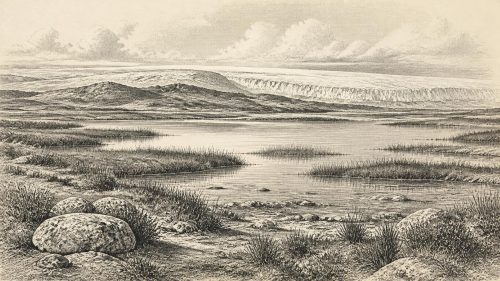
About 30,487 BCE, Ireland experienced an unstable MIS 3 Ice Age environment rather than a datable historical year. Derryvree, County Fermanagh, preserves freshwater sediments between glacial tills, indicating an ice-free interval with shallow wetlands, tundra plants and severe seasonal conditions. Cave deposits at Castlepook, County Cork, show Middle Devensian fauna including reindeer, mammoth, giant deer, predators and small cold-adapted mammals, although they accumulated over time. A cut-marked reindeer femur may indicate fleeting human butchery, not settlement. No political, cultural or economic history can be recovered. Renewed glaciation buried fragile evidence of varied, changing landscapes and possible early visitors to Ireland.
Dateline
The number 30,487 BCE gives an impression of precision that the evidence cannot sustain. No written record, calendar, named community or identifiable event survives for Ireland at this depth in time. This was the Late Pleistocene, during Marine Isotope Stage 3 (MIS 3), a climatically unstable part of the last Ice Age. Modern calendar-year precision is unavailable: the best evidence consists of sediments, pollen and plant remains, animal bones and radiocarbon determinations with wide uncertainties. The responsible subject is therefore not a supposed Irish ‘year’, but the changing landscape and its possible visitors within a broad window around it.
The closest well-known chronological anchor is the Derryvree freshwater deposit near Maguiresbridge, County Fermanagh. Organic muds there returned the radiocarbon determination BIRM-166, conventionally published as 30,500 ± 1,100 radiocarbon years before present; ‘present’ in this system means AD 1950. Radiocarbon years are not identical to calendar years. When calibrated using modern Northern Hemisphere curves, this result is best treated as a broad interval of roughly 36,900–31,700 calibrated years before present, approximately 34,950–29,750 BCE. The requested date lies within that large span, but it cannot date an individual season, animal, settlement or human act.
A Wetland Between Ice Advances
Derryvree matters because it preserves a sequence rather than an isolated fossil. Roadworks exposed freshwater silts, sands and organic deposits trapped between two tills in a Fermanagh drumlin. Till is the unsorted mixture of clay, stones and debris deposited directly by glacier ice. The order of layers shows that ice had occupied the locality, then withdrew or ceased to dominate it long enough for freshwater and wetland sediments to accumulate, before a later advance covered the deposit with fresh glacial material. It is firm evidence for an ice-free interval at this particular place; it is not proof that every part of Ireland was simultaneously green, habitable or free of ice.
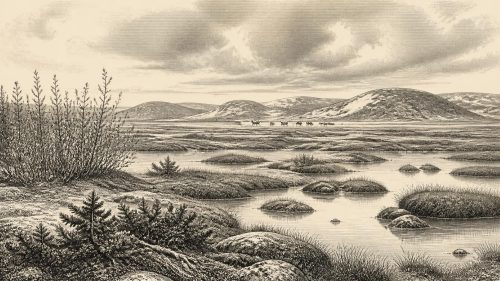
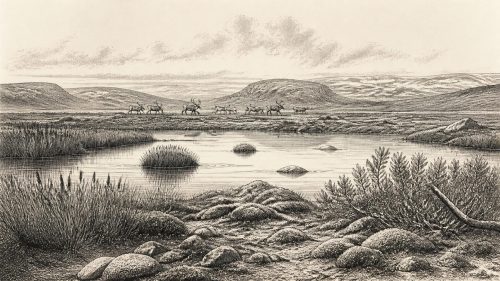
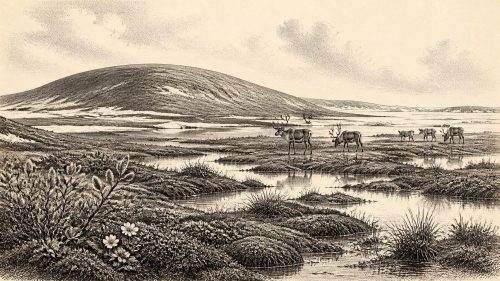
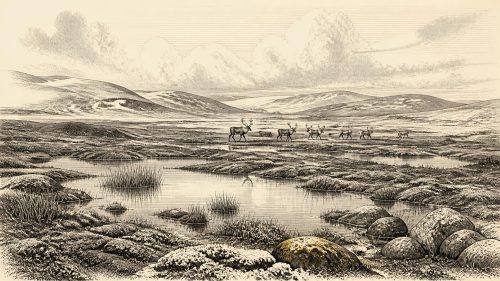
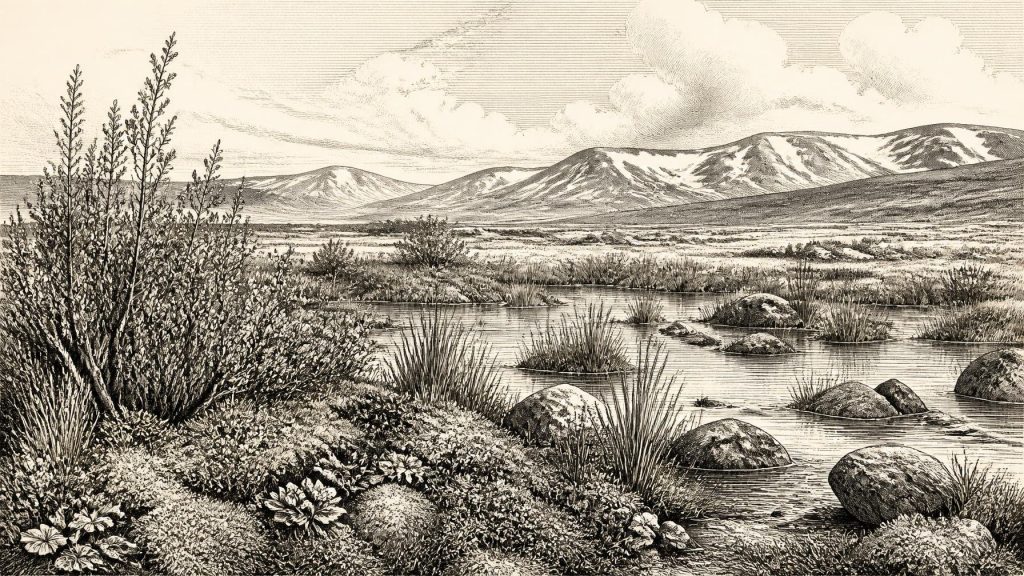
The plant record gives the interval its texture. Moss-rich mud and remains of aquatic and waterside plants, including water-milfoil and bogbean, indicate standing or slow-moving fresh water. Other fossils point to open, cold conditions: dwarf willow, mountain avens, sedges and other Arctic-alpine or tundra-associated plants. Taken together, they suggest a shallow wetland surrounded by sparsely vegetated ground rather than woodland. Short summers could nevertheless sustain pools, marsh margins and patches of flowering vegetation. In winter, frost, snow cover and severe winds would have sharply restricted growth. This was a landscape of local variety, not a featureless ice desert.
That distinction is important. ‘Ice Age Ireland’ did not mean one unchanging sheet of ice. MIS 3 was marked by abrupt climate shifts across the North Atlantic region. Glaciers expanded and contracted; cold open environments could develop in places not covered by ice; and rising or falling sea levels altered coasts and routes. Derryvree’s sediments are a local witness to one such interruption in glaciation. They illuminate the resilience of freshwater life during a cold phase, while also showing how readily that environment could be erased, buried and remade by returning ice.
Animals in the Open Country
County Fermanagh has not supplied a complete animal community from precisely this interval. For larger mammals, the crucial Irish evidence comes mainly from caves and fossil deposits, above all Castlepook Cave, also called Mammoth Cave, near Doneraile in north Cork. Its nineteenth- and early twentieth-century excavations produced an extraordinary but complicated assemblage. The cave has yielded remains attributed to woolly mammoth, reindeer, giant deer, brown bear, wolf, Arctic fox, spotted hyaena, mountain hare and lemmings. A direct date on mammoth bone and later re-dating programmes place important parts of this fauna broadly within the Middle Devensian or MIS 3, though the deposits were accumulated over time and cannot be treated as one momentary scene.
The comparison is still revealing. Reindeer, lemmings and Arctic fox are compatible with a cold, open environment like that indicated by Derryvree’s flora. Mammoth and giant deer imply that at least some Irish landscapes could support large grazing and browsing animals. Wolves and spotted hyaenas remind us that carcasses in caves need not be evidence of human hunting: carnivores carried prey, scavenged bones and used sheltered places themselves. Cave assemblages are therefore records of ecological relationships and bone-accumulating processes, not straightforward inventories of animals peacefully sharing a single valley.
There were probably strong regional differences. Upland and northern districts may have been colder or more exposed; lowlands could include wet hollows, river corridors and sheltered limestone country. The island’s outlines were also unlike those of modern Ireland, because global sea level was lower during the glacial period. Yet lower seas do not by themselves demonstrate an easy, continuous land route from Britain or continental Europe. Ice margins, marine channels, changing shorelines and seasonal conditions all mattered. The arrival of animals, and any people, was a contingent process rather than a permanent open-door migration.
A Possible Human Trace
The most provocative evidence is a reindeer femur from Castlepook Cave. Re-examination identified a deep incision interpreted as a stone-tool cut made while the bone was fresh. The bone has been presented as dating to around 33,000 years ago and, if the interpretation is upheld, it would push evidence for human activity in Ireland far earlier than the long-accepted post-glacial record. It offers a plausible indication that a person handled and butchered a reindeer during the wider MIS 3 period.
Its importance should be matched by caution. The femur is not a camp. No securely associated hearth, stone-tool assemblage, dwelling floor, human burial, food store or repeated butchery area of this age has yet been established in Ireland. Antiquarian excavation also recovered much cave material before modern standards of recording, stratigraphic sampling and contamination control. The animal’s date is not necessarily the exact date of the incision, and one marked bone cannot identify the cutter’s language, ancestry, sex, group size, route or length of stay. It does not establish an enduring population.
What can reasonably be envisaged is modest: perhaps a very small, mobile party reached or moved through an Irish landscape during a favourable interval, encountered a reindeer carcass or killed an animal, and processed part of it. Meat, marrow, hide, sinew, bone and antler would all have been valuable resources to Upper Palaeolithic hunter-gatherers elsewhere in north-west Europe. But these are general possibilities, not demonstrated details for Castlepook. The evidence supports potential human action; it does not support an imagined settlement, tribal territory or ‘first Irish’ community.
No Kingdoms, No Recorded Wars
Political history cannot be written for Ireland at 30,487 BCE. There were no identifiable rulers, states, laws, diplomatic exchanges, ethnic names or territorial frontiers. Nor is there evidence for warfare between human groups on the island. Predation and competition certainly formed part of the natural world—large carnivores, scavengers and people could all have sought animal carcasses—but that is not the same as documented conflict. Language, kinship rules and social organisation remain beyond recovery from the Irish record of this date.
The same limits apply to religion, culture and learning. There is no securely dated Irish art, burial rite, shrine, musical instrument or symbolic object from this horizon. It would be unsafe to import cave art, ornament traditions or rituals known from France, Britain or central Europe and label them Irish. If people were present, they carried knowledge of routes, animals, weather, fire and stone-working, but no Irish material evidence currently permits those skills to be described in detail.
There was no economy in the later sense of farming, markets, coinage, permanent workshops or overseas trade. The relevant economy was ecological: the seasonal use of animals, water, plants, fuel and shelter by mobile creatures, and possibly by short-lived human visitors. There is likewise no evidence for a village or permanent settlement. Derryvree was a wetland accumulating mud and plant matter, while Castlepook was a limestone cave that intermittently received bones, predators and perhaps people. Neither is evidence of a town, a farm or a continuously occupied home.
An Island of Intervals
Around this broad date, Ireland’s most important historical development was environmental instability. Freshwater life flourished for a time at Derryvree after an earlier glacial episode. Cold-adapted plants occupied open ground. Large mammals ranged through at least some parts of the island over the wider Middle Devensian. A reindeer bone from Castlepook raises the serious possibility of a fleeting human presence. Then renewed ice activity transformed parts of the landscape again, burying delicate records beneath till.
That buried evidence is the real archive for 30,487 BCE. It does not supply an anniversary, a leader or a battle. It supplies something older and, in its way, more remarkable: proof that Ireland’s deep past was not simply blank before the final retreat of the ice. In the silts of Fermanagh and the bones of Cork survive traces of wetlands, tundra plants, large mammals, predators and perhaps an early human encounter with a reindeer—each precisely limited in what it can prove, but together revealing a cold and changing Irish world.
Primary Sources
- A Middle Midlandian Freshwater Series at Derryvree, Maguiresbridge, County Fermanagh, Northern Ireland
- Quaternary Deposits and Glacial Stratigraphy in Ireland
- Freshwater Organic Deposits and Stratified Sediments Between Early and Late Midlandian (Devensian) Till Sheets, at Aghnadarragh, County Antrim, Northern Ireland
- The Irish Quaternary Fauna Project
- A Reconsideration of the Radiocarbon Dating of the Marine Isotope Stage 3 Fauna from Southern Ireland
- Castlepook Cave, County Geological Site Report
- Heritage Artefacts of County Cork
- Occurrence of Mammalia Relicts at Site Castlepook Cave
- Pleistocene Vertebrates in the British Isles
- The Timing and Magnitude of the British–Irish Ice Sheet Between Marine Isotope Stages 5d and 2
- Reconstructing the Timing and Extent of the Last British–Irish Ice Sheet: A Review of Evidence and Methods
- Pattern and Timing of Retreat of the Last British-Irish Ice Sheet
- Radiocarbon Constraints on the Age of the Maximum Advance of the British–Irish Ice Sheet in the Celtic Sea
- New Data for the Last Glacial Maximum in Great Britain and Ireland
- Character of Advance and Retreat of the Southwest Sector of the British-Irish Ice Sheet During the Last Glaciation
- The Problem of a Late Quaternary Landbridge Between Britain and Ireland
- The Island of Ireland: Drowning the Myth of an Irish Land-Bridge?
- Relative Sea-Level Changes and Crustal Movements in Britain and Ireland Since the Last Glacial Maximum
- The IntCal20 Northern Hemisphere Radiocarbon Age Calibration Curve (0–55 cal kBP)
- IntCal Publications
- New Insights on the Fauna of Ireland's Younger Dryas and Early Holocene from Alice & Gwendoline Cave
- Aghnadarragh: Late Pleistocene Inter-till Deposits