The BIRM-166 Drumlin Record30570 BCE
Thirty thousand five hundred and seventy BCE is a modern calendar label, not a recoverable Irish historical year. Derryvree, County Fermanagh, preserves freshwater sediments between glacial tills, dated by BIRM-166 to 30,500 radiocarbon years BP and broadly calibrated to 34,950–29,750 BCE. Its fossils indicate an ice-free interval with wetland and treeless tundra vegetation during unstable Marine Isotope Stage 3 conditions. Castlepook Cave, County Cork, contains cold-stage fauna, though its disturbed deposits span multiple episodes. A possibly cut-marked reindeer bone may indicate early human butchery, but cannot prove settlement. Evidence supports transient ecological diversity and possible visitors before later extensive glaciation.
Dateline
A date expressed as 30,570 BCE offers a useful point of orientation, but it cannot describe a recoverable year in Irish history. No written record, settlement sequence or securely dated human activity lets us identify events in a particular season, generation or calendar year. In radiocarbon practice, “before present” means before AD 1950; by simple calendar arithmetic this nominal date lies about 32,520 years before that reference point. Archaeology instead works with calibrated ranges, stratified deposits and cautious correlations. For Ireland, the most informative evidence relevant to this horizon is a buried freshwater deposit at Derryvree near Maguiresbridge, County Fermanagh, alongside the longer but disturbed faunal archive of Castlepook Cave in north Cork.
A Wetland Between Ice Advances
Derryvree was exposed by road-cutting through a drumlin in 1969. The section revealed two thick sheets of till, the unsorted sediment deposited by glacier ice, with freshwater silts, fine sands and organic mud between them. Its basic sequence is unusually powerful evidence. An earlier ice advance had covered the area; this was followed by an interval in which standing or slow-moving fresh water, wetland plants and small animals occupied a hollow; then later ice or glacial meltwater buried that landscape beneath new sediments. The deposit is not a village, campsite or cemetery. It is an environmental archive, preserved precisely because later glacial deposits sealed it.
Organic material from the freshwater bed produced the conventional radiocarbon determination BIRM-166: 30,500 radiocarbon years BP, with a substantial laboratory uncertainty of +1,170/−1,030 years. Radiocarbon years are not calendar years, because atmospheric carbon-14 concentrations have altered over time. Calibration with modern curves therefore converts the result into a wide probability range, broadly about 36,900–31,700 calibrated years BP, or approximately 34,950–29,750 BCE. The nominal year 30,570 BCE falls within that broad interval, but it would be wrong to assign the formation of a particular pool, the death of an individual plant or the passage of an animal to this exact year.
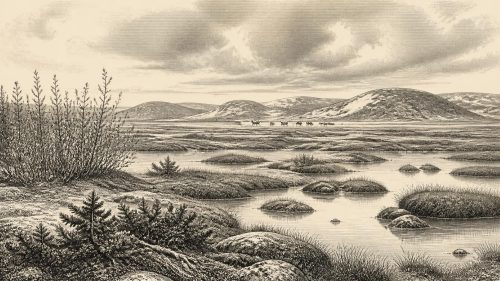
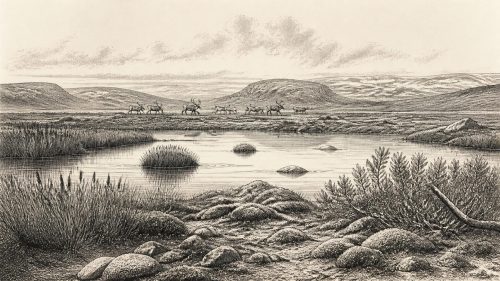
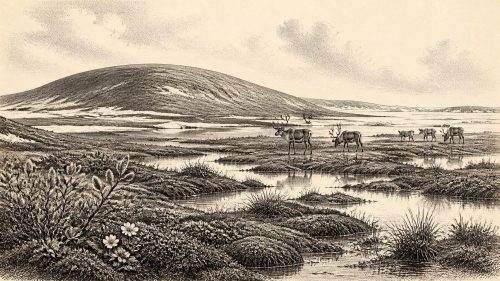
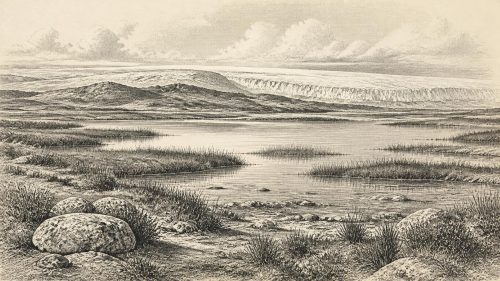
The evidence at Derryvree nevertheless supports a vivid, limited conclusion: part of Fermanagh was ice-free long enough for a freshwater wetland to develop between glacial episodes. Plant macrofossils, pollen and other biological remains point to open, treeless vegetation under a periglacial climate. The published assemblage includes mosses and cold-adapted plants such as mountain avens, dwarf willow and lesser clubmoss, as well as bogbean and water-milfoil associated with wet ground or open water. These remains are direct evidence for organisms in and around the site; the reconstruction of a wider tundra mosaic is an interpretation based on their ecological requirements and the glacial setting.
An Unsettled North Atlantic Climate
This was the later part of Marine Isotope Stage 3, a long phase of the last Ice Age marked by repeated abrupt shifts between relatively milder interstadials and colder stadials. Greenland ice cores provide the clearest annual-layered chronology for those North Atlantic changes, but they do not yield an Irish weather diary. Their importance is contextual: Ireland lay on the Atlantic edge of a region where temperature, snowfall, sea level, vegetation and ice margins could alter dramatically over comparatively short geological periods.
The Derryvree succession captures this instability in local form. A freshwater episode interrupts the record of ice deposition, yet it is enclosed by tills. That does not prove that every part of Ireland was simultaneously free of ice, nor does it establish the exact outlines of the island’s glaciers. It does show that the conventional picture of uninterrupted, uniformly severe glaciation is inadequate for all places and all moments. The landscape available to plants and animals was patchy, transient and vulnerable to renewed cold.
The Last Glacial Maximum, when the British–Irish Ice Sheet reached its greatest late-glacial extent, still lay in the future, generally dated to roughly 26,000–20,000 years BP. By then ice had extensively reshaped Ireland, scouring bedrock, reworking older deposits and destroying or burying much earlier evidence. That later destruction helps explain why Ireland’s Palaeolithic record is so sparse. It is also why a sealed wetland layer in a Fermanagh drumlin is disproportionately important: it preserves a rare glimpse of a landscape that glaciers later overran.
Animals at Castlepook
Nearly 300 kilometres south-west of Derryvree, Castlepook Cave near Doneraile preserves another important, if more complicated, archive. Excavations conducted in the early twentieth century recovered a very large collection of animal bones from limestone passages and chambers. Subsequent study and redating have identified a fauna that, across different deposits and periods, included reindeer, giant deer, brown bear, wolf, arctic fox, spotted hyaena, hare and woolly mammoth. These animals show that Ireland was intermittently accessible to, and capable of supporting, characteristic cold-stage mammals before the maximum expansion of the last ice sheet.
The crucial qualification is that Castlepook is not a single, sealed snapshot. Antiquarian excavations removed much of the original sediment, bones came from different chambers and levels, and the assemblage accumulated through multiple episodes. A mammoth bone and a reindeer bone found in the same cave need not mean that the animals lived there together, still less that they were seen by the same people. Caves also collect material through carnivore activity, natural deaths, water movement and collapse. The cave is an outstanding faunal archive, but its history must be reconstructed specimen by specimen, using secure provenience, modern collagen pretreatment, radiocarbon dating and taphonomic analysis.
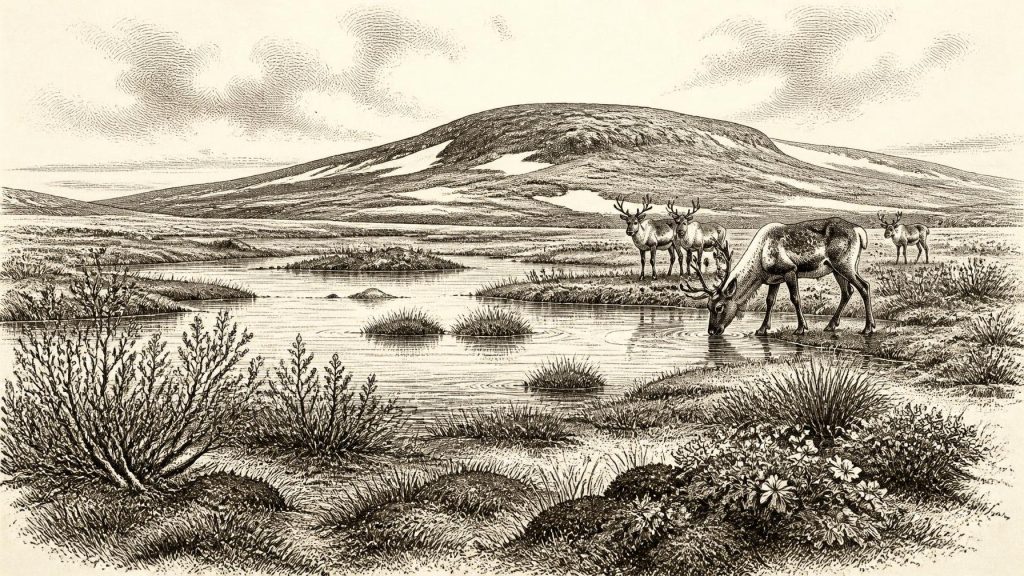
Reindeer are particularly resonant for this date because a Castlepook femur has been reported as bearing a deep mark consistent with cutting fresh bone using a sharp stone edge. The bone has been dated to about 33,000 years ago, making it potentially far older than formerly accepted indications of human presence in Ireland. If the modification is confirmed as a human-made butchery mark, it would show that people processed a reindeer in Ireland during the broad climatic world discussed here. It would not, however, demonstrate a permanent population, a named people, a settlement at Castlepook or activity in 30,570 BCE specifically. No securely associated hearth, stone-tool assemblage, house floor, burial or repeated occupation surface of comparable antiquity has yet been recovered.
People: Possibility, Not a Proven Society
Accordingly, political affairs, warfare and diplomacy cannot responsibly be written for Ireland at this point. There were no states, kingdoms, borders, chiefs or institutions that the evidence can identify. Nor is there evidence for trade, agriculture, livestock, pottery, monuments, metalworking or a resident human economy. The open ground around Derryvree was not farmland; its plant record indicates natural vegetation rather than cultivation. Animal movement across the wider region is not trade, and a possible butchered bone is not proof of organised hunting territories.
It is possible that small, mobile Upper Palaeolithic groups entered Ireland during favourable windows, perhaps tracking game or moving through a wider north-west European landscape shaped by lower sea levels. Yet the precise routes remain uncertain. Lower seas changed the coastline and reduced marine barriers, but researchers cannot simply assume a continuous land bridge, a particular crossing point or easy access at every stage of the Ice Age. Any visitors would have encountered a landscape in flux: exposed ground, wet hollows, streams and limestone caves, but also severe cold, seasonal scarcity and advancing ice.
Likewise, nothing can be established about religion, language, kinship, artistic tradition or formal learning in Ireland at this date. Continental Europe has rich evidence for Upper Palaeolithic technologies and symbolic practices, but it would be methodologically unsound to import those cultures wholesale into Ireland. A possible humanly modified reindeer bone in Cork could indicate practical carcass processing; it does not identify a ritual, a language or an Irish cultural tradition. The absence of evidence is not proof that people never came, but it is a firm limit on what historians should claim.
Everyday Ecology, Not Annual History
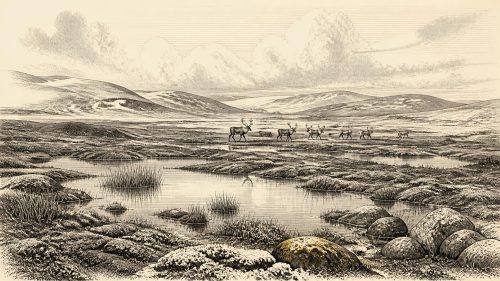
The most tangible “everyday life” available for 30,570 BCE is therefore ecological. At Derryvree, aquatic plants grew in shallow water or wet mud; mosses and low herbs occupied the margins; dwarf willow and alpine-tundra species survived on exposed ground. In southern Ireland, large herbivores and their predators moved through landscapes that could include cave entrances, limestone pavements, grass-herb communities and sheltered valleys. Reindeer would have offered meat, fat, hide, sinew and bone to any human hunters present, but that is an inference from hunter-gatherer practice elsewhere, not direct proof of a Castlepook camp.
Regional difference matters. Derryvree records a local wetland in what is now County Fermanagh; Castlepook records cave fauna in north Cork. Neither site is a complete map of the whole island. Their combined significance lies in demonstrating variety: fresh water and tundra vegetation in one preserved setting, and a diverse cold-stage animal world in another. Ireland was neither a timeless frozen blank nor a fully documented human homeland. It was a changing edge-land of the North Atlantic, periodically hospitable to plants and animals and perhaps visited by people, before later ice transformed the terrain again.
For this nominal year, then, the responsible history is one of scale and uncertainty. The calendar label is modern; the evidence comes in long ranges. BIRM-166 gives Ireland a rare environmental horizon within which 30,570 BCE can be placed, while Castlepook raises a serious but unresolved question about exceptionally early human activity. What can be stated securely is more compelling than a fabricated annual event: during a volatile phase of the Ice Age, parts of Ireland held cold-adapted wetlands and supported Pleistocene fauna, even as the climatic conditions were developing that would eventually bring far more extensive ice.
Primary Sources
- A Middle Midlandian Freshwater Series at Derryvree, Maguiresbridge, County Fermanagh, Northern Ireland
- A Middle Midlandian Freshwater Series at Derryvree, Maguiresbridge, County Fermanagh, Northern Ireland
- Figure 6.— The Subdivision of the Quaternary Period in Ireland
- A Reconsideration of the Radiocarbon Dating of the Marine Isotope Stage 3 Fauna from Southern Ireland
- The Irish Quaternary Fauna Project
- The Exploration of Castlepook Cave, Co. Cork. With 3 Plates.
- 2022:564 – CASTLEPOOK CAVE, Castlepook South, Cork
- Archaeology Research Excavation Grant 2022
- Archaeological Heritage of County Cork
- Geological Heritage Audit Report: County Cork
- First Evidence of a Late Upper Palaeolithic Human Presence in Ireland
- New Insights on the Fauna of Ireland’s Younger Dryas and Early Holocene from Alice & Gwendoline Cave
- The IntCal20 Northern Hemisphere Radiocarbon Age Calibration Curve (0–55 cal kBP)
- The IntCal20 Approach to Radiocarbon Calibration Curve Construction: A New Methodology Using Bayesian Splines and Errors-in-Variables
- The Greenland Ice Core Chronology 2005, 15–42 ka. Part 1: Constructing the Time Scale
- The Nature of MIS 3 Stadial–Interstadial Transitions in Europe: New Insights from Model–Data Comparisons
- Reconstructing the Last Irish Ice Sheet 2: A Geomorphologically-Driven Model of Ice Sheet Growth, Retreat and Dynamics
- Late Pleistocene Chronostratigraphy and Ice Sheet Limits, Southern Ireland
- Last Glacial Maximum Cirque Glaciation in Ireland and Implications for Reconstructions of the Irish Ice Sheet
- Pattern and Timing of Retreat of the Last British-Irish Ice Sheet
- Stratigraphic and Palaeo-Geomorphological Evidence for the Glacial-Deglacial History of the Last British-Irish Ice Sheet in the North-Western Irish Sea
- Growth and Retreat of the Last British–Irish Ice Sheet, 31,000 to 15,000 Years Ago: The BRITICE-CHRONO Reconstruction