Cork Reindeer and Fermanagh Silt30446 BCE
Around 30,446 BCE, Ireland’s evidence records environmental conditions rather than historical events. At Derryvree, County Fermanagh, freshwater silts dated broadly to this period show an ice-free interval with cold, open tundra wetlands, later enclosed by renewed glaciation. Low sea levels and shifting ice created changing, uncertain routes for mammals. Castlepook Cave, County Cork, preserves remains of mammoth, reindeer, giant deer, bear and hyaena, demonstrating Pleistocene fauna but not a single contemporary community. A cut-marked reindeer femur may indicate brief human butchery around 33,000 years ago, yet disturbed cave contexts prevent proof of settlement. Political, cultural and social reconstruction remains impossible.

Dateline
30,446 BCE is not a recoverable Irish calendar year. It is a modern chronological label, approximately 32,395 years before AD 1950, placed within the Late Pleistocene and broadly within Marine Isotope Stage 3. No written record, settlement sequence or annually resolved archaeological deposit permits events in Ireland to be assigned to this particular year. The responsible approach is therefore to examine evidence dating broadly around it: environmental deposits, animal remains, cave taphonomy and the changing extent of ice. These sources can show what conditions existed in parts of Ireland and what animals reached the island. They cannot supply a king, a battle, a tribe, a treaty, a religion or a named human community.
Time Measured in Ranges
The apparent exactness of 30,446 BCE must not be mistaken for prehistoric precision. Radiocarbon laboratories report ages in radiocarbon years before present, conventionally before AD 1950; those ages require calibration against changing atmospheric carbon levels. Even calibrated results produce probability ranges, not a date on which an Irish person did something. At this depth in time, uncertainty is substantial, and archaeological contexts may have their own complications. A date on animal bone records the death of that animal, while a date on organic sediment estimates the age of material incorporated into a deposit. Neither automatically identifies the moment at which a human, if present, visited the landscape.
For this period, the most illuminating Irish terrestrial sequence is at Derryvree near Maguiresbridge, County Fermanagh. Road works exposed freshwater silts and fine sands sealed between two separate tills within a drumlin. The organic horizon, laboratory sample Birm-166, returned an age of 30,500 radiocarbon years BP, with a very wide stated uncertainty of +1,170 and −1,030 years. Later ice-sheet syntheses treat the deposit as evidence for ice-free conditions in that locality before a major later advance. Its age overlaps only broadly, rather than exactly, with the modern label 30,446 BCE. That breadth is the point: Derryvree is a window on an interval, not a diary entry.
An Open, Cold Fermanagh
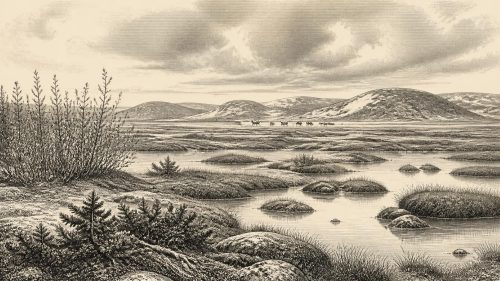
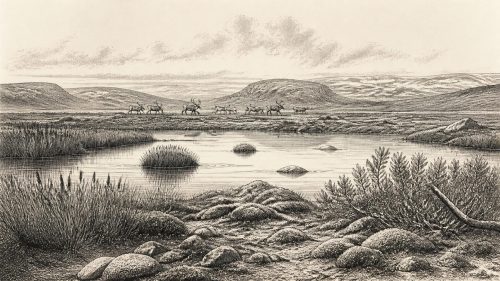
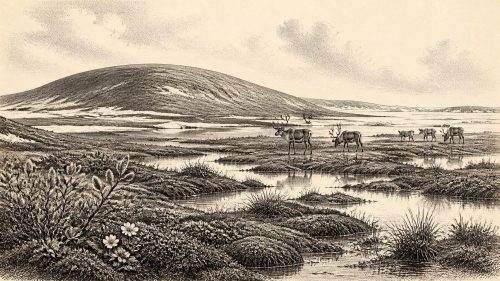
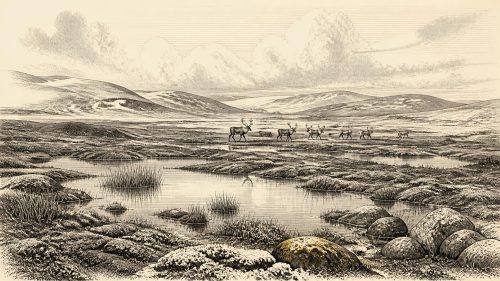
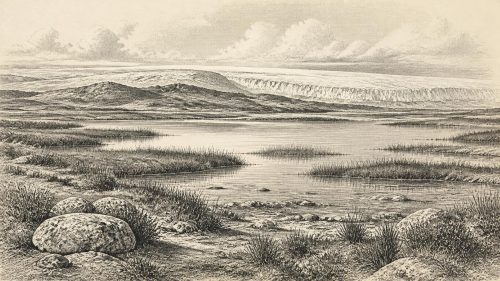
The Derryvree deposit is important because it preserves more than mud. Plant macrofossils, pollen and small animal evidence indicated open tundra vegetation and a periglacial climate. Mosses, sedges, dwarf shrubs and cold-adapted herbs grew around freshwater. Aquatic plants show that shallow pools or sluggish water existed locally during at least part of the year. This was not modern Fermanagh transferred unchanged into deep prehistory: there was no enclosed patchwork of pasture, no hedgerows, no farmsteads and no wooded countryside of the kind familiar today. The evidence instead supports a treeless or near-treeless mosaic of wet ground, exposed mineral soils, short-growing vegetation and water margins.
Such a landscape need not have been uniformly barren. A short growing season could still sustain vegetation in sheltered hollows and beside freshwater, while frost, snow cover and strong seasonal contrasts constrained life. The organic silts show that a drumlin area later overridden or bordered by ice was, during the represented interval, capable of supporting a wetland community. They do not establish that the whole island was simultaneously ice-free, nor do they prove identical conditions in Cork, the west coast or upland Ireland. Regional variation matters greatly in an island affected by expanding and contracting ice masses.
Ice Was a Process, Not a Backdrop
Ireland stood within the wider climatic instability of north-west Europe. The British–Irish Ice Sheet had not yet reached the full extent associated with the Last Glacial Maximum, which later occurred on different Irish sectors at different times, broadly around 25,000–23,000 years ago. Around the period represented by Derryvree, glaciers, local ice masses, meltwater systems and ice-free terrain changed over millennia. The two tills enclosing the freshwater deposit provide tangible evidence of that sequence: ice had affected the district before the wetland interval and did so again afterwards.
Sea level was far lower than today because large quantities of water were held in continental ice. Yet it is unsafe to turn that general fact into a simple picture of a permanent, easily crossed land bridge between Ireland and Britain. Coastlines, marine channels, ice margins and routes changed through time; animal dispersal may have involved different mechanisms in different periods. The defensible conclusion is narrower. Ireland was not environmentally isolated in the modern sense, and mammals did reach it, but the precise corridors, seasons and population movements remain debated.
Caves and the Animal Record
In north Cork, Castlepook Cave near Doneraile is the principal archive for a different kind of evidence. Excavations conducted in the early twentieth century recovered a remarkable Pleistocene fauna, now chiefly represented by museum collections: woolly mammoth, reindeer, giant deer, brown bear and spotted hyaena among it. A spotted-hyaena skull from the cave is held by the National Museum of Ireland. Hyaena remains, gnawed bones and cave chambers caution against imagining the site as a human camp by default. Carnivores could accumulate, transport and modify bones; water, slope movement and early excavation methods could further disturb them.
The fauna nevertheless changes the scale of Ireland’s deep past. It establishes that, during broad pre-Last Glacial Maximum intervals, the island supported or received large grazing mammals and formidable predators now absent from Ireland. Reindeer are particularly relevant to a cold open environment, while mammoth and giant deer evoke a wider Pleistocene faunal world. But the assemblage cannot responsibly be compressed into a single tableau for 30,446 BCE. Individual bones were deposited at different times; some species may have overlapped and others may not. A cave collection is evidence of presence across an interval, not a census conducted on one day.
The Reindeer Femur Question
Castlepook also contains the most intriguing possible indication of human action relevant to this distant period: a reindeer femur reported as carrying a deep incision interpreted by zooarchaeologist Ruth Carden as a stone-tool butchery mark. Public accounts have associated the bone with an age of roughly 33,000 years, and the find has prompted renewed archaeological interest in the cave. If the mark was made on fresh bone by a stone tool and is broadly contemporary with the animal’s death, it would be potentially momentous evidence that people processed a reindeer in Ireland long before the better-attested post-glacial human record.
“Potentially” is essential. The bone came from an old excavation collection, not from a newly excavated, intact occupation surface with a hearth, stone-tool assemblage, butchered animal group and securely related sediments. The date of the bone need not date the incision precisely, and one modified specimen cannot prove a permanent population. Recent work at Castlepook has confirmed the value of its surviving deposits while also underlining how much antiquarian excavation removed or disturbed. The femur is best treated as a serious hypothesis about fleeting Upper Palaeolithic activity, not as proof of an established Irish settlement in this particular year.
What Cannot Be Reconstructed
Accordingly, political affairs, diplomacy and organised warfare are beyond the evidence. There are no rulers, territories, alliances, forts or weapons of conflict securely attributable to Ireland around this point. Nor is there evidence for agriculture, trade networks, craft specialisation, formal burial, monuments, art or religious practice. It would be equally misleading to populate the island with a named “tribe” based on the distribution of animal bones. These absences are not evidence that people elsewhere lacked social lives or beliefs; they mark the limits of what Irish material can demonstrate.
If people did briefly enter Ireland, comparison with Upper Palaeolithic communities elsewhere in north-west Europe suggests they may have travelled in small, mobile groups and relied on detailed knowledge of animals, weather and terrain. That is an interpretation based on analogy, not a fact recovered from Castlepook. Reindeer could provide meat, hide, sinew, marrow, antler and bone, but the Irish femur alone does not show which resources were taken, whether the animal was hunted or scavenged, or whether its processors stayed for hours, days or a season.
A Fragile Northern Record
The principal story around 30,446 BCE is thus environmental opportunity within a changing glacial world. Derryvree preserves a local wetland in cold open country before renewed ice encroachment. Castlepook preserves traces of Pleistocene animals in a southern limestone cave and a contested possibility of human carcass processing. Together they overturn any simple image of an eternally frozen, lifeless Ireland, while also resisting a confident narrative of continuous early settlement.
Future progress depends on carefully excavated stratified deposits, improved direct radiocarbon dating, microscopic study of bone surface damage, ancient biomolecular research where preservation permits, and transparent publication of museum collections. For now, Ireland at this remote point is best understood not through invented events but through its surviving physical witnesses: freshwater silt, plant remains, glacial till, cave bone and one disputed line on a reindeer femur.
Primary Sources
- Middle Midlandian Freshwater Series at Derryvree, Maguiresbridge, County Fermanagh, Northern Ireland
- The Irish Quaternary Fauna Project
- New Insights on the Fauna of Ireland’s Younger Dryas and Early Holocene from Alice & Gwendoline Cave
- Spotted Hyena Skull
- 2022:564 – Castlepook Cave, Castlepook South, Cork
- Heritage Artefacts of County Cork
- Mammoth Cave
- IAH Field Trip 2014
- Growth and Retreat of the Last British–Irish Ice Sheet, 31,000 to 15,000 Years Ago: the BRITICE-CHRONO Reconstruction
- Exploring Controls of the Early and Stepped Deglaciation on the Western Margin of the British-Irish Ice Sheet
- Sedimentology and Chronology of the Advance and Retreat of the Last British-Irish Ice Sheet on the Continental Shelf West of Ireland
- Stratigraphic and Palaeo-Geomorphological Evidence for the Glacial-Deglacial History of the Last British-Irish Ice Sheet in the North-Western Irish Sea
- The IntCal20 Northern Hemisphere Radiocarbon Age Calibration Curve (0–55 cal kBP)
- The IntCal20 Northern Hemisphere Radiocarbon Age Calibration Curve (0–55 cal kBP)
- A Guide to the Quaternary of Ireland
- A North-Western Habitat: the Paleoethology and Colonisation of a European Peninsula
- Occurrence of Mammalia Relicts at Site Castlepook Cave
- Stratigraphic and Palaeo-Geomorphological Evidence for the Glacial-Deglacial History of the Last British-Irish Ice Sheet in the North-Western Irish Sea
- The Mesolithic in Ireland: When Was It?
- Dynamic Ice Stream Retreat in the Central Sector of the Last British-Irish Ice Sheet