Derryvree Freshwater Series30447 BCE
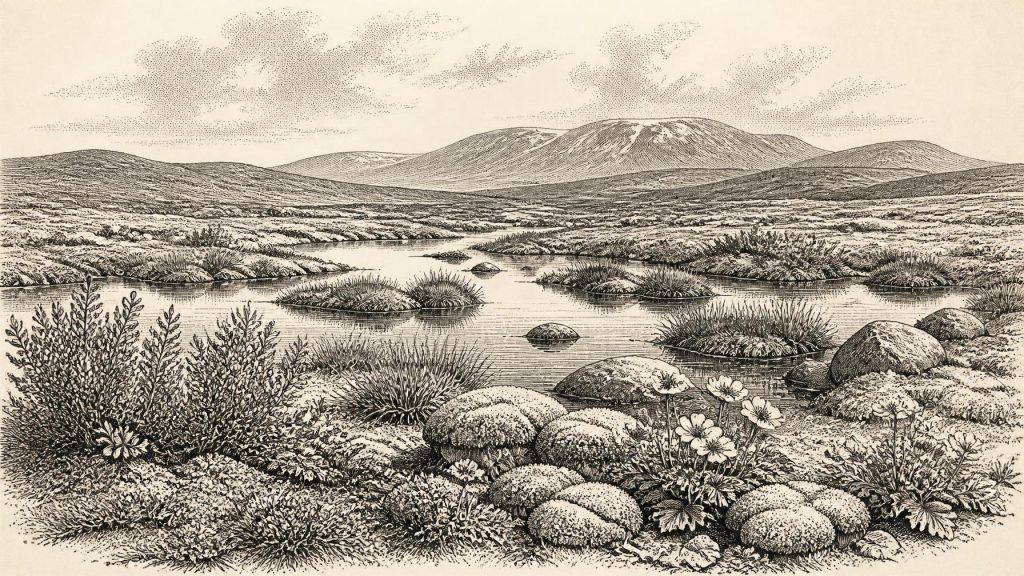
Derryvree, County Fermanagh, preserves freshwater silts deposited between glacial advances during Marine Isotope Stage 3. Radiocarbon evidence places the deposit broadly between c. 34,950 and 29,750 BCE, so 30,447 BCE is only an approximate point within its range. Mosses, sedges, aquatic plants, insects and pollen indicate a cold, treeless tundra wetland with shallow pools, not continuous ice or woodland. Elsewhere, Castlepook Cave yielded cold-adapted mammals and a reindeer bone possibly cut by humans. This suggestive evidence cannot establish settlement or culture. Ireland’s record instead documents changing ice margins, local habitats, intermittent animal access, and a possible brief human visit there.
Dateline
The label 30,447 BCE cannot identify a datable Irish event, a ruler, or a particular season. At this depth of time, modern calendar-year precision is unavailable. It is best treated as a point within a broad Late Pleistocene interval, during Marine Isotope Stage 3, when climate and ice margins changed repeatedly across north-west Europe. The most directly relevant Irish evidence is environmental rather than historical: a buried freshwater deposit at Derryvree, near Maguiresbridge in present-day County Fermanagh. It offers an unusually revealing, though strictly local, view of an ice-age Ireland that was not continuously smothered by ice.
A Date Range, Not a Year
Derryvree was exposed during road works in 1969, when a cut through a drumlin revealed organic silts and fine sands trapped between two thick tills, deposits left by separate advances of glacier ice. The organic layer, laboratory number BIRM-166, returned a conventional radiocarbon age of 30,500 years before present, with a substantial uncertainty of +1,170/−1,030 years. “Before present” in radiocarbon practice means before 1950, not before the present day.
Radiocarbon years are not identical to calendar years. Calibration against changing atmospheric carbon levels converts such a measurement into a probability range rather than a single historical date. Published treatments place the Derryvree deposit broadly in the region of c. 36,900–31,700 calibrated years before present, or roughly c. 34,950–29,750 BCE. Thus 30,447 BCE falls comfortably within the wider calibrated window, but it cannot be attached to one layer, animal, human visit or climatic episode inside it. The deposit accumulated over time; its fossils describe a landscape phase, not a day in the life of Ireland.
Freshwater Between the Ice Sheets
The significance of Derryvree lies in its position between glacial deposits. A lower till shows that ice had previously overridden the area. Above the organic freshwater sediments, another till records a later return of ice. Between those advances, the locality was ice-free enough for shallow freshwater, wet ground and tundra vegetation to develop. This is firm geological evidence for a non-glacial interval in south Fermanagh; it does not prove that every Irish region, coast or upland had the same conditions at the same time.
The setting was periglacial: shaped by severe cold and by processes associated with nearby or seasonal frost, rather than necessarily lying beneath an active glacier. The best reconstruction is not of a forested island resembling modern Ireland. The pollen, plant macrofossils, mosses and insects instead indicate open, largely treeless country, with wet hollows and pools set amid sparse tundra-like vegetation. Winters were harsh, growing seasons short, and exposed ground vulnerable to frost, solifluction and wind. Yet the freshwater layer is an important corrective to any picture of unbroken sterility. Water, plant matter and sheltered wetland niches persisted locally.
Mosses, Sedges and Shallow Pools
Derryvree’s biological evidence is modest in scale but unusually informative. The deposits contained freshwater mosses, sedges and grasses, along with herb pollen and a cold-climate insect fauna. Identifications from the site include dwarf willow, mountain avens, bogbean, alternate water-milfoil and lesser clubmoss. These are not evidence for a lush woodland or productive farmland. They instead point towards a patchwork of low vegetation, damp mineral-rich ground, pool margins and open water.
Bogbean is particularly evocative because it grows in shallow water and wet ground; alternate water-milfoil is an aquatic plant. Their remains show that at least some water bodies were sufficiently persistent to support freshwater vegetation during the period represented by the sediments. Dwarf willow and mountain avens, meanwhile, fit an open arctic-alpine or tundra character. The insects reinforce that reading, suggesting a mossy, plant-rich wetland with open pools rather than a barren expanse of snow and gravel.
These details are evidence, not merely analogy. Even so, the deposit should not be overextended. Fossils collected from one buried freshwater basin do not supply a complete census of Irish plants, nor do they yield annual temperatures, rainfall totals or a map of vegetation across the island. The responsible conclusion is narrower: parts of Ireland supported a cold, treeless wetland mosaic during an interval within the later Ice Age.
Animals in a Changing Country
The wider Irish Pleistocene bone record shows that large mammals could reach and occupy the island during ice-age intervals, although dating and depositional context vary sharply from site to site. Caves, especially in limestone country, preserve a different kind of archive from Derryvree’s wetland silts. At Castlepook Cave near Doneraile in north County Cork, antiquarian excavations recovered bones attributed to animals including reindeer, woolly mammoth, horse, giant deer, brown bear and spotted hyaena. Such faunas belong to changing episodes of the Late Pleistocene, not necessarily to one contemporaneous community.
Reindeer are especially relevant to the open, cold environments suggested at Derryvree, but their presence at Castlepook must not be used to claim that a herd stood in Fermanagh in 30,447 BCE. Cave assemblages can mix remains brought in by carnivores, water movement and repeated use of a cave over long periods. Several old Irish radiocarbon determinations have also required reassessment as laboratory methods improved. The broad conclusion is secure: Ireland was intermittently available to cold-adapted large mammals before the Last Glacial Maximum. The precise routes, timings and duration of their occupations remain unsettled.
The Castlepook Human Question
Castlepook also provides the most provocative possible human clue for this remote era. A reindeer femur from the cave has been described by zooarchaeologist Ruth Carden as bearing a deep mark made by a sharp stone implement during butchery. County Cork heritage material assigns the bone broadly to about 31,000 BCE, close enough to this article’s nominal date to make it important. If the interpretation is sustained, it would indicate that people processed a reindeer in Ireland tens of millennia earlier than the well-established post-glacial archaeological record.
Its limits matter as much as its promise. The bone was recovered from an early twentieth-century cave excavation, not from a newly excavated, sealed campsite with a hearth, stone-tool scatter, dwelling surface, human remains and securely associated food waste. The date measures the death of the animal, not necessarily the moment at which the incision was made. Nor can a single marked bone establish whether people killed the animal, butchered it beside the cave, visited briefly, returned repeatedly, or lived anywhere on the island.
A short visit by mobile hunters is therefore a reasonable interpretation, not a demonstrated history of permanent settlement. It would be methodologically unsound to import named Upper Palaeolithic cultures from France, Britain or central Europe and assign them to Ireland on this basis alone. The material does not identify language, ancestry, kinship, political organisation, ritual practice or artistic tradition. It does, however, justify continued investigation of surviving cave sediments and museum collections.
Society Beyond the Evidence
There is no evidence from Ireland around this broad date for farms, domestic animals, crops, pottery, metalwork, monuments, towns, formal trade networks or territorial polities. Accordingly, there can be no responsible account of government, diplomacy, warfare, taxation, religion or learning in the usual historical sense. Their absence from the record must not be confused with proof that every possible human visitor lacked beliefs, social ties or practical knowledge; it means that Irish evidence cannot recover them.
If people did enter Ireland, their immediate economy would have depended on foraging and hunting in a cold, variable landscape. That is an inference from the environment and from the possible reindeer butchery mark, not proof of a resident hunting population. Any movement between Ireland and neighbouring lands would have been conditioned by lower global sea levels, shifting coastlines, ice margins and the difficult topography of the Irish Sea basin. Lower sea level did not automatically create a simple, stable land bridge. Animals evidently reached Ireland at various times, but the routes used by particular species, and by any people, remain unresolved.
An Island Before History
The principal development relevant to 30,447 BCE is therefore environmental. Derryvree records an interval when a freshwater wetland occupied part of south Fermanagh between glacial advances: an open tundra landscape of sedges, mosses, low shrubs, herbs and shallow pools. Castlepook indicates that other parts of Ireland could support, or at least receive, large cold-climate mammals, while one marked reindeer femur raises the possibility of a fleeting human encounter with that world.
This is not yet a narrative of prehistoric Ireland in the later sense, with settlements, monuments and recoverable communities. It is a carefully bounded glimpse of conditions from which such narratives are still separated by tens of thousands of years. The buried Derryvree silts preserve the strongest lesson: even in an ice-age Ireland, change was not simply a march from frozen to thawed. Ice advanced, withdrew, allowed wetland life to take hold, and returned again—leaving behind a fragile archive beneath the drumlins.
Primary Sources
- Middle Midlandian Freshwater Series at Derryvree, Maguiresbridge, County Fermanagh, Northern Ireland
- Early Midlandian–Middle Midlandian, Pleistocene, Northern Ireland
- Palaeoecology
- Figure 6.— The Subdivision of the Quaternary Period in Ireland
- Exploring Controls of the Early and Stepped Deglaciation on the Western Margin of the British Irish Ice Sheet
- Deglaciation Chronology of the Donegal Ice Centre, North-West Ireland
- First Evidence of a Late Upper Palaeolithic Human Presence in Ireland
- New Insights on the Fauna of Ireland's Younger Dryas and Early Holocene from Alice & Gwendoline Cave
- Heritage Artefacts of County Cork
- 2022:564 – Castlepook Cave, Castlepook South, Cork
- The Mesolithic in Ireland: When Was It?
- BSBI: Menyanthes trifoliata
- BSBI: Salix herbacea
- BSBI: Dryas octopetala
- BSBI: Myriophyllum alterniflorum
- BSBI: Selaginella selaginoides
- Irish Quaternary Vertebrates
- Conserving Quaternary Geoheritage in Northern Ireland
- Proceedings of the Postglacial Conference of the Irish Biogeographical Society
- Archaeological Survey – National Monuments Service