
Castlepook’s Modified Femur30131 BCE
About 32,000 calibrated years BP, Ireland lay within an unstable Ice Age environment, as ice, sea levels and climates changed over periods. The British–Irish Ice Sheet’s local extent remains uncertain, while open tundra-steppe supported reindeer, mammoth, horse and predators. Castlepook Cave, County Cork, produced a reindeer femur with a possible stone-tool cut or chop, tentatively indicating Palaeolithic human handling around 31,000 BC. However, disturbed deposits, antiquarian excavation and absence of associated tools or habitation evidence prevent claims of settlement or continuity. The record instead suggests possible brief hunter incursions amid ecological opportunity, reconstructed through fragmentary bones, sediments, landforms and dates.
Dateline
The label “30,131 BCE” gives a useful point of orientation, but it must not be mistaken for a date at which Irish prehistory can be observed year by year. It corresponds roughly to 32,080 years before AD 1950, the conventional “present” used in radiocarbon work. At this depth in time, calendar-year precision is unavailable: radiocarbon results require calibration, have statistical ranges, and archaeological deposits often mix material accumulated over long periods. The responsible setting is therefore Ireland in the later part of Marine Isotope Stage 3, around c. 32,000 calibrated years BP, when climate, ice and sea level were changing on scales of centuries and millennia.
A Landscape Entering a Colder Phase
This was an Ice Age Ireland, but not necessarily the island uniformly buried beneath the greatest ice cover of the Last Glacial Maximum. Research on the British–Irish Ice Sheet indicates that its major late-glacial build-up was under way by about 35,000–32,000 years ago, while many margins reached their fullest later extent between roughly 27,000 and 21,000 years ago. More recent work also suggests that earlier advances and retreats had already occurred during the preceding cold stages. The exact position, thickness and behaviour of ice over any particular Irish district around c. 32,000 cal BP remain uncertain.
That uncertainty matters. Glacial landforms show where ice later moved, while offshore sediments, dated shells, luminescence ages and cosmogenic exposure dates help reconstruct phases of advance and retreat. They do not provide a single instantaneous map of Ireland for this modern calendar label. Northern and western ice centres, including those in Donegal and the Irish Midlands, could have behaved differently from the south. Ice, meltwater, frost-shattering and wind were reshaping terrain, depositing till and gravel in some places and eroding older deposits in others. Much of the visible texture of Ireland’s landscape owes something to this long Quaternary history, though the landforms surviving today often record several episodes rather than one moment.
Cork Cave Evidence
The most arresting evidence directly relevant to this broad period comes from Castlepook Cave near Doneraile, County Cork, long known as Mammoth Cave. Excavations directed by Richard J. Ussher in the early twentieth century recovered a large and varied animal-bone collection. It includes remains associated with the cold-stage fauna of Pleistocene Ireland: reindeer, woolly mammoth and horse, alongside carnivores and other mammals. Such cave assemblages demonstrate that, during at least some intervals before the Last Glacial Maximum, parts of Ireland supported substantial grazing animals and predators. They do not prove that every species was alive together, in the same valley, in 30,131 BCE.
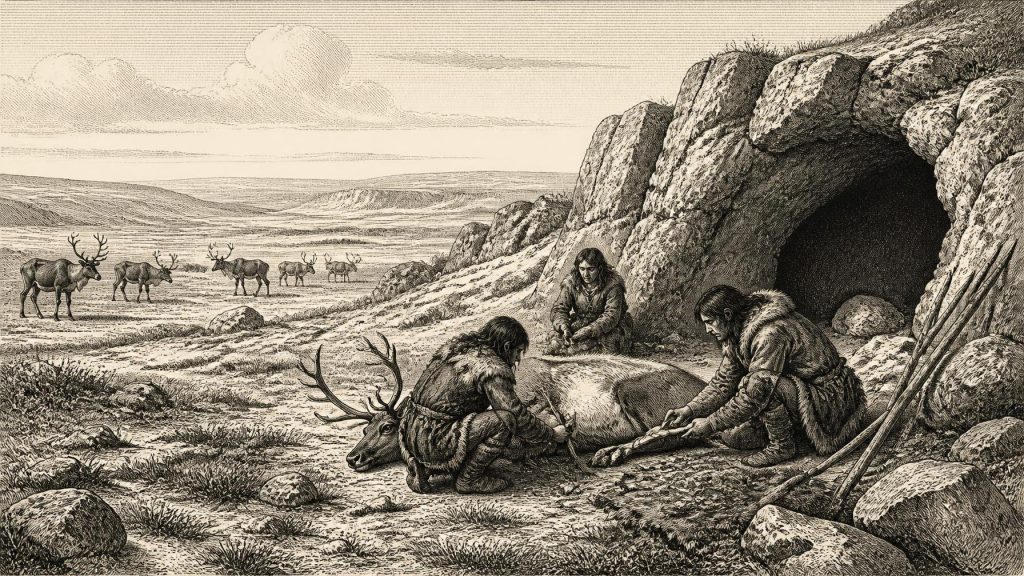
A reindeer femur from Castlepook has received particular attention because it bears a linear modification interpreted by Ruth Carden as a fresh-bone cut or chop made with a sharp stone implement. County Cork’s heritage record places the specimen at about 31,000 BC and identifies it as evidence for Palaeolithic hunters. If that interpretation and broad dating are sustained, it would indicate human handling of a reindeer in Ireland close to the period considered here, vastly earlier than the island’s better documented post-glacial settlement.
Yet this is not evidence for a settled Doneraile community, a named people, or a continuous human population. No securely associated stone toolkit, hearth, dwelling floor, burial or food-preparation area has been recovered from the cave. Moreover, antiquarian excavation removed much of the original sedimentary sequence, and cave bones may have been disturbed, redeposited or dragged in by carnivores. Recent work on Irish cave archives stresses the need to reassess old collections using modern pretreatment, direct dating and taphonomic study. The marked femur is important precisely because it is a small and exceptional piece of evidence, not because it allows a fully populated narrative to be invented around it.
Animals and Open Country
The animal evidence nevertheless gives a responsible impression of the world into which any people may have ventured. Reindeer point towards open, cold-adapted environments rather than the familiar wooded Ireland of later millennia. Mammoth and horse likewise suggest grassland, herb-rich steppe or tundra-steppe mosaics during suitable phases. Such country was not lifeless snowfield. Seasonal vegetation could sustain large herbivores, while wolves, spotted hyenas and bears formed part of a demanding ecological community. Caves may have been dens, scavenging locations, natural traps or places where bones accumulated after repeated animal activity; they should not automatically be read as human homes.
Climate at the North Atlantic edge was variable. Greenland ice-core records reveal abrupt alternations between colder stadials and milder interstadials across the last glacial period. Ireland’s maritime position meant that local conditions depended on the interaction of Atlantic waters, sea ice, wind, topography and the changing ice sheet. A description of c. 32,000 cal BP as simply “frozen” conceals this complexity. The safest interpretation is of a severe, unstable cold-stage environment, in which habitable and productive patches may have opened and closed as climate and ice margins shifted.
Human Life: Possibility, Not Biography
If people were present in Ireland around this period, they were almost certainly highly mobile Upper Palaeolithic hunter-gatherers, travelling through a landscape in which game, weather and terrain governed opportunity. Processing a large animal with sharp stone tools would have supplied meat, marrow, fat, hide, sinew and bone; a single reindeer could be a valuable resource for a small group. These are reasonable inferences from hunter-gatherer practice and the Castlepook modification, but they remain inferences. Archaeology cannot yet say how many people came, how long they stayed, where they slept, what language they spoke or whether they returned season after season.
There is no evidence for farming, permanent villages, fields, domestic livestock, pottery, metalworking or a trade network in Ireland at this date. Nor can exchange routes be reconstructed from the available material. Lower global sea levels altered the outlines of the surrounding continental shelves, but that did not make movement to or from Ireland simple or uniform. Ice, water, exposed coastal plains and changing channels all affected access. The presence of an animal bone bearing a possible human modification demonstrates an event of contact and subsistence, not the existence of a stable economy or an established route of trade.
No States, No Recorded Conflict
Political affairs, diplomacy and organised warfare are beyond the evidence. There were no written records, monuments of authority, defended settlements or identifiable territories from which to infer chiefs, alliances or rival polities. It would be misleading to translate the struggle for survival among Ice Age animals into human “conflict”. Human groups may have competed for seasonal resources, but Ireland has no archaeological record from this horizon capable of showing it. The real regional drama was environmental: ice masses expanded and reorganised drainage, sea level changed, and animal ranges shifted across north-west Europe.
Religion, art, learning and identity are similarly elusive. The ability to make and use a sharp stone edge implies practical skill, embodied knowledge and teaching, but no Irish object securely attributable to this moment reveals symbolic imagery, ceremonial practice or language. Continental Europe possesses rich evidence for Upper Palaeolithic visual culture and ritual, yet it cannot be transferred automatically to Ireland. The appropriate conclusion is not that people here lacked such cultural lives, but that the Irish record has not preserved or identified them.
An Archive of Fragments
For Ireland around 30,131 BCE, the most important development was not a dated political event but a changing Ice Age landscape that could intermittently support fauna and perhaps brief human incursions. Castlepook’s marked reindeer bone keeps that possibility sharply in view. Its value lies in its challenge to an older assumption that Ireland had no human story before the final retreat of the ice. Its limitation is equally important: one modified bone, recovered from a disturbed cave archive, cannot establish continuous occupation.
The history of this period is therefore written through calibrated ranges, animal remains, cave taphonomy, sediment layers, landforms and ice-sheet models. New direct dates and renewed excavation may substantially alter the picture. For now, c. 32,000 cal BP should be understood as an interval of cold, ecological opportunity and profound uncertainty: an Ireland being shaped by ice, visited by large mammals, and possibly crossed by hunters whose presence survives only as a disputed mark on reindeer bone.
Primary Sources
- Heritage Artefacts of County Cork
- First evidence of a Late Upper Palaeolithic human presence in Ireland
- New insights on the fauna of Ireland’s Younger Dryas and early Holocene
- The Irish Quaternary Fauna Project
- Extent and timing of the Last Glacial Maximum (LGM) in Britain and Ireland: a review
- The timing and magnitude of the British–Irish Ice Sheet between Marine Isotope Stages 5d and 2
- Deglaciation chronology of the Donegal Ice Centre, north-west Ireland
- Timing and pace of ice-sheet withdrawal across the marine–terrestrial transition west of Ireland during the last glaciation
- The deglaciation of the western sector of the Irish Ice Sheet from the inner continental shelf to its terrestrial margin
- Trimlines, blockfields and the vertical extent of the last ice sheet in southern Ireland
- Late Pleistocene chronostratigraphy and ice sheet limits, southern Ireland
- Radiocarbon constraints on the age of the maximum advance of the British–Irish Ice Sheet in the Celtic Sea
- New age constraints for the limit of the British-Irish Ice Sheet on the Isles of Scilly
- Cosmogenic 10Be chronology of the last deglaciation of western Ireland, and implications for sensitivity of the Irish Ice Sheet to climate change
- Quaternary
- Outreach and Education Resources
- Ireland through geological time
- The Greenland Ice Core Chronology 2005, 15–42 ka. Part 1: constructing the time scale
- NGRIP/GRIP Data and Greenland Ice Core Chronology 2005
- The IntCal20 Northern Hemisphere radiocarbon age calibration curve (0–55 cal kBP)