
Fermanagh’s Interstadial Mosses
Although 31,887 BCE cannot be treated as a recoverable Irish calendar year, it broadly falls within MIS 3, before the Last Glacial Maximum. Fragmentary evidence from Derryvree and Greenagho, County Fermanagh, records cold, open, wet tundra-like environments, with mosses, pools, sparse vegetation and later glacial burial. Castlepook Cave’s mixed fauna demonstrates varied cold-adapted animals, including reindeer, mammoth, giant deer and carnivores, but not a single contemporaneous community. A cut-marked reindeer bone may indicate brief human activity, yet remains uncertain. No settlements, culture, language or political organisation are known. Ireland’s surviving record chiefly reveals changing Ice Age ecology and advancing ice.
View Record
Castlepook’s Wandering Herds
31,888 BCE is a modern label, not a securely datable Irish event. During Marine Isotope Stage 3, Ireland was a cold, open, climatically unstable landscape before maximum British–Irish Ice Sheet expansion. Derryvree sediments in Fermanagh indicate treeless marshes, with sedges, grasses and low shrubs. Castlepook Cave and other southern caves preserve mixed, imperfectly dated remains of mammoth, reindeer, giant deer, bears, wolves, hyaenas, foxes, hares and lemmings, demonstrating varied cold-stage fauna over time. No secure evidence establishes human settlement, politics or culture, although a possibly cut-marked reindeer bone merits investigation. Later glaciation reshaped Ireland and erased or buried earlier evidence.
View Record
The Doneraile Reindeer Clue
Around 31,889 BCE, Ireland lay in an unstable Late Pleistocene landscape, as cold intensified and the British–Irish Ice Sheet expanded. Derryvree sediments in Fermanagh reveal open, treeless tundra wetlands supporting grasses, sedges, mosses and grazing animals, although evidence is fragmentary. Castlepook Cave in Cork preserves remains of reindeer, mammoth, giant deer and other cold-stage fauna, but disturbed deposits prevent simple reconstructions. A marked reindeer femur, dated about 33,000 years ago, may record stone-tool butchery and a fleeting Upper Palaeolithic visit. It cannot demonstrate permanent settlement, precise travel routes, or tools, hearths, dwellings or social institutions. Ireland’s human presence remains uncertain.
View Record
Maguirebridge Sedge Basin
At roughly 31,890 BCE, Ireland was a climatically unstable Late Pleistocene landscape rather than a documented society. Derryvree sediments near Maguiresbridge, Fermanagh, dated broadly to 36,900–31,700 calibrated years BP, show ice-free freshwater habitats with sedges, mosses, herbs, beetles and periglacial tundra conditions. Other deposits and Crag Cave indicate alternating non-glacial and milder phases amid advancing ice. Castlepook Cave preserves time-mixed remains of cold-adapted and other mammals, demonstrating intermittent faunal connections with Eurasia. A marked reindeer bone may record early human butchery, but remains disputed and cannot prove settlement. Subsequent ice-sheet expansion transformed, buried and destroyed much of this fragile landscape.
View Record
The Derryvree Drumlin Archive
Around 31,891 BCE, Ireland experienced fluctuating Late Pleistocene cold during Marine Isotope Stage 3, not the later glacial maximum. Derryvree, County Fermanagh, preserves freshwater silts dated broadly to this period, revealing treeless, wet, tundra-like ground between glacial advances. Expanding upland ice, permafrost, seasonal thaw and altered drainage shaped a changing landscape, while lower sea levels modified coasts and possible migration routes. Cave remains show mammoths, reindeer, hyaenas and other mammals occupied Ireland during the wider period. Possible cut marks on a Castlepook reindeer bone may indicate early human visits, but no secure evidence demonstrates settlement, communities, institutions or sustained occupation.
View Record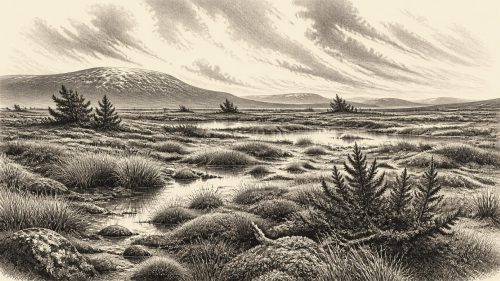
Maguirebridge Between the Tills
Labelled 31,892 BCE, this period cannot be dated to a single Irish calendar year, but falls within Marine Isotope Stage 3. At Derryvree, County Fermanagh, freshwater sediments between glacial tills indicate locally ice-free, treeless tundra, with wetlands, grasses, sedges, herbs, juniper, mosses and severe seasonal conditions. Castlepook Cave, County Cork, preserves mixed evidence of mammoth, reindeer, giant deer and predators, demonstrating intermittent cold-adapted fauna. Possible stone-tool cuts on a dated reindeer bone may suggest brief human visits, but do not prove settlement. Later ice-sheet expansion reshaped or destroyed evidence, leaving a dynamic, sparsely documented glacial Ireland at its western edge.
View Record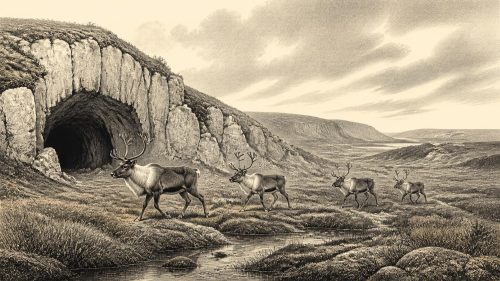
The Doneraile Femur
Castlepook Cave near Doneraile, County Cork, contains a reindeer femur whose deep mark may represent Ireland’s earliest evidence of human activity, perhaps from stone-tool butchery around 33,800 years ago. The date is a broad Late Pleistocene MIS 3 estimate, not a precise annual event, and bone dating records animal death rather than human handling. Excavated deposits were disturbed and include scavenger-accumulated fauna, limiting conclusions. Mammoth, reindeer, giant deer and carnivores indicate cold, open, intermittently habitable landscapes and changing access routes. The find suggests possible brief forager presence, but proves neither settlement, culture, identity nor permanent occupation in Ice Age Ireland.
View Record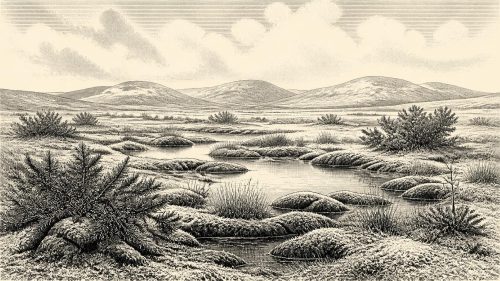
Derryvree’s Treeless Marsh
Around 31,894 BCE, Ireland lay within the unstable Late Pleistocene environment of Marine Isotope Stage 3. Derryvree, County Fermanagh, preserves a marshy, treeless tundra deposit between older and later glacier tills, indicating a temporary ice-free interval. Mosses, grasses, sedges, juniper, herbs and insects supported productive wetland ecosystems despite severe cold and seasonal freezing. Elsewhere, cave remains show that mammoths, giant deer, reindeer, bears, hyaenas and other mammals occupied Ireland during the broader period, though not necessarily simultaneously. Ice-sheet extent, coastlines and migration routes remain uncertain. No secure evidence demonstrates human settlement; possible butchery marks suggest only a tentative, brief visit.
View Record
Derryvree’s Arctic Lake
At the notional date of 31,895 BCE, Ireland lay within the climatically unstable Marine Isotope Stage 3, before maximum glaciation. Its ice sheet, coastlines and habitats changed markedly across Ireland, precluding a precise national reconstruction. Buried lake sediments at Derryvree, Fermanagh, dated broadly to 36,900–31,700 years before present, demonstrate freshwater and sparse tundra-steppe life during an ice-free interval. Castlepook Cave, Cork, preserves MIS 3 fauna including reindeer, mammoth and predators, though not necessarily contemporaneous. No secure human settlement exists. A possibly tool-marked reindeer bone suggests provisional human activity. Radiocarbon calibration, stratigraphy and environmental proxies provide evidence, but retain substantial uncertainty.
View Record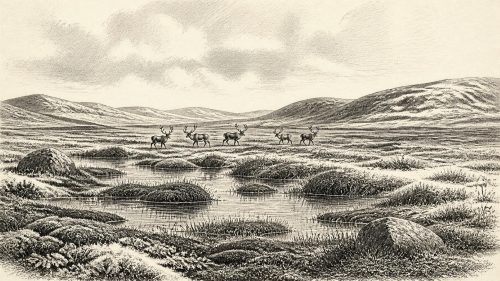
Maguirebridge’s Tundra Lake
About 31,896 BCE, a modern label, Ireland lay in later Marine Isotope Stage 3, before the Last Glacial Maximum. Derryvree near Maguiresbridge preserves sediments beneath glacial tills, indicating ice-free northern ground with treeless tundra, wetlands, pools and cold-adapted plants and insects. Cave evidence from Cork records MIS 3 fauna including mammoth, reindeer, giant deer, bears and hyaenas, though remains span episodes and disturbed contexts. Kerry speleothems indicate milder conditions. Ice expansion was regionally varied and intensified later. No secure human settlement dates to this period; possible butchery evidence remains uncertain. Surviving sediments, bones and calcite reveal a diverse Ice-Age landscape.
View Record