
Sedges Between the Tills31472 BCE
31,472 BCE is a modern label within a broad Late Pleistocene dating range, not a recoverable Irish historical year. Derryvree, County Fermanagh, preserves freshwater sediments between glacial tills, indicating locally ice-free, treeless tundra with sedges, mosses and wet hollows during MIS 3. Castlepook Cave, County Cork, contains diverse cold-stage fauna, including reindeer, mammoth, giant deer, predators and lemmings, though its bones accumulated over long periods. A marked reindeer femur may indicate human butchery around 31,000 BC, but cannot prove settlement. Ireland was climatically unstable, intermittently accessible and increasingly affected by advancing ice, known only through fragmentary environmental and archaeological evidence.
Dateline
31,472 BCE is a modern chronological label, not a year that can be recovered from the Irish archaeological record with calendar-like precision. No person, settlement, political act or seasonal event can responsibly be attached to it. In radiocarbon terms, it lies broadly around 33,400 calendar years before AD 1950, during the Late Pleistocene and Marine Isotope Stage 3 (MIS 3), a long, climatically volatile phase of the last Ice Age. The closest useful Irish evidence comes from deposits and bones dated across wide ranges. It can illuminate a changing environment and the possibility of human visits, but not provide an annal for one numbered year.
A Date Within a Range
The distinction between radiocarbon years and calendar years matters especially at this depth of time. Radiocarbon measures the remaining carbon-14 in once-living material; atmospheric carbon-14 has varied over millennia, so the result must be calibrated against an internationally maintained curve. A conventional radiocarbon age of about 30,500 years BP, for example, is not equivalent to 30,500 calendar years before 1950. It calibrates to a substantially older and often broad range. The uncertainties are not an inconvenience to be ignored: they are part of what the evidence means.
The most relevant Irish chronological anchor is Birm-166, a radiocarbon determination obtained from organic sediments at Derryvree near Maguiresbridge, County Fermanagh. The original result was 30,500 radiocarbon years BP, with an uncertainty of more than a thousand years. Later modelling has placed it at approximately 33.5 ± 1.2 thousand calendar years BP. That broad estimate encompasses the notional date of 31,472 BCE. It does not establish that the Derryvree plants grew, an animal drank, or a human arrived in that precise year. Rather, it places the deposit within an interval in which northern Ireland was locally ice-free and ecologically active.
The Derryvree Freshwater Window
Derryvree was exposed accidentally when road works cut through a drumlin in 1969. A drumlin is a streamlined hill of glacial sediment, shaped beneath moving ice. At this site, researchers found fine sands, silts and organic material trapped between two thick layers of till, the unsorted debris left by glaciers. The lower till records an earlier advance of ice; the upper till records a later one. Between them survived the remains of a freshwater environment formed during an ice-free interval.
This is a rare survival. Later glaciers eroded, mixed and buried large areas of the Irish landscape, leaving few intact terrestrial records from the middle of the last glacial cycle. The Derryvree sequence therefore has importance beyond its modest scale. It shows that an area now within the drumlin country of Fermanagh was not permanently entombed beneath ice. There were pools or slow water, wet ground and enough plant cover to leave an organic archive before a renewed glacial advance overrode the locality.
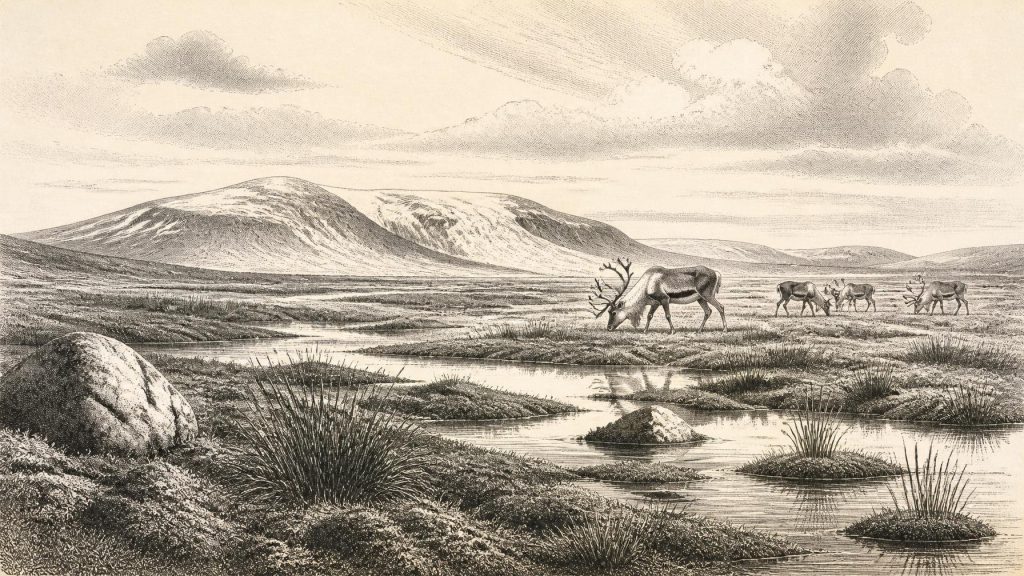
The flora and fauna recovered from the silts indicate open tundra and a periglacial regime: a landscape dominated by severe cold, repeated freezing and thawing, and a short growing season. It was not a forested Ireland. Grasses, sedges, herbs, mosses and hardy cold-adapted plants formed a low cover around wet hollows. Plant remains include water-loving species, while insect and moss evidence points towards muskeg-like ground: saturated, peaty or muddy terrain with shallow open water and dense vegetation at its margins. Juniper may have occurred locally, but there is no basis for imagining extensive woodland.
Such evidence supports a vivid but disciplined reconstruction. In a favourable summer, the wetland would have offered food and shelter to insects, birds and grazing animals, while its pools reflected a low Arctic light. In winter, frozen ground, wind exposure and snow cover would have imposed severe constraints. This was a living landscape, not an empty white desert, yet it was one in which survival depended upon mobility and adaptation. It must also be treated as local evidence. Derryvree cannot supply a weather report for all Ireland, still less a complete map of the island’s vegetation in one year.
Cork’s Cave-Bone Record
County Cork provides a different kind of evidence. Castlepook Cave, near Doneraile in north Cork, has produced Ireland’s most important assemblage of pre-Last Glacial Maximum animal bones. Excavated principally in the late nineteenth and early twentieth centuries, and later re-examined, its collections include remains attributed to reindeer, woolly mammoth, giant deer, wolf, brown bear, spotted hyaena, arctic fox, mountain hare and lemmings. Taken together, they demonstrate that cold-stage and open-country mammals reached Ireland during parts of the Late Pleistocene.
The cave record is powerful, but it has limits. Its fossils were accumulated through more than one process: carnivore activity, deaths in or near the cave, water movement, sediment disturbance and antiquarian excavation. They do not constitute a single simultaneous animal community. A mammoth bone dated to roughly 33,400 radiocarbon years BP and a spotted-hyaena specimen with a broadly comparable age help to locate some of the assemblage within MIS 3, but individual bones may represent different centuries or millennia. Nor should the species list be projected wholesale from north Cork to Fermanagh.
Even so, Castlepook complements Derryvree. Reindeer and lemmings are consistent with the open, cold environments indicated by the Fermanagh sediments. Wolves and hyaenas show that the animal world included predators and scavengers as well as herbivores. Mammoth and giant deer point to the capacity of at least some Irish landscapes to sustain large mammals. This was not the familiar later Irish countryside of enclosed fields, woodland and farms. It belonged to a wider north-west European zone in which animal ranges expanded and contracted with climatic shifts, ice margins and changing coastlines.
The Reindeer Femur Question
One Castlepook object has made the period especially significant for Irish prehistory: a reindeer femur bearing a deep linear mark. Zooarchaeologist Ruth Carden has interpreted the modification as a cut or chopping mark made with a sharp stone implement while the bone was fresh. County Cork heritage publications have presented the find as dating to around 31,000 BC. If that interpretation is confirmed, it would be evidence that a person processed a reindeer in Ireland tens of thousands of years before the formerly accepted terminal-Pleistocene evidence for human activity.
The correct conclusion remains cautious. The dated bone is evidence for the age of the animal, not an exact date for the mark. A cut-mark interpretation requires comparison with damage from carnivores, trampling, sediment abrasion, breakage, weathering and excavation. Moreover, the femur comes from an old cave collection rather than a newly excavated occupation surface where tools, hearths, butchered remains and human traces were found together. Castlepook has not yet supplied a securely associated stone-tool assemblage, dwelling floor, burial, food store or repeated camp of this age.
The bone therefore suggests a possible episode of Upper Palaeolithic human activity, not established permanent settlement. Its maker cannot be named, their language and ancestry cannot be recovered, and even the duration of any visit is unknown. A small hunting party could have reached the island or its then-changing western fringe, processed an animal and left little behind. That is an interpretation consistent with the mark and the wider European context, but it is not a fact demonstrated by a complete archaeological site.
Mobility Without States
There is no evidence for political institutions, chiefs, territories, warfare, diplomacy, formal religion, monuments, farming or trade networks in Ireland at this point. Those are not missing chapters of a known national story; they are categories for which the evidence simply does not exist. If people were present, their society was likely organised in small, mobile hunter-gatherer groups, as elsewhere in Upper Palaeolithic Europe. That comparison may help frame possibilities, but it cannot reveal an Irish social structure from a single modified bone.
Likewise, low global sea level does not automatically prove a reliable dry land bridge between Ireland, Britain and the European mainland. Ice loading, local crustal movement, shelf topography, meltwater and fluctuating sea levels made the geography of the Irish Sea region complex. The animal record proves that movement into Ireland occurred at some points in the Late Pleistocene. It does not demonstrate one route, one crossing season or uninterrupted connection in 31,472 BCE. Animals and perhaps people may have used combinations of exposed ground, coastal corridors, short water crossings or changing ice-edge landscapes at different times.
Before the Greater Advance
The date falls well before the best-established maximum of the last Irish ice sheet, generally placed much later, during the interval roughly 26,000 to 20,000 years ago. Ice was nevertheless already a decisive force. The Derryvree sequence records one advance before its freshwater phase and another afterwards, while wider evidence shows an increasingly unstable climatic setting leading towards more extensive glaciation. Local conditions could vary sharply: exposed wet tundra in one district, a glacier nearby, and a coast transformed by lower sea levels and isostatic change.
For Ireland, then, the importance of 31,472 BCE is not an invented event but a carefully bounded possibility. Derryvree provides direct evidence for a cold, treeless freshwater landscape during a broad interval that includes this date. Castlepook records a rich Late Pleistocene fauna and preserves a reindeer bone that may mark a fleeting human encounter. Together, the sites replace an image of an entirely blank Ice Age island with a more demanding picture: an intermittently accessible land of sedges, pools, grazing animals, predators and expanding ice, known through fragile fragments rather than annual history.
Primary Sources
- A Middle Midlandian Freshwater Series at Derryvree, Maguiresbridge, County Fermanagh, Northern Ireland
- Exploring Controls of the Early and Stepped Deglaciation on the Western Margin of the British-Irish Ice Sheet
- Exploring Controls of the Early and Stepped Deglaciation on the Western Margin of the British-Irish Ice Sheet
- The Irish Quaternary Fauna Project
- The Irish Quaternary Fauna Project
- Irish Pleistocene Biostratigraphy
- Palaeoecology
- The Quaternary Period in Ireland
- Archaeological Heritage of County Cork
- Heritage Artefacts of County Cork
- Last Glacial Maximum Cirque Glaciation in Ireland and Implications for Reconstructions of the Irish Ice Sheet
- Dimensions and Chronology of the Last Ice Sheet in Western Ireland
- Pleistocene Vertebrates in the British Isles
- Quaternary Site Descriptions
- The IntCal20 Northern Hemisphere Radiocarbon Age Calibration Curve (0–55 cal kBP)
- The IntCal20 Approach to Radiocarbon Calibration Curve Construction: A New Methodology Using Bayesian Splines and Errors-in-Variables
- First Evidence of a Late Upper Palaeolithic Human Presence in Ireland
- New Insights on the Fauna of Ireland's Younger Dryas and Early Holocene from Alice & Gwendoline Cave
- Proceedings of the Postglacial Colonisation Conference
- Biogeography of Ireland: Past, Present, and Future
- The Mesolithic in Ireland: When Was It?
- IntCal Publications