
Derryvree’s Buried Summer31464 BCE
Although 31,464 BCE is a modern notional date, evidence places Ireland within the climatically unstable Marine Isotope Stage 3. At Derryvree, County Fermanagh, freshwater organic sediments between glacial tills record a temporary ice-free, cold, treeless wetland, demonstrating local environmental change rather than island-wide conditions. Castlepook Cave, County Cork, preserves pre-Last Glacial Maximum remains of mammoth, giant deer, reindeer, bear and hyaena, indicating intermittent animal dispersal across changing landscapes. A marked reindeer bone may suggest brief human activity, but no settlement or occupation is proven. Ireland had no polities, farming or trade, and remained environmentally dynamic, intermittently habitable and archaeologically uncertain.
Dateline
A Date Without a Diary
The label 31,464 BCE gives an appealingly exact point in time, but no such precision is available for Ireland in the later Ice Age. There is no written record, no named community, ruler or battle, and no excavated settlement that can be assigned to that calendar year. Modern BCE dates are a way of translating deep time for readers, not dates used by Ice Age people. The responsible history of this moment therefore lies in calibrated ranges, fossil assemblages and sediment sequences. These can show what conditions existed during broad intervals; they cannot supply a day, season, or island-wide snapshot.
In radiocarbon terms, 31,464 BCE is approximately 33,400 years before 1950, the conventional present used in radiocarbon reporting. It falls within Marine Isotope Stage 3, an unstable part of the last glacial cycle, when North Atlantic climates repeatedly shifted between relatively milder interstadials and colder stadials. Ireland was not yet at the Last Glacial Maximum, whose major British–Irish ice-sheet expansion came later, principally after about 27,000 calibrated years ago. But it was already a severe northern landscape, vulnerable to abrupt climatic and glacial change.
Freshwater Beneath the Drumlin
The most revealing Irish evidence near this notional date comes from Derryvree, close to Maguiresbridge in County Fermanagh. Roadworks exposed a remarkable sequence inside a drumlin: a lower glacial till, then freshwater sands and organic, moss-rich mud, sealed beneath another thick till. Till is the unsorted mixture of clay, stones and other debris deposited directly by ice. The order of these layers is decisive. It demonstrates that after one glacial episode, the locality stood free of overriding ice long enough for standing or slow-moving freshwater, wet ground and vegetation to develop; a later glacier then covered and preserved the deposit.
Organic material from the Derryvree freshwater bed produced a conventional radiocarbon result of 30,500 ± 1,100 radiocarbon years BP, known as BIRM-166. That is not a calendar date. Its wide uncertainty and the calibration curve mean that it translates into a broad calendar interval, conventionally placed across roughly the later thirty-fifth to thirtieth millennia BCE. The date 31,464 BCE falls within the sort of span that the deposit can illuminate, not at a pinpoint within it. Nor does the Fermanagh evidence prove that every part of Ireland was ice-free at once. It is firm local evidence for an ice-free interval, not a complete map of the island.
A Cold, Living Wetland
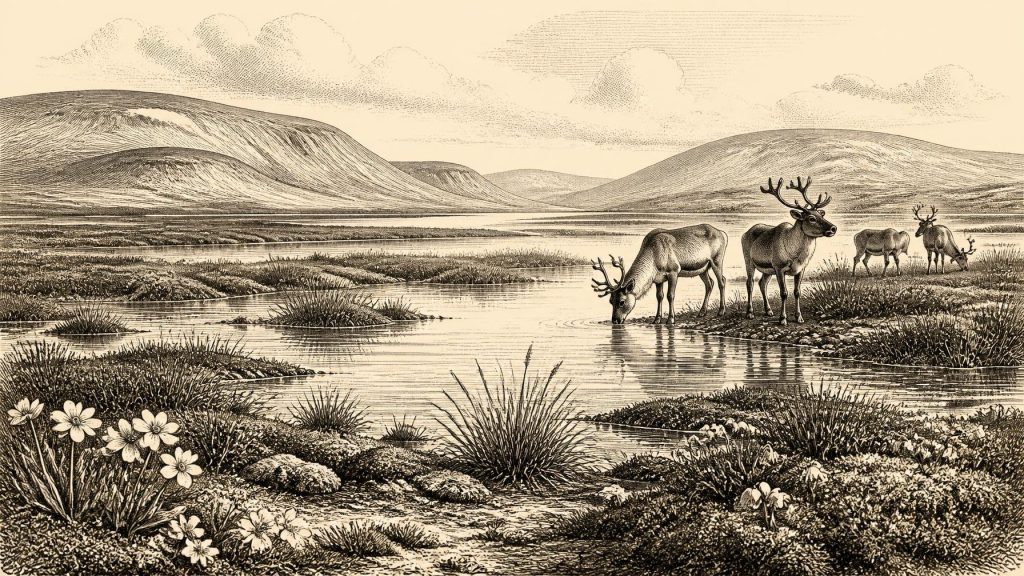
The Derryvree sediments preserve pollen, plant macrofossils, mosses and insect remains. Together they indicate a cold, open and largely treeless setting with freshwater habitats. Sedges and mosses mattered greatly, while the recorded flora includes bogbean (Menyanthes trifoliata), alternate water-milfoil (Myriophyllum alterniflorum) and mountain avens (Dryas octopetala). Such plants point to pools, wet margins and damp mineral ground within a wider periglacial landscape. They rule out a mature temperate forest. They do not, however, justify imagining one uniform tundra plain from Cork to Donegal: vegetation varied with drainage, soil, exposure and local shelter.
For much of the year, frost, snow cover and short growing seasons would have shaped daily possibilities for every animal using the landscape. Yet cold country was not empty country. During the brighter months, shallow pools and wet sedge margins could be productive places for invertebrates, waterfowl and grazing mammals. Low herbs, grasses, dwarf shrubs and mossy ground created a patchwork of food and cover. The important historical development was not human land use but environmental opportunity and constraint: water and vegetation briefly established themselves between episodes of ice advance.
Regional change was rapid by geological standards. The two tills at Derryvree frame the freshwater episode between glacial incursions, while wider evidence shows that the British–Irish Ice Sheet did not behave as a single fixed dome. Its margins and outlets advanced and withdrew differently in the Irish Sea, Atlantic shelf and northern basins. It is therefore misleading to describe Ireland simply as either ‘under ice’ or ‘ice-free’. Around this broad period, some districts could sustain tundra wetland while other regions were affected by ice, snowfields, cold seas or changing glacial drainage.
Animals at the Edge of Europe
County Cork’s Castlepook Cave, near Doneraile, supplies the principal Irish record of mammals living before the Last Glacial Maximum. Its collections include woolly mammoth, giant deer, reindeer, brown bear and spotted hyaena, along with smaller cold-adapted species in parts of the sequence. Geological Survey Ireland describes Castlepook as Ireland’s richest vertebrate site for this earlier Ice Age interval. The cave is consequently essential for understanding the kinds of animals that reached Ireland when climatic and geographical conditions permitted.
That record must still be handled carefully. Cave assemblages are not neat census lists. Bones may have entered through carnivore activity, natural deaths, water movement, roof collapse or excavation disturbance. A hyaena den can accumulate prey and scavenged carcasses from a wide surrounding territory; a bone recovered beside another need not be of the same age. Older excavations at Castlepook removed much sediment before modern recording methods existed, and later work has shown that some early radiocarbon determinations from Irish cave bones were too young because of limitations in past laboratory treatment. Revised dating has made the Castlepook sequence more important, but also more complex.
The animal evidence supports a cautious image of intermittent connections rather than a permanently well-stocked island. During low sea-level phases, the exposed continental shelf enlarged the land area around Ireland, though rivers, sea channels, ice margins and relief still created real barriers. Mammals such as reindeer and hyaena reached the island at certain times. Their presence shows dispersal across a changing north-west European landscape; it does not show that a simple dry land bridge existed everywhere, or continuously, between Ireland and Britain.
The Human Question
One reindeer femur from Castlepook has attracted particular attention because it bears a linear mark interpreted as a possible fresh-bone chop or cut made with a sharp stone implement. It has been publicised as evidence that people handled a reindeer carcass in Ireland about 33,000 years ago. If that interpretation is sustained by further analysis, it would be an exceptionally early sign of human activity on the island and would make the broad era around 31,464 BCE especially significant.
It is not, however, evidence for a settled Ice Age population, a camp, or an Irish ‘first community’. The radiocarbon determination dates the death of the animal, not necessarily the instant of modification; the recovered object is isolated; and no securely associated stone tools, hearth, dwelling surface or human remains have demonstrated an occupation at Castlepook. The 2022 excavation found surviving cave sediments and animal remains but no cultural artefacts. The appropriate conclusion is deliberately limited: people may have visited or used part of Ireland during this long period, perhaps briefly and opportunistically, but permanent residence is unproven.
This caution matters when considering society and everyday life. Elsewhere in north-west Europe, Upper Palaeolithic hunter-gatherers possessed sophisticated stone-working knowledge, social networks and cultural practices. None of that can simply be transferred to Ireland without Irish finds. If humans were present here, they would have needed warmth, food, toolstone and safe movement through a cold landscape. The Castlepook bone may represent carcass processing, but it cannot reveal the size of a group, its language, kinship, dress, beliefs or route of arrival. There is no responsible basis for naming a people, reconstructing a seasonal camp, or claiming ritual activity.
No Polities, No Trade System
Political affairs, warfare, diplomacy, formal religion and organised trade leave no identifiable Irish evidence at this date. There were no states, tribes or kingdoms that archaeology can recognise in the later thirty-second millennium BCE, and no evidence for territorial government, negotiated alliances or conflict between communities in Ireland. Likewise, there are no Irish ritual monuments, burials, artworks or learning traditions securely attributable to this horizon. Their absence from the record is not proof that visiting people had no beliefs or culture; it means the evidence cannot recover them.
Economically, the relevant scale is ecological rather than agricultural. There was no farming, animal husbandry, metalworking, pottery production or known exchange network in Ireland. Wild plants and animals, freshwater and sheltered terrain were the decisive resources. For carnivores and grazing herds, the island’s open habitats formed part of a wider Atlantic fringe. For any human visitors, the practical economy would have been immediate procurement: moving through the landscape, finding fuel and raw materials, and obtaining food before weather or ice conditions changed. That is an inference from the setting, not a documented Irish lifeway.
What the Evidence Can Say
Around 31,464 BCE, Ireland should be understood as a changing Ice Age environment rather than a country with a recoverable annual history. Derryvree records a cold freshwater interval between glacial advances in Fermanagh. Castlepook preserves evidence that an unexpectedly varied large-mammal fauna reached southern Ireland during the broader pre-Last Glacial Maximum period. A marked reindeer bone raises, but does not settle, the possibility of very early human activity. These deposits are powerful precisely because they retain fragments of a world later ice and time mostly erased. Their lesson is not that we can narrate one year, but that Ireland’s deep past was environmentally dynamic, intermittently habitable and still archaeologically unfinished.
Primary Sources
- A Middle Midlandian Freshwater Series at Derryvree, Maguiresbridge, County Fermanagh, Northern Ireland
- The Irish Quaternary Fauna Project
- A Reconsideration of the Radiocarbon Dating of the Marine Isotope Stage 3 Fauna from Southern Ireland
- Castlepook Cave, County Geological Site Report
- 2022:564 – Castlepook Cave, Castlepook South, Cork
- New Insights on the Fauna of Ireland's Younger Dryas and Early Holocene from Alice & Gwendoline Cave
- Timing and Pace of Ice-Sheet Withdrawal Across the Marine–Terrestrial Transition West of Ireland During the Last Glaciation
- Exploring Controls of the Early and Stepped Deglaciation on the Western Margin of the British–Irish Ice Sheet
- Trimlines, Blockfields and the Vertical Extent of the Last Ice Sheet in Southern Ireland
- Advance and Retreat of the Marine-Terminating Irish Sea Ice Stream into the Celtic Sea During the Last Glacial: Timing and Maximum Extent
- Oscillating Retreat of the Last British-Irish Ice Sheet on the Continental Shelf Offshore Galway Bay, Western Ireland
- Radiocarbon Constraints on the Age of the Maximum Advance of the British–Irish Ice Sheet in the Celtic Sea
- Maximum Extent and Readvance Dynamics of the Irish Sea Ice Stream and Irish Sea Glacier Since the Last Glacial Maximum
- A Critical Review and Re-Investigation of the Pleistocene Deposits Between Cranfield Point and Kilkeel, Northern Ireland
- Ireland: Submerged Prehistoric Sites and Landscapes
- European Vegetation During Marine Oxygen Isotope Stage 3
- Myriophyllum alterniflorum in Fermanagh
- Archaeological Excavations at Killuragh Cave, Co. Limerick: A Persistent Place in the Landscape from the Early Mesolithic to the Late Bronze Age
- On the Cave of Castlepook, Near Doneraile, Co. Cork
- The Antiquity of Man in Ireland