
Ballyhoura’s Scored Reindeer31463 BCE
Dateline
The label 31,463 BCE gives a useful point of entry, but it cannot identify an Irish event in the way that a historic year can. It corresponds conventionally to about 33,412 years before AD 1950, the reference point used for “BP” dating. No written calendar, ruler-list, settlement sequence or archaeological layer can distinguish this particular year from those immediately around it. The responsible scale is therefore a broad one: Ireland in the later Middle Midlandian, part of Marine Isotope Stage 3, during an unstable cold phase before the Last Glacial Maximum.
Even calibrated radiocarbon dates do not provide calendar-year precision at this depth of time. They produce probability ranges, and the surviving Irish evidence is sparse, disturbed in places and unevenly distributed. Yet a number of deposits illuminate the country around the nominal date. Most important are the freshwater sediments sealed beneath a drumlin at Derryvree in County Fermanagh and the remarkable animal-bone archive at Castlepook Cave near Doneraile, County Cork, on the northern approaches to the Ballyhoura uplands. Together they show a cold, open and changing Irish landscape that could support tundra life, large mammals and predators, while the expanding British–Irish Ice Sheet increasingly threatened to remake it.
A Date Within a Long Cold Interval
“Midlandian” is the Irish term for the last glacial stage. It should not be imagined as one unbroken age of ice. Climate and ice margins altered repeatedly over millennia. The global Last Glacial Maximum, when the British–Irish Ice Sheet attained its greatest overall extent, belongs chiefly to a later period. Recent ice-sheet synthesis places maximum ice volume at about 23,000 years BP, while showing that different sectors advanced and retreated at different times. For the earlier span around 33,400 BP, researchers expressly acknowledge substantial uncertainty about where ice lay in every region at every moment.
This uncertainty matters. It would be wrong to picture the entire island as either a green refuge or a single white ice cap in 31,463 BCE. The strongest conclusion is regional variation and rapid environmental change. Some ground was ice-free long enough for lakes, marshes and tundra vegetation to develop; other districts may have been influenced by advancing local or marine-fed ice. Subsequent glaciers eroded, transported and buried much of the landscape, which is a major reason why the evidence now comes from a small number of exceptional deposits rather than from a continuous national record.
Derryvree’s Sealed Wetland
Derryvree, near Maguiresbridge in County Fermanagh, is especially valuable because its position in the ground records change rather than merely preserving a fossil. Road cutting exposed organic silts and fine sands between two thick sheets of till: unsorted material deposited by glacier ice. The sequence demonstrates an earlier ice advance, an intervening phase in which freshwater sediment accumulated, and a later advance that sealed the wetland beneath the drumlin. It is direct geological evidence that this locality was not continuously ice-covered.
Organic material from the Derryvree deposit produced a conventional radiocarbon determination of 30,500 years BP, with a substantial laboratory uncertainty. Modern calibration has commonly placed it at approximately 36,900–31,700 calibrated years BP. The nominal date of 31,463 BCE falls near the younger end of that broad interval. That does not mean that the Derryvree pools can be assigned to that precise year, nor that their conditions describe all Ireland. It does mean that the site is a close and scientifically relevant window onto the kind of environment that survived in at least part of the island during this phase.
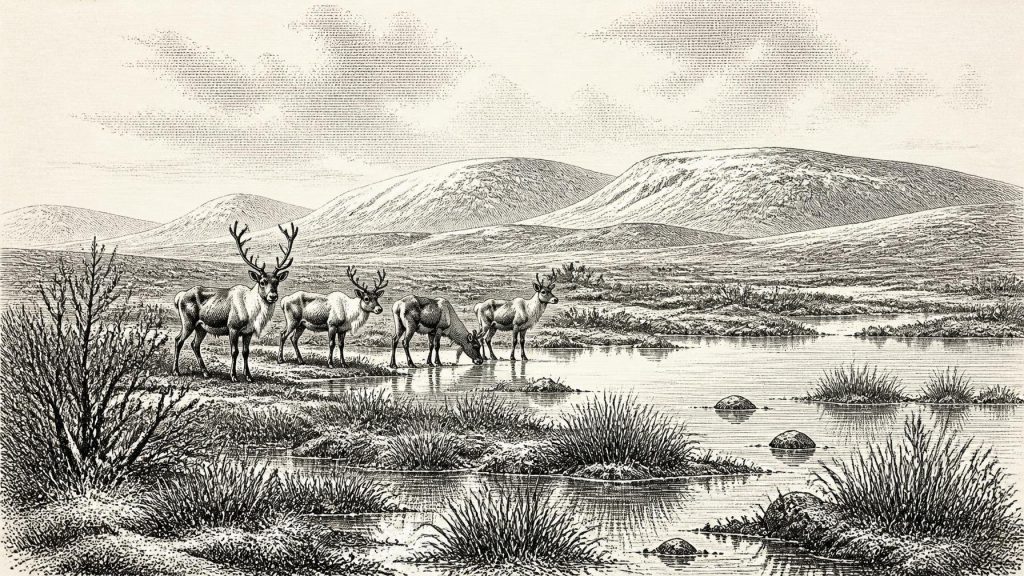
Plant and animal remains indicate open tundra vegetation and a periglacial regime: ground shaped by severe frost, seasonal thaw and short growing seasons rather than by forest. Sedges, herbs, low shrubs, mosses and aquatic plants occupied wet hollows and shallow water. Such an environment was harsh, but it was not lifeless. Summer light and meltwater could make marsh edges productive, attracting insects and grazing animals; winter brought freezing, wind exposure and restricted food. The Derryvree evidence is best read as an ecological reconstruction based on preserved pollen, seeds and other biological traces, not as a view of a single day in Fermanagh.
Doneraile’s Bone Archive
At Castlepook Cave, a limestone maze near Doneraile in north Cork, early twentieth-century excavations recovered more than 2,000 bones. Geological Survey Ireland regards it as Ireland’s richest vertebrate site for the period leading towards the Last Glacial Maximum. The collection includes remains attributed to woolly mammoth, giant deer, reindeer, brown bear, wolf, Arctic fox, spotted hyaena, mountain hare and lemmings. In combination, these animals point to cold open-country habitats and an Irish fauna markedly different from that of the later wooded island.
There are important qualifications. The cave did not function as a neatly layered prehistoric campsite. Its galleries accumulated material over a very long period; carnivores, water movement, older excavation methods and later disturbance all complicated the record. Individual radiocarbon dates demonstrate that bones entered the cave at different times, rather than establishing one single “Castlepook age”. Modern re-dating has also shown that some older measurements were too young because improved laboratory methods remove contamination more effectively. A mammoth femur was dated in the 1970s to 33,500 ± 1,200 radiocarbon years BP, while later work has refined the broader chronology of southern Irish Marine Isotope Stage 3 fauna.
The article’s title refers to a reindeer femur from Castlepook reported by County Cork’s heritage service as c. 31,000 BCE and bearing a score interpreted as a fresh-bone cut made by a sharp stone tool. If that reading is correct, it is potentially dramatic: it would indicate the butchery of reindeer by Upper Palaeolithic hunters in Ireland far earlier than the island’s previously established human record. But the inference must remain carefully bounded. A cut-marked bone is not a dwelling, hearth, tool-kit, burial ground or proof of a permanent community. No securely associated stone tools or occupation surface of this age has yet been recovered at Castlepook. The bone offers a possible trace of a brief human visit; it does not support a detailed story of a named hunting party or a settled population.
People at the Edge of the Record
For this reason, political affairs, diplomacy, institutions, leaders and organised warfare are wholly beyond recovery for Ireland around this date. So are religious rites, languages, kinship rules and artistic traditions. There is no evidence for farming, villages, fields, monuments, metalworking or exchange networks on the island at this time. These are not omissions from the historical account: they are limits imposed by the evidence.
Interpretation can nevertheless outline what a human presence, if the Castlepook cut mark does record one, would probably have entailed. Hunter-gatherers living in north-west Europe during the Upper Palaeolithic were highly mobile and skilled users of animal resources. Reindeer could provide meat and marrow, hides for clothing or shelter, sinew for bindings, and bone and antler for tools. A party pursuing or intercepting animals in cold country would need intimate practical knowledge of terrain, weather, animal movement, water sources and fuel. None of this demonstrates that people lived at Castlepook, or even entered the cave. Indeed, the cave’s hyaena remains make it quite plausible that carnivores carried discarded or scavenged bone into its passages after an animal was killed elsewhere.
An Uncertain Crossing
Geography adds another restraint. Sea level was much lower globally than today because vast volumes of water were held in ice, and the outlines of coasts and shelves differed greatly from modern maps. But lower seas do not automatically prove a dependable dry-land route from Britain to Ireland. Research on the Irish Sea has long argued against assuming a simple, continuous land bridge, while later reconstructions emphasise complex interactions among sea level, crustal movement, ice and changing shorelines. Around 31,463 BCE, the routes by which animals—and any people—could have reached Ireland remain unresolved.
The cave fauna establishes that substantial mammals did reach the island during parts of the Ice Age. It does not reveal whether every species crossed on land, over seasonal sea ice, by routes altered by glacial conditions, or during different intervals with different coastlines. Nor can faunal presence demonstrate trade or contact between human groups. In this setting, “regional change” is more securely traced in the movements of ice, water, vegetation and animals than in human frontiers.
What Can Be Said Responsibly
Ireland around 31,463 BCE was a marginal North Atlantic world in transition. Derryvree preserves evidence for an ice-free, freshwater tundra landscape during a calibrated interval relevant to the date. Castlepook preserves a long and complex archive of cold-stage animals, and one scored reindeer bone that may represent very early human butchery. Those are significant findings, but they are not a year-by-year narrative. The central development was environmental: the conditions that sustained wetlands, tundra plants and mobile fauna were increasingly overshadowed by the build-up of the ice sheet that would later cover Ireland far more extensively. In the surviving record, the most eloquent witnesses are not chronicles or monuments, but silts beneath a drumlin and bones in a cave.
Primary Sources
- A Middle Midlandian Freshwater Series at Derryvree, Maguiresbridge, County Fermanagh, Northern Ireland
- Trimlines, blockfields and the vertical extent of the last ice sheet in southern Ireland
- Growth and retreat of the last British–Irish Ice Sheet, 31,000 to 15,000 years ago: the BRITICE-CHRONO reconstruction
- A reconsideration of the radiocarbon dating of the Marine Isotope Stage 3 fauna from southern Ireland
- Dublin Radiocarbon Dates II
- The Irish Quaternary Fauna Project
- Castlepook Cave, County Geological Site report CK032
- The subdivision of the Quaternary Period in Ireland
- Late Pleistocene chronostratigraphy and ice sheet limits, southern Ireland
- Deglaciation chronology of the Donegal Ice Centre, north-west Ireland
- Ireland: Submerged Prehistoric Sites and Landscapes
- The Problem of a Late Quaternary Landbridge Between Britain and Ireland
- New insights on the fauna of Ireland’s Younger Dryas and Early Holocene from Alice & Gwendoline Cave
- The Mesolithic in Ireland: when was it?
- Heritage Artefacts of County Cork
- 2022:564 – Castlepook Cave, Castlepook South, Cork
- UCD School of Archaeology Research Day 2022
- Archaeological Excavations at Killuragh Cave, Co. Limerick: A Persistent Place in the Landscape from the Early Mesolithic to the Late Bronze Age
- Quaternary Data and Maps
- Geology of Ireland