A Cut Beside Doneraile30408 BCE
About 30,408 BCE, Ireland has no datable historical events, only fragmentary Late Pleistocene environmental evidence. Radiocarbon and climatic records provide broad ranges rather than annual precision. At Derryvree, County Fermanagh, organic deposits between glacial tills preserve tundra-steppe vegetation, freshwater conditions and cold-adapted plants, demonstrating an interval between ice advances. Castlepook Cave, County Cork, contains animal remains accumulated over millennia, including reindeer, mammoth, giant deer and predators. A cut-marked reindeer femur may indicate human carcass processing around 31,000 BC, but cannot prove settlement or continuous occupation. Ireland was affected by advancing, regionally variable ice, with ecological opportunities narrowing amid climatic instability.

Dateline
The label “30,408 BCE” offers a useful position on a modern timeline, but it cannot identify an Irish event in the way that a later historical year can. There were no calendars, written records, named communities or political institutions on the island whose actions can be assigned to this year. In radiocarbon practice, “before present” means before AD 1950, while a BCE date is a modern conversion; neither makes the evidence precise to a single season, let alone a day. Around this notional point, roughly 32,350 calendar years before AD 1950, Ireland belongs to the Late Pleistocene, within the long and climatically unstable last glacial period.
The responsible history of Ireland at this depth of time is therefore built from deposits, animal bones, pollen, plant macrofossils and the changing evidence of ice. The strongest Irish evidence is not a narrative of people or events. It is a fragmentary record of cold landscapes, wet ground, caves used by animals, and an intriguing but limited possible trace of human activity. Its principal lesson is caution: conditions varied greatly over millennia and by region, while later ice, water and excavation disturbed or destroyed much of the original evidence.
A Date Measured in Ranges
Modern calendar-year precision is not available for Ireland around 30,408 BCE. Radiocarbon determinations from this period carry substantial laboratory uncertainties and must be calibrated against changing atmospheric carbon-14 levels. Even then, calibrated results are ranges of probability, not exact historical dates. The internationally maintained IntCal20 curve extends to 55,000 calibrated years before present, but its use does not turn an old bone or sediment layer into evidence for one numbered year.
This distinction matters particularly in Irish prehistory because some important finds are known through older excavations and older dating programmes. The conventional radiocarbon age of an organic deposit at Derryvree, near Maguiresbridge in County Fermanagh, is 30,500 +1,170/−1,030 radiocarbon years BP. It is an exceptionally useful chronological marker, but its uncertainty is already measured in more than a thousand radiocarbon years. It cannot be treated as a deposit made in 30,408 BCE. Rather, it documents a broad Middle Midlandian, or Marine Isotope Stage 3, interval before the later, more extensive growth of the British–Irish Ice Sheet.
Greenland ice cores show that the North Atlantic world underwent abrupt oscillations between colder stadial and relatively milder interstadial conditions during this era. These are valuable guides to the wider climate system, but Greenland’s numbered events are not direct dates for Irish mud, bone or vegetation. Scholars expressly warn against assuming that a climatic shift recorded in Greenland occurred simultaneously, or in the same form, in every Irish landscape. Ireland’s local record is too sparse to map the exact weather of this year.
Water Beneath a Drumlin
Derryvree provides the most evocative environmental evidence near this part of the chronology. Roadworks in 1969 exposed a sequence beneath a drumlin: glacial till below, freshwater silts and fine sands with organic material in the middle, and another till above. The order of deposits is secure. Ice had laid down the lower till; a period followed in which water and vegetation occupied a hollow or basin; then renewed glacial action buried that wetland beneath fresh sediment.
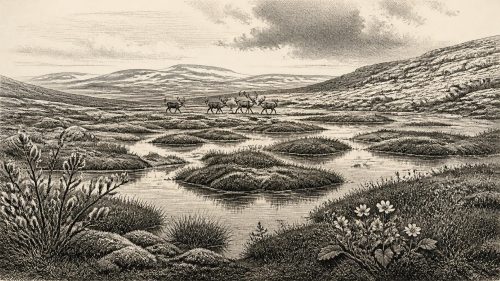
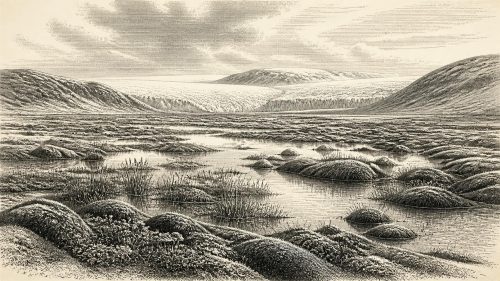
The organic bed contained poorly preserved herb pollen, mosses and plant remains associated with cold, open conditions. Recorded macrofossils include dwarf willow, mountain avens, sedges, clubmosses and aquatic or wet-ground plants such as bogbean and water-milfoil. This was not a forested Ireland and should not be imagined as the familiar green island of later millennia. It was a treeless or near-treeless tundra-steppe mosaic, in which sheltered freshwater margins could support a surprisingly varied flora during a short growing season.
That evidence illuminates environment and regional change, not society. It tells us that some part of south Fermanagh supported pools, silts, mosses and cold-adapted plants between episodes of glaciation. It does not prove that every part of Ireland was ice-free, nor does it establish a continuous wetland, coastline or climate across the island. The later drumlin landscape concealed the deposit for tens of thousands of years, preserving a small but important glimpse of an older world.
Castlepook’s Mixed Fauna
Far to the south-west, Castlepook Cave near Doneraile in north County Cork is Ireland’s most significant archive of pre-Last Glacial Maximum animal life. Antiquarian excavations removed a very large quantity of bone from its limestone passages in the early twentieth century. Later study and radiocarbon dating showed that the assemblage accumulated over a long span, at least from more than 45,000 to about 20,000 radiocarbon years BP. Castlepook is consequently a time-depth archive rather than a single moment frozen in place.
Its fauna includes reindeer, woolly mammoth, giant deer, brown bear, wolf, spotted hyaena, Arctic fox and lemmings. Not every species lived together, and the collection must not be turned into a single illustrated scene. Water re-sorted bones; carnivores may have brought in prey or scavenged material; animals could have fallen into fissures or died in and around the cave. Yet the range of dated remains establishes that Ireland, in different phases of the Late Pleistocene, hosted animals associated with open, cold and often highly seasonal environments.
For everyday life among these animals, the evidence is ecological rather than domestic. Reindeer and giant deer depended on plant resources; predators and scavengers exploited carcasses and prey; caves could become dens, traps or repositories for bones. The stable-isotope evidence from later Irish Pleistocene cave assemblages also supports the importance of herbaceous food webs rather than woodland browse. In the broad period surrounding this article’s notional date, mobility—of animals following seasonally productive ground, and of predators following them—was likely fundamental. That is an interpretation grounded in the ecology, not a record of a particular migration in 30,408 BCE.
The Reindeer Femur Question
One Castlepook object gives this remote period special human interest: a reindeer femur bearing a deep linear mark interpreted by zooarchaeologist Ruth Carden as damage from a sharp stone tool during carcass processing. County Cork heritage material describes it as a Palaeolithic bone of about 31,000 BC, and its re-examination prompted renewed archaeological work at the cave. If the mark is confirmed as a cut mark, it indicates that a person handled and butchered a reindeer in Ireland far earlier than the formerly accepted record of human presence.
But this is evidence of an action upon an animal, not proof of an established settlement. The cave has not yielded a securely associated hearth, stone-tool assemblage, dwelling floor, burial, food store, art panel or concentration of butchered animals of comparable age. The date of a bone is not necessarily the precise moment at which its surface was cut; nor can a bone recovered from a complex, disturbed cave deposit identify the size, language, ancestry or duration of a visiting group. The 2022 Castlepook investigation was designed in part to discover whether undisturbed Pleistocene deposits remain and whether the museum collection can be tied back to securely recorded contexts.
Accordingly, it is not responsible to populate Ireland in 30,408 BCE with a named culture, a permanent hunting camp or a particular Upper Palaeolithic technology. The wider north-west European record shows that hunter-gatherers could use cold environments, but Ireland’s direct evidence remains exceptionally slight. A short incursion by people exploiting an animal carcass is plausible if the interpretation of the femur is sustained. It is not yet demonstrable that people lived continuously on the island.
What Cannot Yet Be Written
There is no evidence for political affairs, diplomacy, warfare, chiefs, territories, formal religion, monuments, trade routes or organised learning in Ireland at this date. There are no known Irish human remains securely assigned to this period. There is likewise no basis for claims about houses, clothing, boats, language, kinship rules or ritual. Such absences are not merely gaps waiting to be filled by imagination: they set the limits of responsible historical writing.
Economy, if people were present at all, can only be discussed at the most modest level. A cut-marked reindeer bone would imply the acquisition and processing of animal tissue, perhaps meat or sinew, with a sharp-edged tool. It cannot demonstrate hunting rather than scavenging, ownership of a landscape, exchange between groups, or a regular seasonal economy. In the same way, the Castlepook fauna demonstrates animal movement into Ireland, but does not establish a human route across the changing sea basins and exposed shelves around the island.
An Island Nearer the Ice
At the scale of the North Atlantic, Ireland stood on the approach to much greater glaciation. Recent reconstructions of the British–Irish Ice Sheet emphasise that its growth was rapid, regional and asynchronous: ice in north-western sectors began advancing during the later part of Marine Isotope Stage 3, while other margins reached their maximum much later. Small ice caps are reconstructed in the Kerry–Cork region during parts of this development, but the evidence for the exact configuration of ice across Ireland around 32,350 calendar years BP remains limited.
The most important development, then, was not a battle, ruler or settlement but narrowing ecological opportunity. Derryvree preserves an interval when cold-adapted plants and freshwater life occupied ground later sealed by ice. Castlepook preserves animal remains from a succession of cold-period worlds, plus one disputedly transformative sign of human butchery. Together they show an Ireland repeatedly reshaped by climate, ice and animal movement. For 30,408 BCE, that is the honest history: a land with pockets of life and water, increasingly overshadowed by advancing ice, and only the faintest possible evidence of people.
Primary Sources
- The Irish Quaternary Fauna Project
- New insights on the fauna of Ireland’s Younger Dryas
- Archaeology Research Excavation Grant 2022: Castlepook Cave Final Report
- 32564: Castlepook Cave, County Cork
- Heritage Artefacts of County Cork
- Pattern and timing of retreat of the last British-Irish Ice Sheet
- Growth and retreat of the last British–Irish Ice Sheet, 31,000 to 15,000 years ago: the BRITICE-CHRONO reconstruction
- Deglaciation chronology of the Donegal Ice Centre, north-west Ireland
- Radiocarbon constraints on the age of the maximum advance of the British-Irish Ice Sheet in the Celtic Sea
- Early deglaciation of the British-Irish Ice Sheet on the Atlantic shelf northwest of Ireland
- A stratigraphic framework for abrupt climatic changes during the Last Glacial period based on three synchronized Greenland ice-core records
- The IntCal20 Northern Hemisphere radiocarbon age calibration curve (0–55 cal kBP)
- The IntCal20 Northern Hemisphere radiocarbon age calibration curve (0–55 cal kBP) PDF
- Palaeoecology
- The Subdivision of the Quaternary Period in Ireland
- Irish Quaternary Association Publications
- Irish Quaternary Association Field Guides
- Irish Quaternary Association Outreach and Education Resources
- Quaternary Geomorphology (Glacial Landforms) 50k Ireland
- Quaternary Data and Maps, Geological Survey Ireland
- Ireland through Geological Time, Geological Survey Ireland
- Zoological Perspectives on the Late Glacial
- Genomic Evidence of Widespread Admixture from Polar Bears into Brown Bears during the Last Ice Age
- Dimensions and chronology of the last ice sheet in Western Ireland