Sperrin Freshwater Archive30409 BCE
30,409 BCE is best understood through Pleistocene deposits rather than historical events. At Derryvree, County Fermanagh, freshwater silts and organic remains between glacial tills indicate an ice-free interval with open tundra, wetland plants and periglacial conditions, although radiocarbon calibration provides only a broad range encompassing the year. Ireland was approaching, not experiencing, the Last Glacial Maximum. Castlepook Cave, County Cork, preserves evidence of varied Ice Age fauna, including reindeer and mammoth, but its mixed deposits cannot date species to one moment. A possibly butchered reindeer bone suggests human presence, yet no evidence proves permanent settlement, organised society, trade or culture.

Dateline
30,409 BCE is a useful modern label, not a date that can be matched to an Irish event. No people in Ireland then left writing, a named calendar, a settlement sequence or an annual record. Modern calendar-year precision is therefore unavailable. Expressed in the scientific convention in which “present” means 1950, the label falls about 32,358 calendar years before present. That is within the later Pleistocene, during Marine Isotope Stage 3, an unstable phase of the last Ice Age. The responsible history of this point is consequently a history of dated ranges, buried layers and changing probabilities—not a chronicle of rulers, battles or a particular winter.
The most illuminating Irish evidence is the Derryvree freshwater deposit near Maguiresbridge in County Fermanagh. It does not identify conditions in the precise modern year 30,409 BCE, but its calibrated age range encompasses it. Roadworks in 1969 exposed the inside of a drumlin: beneath an upper sheet of glacial till lay freshwater silts, fine sands and organic material, themselves resting on an older till. This succession supplies a rare, intelligible sequence. Glacier ice had occupied the place; an interval then followed in which open or slow-moving fresh water, plants and animals left traces; later ice or glacial sediment buried the deposit. The waterlogged horizon was thereby protected beneath the reshaped landscape of the last glaciation.
A Range, Not a Moment
The organic material at Derryvree produced radiocarbon determination BIRM-166, conventionally reported as 30,500 radiocarbon years BP, with a substantial uncertainty of +1,170 and −1,030 years. A radiocarbon age is not a calendar age: the amount of carbon-14 in the atmosphere has varied, so results must be calibrated against independently dated records. Published calibration places this Derryvree evidence broadly at about 36,900–31,700 calibrated years BP, approximately 34,950–29,750 BCE. The requested year lies inside that long span, but this does not date an individual sediment layer, animal, journey or human action to 30,409 BCE.
That distinction matters. The sequence is direct evidence that this Fermanagh locality was ice-free long enough for freshwater sediment and organic remains to accumulate between glacial advances. The wider picture—an open, tundra-like terrain with severe seasonality—is an interpretation drawn from the fossil assemblage, the sediments and comparison with other north-west European records. It should not be converted into a weather report for every part of Ireland, still less into a claim that the whole island was simultaneously open, habitable or occupied.
Water Between the Tills
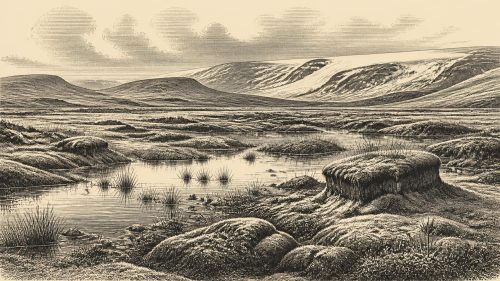
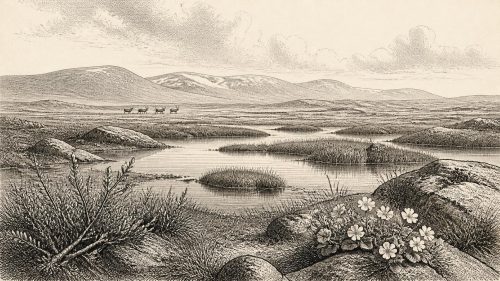
Derryvree’s plants and small animal remains are unusually informative precisely because they come from a freshwater setting. The fossil evidence indicates open tundra vegetation and periglacial conditions: ground subject to repeated freezing and thawing, rather than closed forest. Mosses, sedges, grasses and hardy low shrubs could occupy damp margins and exposed ground; aquatic and wetland plants attest to water persisting locally. Such a landscape would have had a short productive season, long cold intervals and surfaces disturbed by frost. It was neither an unbroken white wilderness nor a familiar modern Irish countryside of pasture, hedgerow and broadleaf woodland.
Freshwater was a significant ecological refuge. Shallow pools and saturated margins could support plants, insects and small animals even where the larger terrain was cold, treeless and exposed. Yet the word “refuge” must not imply comfort or permanence. The two tills enclosing the organic horizon are the essential warning in the site’s geology. They show that this apparently living landscape belonged to a much longer cycle of ice growth, retreat or local withdrawal, and renewed advance. Derryvree preserves a pause in glacial occupation, not the beginning of a stable post-glacial Ireland.
Across the island, regional conditions need not have matched those in Fermanagh. Ice sheets and local ice masses changed their form and direction through time; their deposits were later eroded, redeposited or concealed. Current reconstructions indicate that the Irish Ice Sheet was growing during the broad period around 35,000 years ago and that the full Last Glacial Maximum followed later, roughly 27,000–23,000 calibrated years BP in Ireland and its offshore shelf. Thus 30,409 BCE belongs to a threshold world before the maximum extent of the last ice sheet, not to the maximum itself.
Cork’s Cave Fauna
County Cork provides a second, very different archive. Castlepook Cave, near Doneraile, yielded a major collection of Ice Age animal remains during excavations begun in the early twentieth century. Its deposits and old collections include evidence for a varied cold-stage fauna, among it reindeer, woolly mammoth, giant deer, brown bear, wolves, foxes, Arctic foxes, lemmings and spotted hyaena. The list demonstrates that Ireland was reached, at different points in the Pleistocene, by animals now absent from the island. It does not demonstrate that all species stood together at Castlepook, or that they were all alive in 30,409 BCE. Cave sediments accumulated over long periods; bones may have been moved by water, carnivores or later disturbance; and antiquarian excavations did not record stratigraphy to present standards.
Modern redating has made the cave more important while also making interpretation more cautious. A reassessment of southern Irish Marine Isotope Stage 3 fauna found that older radiocarbon results could be unreliable, especially where methods pre-dated modern collagen ultrafiltration. The work has refined some ages but also underlined that a bone’s date and its final place of deposition need not be identical. Castlepook is therefore powerful evidence for an Ice Age animal world in southern Ireland, but it cannot supply a census for an exact year or a complete reconstruction of a single local food web.
One reindeer femur from Castlepook has attracted particular attention because it carries a deep mark interpreted by Ruth Carden as possible fresh-bone butchery damage made with a stone tool. Public accounts have associated the specimen with an age of about 33,000 years. If the mark is confirmed as human-made and securely related to the bone’s Ice Age context, it would indicate a remarkably early human encounter with an animal in Ireland. But it remains a single, exceptional object. It is not accompanied by a securely associated hearth, stone-tool assemblage, dwelling floor, burial, artwork or human skeletal remains of the same age. It cannot establish a resident population, a named culture or a settled hunting territory around 30,409 BCE.
People: Possibility and Silence
The human question is therefore one of possibility rather than proof of enduring settlement. Anatomically modern humans were living elsewhere in Upper Palaeolithic Europe, and mobile groups could make use of broad, changing plains, river valleys and coastlands. Sea levels were much lower than today because water was stored in global ice sheets, and the outlines of Ireland, Britain and the surrounding shelves differed greatly from the modern map. Lower seas may have enlarged land and altered crossings, but the precise routes available at any one moment are difficult to recover; ice, meltwater, marshy ground and changing coastlines could all obstruct movement. Lower sea level did not automatically make travel easy.
There is no responsible basis for describing political affairs, diplomacy, warfare, tribes, leaders or territories in Ireland at this date. Nor is there evidence for farming, herds of domestic animals, permanent villages, monuments, formal cemeteries, long-distance trade in recognised goods, or a local artistic tradition. The later Mesolithic settlement record, which is abundant enough to support discussion of hunter-gatherer life, belongs many millennia afterwards and should not be projected backwards. Even if people occasionally entered Ireland in this earlier period, their numbers, frequency of visits, routes, languages, social arrangements and duration of stay remain unknown.
Economy Without a Market
It is reasonable to say that large mammals would have represented potential resources for any human visitors: meat, fat, marrow, hide, sinew, antler and bone were valuable in Upper Palaeolithic societies elsewhere in Europe. It is not reasonable to say that Castlepook proves a regular Irish hunting economy. A modified reindeer bone may record one episode of carcass processing; it does not reveal who acquired the animal, whether it was hunted or scavenged, how many people were present, or where they went afterwards. The distinction between potential and demonstrated activity is central to this remote period.
Likewise, there is no evidence for exchange networks operating within Ireland. Animals moved through habitats and perhaps across exposed land or ice-linked routes; people, if present, may have moved too. Such movement is ecology and geography, not proof of trade or diplomacy. The true economy visible in the Irish evidence is the ecological one: seasonal productivity concentrated around water, plant cover and animal movements, continually constrained by cold and expanding ice.
No Recoverable Religion or Learning
Religion, ceremony, storytelling, language and practical learning were surely part of human life wherever people existed, but no Irish evidence from this horizon reveals their forms. It would be misleading to assign cave deposits a ritual purpose or to treat animal remains as evidence of belief. The caves are principally natural traps, dens, repositories and sedimentary archives. Their cultural importance today lies in what careful re-examination can recover from them: information about fauna, dating, depositional processes and the limits of the human record.
Around 30,409 BCE, then, Ireland is best envisaged as a changing northern landscape rather than a country with recoverable institutions or events. In Fermanagh, a freshwater environment existed during a broad ice-free interval and preserved the record of open tundra conditions before renewed glaciation. In Cork, caves accumulated traces of a striking Ice Age fauna and perhaps one contested sign of human butchery. These are fragments, but they are consequential ones. They reveal an Ireland capable of supporting life in severe conditions, while insisting that the deepest past must be written with ranges, qualifications and silence where the evidence runs out.
Primary Sources
- A Middle Midlandian Freshwater Series at Derryvree, Maguiresbridge, County Fermanagh, Northern Ireland
- Palaeoecology
- The Subdivision of the Quaternary Period in Ireland
- A Reconsideration of the Radiocarbon Dating of the Marine Isotope Stage 3 Fauna from Southern Ireland
- The Irish Quaternary Fauna Project
- Occurrence of Mammalia Relicts at Site Castlepook Cave
- The Exploration of Castlepook Cave, Co. Cork. With 3 Plates.
- New Insights on the Fauna of Ireland’s Younger Dryas and Early Holocene from Alice & Gwendoline Cave
- Archaeology Research Excavation Grant 2022: Castlepook Caves Project
- Castlepook Cave, Co. Cork, 2022
- Pleistocene Glaciations in Ireland
- Deglaciation Chronology of the Donegal Ice Centre, North-West Ireland
- The Deglaciation of the Western Sector of the Irish Ice Sheet from the Inner Continental Shelf to Its Terrestrial Margin
- Variations in Esker Morphology and Internal Architecture Record Time-Transgressive Subglacial Drainage beneath the Last Irish Ice Sheet
- The Island of Ireland: Drowning the Myth of an Irish Land-Bridge?
- Postglacial Relative Sea-Level Observations from Ireland and Their Role in Glacial Rebound Modelling
- Ireland: Submerged Prehistoric Sites and Landscapes
- Pleistocene Vertebrates in the British Isles
- Heritage Artefacts of County Cork
- Our Ancient Landscapes: Hunter-Gatherers in Ireland
- Origin of British and Irish Mammals: Disparate Post-Glacial Colonisation and Species Introductions
- Pleistocene Rodents of the British Isles