Colhoun’s Fermanagh Roadcut30416 BCE
30,416 BCE is a modern label within an uncertain Late Pleistocene timespan, not a recoverable Irish year. At Derryvree, Fermanagh, freshwater organic sediments between glacial tills record an ice-free or ice-marginal interval, with cold, treeless wetlands, sparse willow and juniper, insects, mosses and aquatic plants. Ireland then experienced unstable pre-maximum glaciation, changing coastlines and difficult routes. Castlepook Cave’s mammoth, reindeer and hyaena remains show that cold-stage mammals reached Ireland, though not necessarily together. A possibly cut-marked reindeer bone suggests brief human visitation around 33,000 years ago, but cannot prove settlement. Evidence depicts an intermittently habitable, later-glaciated landscape marked by uncertainty.
Dateline
30,416 BCE is a modern calendar label, not a year that can be recovered from Ireland’s archaeological record. It lies about 32,365 calendar years before AD 1950, within the later part of the Pleistocene and the fluctuating cold conditions of Marine Isotope Stage 3. No Irish deposit permits us to say what happened in one named season, let alone in this particular year. The responsible approach is therefore to examine the broad, calibrated ranges that overlap it, and the fragments of landscape, animal life and possible human activity that survive.
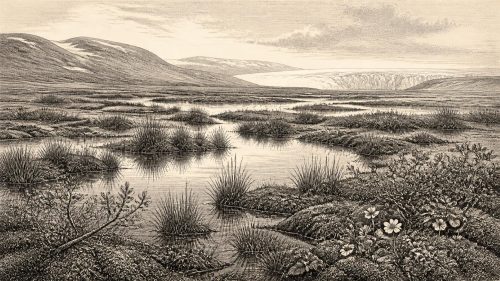
The closest major Irish environmental record is at Derryvree near Maguiresbridge, County Fermanagh. Roadworks in 1969 cut through a drumlin and exposed a remarkable sequence: an older layer of glacial till, freshwater silts and fine sands containing organic remains, and a later, thick till laid down by renewed ice. Eric Colhoun and colleagues reported a radiocarbon determination, BIRM-166, of 30,500 radiocarbon years before present, with a large uncertainty. Under modern calibration, the deposit is commonly placed broadly within about 36,900–31,700 calibrated years before present, or roughly 34,950–29,750 BCE. The nominal date 30,416 BCE falls inside that wide span, but cannot be pinned to a particular layer or event.
Fresh Water Between the Tills
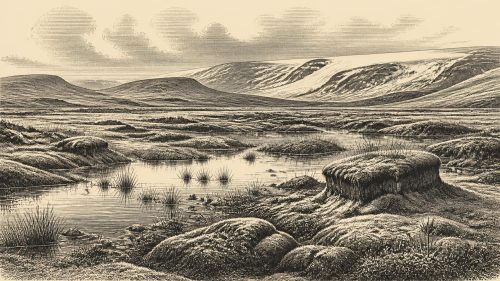
Derryvree’s importance is stratigraphic as much as biological. The lower till shows that ice had previously reached the locality. The sediments above it show that, for a time, water accumulated and living communities occupied the basin. The upper till demonstrates a subsequent return or advance of glacier ice. This is strong local evidence for an ice-free or ice-marginal interval in Fermanagh before the fullest expansion of the last British–Irish Ice Sheet. It is not evidence that every part of Ireland was simultaneously free of ice, nor that the island possessed a stable climate.
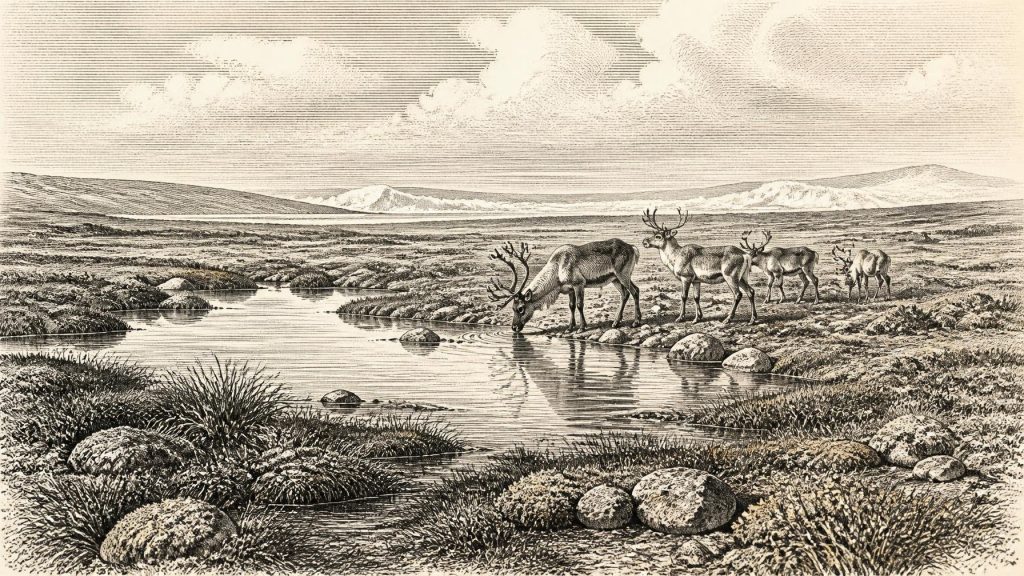
Plant remains, pollen, mosses and insects from the organic layers point to a treeless, cold and wet environment. Earlier writers used the word ‘muskeg’; today it is safest to describe a patchwork of saturated ground, shallow pools, mossy margins, sedges, grasses and hardy arctic-alpine herbs. Dwarf willow and juniper were among the sparse woody plants represented. Water-milfoil and bogbean indicate standing or slow-moving fresh water. Such evidence conveys a landscape with protected wet hollows and short summer growth, not a featureless white wilderness.
The insect record helps to make the setting more tangible. Beetles and other small creatures are sensitive to ground conditions, vegetation and temperature. At Derryvree they support the picture of open, periglacial terrain with organic-rich water and mossy banks. Winters were severe and summers cool. Frost action probably disturbed exposed soils, while snowmelt and seasonal runoff fed pools and channels. The terrain around the basin may have combined gravelly or stony ground with wet depressions, its vegetation constantly vulnerable to shifts in precipitation, temperature and the proximity of ice.
An Island in a Changing Ice Age
It would be misleading to call this the Last Glacial Maximum. The maximum extent of the last British–Irish Ice Sheet came thousands of years later: current reconstructions generally place its largest expansion around 27,000 to 20,000 years before present, with regional differences in the timing of advance and retreat. At 30,416 BCE Ireland was instead moving through an unstable pre-maximum phase. Ice masses, sea level, winds, vegetation and animal ranges could change dramatically over periods far longer than a human lifetime but short in geological terms.
The later ice sheet profoundly complicates the historical record. Glaciers eroded bedrock, moved boulders and sediment, and buried or destroyed former surfaces. Rising post-glacial seas subsequently drowned old coastlines. A lack of campsites, hearths and tools from this time consequently does not prove that no people ever entered Ireland; it does mean that a settled population cannot responsibly be asserted. The landscape known to us is a survivor of repeated remodelling, and its missing evidence is part of the story.
Lower sea levels changed the geographical setting, although they did not create a simple, permanent land bridge from Ireland to Britain or continental Europe. Exposed shelves, ice, fast-changing shorelines and sea channels made routes contingent. For grazing animals, predators and any people, movement depended on the configuration of land and ice at particular times. Ireland was on Europe’s north-western edge: accessible on some occasions, but ecologically precarious and geographically difficult.
Castlepook’s Faunal Evidence
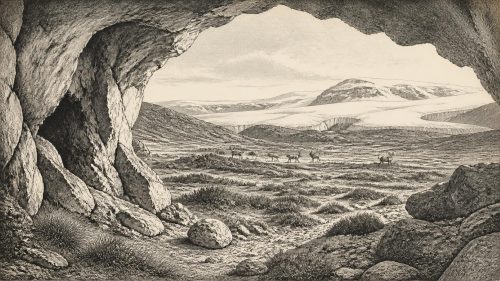
County Cork supplies the other principal window. At Castlepook Cave, near Doneraile, antiquarian excavations recovered remains of cold-stage animals, including woolly mammoth, reindeer and spotted hyaena. Improved radiocarbon pretreatment and re-dating have transformed the chronology of several bones: some results are substantially older than dates obtained in the 1990s. The cave assemblage confirms that, during Marine Isotope Stage 3, Ireland could support or at least receive large mammals associated with cold, open environments. It does not show that all these creatures lived together at one moment, because cave deposits can accumulate over long intervals and have often been disturbed by excavation, scavenging and water movement.
Reindeer are particularly relevant to an open tundra-like world. Their presence is compatible with seasonal movement across broad grazing country. Mammoth remains evoke the wider ‘mammoth-steppe’ communities of Pleistocene Europe, but the Irish evidence is too fragmentary to reconstruct a complete local food web or to estimate herd sizes. Spotted hyaena bones and tooth-marked material show that large scavengers and predators also belonged to the wider faunal story. A cave was not necessarily a human dwelling: it might preserve bones dragged in by carnivores, animals that died naturally, or material washed from outside.
One Castlepook reindeer femur has become especially important because it bears an incision interpreted by zooarchaeologist Ruth Carden as a cut mark from a sharp stone edge, made while processing a carcass. If that interpretation and the broad dating are sustained, it is potentially Ireland’s earliest indication of human handling of an animal, around 33,000 years ago. Yet it remains a single modified bone from an old collection, without a securely associated stone-tool assemblage, hearth, shelter floor or cemetery. It supports the possibility of brief human visitation; it cannot establish a village, a continuous occupation or an identifiable people at 30,416 BCE.
What Society Cannot Yet Be Seen
The conventional headings of later history are mostly silent here. There is no evidence for political communities, rulers, diplomacy, warfare, law, formal religion, writing, monuments, agriculture, livestock, mining, craft workshops or long-distance trade in Ireland at this date. Neither can language, ethnicity, kinship rules or ritual be recovered from a cut-marked bone or wetland sediment. Claims about such matters would turn analogy into fact.
There are, however, cautious inferences. If people did reach Ireland in this period, they were almost certainly highly mobile Upper Palaeolithic hunter-gatherers, entering a demanding landscape in small groups rather than founding documented settlements. Across north-west Europe, groups of that broad era relied on animal resources, portable stone technologies, hides, fire and detailed seasonal knowledge. Those comparisons explain what might have been necessary for survival, but they are not direct proof of clothing, boats, camps or hunting methods in Ireland.
Economy, in the narrow sense, was ecological before it was commercial. Plants and animals, water, shelter, fuel and safe routes mattered more than exchange networks that cannot be demonstrated. A reindeer carcass, if butchered by people, would have offered meat, fat, hide, sinew and bone; but Ireland has not yielded the associated evidence needed to map a local subsistence system. The best-supported picture is one of opportunity and risk: a land capable at intervals of sustaining freshwater wetlands and large mammals, yet exposed to severe cold and approaching glaciation.
Evidence, Not Anniversary
The lasting significance of this nominal year is not an anniversary but a threshold in the evidence. Derryvree preserves an interval when a Fermanagh basin held fresh water and tundra vegetation between two glacial episodes. Castlepook preserves a scattered record of mammals from a different part of the island, together with a provocative possible trace of carcass processing. Scientific re-dating, sediment study and renewed cave excavation continue to test these records rather than simply repeat inherited narratives.
For Ireland around 30,416 BCE, environmental change is the clearest historical force. It shaped what land was available, which animals could arrive, and whether any human excursion was viable. The archaeology does not reveal a nation before nations, or a lost Ice Age society waiting to be named. It reveals a cold, watery and intermittently habitable island landscape, where a few silts, seeds, insects and bones have endured beneath the work of later ice.
Primary Sources
- A Middle Midlandian Freshwater Series at Derryvree, Maguiresbridge, County Fermanagh, Northern Ireland
- A reconsideration of the radiocarbon dating of the Marine Isotope Stage 3 fauna from southern Ireland
- The Irish Quaternary Fauna Project
- Occurrence of mammalia relicts at site Castlepook Cave
- Pleistocene Vertebrates in the British Isles
- Radiocarbon Constraints on the Age of the Maximum Advance of the British-Irish Ice Sheet in the Celtic Sea
- Late Pleistocene Chronostratigraphy and Ice Sheet Limits, Southern Ireland
- New Data for the Last Glacial Maximum in Great Britain and Ireland
- Pattern and Timing of Retreat of the Last British-Irish Ice Sheet
- Early Deglaciation of the British-Irish Ice Sheet on the Atlantic Shelf Northwest of Ireland Driven by Glacioisostatic Depression and High Relative Sea Level
- The Deglaciation of the Western Sector of the Irish Ice Sheet from the Inner Continental Shelf to its Terrestrial Margin
- Deglaciation Chronology of the Donegal Ice Centre, North-West Ireland
- Stratigraphic and Palaeo-Geomorphological Evidence for the Glacial-Deglacial History of the Last British-Irish Ice Sheet in the North-Western Irish Sea
- The IntCal20 Northern Hemisphere Radiocarbon Age Calibration Curve (0–55 cal kBP)
- New Insights on the Fauna of Ireland’s Younger Dryas and Early Holocene from Alice & Gwendoline Cave
- Archaeology Research Excavation Grant 2022: Castlepook Cave Final Report
- Castlepook Cave, County Cork: Excavation Report 2022
- Heritage Artefacts of County Cork 2021
- Irish Pleistocene Biostratigraphy
- Figure 6: The Subdivision of the Quaternary Period in Ireland