Derryvree’s Midlandian Marsh30417 BCE
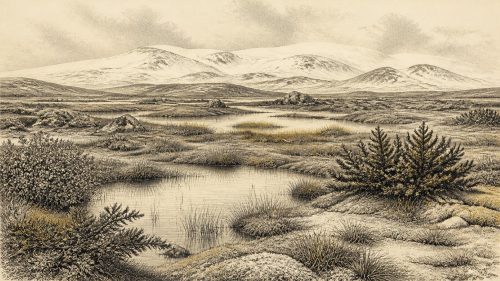
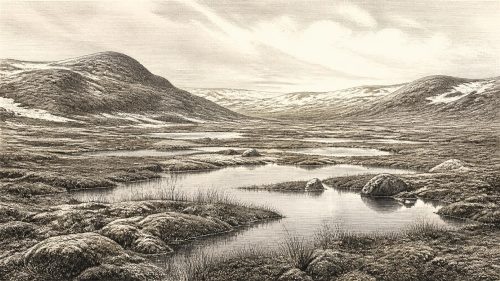
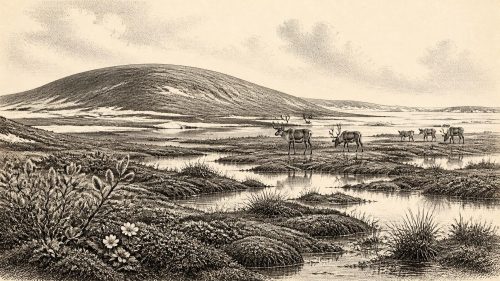
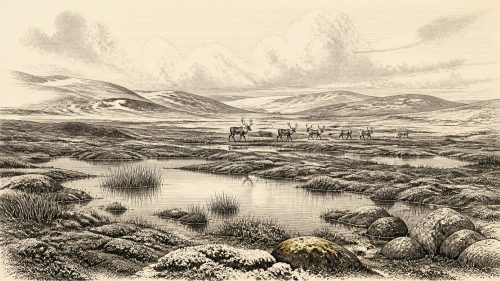
Around 30,417 BCE, Ireland lay in the fluctuating cold climate of Marine Isotope Stage 3, beyond written history. Derryvree, County Fermanagh, preserves freshwater sediments between glacial tills, indicating a local ice-free interval with treeless tundra wetland, pools, mosses, sedges, dwarf willow and cold-adapted insects. Crag Cave stalagmites record repeated climatic shifts. Castlepook Cave fauna, including mammoth, reindeer and predators, suggests connections with wider European open habitats, although deposits are chronologically mixed. A cut-marked reindeer bone may indicate brief human activity, but remains contested and lacks associated artefacts. No evidence supports settlements, politics or continuous population; environmental change dominates the record.
Dateline
“30,417 BCE” is a modern label imposed on a time far beyond any Irish written record. It cannot identify a recoverable year, season, event or individual. Around this point in the Late Pleistocene, Ireland lay within the unstable climatic world of Marine Isotope Stage 3, long before farming, monuments, named peoples or states. The responsible account is therefore not an annual chronicle, but a reconstruction from sediments, fossil plants, insects, animal bones and cave minerals. These survive unevenly, and they illuminate particular places rather than an island-wide scene.
A Date Within a Broad Window
The calendar label 30,417 BCE corresponds approximately to 32,366 years before AD 1950, the conventional reference point for “BP” dating. That precision is misleading. Radiocarbon results of this antiquity have wide uncertainties and must be calibrated because atmospheric carbon-14 has altered through time. The closest especially informative Irish archive is a freshwater deposit at Derryvree, near Maguiresbridge in County Fermanagh. Its key sample, BIRM-166, produced a conventional radiocarbon age of 30,500 BP, with an uncertainty of +1,170 and −1,030 years. Published discussions have expressed this as a broad calibrated span of about 36,900–31,700 calendar years BP, roughly 34,950–29,750 BCE. The nominated year falls within that range; it does not date the deposit, its plants or its animals to one exact year.
This distinction matters. A radiocarbon age dates the death of the organic material sampled, not an entire landscape. The beds at Derryvree accumulated over time, while a fossil assemblage can contain material moved by water, ice or scavengers. Dates from old cave collections can also require reassessment as laboratory methods improve. Ireland at this horizon can be described in cautiously bounded terms, but no archaeological evidence permits a diary-like account of what happened on the island in 30,417 BCE.
Freshwater Between the Tills
Derryvree is valuable because roadworks in 1969 cut through a drumlin and exposed an unusually clear sequence. A lower till—stony, unsorted debris deposited by glacier ice—was overlain by freshwater silts, fine sands and organic mud. A further thick deposit of till lay above. The order is secure: ice had previously occupied the locality; a period followed in which freshwater and wetland sediments formed; later glacial conditions covered and preserved that record. It is strong local evidence for an ice-free or non-glacial interval in south Fermanagh, not proof that every part of Ireland was simultaneously ice-free.
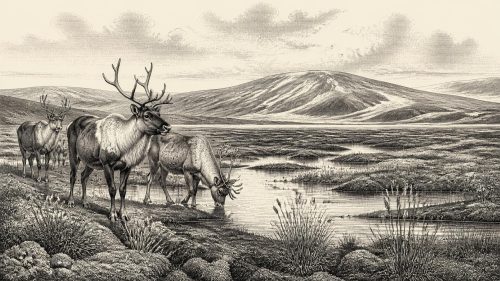
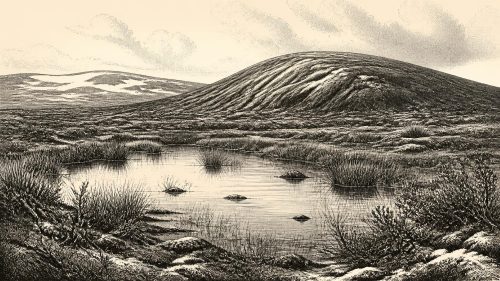
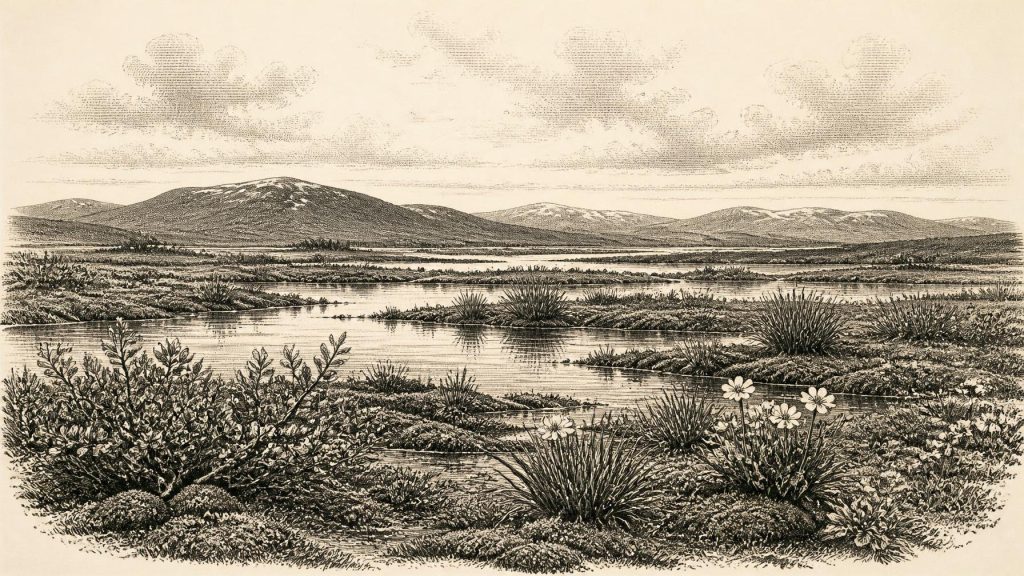
The freshwater beds contain a flora and fauna of markedly cold conditions. Plant macrofossils, pollen, mosses and insect remains point to treeless tundra-like wet ground: sedges and grasses around shallow pools, moss-rich patches, hardy herbs and low shrubs including dwarf willow and juniper. Bogbean and water-milfoil demonstrate freshwater habitats. Mountain avens, rosy saxifrage and other plants now associated with alpine or arctic settings signal exposed, cold ground. The evidence is not a picture of modern blanket bog or woodland. It is of a sparse, varied wetland in which open water, saturated soils and drier mineral ground stood close together.
A Harsh, Changing Landscape
The Derryvree insects reinforce that interpretation. They suggest cold conditions, short growing seasons and a landscape in which vegetation was low and discontinuous rather than forested. Yet the presence of freshwater plants and abundant organic material also shows that this was not simply lifeless ice margin. In favourable summer conditions, pools could support aquatic vegetation, mosses could spread over damp ground, and insects could exploit plant-rich water edges. The contrast between those living surfaces and the later till above them gives the deposit its historical force: environments capable of sustaining wetland communities could be overtaken and buried as ice conditions returned.
Crag Cave in County Kerry offers a separate, more regional climate archive. Its stalagmites formed episodically during milder phases of the last glacial period, when liquid water could percolate through the shallow cave system. Their uranium-series dates show that south-west Ireland responded sharply to millennial-scale North Atlantic climatic shifts. They do not describe Fermanagh in a particular year and cannot be made to yield an exact weather report for 30,417 BCE. Together with Derryvree, however, they demonstrate that Irish environments changed repeatedly between relatively ameliorated intervals and much colder phases.
Animals and Moving Corridors
Irish cave collections indicate that a considerably broader mammal fauna reached the island during parts of the Middle and Late Pleistocene than survived into later millennia. Castlepook Cave, near Doneraile in north County Cork, is particularly important. Its historic excavations produced remains attributed to woolly mammoth, reindeer, spotted hyaena, wolf, brown bear and other animals. Such finds support the view that open, cold habitats in Ireland formed part of wider north-west European ecological networks during Marine Isotope Stage 3.
They do not establish a single contemporaneous animal community at Castlepook, nor do they prove that each species was present in 30,417 BCE. Cave bone assemblages are often mixed accumulations, and the chronology of southern Irish fauna has been significantly revised through improved radiocarbon pretreatment. Large herbivores and predators moved according to changing habitats, sea levels, ice margins and possible land connections; their presence is evidence of ecological opportunity, not of a settled human economy. There is no basis for describing organised hunting territories, livestock management, markets or trade routes in Ireland at this date.
The Human Question
One Castlepook reindeer femur has transformed the question of early people in Ireland. Zooarchaeologist Ruth Carden has interpreted a deep mark on the bone as a fresh-bone incision made by a sharp stone tool during carcass processing. If that interpretation is sustained, it is important evidence that people may have handled a reindeer in Ireland during the Ice Age, far earlier than the previously accepted terminal-Pleistocene evidence. It is, nevertheless, a single contested line of evidence from an old cave collection, rather than a securely excavated camp.
The limits are as important as the possibility. No associated stone-tool assemblage, hearth, dwelling, burial, art, human skeletal remains or undisturbed butchery floor of comparable age has been found at Castlepook. A 2022 investigation located surviving sediments but no cultural artefacts. The marked bone therefore cannot demonstrate a permanent population, a settlement at Doneraile, or a continuous Irish ancestry from this period. At most, it raises the credible possibility of a brief human visit or animal-processing episode within a mobile Ice Age world. Future excavation, microscopic analysis and direct dating may strengthen, alter or reject that interpretation.
What Cannot Be Written
There is no evidence for rulers, tribes, political institutions, warfare, alliances or diplomacy in Ireland around this date. Nor can archaeology responsibly identify language, formal religion, burial custom, artistic tradition, teaching or law. In the same way, animal movement across changing landscapes must not be relabelled as trade. These absences are not minor gaps in an otherwise familiar national story: they define the period. Ireland’s historical record at this depth consists principally of environmental traces, with a very limited and unresolved hint of human action.
The most important development was environmental rather than political. Derryvree preserves an interval when freshwater wetland and tundra vegetation existed between episodes of glacial deposition. Castlepook preserves a more fragmentary record of the animals able to reach and live in such open landscapes. Crag Cave records the wider rhythm of climatic fluctuation. Around 30,417 BCE, then, Ireland was not a country of villages or kingdoms. It was a shifting Ice Age landscape, locally capable of supporting pools, mosses, cold-adapted plants and large mammals, but vulnerable to the renewed growth of ice that would erase, rearrange and seal much of the evidence.
Primary Sources
- Palaeoecology
- Figure 6.— The Subdivision of the Quaternary Period in Ireland
- A Reconsideration of the Radiocarbon Dating of the Marine Isotope Stage 3 Fauna from Southern Ireland
- The Irish Quaternary Fauna Project
- Pleistocene Glaciations in Ireland
- Exploring Controls of the Early and Stepped Deglaciation on the Western Margin of the British Irish Ice Sheet
- Episodic Speleothem Deposition Tracks the Terrestrial Impact of Millennial-Scale Last Glacial Climate Variability in SW Ireland
- The IntCal20 Northern Hemisphere Radiocarbon Age Calibration Curve (0–55 cal kBP)
- IntCal Publications
- Composition and Consequences of the IntCal20 Radiocarbon Calibration Curve
- New Insights on the Fauna of Ireland’s Younger Dryas and Early Holocene from Alice & Gwendoline Cave
- 2022:564 — Castlepook Cave, Castlepook South, Cork
- Heritage Artefacts of County Cork
- Occurrence of Mammalia Relicts at Site Castlepook Cave
- The Exploration of Castlepook Cave, County Cork
- The Irish Quaternary Fauna Project (full-text record)
- Landscapes and Environments of the Last Glacial-Interglacial Transition: A Time of Amazingly Rapid Change in Ireland
- Deglacial Rates and Controls for the British-Irish Ice Sheet Western Margin
- The Mesolithic in Ireland: When Was It?
- New Insights on the Fauna of Ireland’s Younger Dryas and Early Holocene from Alice & Gwendoline Cave (open-access PDF)